100 posts · 560 cards

Samudrika Shastra सामुद्रिक शास्त्र

The traditional reading of bodily signs, presented as a tradition and not as a test of anyone: forty ideas and sixty passages.

Samudrika Shastra

A language of signs

A language of signs, card 1 of 5
A language of signs, card 2 of 5
A language of signs, card 3 of 5
A language of signs, card 4 of 5
A language of signs, card 5 of 5
Read as text

Explore a traditional way of reading the body without reducing a person to a feature.

This tradition interprets bodily features as signs connected with character and fortune. Lakshana is the key word for a characteriztic given meaning within this system.

Learn the symbolizm. Keep the person larger than the sign.

What changes when you separate observation from judgment?

A cultural reading of Samudrika Shastra with a contemporary reflection. Traditional body-reading claims are not reliable judgments of a person’s character or future.

Samudrika Shastra

The ocean in the origin story

The ocean in the origin story, card 1 of 5
The ocean in the origin story, card 2 of 5
The ocean in the origin story, card 3 of 5
The ocean in the origin story, card 4 of 5
The ocean in the origin story, card 5 of 5
Read as text

A myth explains the authority and name of the tradition.

The opening story describes Samudra observing the auspicious marks of Vishnu. It presents this observation as an origin of the body-reading tradition.

An origin story can reveal the world a text inhabits.

What does a tradition’s opening story invite you to notice?

A cultural reading of Samudrika Shastra with a contemporary reflection. Traditional body-reading claims are not reliable judgments of a person’s character or future.

Samudrika Shastra

How the text maps the body

How the text maps the body, card 1 of 5
How the text maps the body, card 2 of 5
How the text maps the body, card 3 of 5
How the text maps the body, card 4 of 5
How the text maps the body, card 5 of 5
Read as text

A system begins by deciding what belongs in each category.

The text distinguishes main bodily parts from smaller associated parts. It then arranges its descriptions into an ordered survey.

Understand the map before accepting the conclusions.

How does a category change what you notice?

A cultural reading of Samudrika Shastra with a contemporary reflection. Traditional body-reading claims are not reliable judgments of a person’s character or future.

Samudrika Shastra

Outer signs and inner qualities

Outer signs and inner qualities, card 1 of 5
Outer signs and inner qualities, card 2 of 5
Outer signs and inner qualities, card 3 of 5
Outer signs and inner qualities, card 4 of 5
Outer signs and inner qualities, card 5 of 5
Read as text

The text distinguishes appearance from the qualities it seeks to interpret.

The text separates external features, such as color and voice, from internal qualities described through temperament and sattva. It nevertheless tries to connect them.

Let curiosity travel beyond the surface.

What could you ask instead of assuming?

A cultural reading of Samudrika Shastra with a contemporary reflection. Traditional body-reading claims are not reliable judgments of a person’s character or future.

Samudrika Shastra

Why the reading begins at the feet

Why the reading begins at the feet, card 1 of 5
Why the reading begins at the feet, card 2 of 5
Why the reading begins at the feet, card 3 of 5
Why the reading begins at the feet, card 4 of 5
Why the reading begins at the feet, card 5 of 5
Read as text

The text follows a deliberate route from the ground upward.

The survey begins with the soles and proceeds through bodily features. Lines and shapes are interpreted through the tradition’s language of auspicious and inauspicious signs.

A modern reflection: value what supports your journey.

What foundation in your life deserves more care?

A cultural reading of Samudrika Shastra with a contemporary reflection. Traditional body-reading claims are not reliable judgments of a person’s character or future.

Samudrika Shastra

Reading an emblem as an emblem

Reading an emblem as an emblem, card 1 of 5
Reading an emblem as an emblem, card 2 of 5
Reading an emblem as an emblem, card 3 of 5
Reading an emblem as an emblem, card 4 of 5
Reading an emblem as an emblem, card 5 of 5
Read as text

Conches, flags and moons belong to a visual vocabulary of fortune.

The text interprets lines resembling objects such as a conch, umbrella, moon or flag as auspicious signs. Recognizable emblems carry symbolic meaning.

A symbol can hold meaning without settling a future.

Which symbol carries a useful meaning for you?

A cultural reading of Samudrika Shastra with a contemporary reflection. Traditional body-reading claims are not reliable judgments of a person’s character or future.

Samudrika Shastra

A toe is a feature, not a verdict

A toe is a feature, not a verdict, card 1 of 5
A toe is a feature, not a verdict, card 2 of 5
A toe is a feature, not a verdict, card 3 of 5
A toe is a feature, not a verdict, card 4 of 5
A toe is a feature, not a verdict, card 5 of 5
Read as text

The text assigns meanings to small differences in proportion.

The early chapters compare the relative lengths and shapes of toes. Within the traditional system, these differences are linked to fortune and relationships.

Let a physical difference remain a difference.

Can you describe what you see without adding a judgment?

A cultural reading of Samudrika Shastra with a contemporary reflection. Traditional body-reading claims are not reliable judgments of a person’s character or future.

Samudrika Shastra

The meaning assigned to nails

The meaning assigned to nails, card 1 of 5
The meaning assigned to nails, card 2 of 5
The meaning assigned to nails, card 3 of 5
The meaning assigned to nails, card 4 of 5
The meaning assigned to nails, card 5 of 5
Read as text

A descriptive detail becomes a symbol inside the traditional system.

The text discusses nails among the visible details of toes and fingers. Their shape, texture and color become part of its traditional judgments.

Do not turn a small bodily detail into a whole biography.

Where does description end and inference begin?

A cultural reading of Samudrika Shastra with a contemporary reflection. Traditional body-reading claims are not reliable judgments of a person’s character or future.

Samudrika Shastra

The lotus appears in the smallest details

The lotus appears in the smallest details, card 1 of 5
The lotus appears in the smallest details, card 2 of 5
The lotus appears in the smallest details, card 3 of 5
The lotus appears in the smallest details, card 4 of 5
The lotus appears in the smallest details, card 5 of 5
Read as text

Nature supplies the text with comparisons for bodily forms.

The text compares certain ankle forms with a lotus bud and others with animal forms. These analogies are used to express favorable or unfavorable readings.

Enjoy the metaphor without making it a measure of worth.

What does a lotus suggest to you beyond physical appearance?

A cultural reading of Samudrika Shastra with a contemporary reflection. Traditional body-reading claims are not reliable judgments of a person’s character or future.

Samudrika Shastra

A pattern is not a personality

A pattern is not a personality, card 1 of 5
A pattern is not a personality, card 2 of 5
A pattern is not a personality, card 3 of 5
A pattern is not a personality, card 4 of 5
A pattern is not a personality, card 5 of 5
Read as text

The text studies body hair as another field of visible signs.

The text compares the texture, arrangement and number of hairs in its body-reading scheme. It attaches social and personal meanings to these observations.

A person deserves respect before any interpretation begins.

Which everyday descriptions could you make less judgmental?

A cultural reading of Samudrika Shastra with a contemporary reflection. Traditional body-reading claims are not reliable judgments of a person’s character or future.

Samudrika Shastra

Why compare a person with a lion?

Why compare a person with a lion?, card 1 of 5
Why compare a person with a lion?, card 2 of 5
Why compare a person with a lion?, card 3 of 5
Why compare a person with a lion?, card 4 of 5
Why compare a person with a lion?, card 5 of 5
Read as text

Animal imagery carries ideals of strength and authority.

The book compares some bodily forms and behaviors with animals, including the lion. Such images help express its traditional ideals of power and rank.

Let strength be known by what it protects.

How could you use your strength responsibly today?

A cultural reading of Samudrika Shastra with a contemporary reflection. Traditional body-reading claims are not reliable judgments of a person’s character or future.

Samudrika Shastra

The center as a symbol

The center as a symbol, card 1 of 5
The center as a symbol, card 2 of 5
The center as a symbol, card 3 of 5
The center as a symbol, card 4 of 5
The center as a symbol, card 5 of 5
Read as text

The navel becomes another place where form is given meaning.

The text describes navel shapes, depth and direction, sometimes using lotus imagery. It then connects those forms with prosperity or other outcomes.

A modern reflection: know what helps you stay centered.

What value helps you find your direction again?

A cultural reading of Samudrika Shastra with a contemporary reflection. Traditional body-reading claims are not reliable judgments of a person’s character or future.

Samudrika Shastra

The body imagined as a landscape

The body imagined as a landscape, card 1 of 5
The body imagined as a landscape, card 2 of 5
The body imagined as a landscape, card 3 of 5
The body imagined as a landscape, card 4 of 5
The body imagined as a landscape, card 5 of 5
Read as text

Rock, mountain and animal comparisons give the descriptions their visual force.

The text uses comparisons such as a firm mountain rock when describing the chest. These forms are associated with the ideal of a powerful ruler.

Responsibility is shown through conduct, not proportions.

What makes someone safe to trust with responsibility?

A cultural reading of Samudrika Shastra with a contemporary reflection. Traditional body-reading claims are not reliable judgments of a person’s character or future.

Samudrika Shastra

Arms as images of capability

Arms as images of capability, card 1 of 5
Arms as images of capability, card 2 of 5
Arms as images of capability, card 3 of 5
Arms as images of capability, card 4 of 5
Arms as images of capability, card 5 of 5
Read as text

The text links bodily reach with ideals of status and power.

The text describes arms and shoulders through shape, length and firmness. It reads these features within a broader system of auspicious bodily form.

Capability grows through what people can do together.

Whose contribution makes your work possible?

A cultural reading of Samudrika Shastra with a contemporary reflection. Traditional body-reading claims are not reliable judgments of a person’s character or future.

Samudrika Shastra

The palm as a symbolic landscape

The palm as a symbolic landscape, card 1 of 5
The palm as a symbolic landscape, card 2 of 5
The palm as a symbolic landscape, card 3 of 5
The palm as a symbolic landscape, card 4 of 5
The palm as a symbolic landscape, card 5 of 5
Read as text

The book reads the hand through form, lines and imagined resemblances.

The palm is a major subject of the text. Its surface, shape and lines are treated as clues within a traditional system of interpretation.

A modern reflection: let your hands be known for their work.

What could you make or care for with your hands today?

A cultural reading of Samudrika Shastra with a contemporary reflection. Traditional body-reading claims are not reliable judgments of a person’s character or future.

Samudrika Shastra

A line does not fix a lifetime

A line does not fix a lifetime, card 1 of 5
A line does not fix a lifetime, card 2 of 5
A line does not fix a lifetime, card 3 of 5
A line does not fix a lifetime, card 4 of 5
A line does not fix a lifetime, card 5 of 5
Read as text

The text gives palm lines names and predicted outcomes.

The book interprets palm lines through their course, depth, clarity and interruptions. It associates them with matters such as longevity, wealth and family.

Leave the future larger than a line.

What present choice deserves more attention than a prediction?

A cultural reading of Samudrika Shastra with a contemporary reflection. Traditional body-reading claims are not reliable judgments of a person’s character or future.

Samudrika Shastra

Fish, lotus and conch

Fish, lotus and conch, card 1 of 5
Fish, lotus and conch, card 2 of 5
Fish, lotus and conch, card 3 of 5
Fish, lotus and conch, card 4 of 5
Fish, lotus and conch, card 5 of 5
Read as text

Repeated emblems reveal what the tradition associates with abundance.

The book interprets fish-like, conch-like and lotus-like markings as auspicious. These motifs form part of its language of prosperity and honor.

Let a symbol deepen reflection rather than close possibility.

Which traditional motif would you like to understand more deeply?

A cultural reading of Samudrika Shastra with a contemporary reflection. Traditional body-reading claims are not reliable judgments of a person’s character or future.

Samudrika Shastra

The thumb in a detailed reading

The thumb in a detailed reading, card 1 of 5
The thumb in a detailed reading, card 2 of 5
The thumb in a detailed reading, card 3 of 5
The thumb in a detailed reading, card 4 of 5
The thumb in a detailed reading, card 5 of 5
Read as text

Even a small joint becomes meaningful inside the traditional system.

The text describes the thumb and markings around its joints, including shapes compared with grain. These details are given auspicious meanings.

Detailed language still needs careful judgment.

Does a precise description always justify the conclusion attached to it?

A cultural reading of Samudrika Shastra with a contemporary reflection. Traditional body-reading claims are not reliable judgments of a person’s character or future.

Samudrika Shastra

The neck and the image of dignity

The neck and the image of dignity, card 1 of 5
The neck and the image of dignity, card 2 of 5
The neck and the image of dignity, card 3 of 5
The neck and the image of dignity, card 4 of 5
The neck and the image of dignity, card 5 of 5
Read as text

The book connects bodily form with its ideals of appearance and status.

The text describes the neck and nearby features through proportions and comparisons. It uses them in its traditional evaluation of bodily signs.

Respect does not depend on fitting an ideal form.

How can you make room for someone to describe themselves?

A cultural reading of Samudrika Shastra with a contemporary reflection. Traditional body-reading claims are not reliable judgments of a person’s character or future.

Samudrika Shastra

Read the metaphor in the face

Read the metaphor in the face, card 1 of 5
Read the metaphor in the face, card 2 of 5
Read the metaphor in the face, card 3 of 5
Read the metaphor in the face, card 4 of 5
Read the metaphor in the face, card 5 of 5
Read as text

The text often turns familiar natural forms into comparisons.

The book describes the mouth and lips through shape, softness and color comparisons. It attaches ideas of fortune and character to these details.

Let people’s words be heard before their faces are judged.

What could better listening help you understand?

A cultural reading of Samudrika Shastra with a contemporary reflection. Traditional body-reading claims are not reliable judgments of a person’s character or future.

Samudrika Shastra

From the tongue to the words

From the tongue to the words, card 1 of 5
From the tongue to the words, card 2 of 5
From the tongue to the words, card 3 of 5
From the tongue to the words, card 4 of 5
From the tongue to the words, card 5 of 5
Read as text

A modern reflection can move from bodily description to chosen conduct.

The text describes the tongue and palate as bodily signs. It connects particular forms with enjoyment, learning and other predicted outcomes.

Let the quality of speech matter more than a bodily sign.

What could you say more clearly and kindly?

A cultural reading of Samudrika Shastra with a contemporary reflection. Traditional body-reading claims are not reliable judgments of a person’s character or future.

Samudrika Shastra

The nose in a world of comparisons

The nose in a world of comparisons, card 1 of 5
The nose in a world of comparisons, card 2 of 5
The nose in a world of comparisons, card 3 of 5
The nose in a world of comparisons, card 4 of 5
The nose in a world of comparisons, card 5 of 5
Read as text

Animal and geometric imagery shape the text’s descriptions.

The text classifies nose shapes and compares some with animal forms. It gives these comparisons meanings involving fortune, comfort and longevity.

Meet the person beyond the profile.

What information matters more than your first visual impression?

A cultural reading of Samudrika Shastra with a contemporary reflection. Traditional body-reading claims are not reliable judgments of a person’s character or future.

Samudrika Shastra

Eyes are more than an omen

Eyes are more than an omen, card 1 of 5
Eyes are more than an omen, card 2 of 5
Eyes are more than an omen, card 3 of 5
Eyes are more than an omen, card 4 of 5
Eyes are more than an omen, card 5 of 5
Read as text

The book gives the eyes a large place in its reading of appearance.

The text discusses the eyes through shape, color, movement and comparisons with nature. It assigns different meanings within its traditional system.

Let understanding come from more than a glance.

What might you learn by listening longer?

A cultural reading of Samudrika Shastra with a contemporary reflection. Traditional body-reading claims are not reliable judgments of a person’s character or future.

Samudrika Shastra

An expression needs context

An expression needs context, card 1 of 5
An expression needs context, card 2 of 5
An expression needs context, card 3 of 5
An expression needs context, card 4 of 5
An expression needs context, card 5 of 5
Read as text

The text examines eyebrows as part of its detailed study of the face.

The text compares eyebrow shape, height and arrangement. These features become part of its traditional account of appearance and fortune.

Leave room for the story you cannot see.

What could a simple question reveal that a glance cannot?

A cultural reading of Samudrika Shastra with a contemporary reflection. Traditional body-reading claims are not reliable judgments of a person’s character or future.

Samudrika Shastra

Turn attention toward listening

Turn attention toward listening, card 1 of 5
Turn attention toward listening, card 2 of 5
Turn attention toward listening, card 3 of 5
Turn attention toward listening, card 4 of 5
Turn attention toward listening, card 5 of 5
Read as text

The text reads ears as signs; a modern reflection can focus on what listening does.

The book describes ears through size, form and visible features. It attaches predictions to those descriptions as part of its body-reading system.

Give another person the experience of being heard.

Who could use your full attention today?

A cultural reading of Samudrika Shastra with a contemporary reflection. Traditional body-reading claims are not reliable judgments of a person’s character or future.

Samudrika Shastra

A forehead cannot count your years

A forehead cannot count your years, card 1 of 5
A forehead cannot count your years, card 2 of 5
A forehead cannot count your years, card 3 of 5
A forehead cannot count your years, card 4 of 5
A forehead cannot count your years, card 5 of 5
Read as text

The text’s line readings show how description becomes prediction.

The book connects forehead lines and other marks with predicted lifespan or status. These are examples of its traditional forecasting method.

Do not let a predicted number narrow your life.

What deserves your attention in the time you have today?

A cultural reading of Samudrika Shastra with a contemporary reflection. Traditional body-reading claims are not reliable judgments of a person’s character or future.

Samudrika Shastra

Hair carries stories, not rankings

Hair carries stories, not rankings, card 1 of 5
Hair carries stories, not rankings, card 2 of 5
Hair carries stories, not rankings, card 3 of 5
Hair carries stories, not rankings, card 4 of 5
Hair carries stories, not rankings, card 5 of 5
Read as text

The book treats texture and arrangement as signs within its system.

The text evaluates hair through qualities such as texture, length and arrangement. Similar descriptions appear in its sections on men and women.

A person’s dignity is not a style requirement.

Which appearance rule would you like to question more thoughtfully?

A cultural reading of Samudrika Shastra with a contemporary reflection. Traditional body-reading claims are not reliable judgments of a person’s character or future.

Samudrika Shastra

The body as an interconnected whole

The body as an interconnected whole, card 1 of 5
The body as an interconnected whole, card 2 of 5
The body as an interconnected whole, card 3 of 5
The body as an interconnected whole, card 4 of 5
The body as an interconnected whole, card 5 of 5
Read as text

The text expands from separate features to an account of bodily substance.

The text discusses sara through bodily substances and qualities, including skin, blood, flesh and bone. It places these within its larger traditional classification.

Care for the whole person rather than ranking separate parts.

What kind of care have you been overlooking?

A cultural reading of Samudrika Shastra with a contemporary reflection. Traditional body-reading claims are not reliable judgments of a person’s character or future.

Samudrika Shastra

Measurement and meaning are different

Measurement and meaning are different, card 1 of 5
Measurement and meaning are different, card 2 of 5
Measurement and meaning are different, card 3 of 5
Measurement and meaning are different, card 4 of 5
Measurement and meaning are different, card 5 of 5
Read as text

A precise proportion does not automatically justify a prediction.

The text gives measurements and proportions for bodily parts, often using the finger-width unit. It connects ideal proportions with its judgments about a person.

Precision in description is not proof of interpretation.

What would you need to know before trusting a precise claim?

A cultural reading of Samudrika Shastra with a contemporary reflection. Traditional body-reading claims are not reliable judgments of a person’s character or future.

Samudrika Shastra

Temperament through nature imagery

Temperament through nature imagery, card 1 of 5
Temperament through nature imagery, card 2 of 5
Temperament through nature imagery, card 3 of 5
Temperament through nature imagery, card 4 of 5
Temperament through nature imagery, card 5 of 5
Read as text

The text uses elements and other beings as models for describing disposition.

The text describes dispositions through comparisons with earth, water, fire, air, space and other beings. These form a traditional vocabulary of temperament.

Use a metaphor to reflect, not to confine a person.

Which quality does the present moment ask you to practice?

A cultural reading of Samudrika Shastra with a contemporary reflection. Traditional body-reading claims are not reliable judgments of a person’s character or future.

Samudrika Shastra

Qualities are invitations to reflect

Qualities are invitations to reflect, card 1 of 5
Qualities are invitations to reflect, card 2 of 5
Qualities are invitations to reflect, card 3 of 5
Qualities are invitations to reflect, card 4 of 5
Qualities are invitations to reflect, card 5 of 5
Read as text

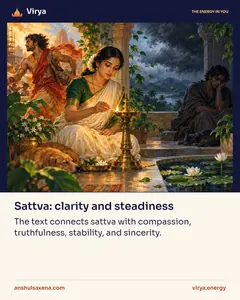
Sattva, rajas and tamas belong to a traditional account of disposition.

The text discusses differing qualities of disposition and praises compassion, truthfulness and steadiness in its account of sattva. These are part of its traditional framework.

Practice a quality instead of claiming a superior identity.

Where would a steadier response make a difference?

A cultural reading of Samudrika Shastra with a contemporary reflection. Traditional body-reading claims are not reliable judgments of a person’s character or future.

Samudrika Shastra

The spiral as a traditional sign

The spiral as a traditional sign, card 1 of 5
The spiral as a traditional sign, card 2 of 5
The spiral as a traditional sign, card 3 of 5
The spiral as a traditional sign, card 4 of 5
The spiral as a traditional sign, card 5 of 5
Read as text

Whorls become meaningful through location and direction in the text.

The book interprets whorls in hair or on the body according to where they appear and how they turn. Their meaning comes from the traditional reading system.

Let a pattern awaken curiosity without deciding a life.

What meaning do you add to a shape before you notice it?

A cultural reading of Samudrika Shastra with a contemporary reflection. Traditional body-reading claims are not reliable judgments of a person’s character or future.

Samudrika Shastra

A walk has a context

A walk has a context, card 1 of 5
A walk has a context, card 2 of 5
A walk has a context, card 3 of 5
A walk has a context, card 4 of 5
A walk has a context, card 5 of 5
Read as text

The book compares movement with animals and assigns it meaning.

The text interprets ways of walking through animal comparisons and ideas of composure. It connects these with its traditional judgments of fortune.

Make the path welcoming rather than judging the walk.

How could you make a shared space easier to move through?

A cultural reading of Samudrika Shastra with a contemporary reflection. Traditional body-reading claims are not reliable judgments of a person’s character or future.

Samudrika Shastra

What does radiance mean here?

What does radiance mean here?, card 1 of 5
What does radiance mean here?, card 2 of 5
What does radiance mean here?, card 3 of 5
What does radiance mean here?, card 4 of 5
What does radiance mean here?, card 5 of 5
Read as text

Chaya describes a kind of appearance that the text finds difficult to reduce to shape.

The text describes chaya as an outward radiance, using images such as a lamp shining through a clear vessel. It treats this quality as significant within its system.

Appreciate presence without claiming to know a destiny.

What makes an encounter feel warm or memorable to you?

A cultural reading of Samudrika Shastra with a contemporary reflection. Traditional body-reading claims are not reliable judgments of a person’s character or future.

Samudrika Shastra

Listen beyond the sound of a voice

Listen beyond the sound of a voice, card 1 of 5
Listen beyond the sound of a voice, card 2 of 5
Listen beyond the sound of a voice, card 3 of 5
Listen beyond the sound of a voice, card 4 of 5
Listen beyond the sound of a voice, card 5 of 5
Read as text

The text gives vocal qualities symbolic meanings.

The book compares voices with instruments, birds and natural sounds. It ranks these sounds within its traditional account of auspicious qualities.

Make room for the meaning behind every voice.

Whose words might you hear better with a little more patience?

A cultural reading of Samudrika Shastra with a contemporary reflection. Traditional body-reading claims are not reliable judgments of a person’s character or future.

Samudrika Shastra

Scent as a literary comparison

Scent as a literary comparison, card 1 of 5
Scent as a literary comparison, card 2 of 5
Scent as a literary comparison, card 3 of 5
Scent as a literary comparison, card 4 of 5
Scent as a literary comparison, card 5 of 5
Read as text

Flowers and other familiar things become a vocabulary of description.

The text compares bodily scent with flowers and other substances, then attaches favorable or unfavorable meanings. This is another part of its sensory reading system.

A sensory association is not a verdict about someone.

What memory does a familiar scent bring back?

A cultural reading of Samudrika Shastra with a contemporary reflection. Traditional body-reading claims are not reliable judgments of a person’s character or future.

Samudrika Shastra

Skin color is not character

Skin color is not character, card 1 of 5
Skin color is not character, card 2 of 5
Skin color is not character, card 3 of 5
Skin color is not character, card 4 of 5
Skin color is not character, card 5 of 5
Read as text

Reading an old text carefully includes recognizing its hierarchies.

In these passages, varna refers to bodily color. The text assigns different values and predictions to colors as part of its traditional system.

Respect belongs equally to people of every skin tone.

What small change in language would make your everyday speech more inclusive?

A cultural reading of Samudrika Shastra with a contemporary reflection. Traditional body-reading claims are not reliable judgments of a person’s character or future.

Samudrika Shastra

A category cannot contain a woman

A category cannot contain a woman, card 1 of 5
A category cannot contain a woman, card 2 of 5
A category cannot contain a woman, card 3 of 5
A category cannot contain a woman, card 4 of 5
A category cannot contain a woman, card 5 of 5
Read as text

The text’s classifications reveal assumptions about gender and appearance.

The text gives extensive descriptions of women and names categories such as Padmini, Hastini, Shankhini and Chitrini. These mix appearance with idealized temperament and social expectations.

Let a person speak beyond the category assigned to her.

What might change if you began with someone’s own account?

A cultural reading of Samudrika Shastra with a contemporary reflection. Traditional body-reading claims are not reliable judgments of a person’s character or future.

Samudrika Shastra

Inner strength deserves attention

Inner strength deserves attention, card 1 of 5
Inner strength deserves attention, card 2 of 5
Inner strength deserves attention, card 3 of 5
Inner strength deserves attention, card 4 of 5
Inner strength deserves attention, card 5 of 5
Read as text

The text itself gives special importance to qualities beyond bodily form.

In its account of sattva, the text praises compassion, truthfulness and steadiness. It also gives inner strength special importance among the qualities it describes.

Let character become visible through care and conduct.

How can you be both truthful and compassionate today?

A cultural reading of Samudrika Shastra with a contemporary reflection. Traditional body-reading claims are not reliable judgments of a person’s character or future.

Samudrika Shastra

Let your words bring comfort

Let your words bring comfort, card 1 of 5
Let your words bring comfort, card 2 of 5
Let your words bring comfort, card 3 of 5
Let your words bring comfort, card 4 of 5
Let your words bring comfort, card 5 of 5
Read as text

A closing reflection can turn from reading signs to practicing care.

The text praises speech that is gentle, free from deceit and reassuring to others. This points toward a quality expressed through action rather than physical form.

Let the meaning you carry become care you can offer.

Who could use a few honest and reassuring words today?

A cultural reading of Samudrika Shastra with a contemporary reflection. Traditional body-reading claims are not reliable judgments of a person’s character or future.

Samudrika Shastra

The ocean's observation

The ocean's observation, card 1 of 6
The ocean's observation, card 2 of 6
The ocean's observation, card 3 of 6
The ocean's observation, card 4 of 6
The ocean's observation, card 5 of 6
The ocean's observation, card 6 of 6
Read as text

A sacred story introduces the tradition: careful looking comes before interpretation.

Original words:
शुभलक्षणानि दृष्ट्वा क्षणं समुद्रः पुरा दध्यौ ।

In simple English:
The opening story says the ocean paused to contemplate Vishnu's auspicious bodily signs. This gives the tradition a sacred origin; it is a narrative of revelation, rather than a record of an experiment.

A modern reflection:
Look carefully. Interpret patiently.
What changes when you pause before deciding what something means?

A cultural reading of Samudrika Shastra. Body-based predictions are presented as traditional beliefs, not reliable ways to judge a person's character or future.

Samudrika Shastra

Gathering scattered knowledge

Gathering scattered knowledge, card 1 of 6
Gathering scattered knowledge, card 2 of 6
Gathering scattered knowledge, card 3 of 6
Gathering scattered knowledge, card 4 of 6
Gathering scattered knowledge, card 5 of 6
Gathering scattered knowledge, card 6 of 6
Read as text

The author presents the work as a gathering of earlier, scattered teachings.

Original words:
खण्डीकृतानि च पुनः पिण्डीकृत्याखिलानि तान्यधुना ।

In simple English:
The writer says he is bringing fragmented material together again. The surrounding verse presents the book as a brief account of auspicious and inauspicious signs drawn from earlier teachings.

A modern reflection:
Understanding grows through careful reading.
Which part of a familiar teaching would you like to understand more fully?

A cultural reading of Samudrika Shastra. Body-based predictions are presented as traditional beliefs, not reliable ways to judge a person's character or future.

Samudrika Shastra

Parts of a whole

Parts of a whole, card 1 of 6
Parts of a whole, card 2 of 6
Parts of a whole, card 3 of 6
Parts of a whole, card 4 of 6
Parts of a whole, card 5 of 6
Parts of a whole, card 6 of 6
Read as text

The book begins by giving readers a way to organize the body and its details.

Original words:
इत्यष्टाङ्गानि नृणां भवन्ति शेषाण्युपाङ्गानि ।

In simple English:
This passage distinguishes eight main bodily parts from their smaller parts. It is the book's organizing system: large regions come first, followed by details such as fingers, nails, and facial features.

A modern reflection:
Learn the parts. Remember the whole.
What becomes easier to understand when you first organize its parts?

A cultural reading of Samudrika Shastra. Body-based predictions are presented as traditional beliefs, not reliable ways to judge a person's character or future.

Samudrika Shastra

The belief behind the signs

The belief behind the signs, card 1 of 6
The belief behind the signs, card 2 of 6
The belief behind the signs, card 3 of 6
The belief behind the signs, card 4 of 6
The belief behind the signs, card 5 of 6
The belief behind the signs, card 6 of 6
Read as text

To understand the predictions, first understand the worldview behind them.

Original words:
पूर्वभवान्तरजनितं शुभमशुभमिहापि लक्ष्यते येन ।

In simple English:
The verse connects bodily signs with good and bad results from a previous birth. This karmic belief explains why the text treats visible features as clues to a person's life and fortune.

A modern reflection:
Understand the belief beneath the claim.
What assumption is doing the most work in the idea you are reading?

A cultural reading of Samudrika Shastra. Body-based predictions are presented as traditional beliefs, not reliable ways to judge a person's character or future.

Samudrika Shastra

Outer signs, inner qualities

Outer signs, inner qualities, card 1 of 6
Outer signs, inner qualities, card 2 of 6
Outer signs, inner qualities, card 3 of 6
Outer signs, inner qualities, card 4 of 6
Outer signs, inner qualities, card 5 of 6
Outer signs, inner qualities, card 6 of 6
Read as text

The tradition looks beyond visible features to temperament and inner strength.

Original words:
वर्णस्वरादि बाह्यं पुनरन्तः प्रकृतिसत्त्वादि ।

In simple English:
Color and voice are named as outer signs. Temperament and sattva, a quality of inner strength or steadiness, belong to the inner side of the book's system.

A modern reflection:
A person has an inner life.
What important quality cannot be understood from a photograph?

A cultural reading of Samudrika Shastra. Body-based predictions are presented as traditional beliefs, not reliable ways to judge a person's character or future.

Samudrika Shastra

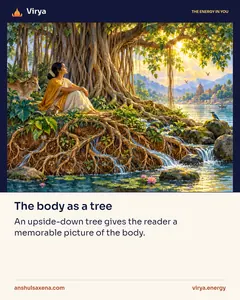
The body as a tree

The body as a tree, card 1 of 6
The body as a tree, card 2 of 6
The body as a tree, card 3 of 6
The body as a tree, card 4 of 6
The body as a tree, card 5 of 6
The body as a tree, card 6 of 6
Read as text

An upside-down tree gives the reader a memorable picture of the body.

Original words:
इह तावदूर्ध्वमूलो नरकल्पतरुर्भवेदधः शाखः ।

In simple English:
The text compares the human body to a tree with its root above and branches below. It then begins its detailed description at the soles and moves upward through the body.

A modern reflection:
A good image can organize an idea.
What image helps you remember something that once felt complicated?

A cultural reading of Samudrika Shastra. Body-based predictions are presented as traditional beliefs, not reliable ways to judge a person's character or future.

Samudrika Shastra

The lotus-like foot

The lotus-like foot, card 1 of 6
The lotus-like foot, card 2 of 6
The lotus-like foot, card 3 of 6
The lotus-like foot, card 4 of 6
The lotus-like foot, card 5 of 6
The lotus-like foot, card 6 of 6
Read as text

The lotus becomes a visual model for an ideal foot in the traditional description.

Original words:
अस्वेदमुष्णमरुणं कमलोदरकान्ति मांसलं श्लक्ष्णम् ।

In simple English:
The excerpt describes a sole as warm, reddish, fleshy, smooth, and free from sweat, with a lotus-like glow. The full verse associates this ideal with royal prosperity.

A modern reflection:
Notice the poetry in the description.
Which everyday part of life deserves more appreciation from you?

A cultural reading of Samudrika Shastra. Body-based predictions are presented as traditional beliefs, not reliable ways to judge a person's character or future.

Samudrika Shastra

Symbols underfoot

Symbols underfoot, card 1 of 6
Symbols underfoot, card 2 of 6
Symbols underfoot, card 3 of 6
Symbols underfoot, card 4 of 6
Symbols underfoot, card 5 of 6
Symbols underfoot, card 6 of 6
Read as text

A conch, parasol, or flag turns a bodily mark into a symbol of good fortune.

Original words:
अच्छिद्रा गम्भीराः स्फुटास्तले भागधेयवताम् ।

In simple English:
The selected words describe clear, deep, unbroken lines on the soles of fortunate people. The full verse names shapes such as a conch, parasol, and other emblems that the tradition reads as auspicious.

A modern reflection:
Symbols carry stories with them.
What familiar symbol means more once you know its cultural background?

A cultural reading of Samudrika Shastra. Body-based predictions are presented as traditional beliefs, not reliable ways to judge a person's character or future.

Samudrika Shastra

Reading the toes

Reading the toes, card 1 of 6
Reading the toes, card 2 of 6
Reading the toes, card 3 of 6
Reading the toes, card 4 of 6
Reading the toes, card 5 of 6
Reading the toes, card 6 of 6
Read as text

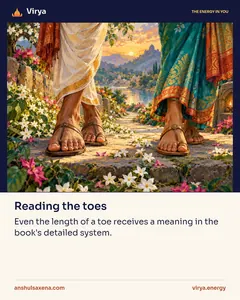
Even the length of a toe receives a meaning in the book's detailed system.

Original words:
यस्यानाम्ना दीर्घा स प्रज्ञाभाजनो मनुजः ।

In simple English:
The verse associates a long ring toe with intelligence. Its commentary compares that toe with the middle toe, showing how small differences in proportion become signs in the tradition.

A modern reflection:
Learn about people through engagement.
When has a conversation changed your first impression of someone?

A cultural reading of Samudrika Shastra. Body-based predictions are presented as traditional beliefs, not reliable ways to judge a person's character or future.

Samudrika Shastra

Nails in the old vocabulary

Nails in the old vocabulary, card 1 of 6
Nails in the old vocabulary, card 2 of 6
Nails in the old vocabulary, card 3 of 6
Nails in the old vocabulary, card 4 of 6
Nails in the old vocabulary, card 5 of 6
Nails in the old vocabulary, card 6 of 6
Read as text

The description of nails combines color, shine, smoothness, and shape.

Original words:
विमलाः प्रवालरुचयः स्निग्धाः कूर्मोन्नता नखाः श्लक्ष्णाः ।

In simple English:
The excerpt praises clear, coral-colored, glossy, smooth nails, raised like a tortoise's shell. In the complete verse, these features are associated with happiness and good fortune.

A modern reflection:
Learn the language of comparison.
How would you describe something familiar using two images from nature?

A cultural reading of Samudrika Shastra. Body-based predictions are presented as traditional beliefs, not reliable ways to judge a person's character or future.

Samudrika Shastra

The lotus-bud comparison

The lotus-bud comparison, card 1 of 6
The lotus-bud comparison, card 2 of 6
The lotus-bud comparison, card 3 of 6
The lotus-bud comparison, card 4 of 6
The lotus-bud comparison, card 5 of 6
The lotus-bud comparison, card 6 of 6
Read as text

A rounded lotus bud becomes the image used for an auspicious ankle.

Original words:
अन्तर्गूढा गुल्फाः सरोजमुकुलोपमाः श्रियं ददते ।

In simple English:
The text links ankles that are set within the surrounding flesh and resemble lotus buds with prosperity. It is describing a preferred bodily shape through a natural image.

A modern reflection:
Ask what the image is showing.
What does the lotus comparison help you picture here?

A cultural reading of Samudrika Shastra. Body-based predictions are presented as traditional beliefs, not reliable ways to judge a person's character or future.

Samudrika Shastra

Hair as a royal sign

Hair as a royal sign, card 1 of 6
Hair as a royal sign, card 2 of 6
Hair as a royal sign, card 3 of 6
Hair as a royal sign, card 4 of 6
Hair as a royal sign, card 5 of 6
Hair as a royal sign, card 6 of 6
Read as text

Fine details of texture and color become part of an ideal royal portrait.

Original words:
ललितानि स्निग्धानि भ्रमरश्यामानि देहरोमाणि ।

In simple English:
The excerpt describes body hair as graceful, smooth, and dark like a bee. The rest of the verse adds softness and fineness, associating these qualities with kings.

A modern reflection:
An old ideal is not everyone's standard.
Which beauty standard have you learned to question?

A cultural reading of Samudrika Shastra. Body-based predictions are presented as traditional beliefs, not reliable ways to judge a person's character or future.

Samudrika Shastra

The lotus at the center

The lotus at the center, card 1 of 6
The lotus at the center, card 2 of 6
The lotus at the center, card 3 of 6
The lotus at the center, card 4 of 6
The lotus at the center, card 5 of 6
The lotus at the center, card 6 of 6
Read as text

The center of a lotus becomes an image for the navel in the traditional portrait.

Original words:
शतपत्रकर्णिकाभा नाभिः स्याद्यस्य मनुजमात्रस्य ।

In simple English:
The passage describes a navel resembling the center of a many-petalled lotus. The full verse links that form with rulership and possession of a prosperous realm.

A modern reflection:
Resemblance is the start of a metaphor.
Where do you notice similar patterns in very different things?

A cultural reading of Samudrika Shastra. Body-based predictions are presented as traditional beliefs, not reliable ways to judge a person's character or future.

Samudrika Shastra

The ideal of evenness

The ideal of evenness, card 1 of 6
The ideal of evenness, card 2 of 6
The ideal of evenness, card 3 of 6
The ideal of evenness, card 4 of 6
The ideal of evenness, card 5 of 6
The ideal of evenness, card 6 of 6
Read as text

Balance and evenness recur in the book's descriptions of an auspicious body.

Original words:
जठरं यस्य समं स्यादभितः स पुमान्महार्थाढ्यः ।

In simple English:
This line associates an evenly formed abdomen with great wealth. The surrounding verses compare different abdominal shapes with animals and objects, assigning a different outcome to each.

A modern reflection:
Repeated words reveal a pattern.
What idea keeps returning in the book or teaching you are studying?

A cultural reading of Samudrika Shastra. Body-based predictions are presented as traditional beliefs, not reliable ways to judge a person's character or future.

Samudrika Shastra

The image of a strong chest

The image of a strong chest, card 1 of 6
The image of a strong chest, card 2 of 6
The image of a strong chest, card 3 of 6
The image of a strong chest, card 4 of 6
The image of a strong chest, card 5 of 6
The image of a strong chest, card 6 of 6
Read as text

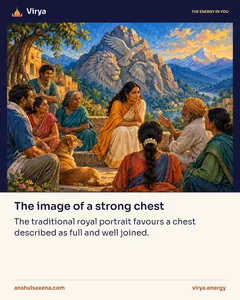
The traditional royal portrait favors a chest described as full and well joined.

Original words:
अभ्युन्नतेन मांसोपचितेन सुसंहतेन भूमिभुजः ।

In simple English:
The excerpt associates an elevated, fleshy, well-knit chest with rulers. The surrounding passage also connects breadth with wealth and long life within its system of bodily signs.

A modern reflection:
Dependability is a strength you can show.
Who has shown you strength through steady support?

A cultural reading of Samudrika Shastra. Body-based predictions are presented as traditional beliefs, not reliable ways to judge a person's character or future.

Samudrika Shastra

Arms and royal imagery

Arms and royal imagery, card 1 of 6
Arms and royal imagery, card 2 of 6
Arms and royal imagery, card 3 of 6
Arms and royal imagery, card 4 of 6
Arms and royal imagery, card 5 of 6
Arms and royal imagery, card 6 of 6
Read as text

Long, rounded arms form part of the text's image of a king.

Original words:
बाहू वामविवर्जितौ वृत्तावाजानुलंबिनौ पीनौ ।

In simple English:
The line describes full, rounded arms extending to the knees and not turned to the left. In the full verse, these are included among the bodily features assigned to a king.

A modern reflection:
Let strength become useful action.
What practical help can you offer with the strength you have?

A cultural reading of Samudrika Shastra. Body-based predictions are presented as traditional beliefs, not reliable ways to judge a person's character or future.

Samudrika Shastra

Three lines at the wrist

Three lines at the wrist, card 1 of 6
Three lines at the wrist, card 2 of 6
Three lines at the wrist, card 3 of 6
Three lines at the wrist, card 4 of 6
Three lines at the wrist, card 5 of 6
Three lines at the wrist, card 6 of 6
Read as text

The book treats wrist lines as part of the wider language of the hand.

Original words:
रेखाभिः पूर्णाभिस्तिसृभिः करमूलमङ्कितं यस्य ।

In simple English:
The passage describes a wrist marked by three complete lines. The rest of the verse says Lakshmi favors such a person with wealth, gold, and jewels.

A modern reflection:
A pattern invites a question.
What extra information would you need before trusting a prediction?

A cultural reading of Samudrika Shastra. Body-based predictions are presented as traditional beliefs, not reliable ways to judge a person's character or future.

Samudrika Shastra

The shape of a palm

The shape of a palm, card 1 of 6
The shape of a palm, card 2 of 6
The shape of a palm, card 3 of 6
The shape of a palm, card 4 of 6
The shape of a palm, card 5 of 6
The shape of a palm, card 6 of 6
Read as text

The palm is read for generosity as well as possession of wealth.

Original words:
सुवृत्तनिम्नेन धनी पाणितलेनोन्नतेन दानरुचिः ।

In simple English:
The line links a round, hollowed palm with wealth and a raised palm with a taste for giving. These are two different meanings attached to two different shapes.

A modern reflection:
Generosity becomes visible through giving.
What can you share that would be genuinely useful to someone?

A cultural reading of Samudrika Shastra. Body-based predictions are presented as traditional beliefs, not reliable ways to judge a person's character or future.

Samudrika Shastra

What made a line auspicious?

What made a line auspicious?, card 1 of 6
What made a line auspicious?, card 2 of 6
What made a line auspicious?, card 3 of 6
What made a line auspicious?, card 4 of 6
What made a line auspicious?, card 5 of 6
What made a line auspicious?, card 6 of 6
Read as text

The tradition pays attention to the quality of a line, not only where it runs.

Original words:
अन्तर्वृत्ता स्निग्धा कररेखा शस्यते पुंसाम् ।

In simple English:
The chosen words praise a hand line that curves inward and appears smooth. The full verse also values clear, deep, complete lines, using the red lotus petal as a comparison.

A modern reflection:
Clear definitions come before interpretation.
Which word in this passage needed a closer look?

A cultural reading of Samudrika Shastra. Body-based predictions are presented as traditional beliefs, not reliable ways to judge a person's character or future.

Samudrika Shastra

Three lines, three concerns

Three lines, three concerns, card 1 of 6
Three lines, three concerns, card 2 of 6
Three lines, three concerns, card 3 of 6
Three lines, three concerns, card 4 of 6
Three lines, three concerns, card 5 of 6
Three lines, three concerns, card 6 of 6
Read as text

Family, resources, and lifespan become the three concerns named in this passage.

Original words:
आद्या भवन्ति तिस्रो गोत्रद्रव्यायुषां रेखाः ।

In simple English:
The text names three principal lines connected with family lineage, wealth, and length of life. The preceding words locate them by the wrist and the space between the thumb and index finger.

A modern reflection:
Recognize the human concerns beneath the signs.
Which deserves more attention today: connection, resources, or how you use your time?

A cultural reading of Samudrika Shastra. Body-based predictions are presented as traditional beliefs, not reliable ways to judge a person's character or future.

Samudrika Shastra

A palm full of symbols

A palm full of symbols, card 1 of 6
A palm full of symbols, card 2 of 6
A palm full of symbols, card 3 of 6
A palm full of symbols, card 4 of 6
A palm full of symbols, card 5 of 6
A palm full of symbols, card 6 of 6
Read as text

The conch and lotus become emblems of abundance when their shapes appear in the hand.

Original words:
शंखाङ्को लक्षपतिः कोटिपतिर्भवति पद्माङ्कः ।

In simple English:
The excerpt associates a conch mark with great wealth and a lotus mark with still greater wealth. It belongs to a longer list of recognizable shapes assigned symbolic outcomes.

A modern reflection:
Abundance has more than one meaning.
What already makes your life feel rich?

A cultural reading of Samudrika Shastra. Body-based predictions are presented as traditional beliefs, not reliable ways to judge a person's character or future.

Samudrika Shastra

The thumb and its joints

The thumb and its joints, card 1 of 6
The thumb and its joints, card 2 of 6
The thumb and its joints, card 3 of 6
The thumb and its joints, card 4 of 6
The thumb and its joints, card 5 of 6
The thumb and its joints, card 6 of 6
Read as text

The old commentary makes even the joints of the thumb part of its description.

Original words:
धनवानों के अंगूठे में भी कठिन और बराबर पोरवे होते हैं।

In simple English:
The commentary says that wealthy people have firm, evenly formed thumb joints. It explains the verse's preference for a straight, smooth, rounded thumb and regular joints.

A modern reflection:
Be precise about what a sign can tell you.
Where might a careful observation still lead to an unsupported conclusion?

A cultural reading of Samudrika Shastra. Body-based predictions are presented as traditional beliefs, not reliable ways to judge a person's character or future.

Samudrika Shastra

Fingers and fortune

Fingers and fortune, card 1 of 6
Fingers and fortune, card 2 of 6
Fingers and fortune, card 3 of 6
Fingers and fortune, card 4 of 6
Fingers and fortune, card 5 of 6
Fingers and fortune, card 6 of 6
Read as text

Finger length and joint length receive separate meanings in the traditional account.

Original words:
दीर्घायुरङ्गुलीभिः सौभाग्ययुतः सुदीर्घपर्वाभिः ।

In simple English:
The line associates long fingers with long life and long finger segments with good fortune. These are claims within the text's body-reading tradition, not proven links.

A modern reflection:
A hand's actions tell a richer story.
What is something meaningful you have learned to do with your hands?

A cultural reading of Samudrika Shastra. Body-based predictions are presented as traditional beliefs, not reliable ways to judge a person's character or future.

Samudrika Shastra

The ideal face

The ideal face, card 1 of 6
The ideal face, card 2 of 6
The ideal face, card 3 of 6
The ideal face, card 4 of 6
The ideal face, card 5 of 6
The ideal face, card 6 of 6
Read as text

The text combines gentle appearance, smoothness, and evenness in its preferred facial portrait.

Original words:
वर्तुलमभीरु सूक्ष्मं स्निग्धं सौम्यं समं सुरभि वदनम् ।

In simple English:
The excerpt describes a rounded, unfrightening, delicate, smooth, gentle, even, and pleasantly scented face. The complete verse connects the portrait with rulership and enjoyment of life's comforts.

A modern reflection:
Let trust grow through experience.
What repeated action helps you trust someone?

A cultural reading of Samudrika Shastra. Body-based predictions are presented as traditional beliefs, not reliable ways to judge a person's character or future.

Samudrika Shastra

How lips were described

How lips were described, card 1 of 6
How lips were described, card 2 of 6
How lips were described, card 3 of 6
How lips were described, card 4 of 6
How lips were described, card 5 of 6
How lips were described, card 6 of 6
Read as text

Shape, softness, and proportion all contribute to the book's description of lips.

Original words:
यस्याधरोत्तरोष्ठौ द्व्यंगुलमानौ सुकोमलौ मसृणौ ।

In simple English:
The excerpt describes the two lips by a finger-based measure, softness, and smoothness. The full verse adds regular edges and connects the resulting ideal with wealth.

A modern reflection:
Let your words carry care.
What could you say more thoughtfully today?

A cultural reading of Samudrika Shastra. Body-based predictions are presented as traditional beliefs, not reliable ways to judge a person's character or future.

Samudrika Shastra

Teeth like jasmine buds

Teeth like jasmine buds, card 1 of 6
Teeth like jasmine buds, card 2 of 6
Teeth like jasmine buds, card 3 of 6
Teeth like jasmine buds, card 4 of 6
Teeth like jasmine buds, card 5 of 6
Teeth like jasmine buds, card 6 of 6
Read as text

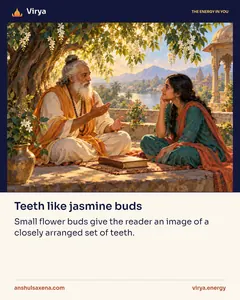
Small flower buds give the reader an image of a closely arranged set of teeth.

Original words:
कुन्दमुकुलोपमाः स्युर्यस्यारुणपीडिकासमा सुघनाः ।

In simple English:
The excerpt compares teeth with jasmine buds and describes them as closely set. The rest of the verse adds smoothness and other details, then associates the ideal with wealth.

A modern reflection:
A simple image can make language vivid.
What ordinary thing could become a fresh comparison in your writing?

A cultural reading of Samudrika Shastra. Body-based predictions are presented as traditional beliefs, not reliable ways to judge a person's character or future.

Samudrika Shastra

The lotus-petal tongue

The lotus-petal tongue, card 1 of 6
The lotus-petal tongue, card 2 of 6
The lotus-petal tongue, card 3 of 6
The lotus-petal tongue, card 4 of 6
The lotus-petal tongue, card 5 of 6
The lotus-petal tongue, card 6 of 6
Read as text

The red lotus petal becomes another model of smoothness and delicate form.

Original words:
सङ्कीर्णाग्रा स्निग्धा रक्ताम्बुजपत्रसन्निभा रसना ।

In simple English:
The passage describes a tongue with a narrow tip, a smooth surface, and the appearance of a red lotus petal. The complete verse associates this form with a ruler.

A modern reflection:
Give your words a thoughtful beginning.
What conversation would benefit from a calmer opening sentence?

A cultural reading of Samudrika Shastra. Body-based predictions are presented as traditional beliefs, not reliable ways to judge a person's character or future.

Samudrika Shastra

The gentle smile

The gentle smile, card 1 of 6
The gentle smile, card 2 of 6
The gentle smile, card 3 of 6
The gentle smile, card 4 of 6
The gentle smile, card 5 of 6
The gentle smile, card 6 of 6
Read as text

A restrained, sweet smile belongs to the text's portrait of a leading person.

Original words:
हसितमलक्षितदशनं किञ्चिद्विकसितकपोलमतिमधुरम् ।

In simple English:
The line describes a very pleasant smile with teeth not visible and cheeks slightly opening. The full verse also values composure and the absence of shaking in its ideal of a leader's laughter.

A modern reflection:
Warmth matters more than a perfect expression.
When did a shared smile make a difficult moment lighter?

A cultural reading of Samudrika Shastra. Body-based predictions are presented as traditional beliefs, not reliable ways to judge a person's character or future.

Samudrika Shastra

Nature as a visual dictionary

Nature as a visual dictionary, card 1 of 6
Nature as a visual dictionary, card 2 of 6
Nature as a visual dictionary, card 3 of 6
Nature as a visual dictionary, card 4 of 6
Nature as a visual dictionary, card 5 of 6
Nature as a visual dictionary, card 6 of 6
Read as text

A sesame flower and a parrot supply two different images for the nose.

Original words:
तिलपुष्पतुल्यनासः शुकनासो भूपतिर्मनुजः ।

In simple English:
The text associates noses resembling a sesame flower or a parrot's beak with kingship. Nature provides the shapes; the author supplies their symbolic meaning.

A modern reflection:
Begin with an image your reader knows.
What comparison would make a difficult idea easier to picture?

A cultural reading of Samudrika Shastra. Body-based predictions are presented as traditional beliefs, not reliable ways to judge a person's character or future.

Samudrika Shastra

Eyes in animal imagery

Eyes in animal imagery, card 1 of 6
Eyes in animal imagery, card 2 of 6
Eyes in animal imagery, card 3 of 6
Eyes in animal imagery, card 4 of 6
Eyes in animal imagery, card 5 of 6
Eyes in animal imagery, card 6 of 6
Read as text

Animal comparisons are part of how the book classifies the shape of the eyes.

Original words:
सेनापतिर्गजाक्षश्चिरजीवी जायते सुदीर्घाक्षः ।

In simple English:
The line connects elephant-like eyes with military command and very long eyes with long life. It illustrates the text's habit of moving from a resemblance to a predicted outcome.

A modern reflection:
Look beyond a striking resemblance.
How can you separate an appealing image from a reliable explanation?

A cultural reading of Samudrika Shastra. Body-based predictions are presented as traditional beliefs, not reliable ways to judge a person's character or future.

Samudrika Shastra

The meaning assigned to a gaze

The meaning assigned to a gaze, card 1 of 6
The meaning assigned to a gaze, card 2 of 6
The meaning assigned to a gaze, card 3 of 6
The meaning assigned to a gaze, card 4 of 6
The meaning assigned to a gaze, card 5 of 6
The meaning assigned to a gaze, card 6 of 6
Read as text

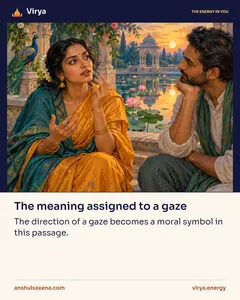
The direction of a gaze becomes a moral symbol in this passage.

Original words:
ऋजु पश्यति सरलमनाः पश्यन्त्यूर्ध्वं सदैव पुण्याढ्याः ।

In simple English:
The excerpt says that a straightforward person looks straight and a virtuous person looks upward. This is the text's interpretation of looking behavior, not a dependable way to read honesty.

A modern reflection:
Listen before you label.
How can you make a conversation comfortable for someone unlike you?

A cultural reading of Samudrika Shastra. Body-based predictions are presented as traditional beliefs, not reliable ways to judge a person's character or future.

Samudrika Shastra

Reading the brow

Reading the brow, card 1 of 6
Reading the brow, card 2 of 6
Reading the brow, card 3 of 6
Reading the brow, card 4 of 6
Reading the brow, card 5 of 6
Reading the brow, card 6 of 6
Read as text

Raised, clearly formed brows receive a favorable meaning in the traditional portrait.

Original words:
धनवन्तः सुतवन्तः शिखरैः पुरुषाः समुन्नतैर्विशदैः ।

In simple English:
The line associates elevated, distinct brows with wealth and children. The commentary makes clear that the raised feature being discussed is the eyebrow.

A modern reflection:
A small detail is only a small detail.
Where have you once read too much into a first impression?

A cultural reading of Samudrika Shastra. Body-based predictions are presented as traditional beliefs, not reliable ways to judge a person's character or future.

Samudrika Shastra

Ears in the traditional portrait

Ears in the traditional portrait, card 1 of 6
Ears in the traditional portrait, card 2 of 6
Ears in the traditional portrait, card 3 of 6
Ears in the traditional portrait, card 4 of 6
Ears in the traditional portrait, card 5 of 6
Ears in the traditional portrait, card 6 of 6
Read as text

Length, fullness, and softness are the qualities named in this description of ears.

Original words:
आद्ये प्रलम्बकर्णः सुखी स्वभावपीनमृदुकर्णः ।

In simple English:
The line links long ears and naturally full, soft ears with happiness in early life. It is one example of the book assigning different fortunes to different bodily forms.

A modern reflection:
Make listening an act of care.
Who would benefit from your uninterrupted attention today?

A cultural reading of Samudrika Shastra. Body-based predictions are presented as traditional beliefs, not reliable ways to judge a person's character or future.

Samudrika Shastra

Lines across the forehead

Lines across the forehead, card 1 of 6
Lines across the forehead, card 2 of 6
Lines across the forehead, card 3 of 6
Lines across the forehead, card 4 of 6
Lines across the forehead, card 5 of 6
Lines across the forehead, card 6 of 6
Read as text

The book gives forehead lines numerical meanings connected with length of life.

Original words:
रेखाभिर्वर्षशतं पञ्चभिरायुर्ललाटसंस्थाभिः ।

In simple English:
The excerpt assigns a lifespan of one hundred years to five forehead lines. Nearby verses attach other numbers to other patterns, showing how specific the traditional predictions become.

A modern reflection:
Precision is not the same as proof.
What makes a numerical claim worth trusting?

A cultural reading of Samudrika Shastra. Body-based predictions are presented as traditional beliefs, not reliable ways to judge a person's character or future.

Samudrika Shastra

The language of hair

The language of hair, card 1 of 6
The language of hair, card 2 of 6
The language of hair, card 3 of 6
The language of hair, card 4 of 6
The language of hair, card 5 of 6
The language of hair, card 6 of 6
Read as text

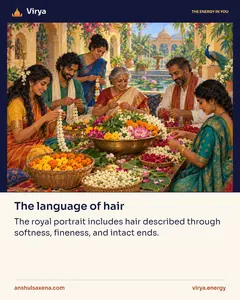
The royal portrait includes hair described through softness, fineness, and intact ends.

Original words:
अत्रुटिताग्राः स्निग्धा ऋजवो मृदवः समास्तनीयांसः ।

In simple English:
The excerpt lists unbroken ends, smoothness, straightness, softness, evenness, and fineness. The complete verse adds other details and associates this preferred hair with rulers.

A modern reflection:
Human variety deserves room.
What part of your appearance have you learned to accept more kindly?

A cultural reading of Samudrika Shastra. Body-based predictions are presented as traditional beliefs, not reliable ways to judge a person's character or future.

Samudrika Shastra

How the body holds together

How the body holds together, card 1 of 6
How the body holds together, card 2 of 6
How the body holds together, card 3 of 6
How the body holds together, card 4 of 6
How the body holds together, card 5 of 6
How the body holds together, card 6 of 6
Read as text

Samhati shifts attention from isolated features to the way bodily parts are joined.

Original words:
यत्र मिथः श्लिष्टत्वं मांसस्नाय्वस्थिसंधिबंधानाम् ।

In simple English:
The passage describes the mutual connection of flesh, sinews, bones, joints, and their bindings. The next line names this coming together as samhati, also using related terms for bodily cohesion.

A modern reflection:
Strength can come from connection.
Which connection would make the whole of your work function better?

A cultural reading of Samudrika Shastra. Body-based predictions are presented as traditional beliefs, not reliable ways to judge a person's character or future.

Samudrika Shastra

Seven kinds of bodily essence

Seven kinds of bodily essence, card 1 of 6
Seven kinds of bodily essence, card 2 of 6
Seven kinds of bodily essence, card 3 of 6
Seven kinds of bodily essence, card 4 of 6
Seven kinds of bodily essence, card 5 of 6
Seven kinds of bodily essence, card 6 of 6
Read as text

Sara is the book's way of discussing the quality or substance of bodily tissues.

Original words:
साराः सप्त भवेयुः समासतस्तत्फलं ब्रूमः ।

In simple English:
The verse announces seven kinds of sara. Its surrounding text lists skin, blood, flesh, fat, bone, marrow, and reproductive substance, then assigns qualities and fortunes to each category.

A modern reflection:
Understand a term in its own setting.
Which familiar word takes on a different meaning in this book?

A cultural reading of Samudrika Shastra. Body-based predictions are presented as traditional beliefs, not reliable ways to judge a person's character or future.

Samudrika Shastra

Patterns carried forward

Patterns carried forward, card 1 of 6
Patterns carried forward, card 2 of 6
Patterns carried forward, card 3 of 6
Patterns carried forward, card 4 of 6
Patterns carried forward, card 5 of 6
Patterns carried forward, card 6 of 6
Read as text

Anuka names a pattern that the tradition believes continues from an earlier birth.

Original words:
पुनरिह यदनुक्रियते तदनूकं कथ्यते सद्भिः ।

In simple English:
The excerpt calls a repeated pattern anuka. The preceding line connects it with the character, form, and movement cultivated in a previous existence; later examples compare such patterns with animals.

A modern reflection:
Notice the pattern you can observe.
Which repeated response would you like to handle differently next time?

A cultural reading of Samudrika Shastra. Body-based predictions are presented as traditional beliefs, not reliable ways to judge a person's character or future.

Samudrika Shastra

The warmth of sneha

The warmth of sneha, card 1 of 6
The warmth of sneha, card 2 of 6
The warmth of sneha, card 3 of 6
The warmth of sneha, card 4 of 6
The warmth of sneha, card 5 of 6
The warmth of sneha, card 6 of 6
Read as text

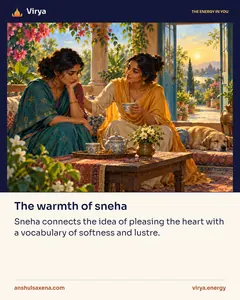
Sneha connects the idea of pleasing the heart with a vocabulary of softness and lustre.

Original words:
चित्तप्रसत्तिजननं प्रीणनमिति कथ्यते ध्रुवं स्नेहः ।

In simple English:
The line describes sneha as something that gives pleasure and brings clarity or gladness to the mind. The following verses use the same word for qualities of the tongue, teeth, skin, eyes, nails, and hair.

A modern reflection:
Warmth changes how a moment feels.
What small expression of care could brighten someone's day?

A cultural reading of Samudrika Shastra. Body-based predictions are presented as traditional beliefs, not reliable ways to judge a person's character or future.

Samudrika Shastra

A measure taken from the body

A measure taken from the body, card 1 of 6
A measure taken from the body, card 2 of 6
A measure taken from the body, card 3 of 6
A measure taken from the body, card 4 of 6
A measure taken from the body, card 5 of 6
A measure taken from the body, card 6 of 6
Read as text

The passage uses a person's own finger segments as its unit of measurement.

Original words:
निजपर्वाङ्गुलिसंख्या नियतं तेषां विबोद्धव्या ।

In simple English:
The selected line says to understand the measurements through the person's own finger-joint units. It appears in a discussion of bodily dimensions and proportions, rather than a modern system of fixed centimeters.

A modern reflection:
A comparison needs a clear standard.
Where might the wrong standard be making a comparison unfair?

A cultural reading of Samudrika Shastra. Body-based predictions are presented as traditional beliefs, not reliable ways to judge a person's character or future.

Samudrika Shastra

Measuring with water

Measuring with water, card 1 of 6
Measuring with water, card 2 of 6
Measuring with water, card 3 of 6
Measuring with water, card 4 of 6
Measuring with water, card 5 of 6
Measuring with water, card 6 of 6
Read as text

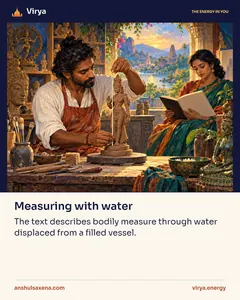
The text describes bodily measure through water displaced from a filled vessel.

Original words:
जलभृतकटाहमध्यासीनस्य चतुर्दिशं नरस्य बहिः । पतति यदम्बु द्रोणं परिणाहत्वेन तन्मानम् ।

In simple English:
The verse describes a person sitting in a vessel filled with water and refers to the water flowing out around it. It uses a traditional volume unit in its account of bodily measure.

A modern reflection:
Measurement and meaning are separate steps.
What does a measurement tell you, and what does it leave unanswered?

A cultural reading of Samudrika Shastra. Body-based predictions are presented as traditional beliefs, not reliable ways to judge a person's character or future.

Samudrika Shastra

The earth-like temperament

The earth-like temperament, card 1 of 6
The earth-like temperament, card 2 of 6
The earth-like temperament, card 3 of 6
The earth-like temperament, card 4 of 6
The earth-like temperament, card 5 of 6
The earth-like temperament, card 6 of 6
Read as text

The earth image gathers steadiness, enjoyment, and pleasant scent into one traditional type.

Original words:
सुरभिः प्रसूनगन्धः सुखवान् भोगी स्थिरः क्षितिप्रकृतिः ।

In simple English:
The line describes the earth-like person as pleasantly scented, flower-like in fragrance, comfortable, fond of enjoyment, and steady. These qualities form one type in the book's wider temperament system.

A modern reflection:
Steadiness can be practiced.
What small commitment would help you feel more grounded today?

A cultural reading of Samudrika Shastra. Body-based predictions are presented as traditional beliefs, not reliable ways to judge a person's character or future.

Samudrika Shastra

The water-like temperament

The water-like temperament, card 1 of 6
The water-like temperament, card 2 of 6
The water-like temperament, card 3 of 6
The water-like temperament, card 4 of 6
The water-like temperament, card 5 of 6
The water-like temperament, card 6 of 6
Read as text

Pleasant speech and enjoyment of liquids appear together in the water-like portrait.

Original words:
प्रियवाग्घनाम्बुपायी नीरप्रकृतिर्नरो रसभुक् ।

In simple English:
The line describes the water-like person as pleasant in speech, drinking much water, and enjoying tastes or juices. The element supplies a shared image for these qualities in the traditional classification.

A modern reflection:
Gentleness can still be clear.
How could you express a firm boundary with a calmer tone?

A cultural reading of Samudrika Shastra. Body-based predictions are presented as traditional beliefs, not reliable ways to judge a person's character or future.

Samudrika Shastra

The fire-like temperament

The fire-like temperament, card 1 of 6
The fire-like temperament, card 2 of 6
The fire-like temperament, card 3 of 6
The fire-like temperament, card 4 of 6
The fire-like temperament, card 5 of 6
The fire-like temperament, card 6 of 6
Read as text

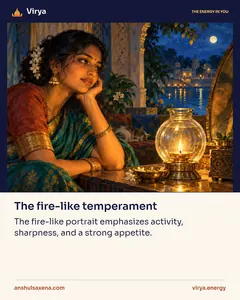
The fire-like portrait emphasizes activity, sharpness, and a strong appetite.

Original words:
चपलः खण्डस्तीक्ष्णः क्षुद्वान् घनभोजनः शिखिप्रकृतिः ।

In simple English:
The verse describes a lively, sharp, hungry person who eats much, grouping these qualities under a fire-like nature. Its old commentary also includes sweetness in explaining the description.

A modern reflection:
Give your energy a clear direction.
Where would focused effort help more than scattered intensity?

A cultural reading of Samudrika Shastra. Body-based predictions are presented as traditional beliefs, not reliable ways to judge a person's character or future.

Samudrika Shastra

The wind-like temperament

The wind-like temperament, card 1 of 6
The wind-like temperament, card 2 of 6
The wind-like temperament, card 3 of 6
The wind-like temperament, card 4 of 6
The wind-like temperament, card 5 of 6
The wind-like temperament, card 6 of 6
Read as text

Movement and speed are central to the text's image of a wind-like person.

Original words:
चटुलः क्षामः क्षिप्रः सकोपनः स्यान्मरुत्प्रकृतिः ।

In simple English:
The excerpt describes a mobile, lean, quick, and easily angered person as wind-like. It gathers these features into a traditional type; it does not mean every fast-moving or lean person has that temperament.

A modern reflection:
You can choose the pace of a response.
What would improve if you gave it one extra moment of attention?

A cultural reading of Samudrika Shastra. Body-based predictions are presented as traditional beliefs, not reliable ways to judge a person's character or future.

Samudrika Shastra

The space-like temperament

The space-like temperament, card 1 of 6
The space-like temperament, card 2 of 6
The space-like temperament, card 3 of 6
The space-like temperament, card 4 of 6
The space-like temperament, card 5 of 6
The space-like temperament, card 6 of 6
Read as text

Learning, skill, and a pleasing voice shape the space-like portrait.

Original words:
विद्वान् सुस्वरकुशलो विवृताक्ष शिक्षितोऽम्बरप्रकृतिः ।

In simple English:
The line describes a learned, skilled, educated person with a good voice and open eyes as space-like. These traits form another category in the text's scheme of temperaments.

A modern reflection:
Leave room to learn.
Which question deserves more space in your thinking?

A cultural reading of Samudrika Shastra. Body-based predictions are presented as traditional beliefs, not reliable ways to judge a person's character or future.

Samudrika Shastra

More than one pattern

More than one pattern, card 1 of 6
More than one pattern, card 2 of 6
More than one pattern, card 3 of 6
More than one pattern, card 4 of 6
More than one pattern, card 5 of 6
More than one pattern, card 6 of 6
Read as text

After listing types, the author turns to combinations of features.

Original words:
इति दशविधा नराणां निर्दिष्टाः प्रकृतयो यथा दृष्टाः । किञ्चिन्मिश्रकलक्षणमधुना वक्ष्याम्यतो लोके ।

In simple English:
The verse says that ten kinds of nature have been described, then introduces mixed characteriztics. The classification continues beyond simple types, although these combinations still belong to its traditional predictive system.

A modern reflection:
One label cannot contain a person.
Which two apparently different qualities coexist in you?

A cultural reading of Samudrika Shastra. Body-based predictions are presented as traditional beliefs, not reliable ways to judge a person's character or future.

Samudrika Shastra

Sattva: clarity and steadiness

Sattva: clarity and steadiness, card 1 of 6
Sattva: clarity and steadiness, card 2 of 6
Sattva: clarity and steadiness, card 3 of 6
Sattva: clarity and steadiness, card 4 of 6
Sattva: clarity and steadiness, card 5 of 6
Sattva: clarity and steadiness, card 6 of 6
Read as text

The text connects sattva with compassion, truthfulness, stability, and sincerity.

Original words:
यः सत्त्वगुणोपेतः स दयालुः सत्यवाक् स्थिरः सरलः ।

In simple English:
The line describes a person with sattva as kind, truthful, steady, and straightforward. The rest of the verse adds devotion and patience through both difficulty and success.

A modern reflection:
Clarity can show up as kindness.
What would a truthful and compassionate response look like right now?

A cultural reading of Samudrika Shastra. Body-based predictions are presented as traditional beliefs, not reliable ways to judge a person's character or future.

Samudrika Shastra

Rajas: the energy to engage

Rajas: the energy to engage, card 1 of 6
Rajas: the energy to engage, card 2 of 6
Rajas: the energy to engage, card 3 of 6
Rajas: the energy to engage, card 4 of 6
Rajas: the energy to engage, card 5 of 6
Rajas: the energy to engage, card 6 of 6
Read as text

Rajas appears in a portrait of creativity, desire, and courage.

Original words:
काव्यकलासु प्रवणः कुलनारीकृतरतिस्सदा शूरः ।

In simple English:
The excerpt describes a man drawn to poetry and the arts, attached to romantic enjoyment, and courageous. The next line identifies this as a portrait in which rajas is prominent.

A modern reflection:
Turn creative energy into deliberate work.
What small piece of work would give your energy a useful outlet?

A cultural reading of Samudrika Shastra. Body-based predictions are presented as traditional beliefs, not reliable ways to judge a person's character or future.

Samudrika Shastra

Tamas: when energy feels heavy

Tamas: when energy feels heavy, card 1 of 6
Tamas: when energy feels heavy, card 2 of 6
Tamas: when energy feels heavy, card 3 of 6
Tamas: when energy feels heavy, card 4 of 6
Tamas: when energy feels heavy, card 5 of 6
Tamas: when energy feels heavy, card 6 of 6
Read as text

The text's portrait of tamas brings together dullness, sleep, inactivity, and anger.

Original words:
मूर्खस्तमोऽन्वितः स्यान्निद्रां कुर्वंश्च सालसः क्रोधी ।

In simple English:
The verse describes a person dominated by tamas in harsh terms: lacking understanding, sleepy, inactive, and angry. Its following line allows for mixtures of these qualities with others.

A modern reflection:
Begin again without self-contempt.
What is the smallest helpful step available to you today?

A cultural reading of Samudrika Shastra. Body-based predictions are presented as traditional beliefs, not reliable ways to judge a person's character or future.

Samudrika Shastra

Spirals on the body

Spirals on the body, card 1 of 6
Spirals on the body, card 2 of 6
Spirals on the body, card 3 of 6
Spirals on the body, card 4 of 6
Spirals on the body, card 5 of 6
Spirals on the body, card 6 of 6
Read as text

Avarta names the turning patterns the book reads in hair and skin.

Original words:
रोमत्वग्बालभवः स्यादावर्तः शुभस्त्रिधा वपुषि ।

In simple English:
The line distinguishes whorls associated with body hair, skin, and head hair. The rest of the verse favors clear, smooth patterns turning to the right within its auspicious-sign system.

A modern reflection:
Wonder does not require a prediction.
What repeating natural pattern has caught your attention recently?

A cultural reading of Samudrika Shastra. Body-based predictions are presented as traditional beliefs, not reliable ways to judge a person's character or future.

Samudrika Shastra

How movement was read

How movement was read, card 1 of 6
How movement was read, card 2 of 6
How movement was read, card 3 of 6
How movement was read, card 4 of 6
How movement was read, card 5 of 6
How movement was read, card 6 of 6
Read as text

The book connects a composed, quiet gait with its image of prosperity.

Original words:
धनिनां गमनं स्तिमितं समाहितं शब्दहीनमस्तब्धम् ।

In simple English:
The line describes the wealthy person's gait as steady, composed, quiet, and unimpeded. The surrounding section assigns meanings to other movements and compares some with animals.

A modern reflection:
Make room for different ways of moving.
What could you do to make a shared space more welcoming?

A cultural reading of Samudrika Shastra. Body-based predictions are presented as traditional beliefs, not reliable ways to judge a person's character or future.

Samudrika Shastra

Radiance like a lamp

Radiance like a lamp, card 1 of 6
Radiance like a lamp, card 2 of 6
Radiance like a lamp, card 3 of 6
Radiance like a lamp, card 4 of 6
Radiance like a lamp, card 5 of 6
Radiance like a lamp, card 6 of 6
Read as text

The text explains chaya through the image of light shining inside clear crystal.

Original words:
विमलस्फटिकघटान्तर्विलसति सा दीपकलिकेव ।

In simple English:
The line compares bodily radiance to a small flame shining within a clear crystal vessel. The surrounding verses classify different kinds of chaya and connect them with traditional outcomes.

A modern reflection:
Let your presence carry care.
How do people tend to feel after spending time with you?

A cultural reading of Samudrika Shastra. Body-based predictions are presented as traditional beliefs, not reliable ways to judge a person's character or future.

Samudrika Shastra

The voice that pleases

The voice that pleases, card 1 of 6
The voice that pleases, card 2 of 6
The voice that pleases, card 3 of 6
The voice that pleases, card 4 of 6
The voice that pleases, card 5 of 6
The voice that pleases, card 6 of 6
Read as text

The old commentary describes a good voice through the pleasure it gives a listener.

Original words:
पुरुषों की अच्छी जो बोली है सोई प्रसन्न करती है।

In simple English:
The passage says that a good speaking voice gives pleasure. The surrounding verses describe tones and compare voices with drums, clouds, and birds, assigning them symbolic outcomes.

A modern reflection:
Speak so another person can receive it.
What would make your next explanation easier to listen to?

A cultural reading of Samudrika Shastra. Body-based predictions are presented as traditional beliefs, not reliable ways to judge a person's character or future.

Samudrika Shastra

Scent as a perceived quality

Scent as a perceived quality, card 1 of 6
Scent as a perceived quality, card 2 of 6
Scent as a perceived quality, card 3 of 6
Scent as a perceived quality, card 4 of 6
Scent as a perceived quality, card 5 of 6
Scent as a perceived quality, card 6 of 6
Read as text

The book begins its section on scent by identifying the sense through which it is known.

Original words:
गन्धो भुवि मनुजानां प्रजायते नासिकेन्द्रियग्राह्यः ।

In simple English:
The line describes human scent as something perceived through the nose. The rest of the verse relates it to breath and sweat before the text divides scents into favorable and unfavorable kinds.

A modern reflection:
A sensation is not a verdict.
Which scent brings you a vivid memory, and why?

A cultural reading of Samudrika Shastra. Body-based predictions are presented as traditional beliefs, not reliable ways to judge a person's character or future.

Samudrika Shastra

Color and the limits of a ranking

Color and the limits of a ranking, card 1 of 6
Color and the limits of a ranking, card 2 of 6
Color and the limits of a ranking, card 3 of 6
Color and the limits of a ranking, card 4 of 6
Color and the limits of a ranking, card 5 of 6
Color and the limits of a ranking, card 6 of 6
Read as text

The book's color categories reveal a historical preference that deserves careful reading.

Original words:
गौरः श्यामः कृष्णो वर्णः संभवति देहिनां त्रेधा ।

In simple English:
The line names three broad complexion categories: fair, dusky, and dark. The following lines rank them unequally, revealing color bias in this part of the text.

A modern reflection:
Dignity has no color ranking.
What inherited beauty assumption are you ready to leave behind?

A cultural reading of Samudrika Shastra. Body-based predictions are presented as traditional beliefs, not reliable ways to judge a person's character or future.

Samudrika Shastra

Inner strength matters most

Inner strength matters most, card 1 of 6
Inner strength matters most, card 2 of 6
Inner strength matters most, card 3 of 6
Inner strength matters most, card 4 of 6
Inner strength matters most, card 5 of 6
Inner strength matters most, card 6 of 6
Read as text

A later passage places sattva above the many bodily qualities described before it.

Original words:
यः सत्त्ववान् स पूज्यस्तत्सकलगुणाधिकं सत्त्वम् ।

In simple English:
The line says that the person with sattva deserves respect and that sattva exceeds all other qualities. The preceding line lists contrasting body sizes and textures, shifting emphasis away from those differences.

A modern reflection:
Respect the strength within.
Whose inner strength would you like to acknowledge today?

A cultural reading of Samudrika Shastra. Body-based predictions are presented as traditional beliefs, not reliable ways to judge a person's character or future.

Samudrika Shastra

Conduct is the real ornament

Conduct is the real ornament, card 1 of 6
Conduct is the real ornament, card 2 of 6
Conduct is the real ornament, card 3 of 6
Conduct is the real ornament, card 4 of 6
Conduct is the real ornament, card 5 of 6
Conduct is the real ornament, card 6 of 6
Read as text

In the section on women, conduct becomes the quality described as a mark, beauty, and good fortune.

Original words:
वृत्तं च लक्ष्म वृत्तं रूपं वृत्तं समग्रसौभाग्यम् ।

In simple English:
The passage calls conduct the true mark, beauty, and complete good fortune. Nearby verses say favorable physical signs are insufficient without good conduct, giving behavior a central role in this discussion.

A modern reflection:
Let your conduct speak for you.
What repeated action would you be proud to be known for?

A cultural reading of Samudrika Shastra. Body-based predictions are presented as traditional beliefs, not reliable ways to judge a person's character or future.

Samudrika Shastra

Compassion is a sign of strength

Compassion is a sign of strength, card 1 of 6
Compassion is a sign of strength, card 2 of 6
Compassion is a sign of strength, card 3 of 6
Compassion is a sign of strength, card 4 of 6
Compassion is a sign of strength, card 5 of 6
Compassion is a sign of strength, card 6 of 6
Read as text

The portrait of inner strength includes kindness, truth, steadiness, and depth.

Original words:
सत्त्वोपेता प्रायः सदया सत्या स्थिरा गभीरा च ।

In simple English:
The excerpt describes a woman with sattva as compassionate, truthful, steady, and deep in character. The rest of the verse adds freedom from crookedness and an orientation toward others' well-being.

A modern reflection:
Strength can be gentle and truthful.
How can you be both more honest and more compassionate today?

A cultural reading of Samudrika Shastra. Body-based predictions are presented as traditional beliefs, not reliable ways to judge a person's character or future.

Samudrika Shastra

Words that bring comfort

Words that bring comfort, card 1 of 6
Words that bring comfort, card 2 of 6
Words that bring comfort, card 3 of 6
Words that bring comfort, card 4 of 6
Words that bring comfort, card 5 of 6
Words that bring comfort, card 6 of 6
Read as text

The closing reflection values speech that is sincere, gentle, and reassuring to others.

Original words:
गतकौटिल्यमदीनं स्निग्धं दाक्षिण्यपुण्यमकठोरम् । सकलजनसांत्वनकरं भाषितमिह योषितां शस्तम् ।

In simple English:
The verse praises a woman's speech when it is free from deceit and dejection, warm, gracious, and not harsh. It especially values words that bring comfort to other people.

A modern reflection:
Let your words make room for someone.
What truthful, comforting words could you offer today?

A cultural reading of Samudrika Shastra. Body-based predictions are presented as traditional beliefs, not reliable ways to judge a person's character or future.