




























40 posts · 240 cards

Rigveda ऋग्वेद

Forty hymns read for a lesson you can carry into the day.

Rigveda

Tend what matters

Painting for Tend what matters
Tend what matters. Care grows through returning, day after day.
The collection opens with fire. Agni, the sacred fire, is praised as the priest who brings the gods to the offering. The worshipers return each day, asking for nourishment, protection and closeness. Steady attention gives devotion a place in daily life.
Keep the practice alive. Begin with attention. The opening hymn makes worship an act of turning toward the sacred. Return regularly. The worshipers approach Agni again and again. Carry it into life. A small daily act can express what you value.
Ivory Virya card, a reflection for today. Give a value a daily place. Choose a practice that matters to you. Connect it to a familiar moment in your day. Return to it gently when you miss a day.
Indigo Virya closing card. What you value needs your care. Reflection question: What deserves a little of your attention every day?
Read as text

Agni, the sacred fire, is praised as the priest who brings the gods to the offering. The worshipers return each day, asking for nourishment, protection and closeness.

A reflection for today: Steady attention gives devotion a place in daily life.

What deserves a little of your attention every day?

Rigveda

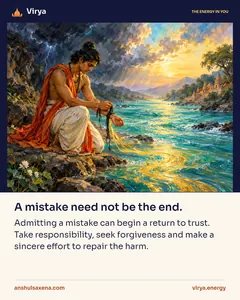
A mistake need not be the end

Painting for A mistake need not be the end
A mistake need not be the end. Honesty can open a path back.
A prayer admits human failure. The speaker tells Varuna, a god associated with sacred order, that people make mistakes. Rather than hide, the speaker asks for mercy, protection and release from binding cords. The prayer holds wrongdoing and the hope of restoration together.
Leave room for return. Admit imperfection. The speaker begins by acknowledging failure. Ask for mercy. The wish is to be restored, rather than abandoned. Allow repair. In daily life, an honest response can begin a better pattern.
Ivory Virya card, a reflection for today. When you get something wrong… Say clearly what you did. Ask what repair would be useful. Follow through without demanding instant forgiveness.
Indigo Virya closing card. Let honesty make repair possible. Reflection question: What would a sincere attempt to make things right look like?
Read as text

The speaker tells Varuna, a god associated with sacred order, that people make mistakes. Rather than hide, the speaker asks for mercy, protection and release from binding cords.

A reflection for today: The prayer holds wrongdoing and the hope of restoration together.

What would a sincere attempt to make things right look like?

Rigveda

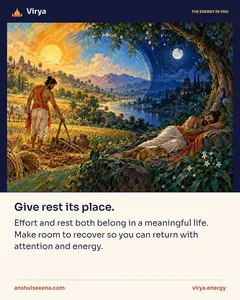
Give rest its place

Painting for Give rest its place
Give rest its place. Life has a rhythm beyond constant effort.
Night is welcomed too. The hymn calls on Savitr, the divine power that sets life in motion, and also welcomes night as a time of rest. Activity and rest both belong within its sacred picture of the day. A meaningful rhythm makes room for both effort and renewal.
Notice the turning of the day. Welcome activity. The hymn praises the power that awakens and moves life. Welcome rest. Its opening also honors the night that gives creatures repose. Create a transition. A clear ending can help you leave one part of the day behind.
Ivory Virya card, a reflection for today. At the end of a busy day… Choose a point to finish ordinary work. Write down what can wait until tomorrow. Spend a quiet moment letting the day settle.
Indigo Virya closing card. Rest belongs in the rhythm. Reflection question: What helps you recognize that today’s work can end?
Read as text

The hymn calls on Savitr, the divine power that sets life in motion, and also welcomes night as a time of rest. Activity and rest both belong within its sacred picture of the day.

A reflection for today: A meaningful rhythm makes room for both effort and renewal.

What helps you recognize that today’s work can end?

Rigveda

Meet the new day

Painting for Meet the new day
Meet the new day. Dawn invites life back into motion.
Ushas awakens the world. Ushas, the goddess of dawn, brings light and stirs people and birds into activity. Her arrival offers a fresh opening, even as each dawn marks the passing of time. A new day is both an opportunity and a reminder that time moves on.
Make the opening count. Notice renewal. Familiar light returns to a changing world. Respect passing time. The hymn also describes dawn as aging living beings. Begin something useful. A fresh start becomes real through a small action.
Ivory Virya card, a reflection for today. When the day begins… Notice something outside before reaching for a screen. Choose one task that deserves your attention. Start with a step small enough to take now.
Indigo Virya closing card. Greet the light. Begin with care. Reflection question: What would make this day meaningfully different from yesterday?
Read as text

Ushas, the goddess of dawn, brings light and stirs people and birds into activity. Her arrival offers a fresh opening, even as each dawn marks the passing of time.

A reflection for today: A new day is both an opportunity and a reminder that time moves on.

What would make this day meaningfully different from yesterday?

Rigveda

Choose what you take in

Painting for Choose what you take in
Choose what you take in. What we hear and see becomes part of our day.
A wish for wholesome experience. The worshipers ask to hear what is good, see what is good and live their allotted lives with strong bodies. The verse joins attention, gratitude and the wish for a full life. Let your attention make room for what is truthful and life-giving.
Be thoughtful about attention. Listen well. Give time to words that deepen understanding. Look with care. Notice kindness and beauty alongside what needs changing. Stay engaged. Seeking what is good need not mean ignoring difficult facts.
Ivory Virya card, a reflection for today. Review what fills your attention. Notice how a regular source of content affects you. Make room for something that teaches or encourages care. Check important claims before passing them on.
Indigo Virya closing card. Your attention is worth caring for. Reflection question: What deserves more space in what you hear and see?
Read as text

The worshipers ask to hear what is good, see what is good and live their allotted lives with strong bodies. The verse joins attention, gratitude and the wish for a full life.

A reflection for today: Let your attention make room for what is truthful and life-giving.

What deserves more space in what you hear and see?

Rigveda

Wish well for the whole world

Painting for Wish well for the whole world
Wish well for the whole world. Our well-being rests on more than ourselves.
A prayer full of sweetness. The hymn asks that winds, rivers, plants, night, dawn, the sun and cattle be sweet or beneficial. Its blessing reaches across the many things that sustain a household and its world. Gratitude becomes wider when we notice what life depends on.
See the web of support. Look beyond yourself. Air, water, light and food surround the prayer. Notice ordinary gifts. What is familiar can still deserve appreciation. Turn thanks into care. A modern response is to protect what supports shared life.
Ivory Virya card, a reflection for today. Begin with one ordinary meal. Notice the water, land and work behind it. Take what you can use without needless waste. Thank someone whose contribution is easy to overlook.
Indigo Virya closing card. Gratitude grows when we look wider. Reflection question: What supports your life so quietly that you rarely notice it?
Read as text

The hymn asks that winds, rivers, plants, night, dawn, the sun and cattle be sweet or beneficial. Its blessing reaches across the many things that sustain a household and its world.

A reflection for today: Gratitude becomes wider when we notice what life depends on.

What supports your life so quietly that you rarely notice it?

Rigveda

Help must reach the person

Painting for Help must reach the person
Help must reach the person. Concern becomes meaningful when support arrives.
The Ashvins rescue Bhujyu. The Ashvins, divine twins praised for rescue and healing, bring Bhujyu to safety when he is stranded at sea. The hymn remembers help reaching someone who has no firm place to stand. The story invites us to notice vulnerability and make support practical.
Move from concern to support. Recognize the need. Bhujyu is beyond ordinary safety and support. Make help concrete. The rescue is remembered through the means that carry him home. Respect your limits. In daily life, useful help may mean contacting someone equipped to act.
Ivory Virya card, a reflection for today. When someone is overwhelmed… Ask what would make the next step easier. Offer a specific task you can actually do. Help them reach appropriate support when the need exceeds your ability.
Indigo Virya closing card. Care becomes real when it arrives. Reflection question: What practical help could you offer someone this week?
Read as text

The Ashvins, divine twins praised for rescue and healing, bring Bhujyu to safety when he is stranded at sea. The hymn remembers help reaching someone who has no firm place to stand.

A reflection for today: The story invites us to notice vulnerability and make support practical.

What practical help could you offer someone this week?

Rigveda

Pause before you react

Painting for Pause before you react
Pause before you react. There is value in noticing an experience.
Two birds share one tree. The verse pictures two companion birds on the same tree: one eats the sweet fruit, while the other watches. A traditional reading sees them as the individual self and the supreme self. As a reflection for daily life, the image invites a pause between experience and response.
Make room for observation. Notice the experience. Pleasure, frustration and desire can quickly draw us in. Observe the impulse. Recognize what you feel before choosing what to do. Respond deliberately. A pause can help you act with greater care.
Ivory Virya card, a reflection for today. Before an impulsive reply… Name the feeling without sending the message. Read the other person’s words again. Choose a response you can stand by later.
Indigo Virya closing card. Notice first. Respond with care. Reflection question: What becomes clearer when you watch your reaction for a moment?
Read as text

The verse pictures two companion birds on the same tree: one eats the sweet fruit, while the other watches. A traditional reading sees them as the individual self and the supreme self.

A reflection for today: As a reflection for daily life, the image invites a pause between experience and response.

What becomes clearer when you watch your reaction for a moment?

Rigveda

Many names. A deeper unity

Painting for Many names. A deeper unity
Many names. A deeper unity. A familiar name may not exhaust what it points to.
The sacred receives many names. The verse speaks of one reality that wise people name in different ways, including Indra, Mitra, Varuna and Agni. The many divine names are placed beside an underlying unity. Different names can invite deeper inquiry rather than immediate dismissal.
Let language open understanding. Look beyond the label. A name points toward something; it does not explain everything. Ask what is meant. The same word can carry different meanings for different people. Listen respectfully. Understanding does not require pretending every belief is identical.
Ivory Virya card, a reflection for today. When someone uses unfamiliar language… Ask what the word means to them. Listen for the experience or belief behind it. Explain your own view without belittling theirs.
Indigo Virya closing card. Let curiosity go beyond the name. Reflection question: Which unfamiliar idea could you approach with a better question?
Read as text

The verse speaks of one reality that wise people name in different ways, including Indra, Mitra, Varuna and Agni. The many divine names are placed beside an underlying unity.

A reflection for today: Different names can invite deeper inquiry rather than immediate dismissal.

Which unfamiliar idea could you approach with a better question?

Rigveda

Let strength support life

Painting for Let strength support life
Let strength support life. Ability matters through what it makes possible.
Indra is known through his deeds. The hymn praises Indra for steadying the earth, releasing waters and aiding worshipers, including the poor and weak. It describes divine power through actions that sustain and protect. A useful reflection is to judge strength by the help it provides.
Ask what your ability serves. Notice the effect. The hymn connects power with visible deeds. See who needs support. The weak and the needy are included in its praise. Use your advantage well. Skill or influence can remove an obstacle for someone else.
Ivory Virya card, a reflection for today. Put an ability to work. Name one skill or resource you can share. Find a real need rather than assuming one. Offer help that leaves the other person with more agency.
Indigo Virya closing card. Strong enough to be useful. Reflection question: Who could benefit from something you already know how to do?
Read as text

The hymn praises Indra for steadying the earth, releasing waters and aiding worshipers, including the poor and weak. It describes divine power through actions that sustain and protect.

A reflection for today: A useful reflection is to judge strength by the help it provides.

Who could benefit from something you already know how to do?

Rigveda

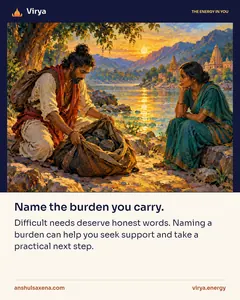
Name the burden you carry

Painting for Name the burden you carry
Name the burden you carry. A prayer can begin with an honest need.
The speaker asks for release. In a prayer to Varuna, the speaker asks to be freed from wrongdoing, fear and debts, including those inherited from earlier generations. The wish is for enough to live without humiliating dependence. The hymn gives difficult needs a voice.
Bring the need into words. Be specific. Fear, debt and a lack of basic means are named directly. Recognize the weight. Not every burden began with the person carrying it. Reach for support. An honest conversation can reveal a possible next step.
Ivory Virya card, a reflection for today. When a burden feels hard to explain… Describe the immediate difficulty in a sentence. Separate what you can act on from what you cannot control. Speak with someone who can offer practical, relevant help.
Indigo Virya closing card. You can begin by naming the need. Reflection question: What have you been carrying without putting it into words?
Read as text

In a prayer to Varuna, the speaker asks to be freed from wrongdoing, fear and debts, including those inherited from earlier generations. The wish is for enough to live without humiliating dependence.

A reflection for today: The hymn gives difficult needs a voice.

What have you been carrying without putting it into words?

Rigveda

Listen before you move forward

Painting for Listen before you move forward
Listen before you move forward. A request begins with recognizing what stands before you.
A poet speaks with rivers. Vishvamitra asks two rivers to lower their flow so his people and their wagons can cross. The rivers answer, hear his request and make way in a poetic exchange. The scene invites a thoughtful approach to obstacles and relationships.
Begin with understanding. Recognize another power. The rivers have their own motion and purpose. Explain the need. The poet asks for a specific passage across. Remember the help. After crossing, he praises the rivers and wishes them abundance.
Ivory Virya card, a reflection for today. Before asking someone to change plans… Understand what they are responsible for. Explain what you need and why it matters. Acknowledge the effort if they make room for you.
Indigo Virya closing card. A good request begins by listening. Reflection question: Have you understood the other person’s situation before asking?
Read as text

Vishvamitra asks two rivers to lower their flow so his people and their wagons can cross. The rivers answer, hear his request and make way in a poetic exchange.

A reflection for today: The scene invites a thoughtful approach to obstacles and relationships.

Have you understood the other person’s situation before asking?

Rigveda

Be someone others can rely on

Painting for Be someone others can rely on
Be someone others can rely on. Trust grows through dependable care.
Mitra sustains an ordered world. Mitra is praised as a deity who watches over people, sets them to their work and supports earth and heaven. The hymn seeks his protection, friendship and nourishment. A daily-life reflection: reliability helps a shared world hold together.
Give trust something to rest on. Look beyond a kind word. The hymn praises ongoing support and protection. Show up consistently. Reliability becomes visible through repeated actions. Make commitments clear. Others can plan when they know what to expect from you.
Ivory Virya card, a reflection for today. When you make a promise… Say clearly what you can do. Let the person know early if circumstances change. Complete the task or agree on a realiztic repair.
Indigo Virya closing card. Trust grows through follow-through. Reflection question: Which small commitment would matter most if you kept it well?
Read as text

Mitra is praised as a deity who watches over people, sets them to their work and supports earth and heaven. The hymn seeks his protection, friendship and nourishment.

A reflection for today: A daily-life reflection: reliability helps a shared world hold together.

Which small commitment would matter most if you kept it well?

Rigveda

Ask for clearer understanding

Painting for Ask for clearer understanding
Ask for clearer understanding. A bright mind needs a worthy direction.
A prayer turns toward divine light. The verse honors the radiant splendor of Savitr and connects it with the inspiration of our understanding. It is the celebrated verse commonly called the Gayatri mantra. The focus is not only what we think, but what guides our thinking.
Make room for clarity. Begin with reverence. The verse directs attention toward divine radiance. Value understanding. The mind’s direction matters alongside its ability. Examine the motive. Clear thinking includes asking what an action is meant to serve.
Ivory Virya card, a reflection for today. Before an important choice… State the question you are trying to answer. Distinguish what you know from what you are assuming. Choose a response that fits your considered values.
Indigo Virya closing card. Seek the light that guides thought. Reflection question: What would help you see your next decision more clearly?
Read as text

The verse honors the radiant splendor of Savitr and connects it with the inspiration of our understanding. It is the celebrated verse commonly called the Gayatri mantra.

A reflection for today: The focus is not only what we think, but what guides our thinking.

What would help you see your next decision more clearly?

Rigveda

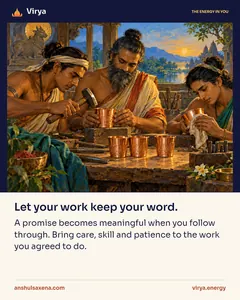
Let your work keep your word

Painting for Let your work keep your word
Let your work keep your word. Skill becomes trustworthy through careful execution.
The Rbhus fulfill a challenge. The Rbhus, celebrated divine craftspeople, make several cups from a single cup. The hymn praises them for doing what they said they would do and for the excellence of their work. A promise gains value when care and skill bring it into reality.
Give the work your attention. Understand the task. The hymn remembers a clear challenge and a response. Make skill visible. The finished work demonstrates the makers’ ability. Honor the commitment. Their words and actions agree.
Ivory Virya card, a reflection for today. Before calling a task finished… Check the result against what you promised. Fix a detail that would cause trouble for the next person. Hand it over with clear instructions if needed.
Indigo Virya closing card. Good work keeps its promise. Reflection question: What detail would make your work easier for someone else to trust?
Read as text

The Rbhus, celebrated divine craftspeople, make several cups from a single cup. The hymn praises them for doing what they said they would do and for the excellence of their work.

A reflection for today: A promise gains value when care and skill bring it into reality.

What detail would make your work easier for someone else to trust?

Rigveda

Honor the work behind your food

Painting for Honor the work behind your food
Honor the work behind your food. A harvest depends on a whole field of care.
A blessing for cultivation. The hymn asks for fertile fields, nourishing water, willing workers and well-being for the animals that pull the plow. It also honors the furrow, the line opened in the earth for planting. Food connects land, weather, effort and living beings.
Look beyond the finished meal. Remember the field. The prayer begins with the land that makes growth possible. Remember the workers. The well-being of those doing the work is part of the blessing. Remember the animals. The hymn also asks for ease in their labor.
Ivory Virya card, a reflection for today. Make gratitude for food practical. Learn something about where an ingredient comes from. Store and use food with care. Acknowledge the people who grow, prepare or serve it.
Indigo Virya closing card. A meal carries many contributions. Reflection question: Whose work becomes invisible once food reaches your plate?
Read as text

The hymn asks for fertile fields, nourishing water, willing workers and well-being for the animals that pull the plow. It also honors the furrow, the line opened in the earth for planting.

A reflection for today: Food connects land, weather, effort and living beings.

Whose work becomes invisible once food reaches your plate?

Rigveda

Choose a path that brings good

Painting for Choose a path that brings good
Choose a path that brings good. The way we travel matters, as well as the destination.
A wish to walk well. After asking many deities for well-being, the hymn imagines people moving on a good path as the sun and moon move on theirs. It also welcomes reunion with remembered companions. A worthwhile path includes both direction and good company.
Think about the way ahead. Consider the direction. Ask what kind of life repeated choices are creating. Value companionship. The prayer includes the people met along the way. Keep room for goodwill. A long separation need not erase a meaningful connection.
Ivory Virya card, a reflection for today. Review one direction in your life. Ask whether this path supports what you value. Notice who helps you travel it with care. Reconnect with someone whose company you miss.
Indigo Virya closing card. Walk with purpose. Keep good company. Reflection question: Who helps you move toward a life you respect?
Read as text

After asking many deities for well-being, the hymn imagines people moving on a good path as the sun and moon move on theirs. It also welcomes reunion with remembered companions.

A reflection for today: A worthwhile path includes both direction and good company.

Who helps you move toward a life you respect?

Rigveda

Be grateful. Stay respectful

Painting for Be grateful. Stay respectful
Be grateful. Stay respectful. What nourishes life can also be powerful.
Rain brings relief and awe. Parjanya, the rain deity, is praised for storms that make plants grow and give animals water. The hymn also recognizes their force and, after abundant rain, asks for it to stop. Reverence notices both the gift and the power of nature.
Hold gratitude with respect. See the nourishment. Rain renews plants, land and water supplies. Recognize the force. Thunder and storms inspire fear as well as praise. Notice when enough arrives. The closing prayer asks for the rain to cease.
Ivory Virya card, a reflection for today. When nature changes your plans… Notice what the weather makes possible for living things. Adjust your plans to the actual conditions. Treat shared water and green spaces with care.
Indigo Virya closing card. Nature deserves thanks and respect. Reflection question: What part of nature do you value only when it becomes scarce?
Read as text

Parjanya, the rain deity, is praised for storms that make plants grow and give animals water. The hymn also recognizes their force and, after abundant rain, asks for it to stop.

A reflection for today: Reverence notices both the gift and the power of nature.

What part of nature do you value only when it becomes scarce?

Rigveda

Care for the lives in your keeping

Painting for Care for the lives in your keeping
Care for the lives in your keeping. Receiving a benefit also creates a responsibility.
The hymn wishes cattle safety. Cattle are welcomed as a source of nourishment and household prosperity. The prayer asks that they be protected from theft and harm, with room to graze and clean water to drink. Care should include the conditions in which a living being spends its life.
Look at everyday well-being. See the living being. The animals are more than a source of useful goods. Attend to basic needs. Food, water and freedom from harm are named in the hymn. Make care consistent. Responsibility continues beyond the moment of receiving a benefit.
Ivory Virya card, a reflection for today. If an animal depends on you… Pay attention to its ordinary needs and behavior. Keep its living space and water clean. Seek suitable help when you cannot provide the care it needs.
Indigo Virya closing card. Responsibility includes daily care. Reflection question: What does the life in your keeping need from you today?
Read as text

Cattle are welcomed as a source of nourishment and household prosperity. The prayer asks that they be protected from theft and harm, with room to graze and clean water to drink.

A reflection for today: Care should include the conditions in which a living being spends its life.

What does the life in your keeping need from you today?

Rigveda

Ask someone who knows the way

Painting for Ask someone who knows the way
Ask someone who knows the way. Seeking guidance can be a form of good judgment.
Pushan helps people find what is lost. The hymn asks Pushan, a guiding and protective deity, to bring someone who knows the route and can locate missing cattle. It seeks safe movement and a return home. Not knowing the way is a reason to seek guidance, not to pretend certainty.
Make the next step clearer. Recognize the gap. The prayer openly asks for someone with useful knowledge. Choose relevant help. Experience with the actual problem matters. Keep the purpose in view. The goal is to find and protect what has been lost.
Ivory Virya card, a reflection for today. When you are unsure how to proceed… Write down exactly where you are stuck. Ask someone with experience of that situation. Check that you understand the next step before taking it.
Indigo Virya closing card. Good guidance can shorten confusion. Reflection question: Where would an informed question help more than another guess?
Read as text

The hymn asks Pushan, a guiding and protective deity, to bring someone who knows the route and can locate missing cattle. It seeks safe movement and a return home.

A reflection for today: Not knowing the way is a reason to seek guidance, not to pretend certainty.

Where would an informed question help more than another guess?

Rigveda

Respect what sustains you

Painting for Respect what sustains you
Respect what sustains you. A source of nourishment deserves more than casual use.
Sarasvati is a powerful river. This hymn praises Sarasvati as a mighty river and deity who nourishes and protects. Its closing prayer seeks her friendship and asks that her waters cause no harm. The river is approached as a presence with power, not simply a resource.
Let gratitude deepen respect. Notice the river itself. The hymn describes strong currents, waves and flowing water. Remember dependence. Nourishment is repeatedly sought from Sarasvati. Act with care. A modern response is to consider the effects of how we use water.
Ivory Virya card, a reflection for today. Think about the water near you. Learn which river, lake or other source supports your area. Avoid leaving litter near water or drains. Support a practical effort that cares for that shared place.
Indigo Virya closing card. Care for what carries life. Reflection question: What water source supports your daily life?
Read as text

This hymn praises Sarasvati as a mighty river and deity who nourishes and protects. Its closing prayer seeks her friendship and asks that her waters cause no harm.

A reflection for today: The river is approached as a presence with power, not simply a resource.

What water source supports your daily life?

Rigveda

Water connects our lives

Painting for Water connects our lives
Water connects our lives. What reaches your home belongs to a wider world.
Many waters receive one prayer. The hymn honors waters from the sky, flowing rivers, dug sources and natural springs. These waters are praised as divine, purifying and protective as they move toward the sea. Different sources participate in the shared gift of water.
Notice the connections. Recognize many sources. The hymn names water found in several places. Notice its movement. Water is described as flowing rather than standing apart. Treat access with care. Your daily supply depends on places and people beyond your home.
Ivory Virya card, a reflection for today. Make water less invisible. Notice where you use water most often. Address a wasteful habit you can change. Learn about the work that brings safe water to your community.
Indigo Virya closing card. A shared gift calls for shared care. Reflection question: What could help you treat water with greater attention?
Read as text

The hymn honors waters from the sky, flowing rivers, dug sources and natural springs. These waters are praised as divine, purifying and protective as they move toward the sea.

A reflection for today: Different sources participate in the shared gift of water.

What could help you treat water with greater attention?

Rigveda

Hold life with tenderness

Painting for Hold life with tenderness
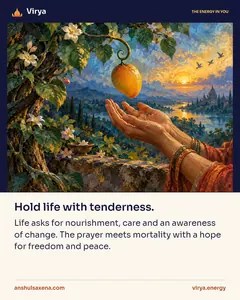
Hold life with tenderness. A prayer can give hope a voice in the face of mortality.
A wish for release from death. The worshipers praise Tryambaka, associated with Rudra, as fragrant and nourishing. They ask to be freed from death’s bond as a ripe fruit loosens from its stem, without losing immortality. The verse brings nourishment, mortality and the hope of freedom into one image.
Let the image invite care. Value nourishment. The deity is praised for helping life flourish. Acknowledge mortality. The prayer names the bond people long to escape. Keep hope gentle. A meaningful prayer need not become a demand for a guaranteed outcome.
Ivory Virya card, a reflection for today. When life feels especially precious… Give your full attention to someone you love. Say a needed word of affection or gratitude. Make room for prayer, reflection or quiet companionship.
Indigo Virya closing card. Let awareness of life deepen your care. Reflection question: What would you say or do if you treated today as precious?
Read as text

The worshipers praise Tryambaka, associated with Rudra, as fragrant and nourishing. They ask to be freed from death’s bond as a ripe fruit loosens from its stem, without losing immortality.

A reflection for today: The verse brings nourishment, mortality and the hope of freedom into one image.

What would you say or do if you treated today as precious?

Rigveda

Ask what needs to change

Painting for Ask what needs to change
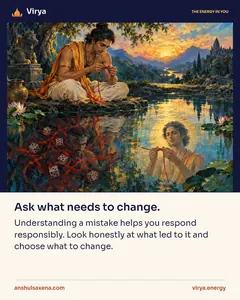
Ask what needs to change. A sincere apology begins with understanding the harm.
The speaker seeks to know the fault. The speaker asks Varuna what wrongdoing has damaged their relationship. The hymn recognizes influences such as anger, gambling and confusion, while seeking release and a return to devoted service. Understanding how you went wrong can help you respond more responsibly.
Move from regret to understanding. Ask a direct question. The speaker wants the offense made clear. Look at contributing causes. Habit, emotion and influence can shape an action. Choose a better response. Explaining a mistake can support repair without erasing responsibility.
Ivory Virya card, a reflection for today. After a difficult interaction… Ask what specifically caused hurt or difficulty. Notice the habit or pressure that shaped your response. Agree on one change you can actually sustain.
Indigo Virya closing card. Regret becomes useful when it changes action. Reflection question: What pattern deserves attention behind the apology?
Read as text

The speaker asks Varuna what wrongdoing has damaged their relationship. The hymn recognizes influences such as anger, gambling and confusion, while seeking release and a return to devoted service.

A reflection for today: Understanding how you went wrong can help you respond more responsibly.

What pattern deserves attention behind the apology?

Rigveda

Listen to life returning

Painting for Listen to life returning
Listen to life returning. An ordinary sound can reveal a change in the world.
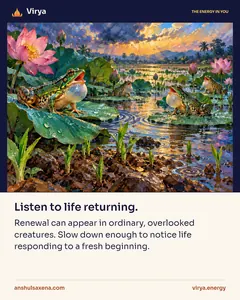
The frogs greet the rain. After a long dry season, frogs begin calling when the rains arrive. The hymn playfully compares their answering voices with pupils repeating a teacher and priests reciting together. The poem notices renewal in a creature many people overlook.
Pay attention to small signs. Notice the season. The return of rain changes what can be heard. Notice the variety. The frogs differ in color and voice. Keep a sense of wonder. Close observation gives an ordinary scene poetic depth.
Ivory Virya card, a reflection for today. On your next walk… Listen before deciding that a place is quiet. Notice one sign of the season changing. Share what you observed without disturbing the living things around you.
Indigo Virya closing card. Wonder often starts with paying attention. Reflection question: What small sign tells you that the season has changed?
Read as text

After a long dry season, frogs begin calling when the rains arrive. The hymn playfully compares their answering voices with pupils repeating a teacher and priests reciting together.

A reflection for today: The poem notices renewal in a creature many people overlook.

What small sign tells you that the season has changed?

Rigveda

Make room for many contributions

Painting for Make room for many contributions
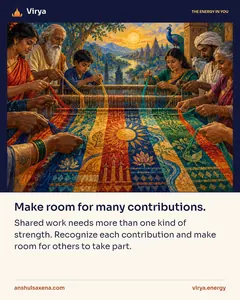
Make room for many contributions. A shared purpose can call on different strengths.
A prayer addresses the gods together. The hymn honors the gathered gods as great and asks them collectively for protection, kind speech and well-being. Its appeal is addressed to a company of divine powers. As a daily-life reflection, shared work benefits from recognizing more than one contributor.
Look around the whole group. Widen the attention. The prayer addresses the deities together. Recognize different strengths. In a team, useful contributions can take several forms. Share appreciation. Visible work is not the only work that deserves thanks.
Ivory Virya card, a reflection for today. After a group effort… Name the different tasks that made the result possible. Thank someone whose work stayed out of view. Invite a quieter contributor to explain their perspective.
Indigo Virya closing card. Shared work deserves shared thanks. Reflection question: Whose contribution is missing from the way you tell the story?
Read as text

The hymn honors the gathered gods as great and asks them collectively for protection, kind speech and well-being. Its appeal is addressed to a company of divine powers.

A reflection for today: As a daily-life reflection, shared work benefits from recognizing more than one contributor.

Whose contribution is missing from the way you tell the story?

Rigveda

Let joy deepen your gratitude

Painting for Let joy deepen your gratitude
Let joy deepen your gratitude. A moment of uplift can turn us toward what matters.
Soma is praised with wonder. In a ritual hymn, the worshipers praise Soma, a sacred drink and deity, with images of divine light and immortality. They ask for comfort, long life and protection from going astray. The hymn links exaltation with a wish for support and a well-directed life.
Consider what a joyful moment gives. Recognize the setting. This is praise within an ancient sacred ritual. Notice the relationship. Soma is compared with the comfort of a parent and a friend. Carry gratitude forward. A joyful experience can encourage a thoughtful action afterward.
Ivory Virya card, a reflection for today. After a moment of real joy… Pause long enough to appreciate it. Thank someone who helped make it possible. Let the feeling support an act of kindness.
Indigo Virya closing card. Let joy leave something generous behind. Reflection question: What has a joyful moment helped you appreciate more deeply?
Read as text

In a ritual hymn, the worshipers praise Soma, a sacred drink and deity, with images of divine light and immortality. They ask for comfort, long life and protection from going astray.

A reflection for today: The hymn links exaltation with a wish for support and a well-directed life.

What has a joyful moment helped you appreciate more deeply?

Rigveda

Offer what you can

Painting for Offer what you can
Offer what you can. Care does not need a display of wealth.
A worshiper brings a modest offering. The speaker tells Agni that they have no cow and no axe for cutting wood. They ask that the little wood they can bring be accepted with the value of a rich offering. Sincere participation can begin with the means you have.
Give within your capacity. Be honest about your means. The worshiper does not pretend to possess more. Offer something real. The small gift is still brought with devotion. Let care guide the scale. Meaning need not depend on making an impressive display.
Ivory Virya card, a reflection for today. When you want to contribute… Choose help that fits your time and resources. Offer it clearly and without show. Respect another person’s contribution even when it looks different.
Indigo Virya closing card. A modest offering can carry real care. Reflection question: What can you give sincerely with the means you have today?
Read as text

The speaker tells Agni that they have no cow and no axe for cutting wood. They ask that the little wood they can bring be accepted with the value of a rich offering.

A reflection for today: Sincere participation can begin with the means you have.

What can you give sincerely with the means you have today?

Rigveda

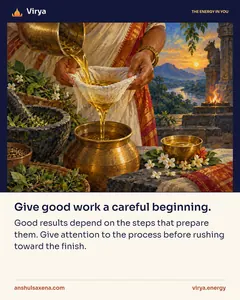
Give good work a careful beginning

Painting for Give good work a careful beginning
Give good work a careful beginning. What reaches the final stage depends on what came before.
The hymn follows Soma’s preparation. Soma is pressed, purified and prepared as an offering for Indra. The hymn notices the hands doing the work, the filtering and the mixing with milk as parts of a sacred process. For daily life, the image suggests care for the steps that precede a result.
Respect the preparation. Notice each stage. The offering takes shape through a sequence of actions. Remember the hands. The hymn draws attention to the fingers doing the work. Prepare with purpose. Care at the beginning can make a later task more dependable.
Ivory Virya card, a reflection for today. Before sharing something you made… Check the material you started with. Review the part most likely to cause confusion. Make the result clear enough for its intended use.
Indigo Virya closing card. Care at the start shapes what follows. Reflection question: Which preparation step would most improve the result you want?
Read as text

Soma is pressed, purified and prepared as an offering for Indra. The hymn notices the hands doing the work, the filtering and the mixing with milk as parts of a sacred process.

A reflection for today: For daily life, the image suggests care for the steps that precede a result.

Which preparation step would most improve the result you want?

Rigveda

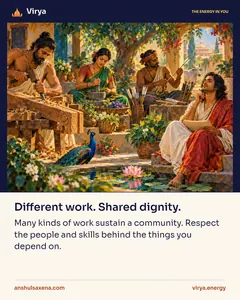
Different work. Shared dignity

Painting for Different work. Shared dignity
Different work. Shared dignity. People can contribute through very different skills.
The poet notices many occupations. The hymn describes a carpenter, a healer, a maker of arrows and a poet, each seeking a livelihood through different work. It also pictures varied occupations within a single household. The passage invites attention to the variety of work that sustains life.
Look beyond one measure of success. Notice different abilities. The workers need different kinds of knowledge and skill. Recognize livelihood. Each person seeks the means to support life. Offer equal respect. Today, we can value useful work without ranking people’s worth by status.
Ivory Virya card, a reflection for today. Notice an often-overlooked worker. Learn what their task actually involves. Acknowledge the skill or effort it requires. Treat them with the courtesy you would offer anyone else.
Indigo Virya closing card. Respect the person behind the work. Reflection question: Which kind of work have you underestimated because it is familiar?
Read as text

The hymn describes a carpenter, a healer, a maker of arrows and a poet, each seeking a livelihood through different work. It also pictures varied occupations within a single household.

A reflection for today: The passage invites attention to the variety of work that sustains life.

Which kind of work have you underestimated because it is familiar?

Rigveda

When the thrill takes too much

Painting for When the thrill takes too much
When the thrill takes too much. A moment of excitement can carry a lasting cost.
A gambler describes his losses. The speaker is drawn back to the dice even after deciding to stop, while his household and relationships suffer. The hymn urges him to leave the dice and value the livelihood of farming. The poem shows a pleasure becoming something that rules a life.
Look beyond the next win. Hear the conflict. The speaker knows the damage yet feels the pull to return. Count the wider cost. The losses reach beyond money into trust and family life. Value steady support. The hymn turns toward ordinary work and a sustainable household.
Ivory Virya card, a reflection for today. When an excitement is taking over… Name what it is costing you in time, trust or attention. Tell someone you trust what is happening. Make space for help and for activities that support ordinary life.
Indigo Virya closing card. The next thrill is not the whole life. Reflection question: What cost becomes visible when you look beyond the immediate excitement?
Read as text

The speaker is drawn back to the dice even after deciding to stop, while his household and relationships suffer. The hymn urges him to leave the dice and value the livelihood of farming.

A reflection for today: The poem shows a pleasure becoming something that rules a life.

What cost becomes visible when you look beyond the immediate excitement?

Rigveda

Give your words some thought

Painting for Give your words some thought
Give your words some thought. Hearing words and understanding them are different things.
Speech is compared with sifted grain. The hymn describes thoughtful people refining speech as grain is sifted. It also says that someone may hear words without truly understanding them, and connects meaningful speech with companionship. Clear words and attentive listening belong together.
Let meaning matter. Consider before speaking. The grain image suggests care in shaping what is said. Check understanding. Sound alone does not guarantee that meaning has reached someone. Protect the relationship. The hymn treats abandoning a companion as a serious failure.
Ivory Virya card, a reflection for today. Before a difficult conversation… Decide what you actually need to communicate. Use a concrete example instead of a broad accusation. Ask the other person what they understood.
Indigo Virya closing card. Speak with care. Listen for meaning. Reflection question: What would change if being understood mattered more than sounding right?
Read as text

The hymn describes thoughtful people refining speech as grain is sifted. It also says that someone may hear words without truly understanding them, and connects meaningful speech with companionship.

A reflection for today: Clear words and attentive listening belong together.

What would change if being understood mattered more than sounding right?

Rigveda

Build a life you can share

Painting for Build a life you can share
Build a life you can share. Lasting companionship is more than a single ceremony.
A wedding hymn looks toward old age. The marriage verses speak of taking a hand for good fortune, growing old together and having hearts joined. They imagine the household as a place of shared life across time. A contemporary reflection is to make companionship visible in daily care.
Look beyond the celebration. Think in years. The wish reaches toward a whole life together. Value the shared home. The hymn imagines ordinary life beyond the wedding. Keep understanding alive. A bond needs attention as the people within it change.
Ivory Virya card, a reflection for today. Care for a close partnership. Ask what would make the other person’s week easier. Discuss an ordinary responsibility fairly. Make time to listen without immediately trying to solve everything.
Indigo Virya closing card. Companionship grows through daily care. Reflection question: What small act would make a shared life feel more considerate?
Read as text

The marriage verses speak of taking a hand for good fortune, growing old together and having hearts joined. They imagine the household as a place of shared life across time.

A reflection for today: A contemporary reflection is to make companionship visible in daily care.

What small act would make a shared life feel more considerate?

Rigveda

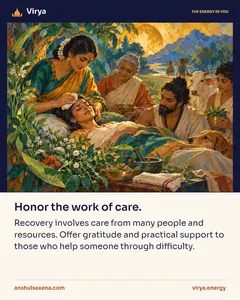
Honor the work of care

Painting for Honor the work of care
Honor the work of care. The wish to ease suffering deserves attention.
Plants and healers receive praise. The hymn addresses healing plants as mothers and asks them to work together for a suffering person. It also recognizes the healer who gathers and uses them in the hope of recovery. The passage gives voice to gratitude for those involved in care.
Notice what care requires. See the person in need. The repeated wish is for suffering to be relieved. Recognize many contributions. Plants, the healer and the surrounding community appear in the hymn. Express appreciation. Practical support can honor the effort of caring for someone.
Ivory Virya card, a reflection for today. Support someone who is caring for others. Ask which ordinary task would lighten their day. Offer practical help you can reliably provide. Thank them for a specific act of care.
Indigo Virya closing card. Care deserves care in return. Reflection question: Who is caring for others while receiving too little support?
Read as text

The hymn addresses healing plants as mothers and asks them to work together for a suffering person. It also recognizes the healer who gathers and uses them in the hope of recovery.

A reflection for today: The passage gives voice to gratitude for those involved in care.

Who is caring for others while receiving too little support?

Rigveda

Let your table make room

Painting for Let your table make room
Let your table make room. Having enough creates an opportunity to share.
The hymn challenges a closed hand. A person with food is urged to feed someone who is hungry. The hymn criticizes refusing help even to a companion and reminds listeners that wealth moves from one person to another. Generosity responds to an actual need rather than merely praising kindness.
Make sharing practical. Notice the person before you. Hunger is treated as a need calling for a response. Use what you have. The appeal is directed to someone able to give. Remember change. The image of a turning wheel recalls that circumstances do not stay fixed.
Ivory Virya card, a reflection for today. Make one act of sharing useful. Ask what is needed instead of choosing for appearances. Give within your means through a reliable person or effort. Preserve the dignity and privacy of the person receiving help.
Indigo Virya closing card. Enough can become something shared. Reflection question: Where could a small, useful act of generosity matter today?
Read as text

A person with food is urged to feed someone who is hungry. The hymn criticizes refusing help even to a companion and reminds listeners that wealth moves from one person to another.

A reflection for today: Generosity responds to an actual need rather than merely praising kindness.

Where could a small, useful act of generosity matter today?

Rigveda

A divine voice fills the world

Painting for A divine voice fills the world
A divine voice fills the world. Power and wisdom speak in a feminine voice.
The goddess speaks for herself. Vac, divine Speech, declares that she moves with the gods and supports seeing, breathing, eating and hearing. Her voice describes a presence that reaches across earth and heaven. The hymn presents feminine divinity as active, wise and powerful.
Listen to the scale of the voice. Notice who speaks. The goddess describes her own power in the first person. Notice what she sustains. Ordinary life and divine activity both enter her account. Let recognition shape conduct. A reflection for today is to make room for voices too often overlooked.
Ivory Virya card, a reflection for today. Consider whose ideas receive attention. Notice who is interrupted or passed over in a discussion. Create room for them to finish their thought. Credit an idea to the person who offered it.
Indigo Virya closing card. Wisdom deserves room to speak. Reflection question: Whose voice would enrich a conversation if it were fully heard?
Read as text

Vac, divine Speech, declares that she moves with the gods and supports seeing, breathing, eating and hearing. Her voice describes a presence that reaches across earth and heaven.

A reflection for today: The hymn presents feminine divinity as active, wise and powerful.

Whose voice would enrich a conversation if it were fully heard?

Rigveda

Leave room for wonder

Painting for Leave room for wonder
Leave room for wonder. A deep question does not always end in certainty.
The creation hymn keeps asking. The hymn explores what could have existed before the familiar world, before day and night. It ends by asking who truly knows how creation arose, even leaving the highest observer’s knowledge uncertain. Wonder can include the honesty of not knowing.
Keep inquiry open. Ask beyond the familiar. The poem questions the categories we usually take for granted. Notice the limits. It asks how anyone could know the first beginning. Remain curious. An unanswered question can still deepen attention and thought.
Ivory Virya card, a reflection for today. When a question has no easy answer… Separate what is known from what is imagined. Explore more than one thoughtful explanation. Allow yourself to say that you do not yet know.
Indigo Virya closing card. Uncertainty can keep wonder alive. Reflection question: Which question would you like to explore without rushing to a conclusion?
Read as text

The hymn explores what could have existed before the familiar world, before day and night. It ends by asking who truly knows how creation arose, even leaving the highest observer’s knowledge uncertain.

A reflection for today: Wonder can include the honesty of not knowing.

Which question would you like to explore without rushing to a conclusion?

Rigveda

A forest is already a home

Painting for A forest is already a home
A forest is already a home. A place can be full of life without being built by us.
The forest is heard and praised. The hymn listens to the forest’s strange sounds and praises Aranyani, the forest presence, as a mother of wild creatures. It notices food and fragrance growing where no farmer works. The forest has life and value beyond human plans for it.
Look with the care of a visitor. Listen before judging. Sounds reveal activity that may be hidden from view. Notice lives beyond your own. The forest is praised as a home for creatures. Visit considerately. A contemporary response is to avoid disturbing what already belongs there.
Ivory Virya card, a reflection for today. When you visit a green space… Observe quietly before moving through it. Leave plants, nests and wild creatures undisturbed. Take your litter away and respect the place’s access rules.
Indigo Virya closing card. Enter with wonder. Leave with care. Reflection question: What changes when you see a landscape as someone else’s home?
Read as text

The hymn listens to the forest’s strange sounds and praises Aranyani, the forest presence, as a mother of wild creatures. It notices food and fragrance growing where no farmer works.

A reflection for today: The forest has life and value beyond human plans for it.

What changes when you see a landscape as someone else’s home?

Rigveda

Let faith take a daily form

Painting for Let faith take a daily form
Let faith take a daily form. Commitment becomes visible through practice.
Shraddha is invoked throughout the day. The hymn connects shraddha, faith or trusting commitment, with kindling the fire and making an offering. It calls on this quality in the morning, at midday and at sunset. What we trust can be expressed through repeated acts of care and devotion.
Give commitment a form. Notice the action. Faith is linked with lighting and offering. Return through the day. The hymn invokes it at more than one moment. Keep the practice meaningful. A repeated act works best when attention remains present.
Ivory Virya card, a reflection for today. Choose a commitment you want to live. Name the belief or value behind it. Give it a small, regular expression. Pause to remember why the practice matters to you.
Indigo Virya closing card. Commitment becomes visible in practice. Reflection question: What regular action expresses something you deeply believe?
Read as text

The hymn connects shraddha, faith or trusting commitment, with kindling the fire and making an offering. It calls on this quality in the morning, at midday and at sunset.

A reflection for today: What we trust can be expressed through repeated acts of care and devotion.

What regular action expresses something you deeply believe?

Rigveda

Find a purpose you can share

Painting for Find a purpose you can share
Find a purpose you can share. Working together begins with understanding one another.
The closing hymn calls for concord. The hymn asks the gathered people to come together, speak together and share understanding. It wishes for their intentions and hearts to be in harmony within a common gathering. Shared purpose grows when people give it words and attention.
Build agreement with care. Come together. A shared task begins with making room for one another. Speak and listen. Understanding cannot be assumed simply because people are present. Agree on the purpose. A common direction can guide what happens next.
Ivory Virya card, a reflection for today. Before a group begins work… Invite each person to say what matters to them. Write a purpose everyone can understand. Agree on the next action and who will take it.
Indigo Virya closing card. Move together with understanding. Reflection question: What shared purpose could bring this group into better alignment?
Read as text

The hymn asks the gathered people to come together, speak together and share understanding. It wishes for their intentions and hearts to be in harmony within a common gathering.

A reflection for today: Shared purpose grows when people give it words and attention.

What shared purpose could bring this group into better alignment?