














90 posts · 630 cards

Upanishads उपनिषद्

Thirteen Upanishads, from the Isha to the Maitri: an excerpt, its meaning and a practice for each idea.

Upanishads

Begin with the underlying Self

Aitareya Upanishad

Begin with the underlying Self, card 1 of 7
Begin with the underlying Self, card 2 of 7
Begin with the underlying Self, card 3 of 7
Begin with the underlying Self, card 4 of 7
Begin with the underlying Self, card 5 of 7
Begin with the underlying Self, card 6 of 7
Begin with the underlying Self, card 7 of 7
Read as text

Begin with the underlying Self

The text begins with the Self alone and unfolds a story of worlds, powers, and embodied life. In the Advaita commentary, this imagery guides the reader toward the unity underlying apparent multiplicity.

In everyday life: Looking only at separate objects can hide their relationships. This teaching invites a deeper inquiry into what our ordinary descriptions take for granted.

Try this: Choose a familiar object. Notice the materials, relationships, and experience through which it becomes meaningful to you.

What do you assume is separate before you have examined it?

Virya, The Energy in You

Upanishads

The body is pictured within a larger world

Aitareya Upanishad

The body is pictured within a larger world, card 1 of 7
The body is pictured within a larger world, card 2 of 7
The body is pictured within a larger world, card 3 of 7
The body is pictured within a larger world, card 4 of 7
The body is pictured within a larger world, card 5 of 7
The body is pictured within a larger world, card 6 of 7
The body is pictured within a larger world, card 7 of 7
Read as text

The creation passage connects sight with the sun, speech with fire, and other faculties with corresponding powers of the world. The person is presented within a meaningful whole rather than in isolation.

In everyday life: We experience life through our bodies and environments together. Paying attention to surroundings can reveal conditions that help or hinder how we learn and relate.

Try this: Notice how light, sound, and space affect one ordinary activity. Make one considerate adjustment for yourself or another person.

How does your environment participate in what you experience?

Virya, The Energy in You

Upanishads

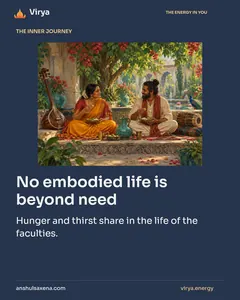
No embodied life is beyond need

Aitareya Upanishad

No embodied life is beyond need, card 1 of 7
No embodied life is beyond need, card 2 of 7
No embodied life is beyond need, card 3 of 7
No embodied life is beyond need, card 4 of 7
No embodied life is beyond need, card 5 of 7
No embodied life is beyond need, card 6 of 7
No embodied life is beyond need, card 7 of 7
Read as text

In the story, hunger and thirst ask for a place and are made sharers with the powers of the body. Even remarkable abilities remain situated within a life that needs nourishment.

In everyday life: People cannot be understood only through output or achievement. Care for basic needs belongs within education, work, and community life.

Try this: Notice one setting where results are praised but people's needs are overlooked. Consider a practical improvement within your reach.

Whose needs disappear when you focus only on what they produce?

Virya, The Energy in You

Upanishads

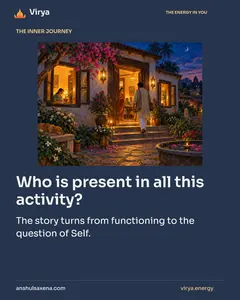
Who is present in all this activity?

Aitareya Upanishad

Who is present in all this activity?, card 1 of 7
Who is present in all this activity?, card 2 of 7
Who is present in all this activity?, card 3 of 7
Who is present in all this activity?, card 4 of 7
Who is present in all this activity?, card 5 of 7
Who is present in all this activity?, card 6 of 7
Who is present in all this activity?, card 7 of 7
Read as text

After the faculties and their activities have been described, the narrative asks how this could be without the Self. The image of entry into the body leads toward inquiry into the one who experiences.

In everyday life: A list of abilities does not exhaust the question of who we are. Seeing, speaking, and thinking can become starting points for reflection rather than complete definitions.

Try this: Notice yourself hearing, remembering, and deciding. Ask what you mean by the same I across these different activities.

What connects the many activities you call your experience?

Virya, The Energy in You

Upanishads

Care for the one who gives care

Aitareya Upanishad

Care for the one who gives care, card 1 of 7
Care for the one who gives care, card 2 of 7
Care for the one who gives care, card 3 of 7
Care for the one who gives care, card 4 of 7
Care for the one who gives care, card 5 of 7
Care for the one who gives care, card 6 of 7
Care for the one who gives care, card 7 of 7
Read as text

The passage describes a mother nourishing new life and says that she, as nourisher, must herself be nourished. Within its wider account of birth and continuity, care creates responsibilities for others.

In everyday life: Caregivers can become invisible when attention goes only to the person receiving care. Families and communities need to support those whose work sustains others.

Try this: Offer a caregiver a specific useful form of help, such as a meal, an errand, or time to rest.

Who supports the person everyone else depends on?

Virya, The Energy in You

Upanishads

Consciousness is Brahman

Aitareya Upanishad

Consciousness is Brahman, card 1 of 7
Consciousness is Brahman, card 2 of 7
Consciousness is Brahman, card 3 of 7
Consciousness is Brahman, card 4 of 7
Consciousness is Brahman, card 5 of 7
Consciousness is Brahman, card 6 of 7
Consciousness is Brahman, card 7 of 7
Read as text

The text connects the many functions of knowing with consciousness and declares consciousness to be Brahman. In the Advaita reading, this concerns the underlying reality of awareness, not the superiority of an individual intellect.

In everyday life: A person's dignity should not depend on speed, qualifications, or performance. The teaching invites a view deeper than the abilities by which society often ranks people.

Try this: Meet one person with full attention before deciding what they can do for you or how they compare with others.

What changes when you look beyond performance to the person before you?

Virya, The Energy in You

Upanishads

Move toward clearer seeing

Brihadaranyaka Upanishad

Move toward clearer seeing, card 1 of 7
Move toward clearer seeing, card 2 of 7
Move toward clearer seeing, card 3 of 7
Move toward clearer seeing, card 4 of 7
Move toward clearer seeing, card 5 of 7
Move toward clearer seeing, card 6 of 7
Move toward clearer seeing, card 7 of 7
Read as text

Move toward clearer seeing

The prayer asks for a passage from darkness to light, alongside movement from the unreal to the real and from death to immortality. It expresses a longing for liberating understanding.

In everyday life: When a claim feels comforting, ask whether it is also true. Learning can begin by allowing evidence or honest conversation to challenge an assumption you wanted to keep.

Try this: Choose one belief you repeat often. Look for the strongest reason that could make you revise it.

What would you be willing to see more honestly?

Virya, The Energy in You

Upanishads

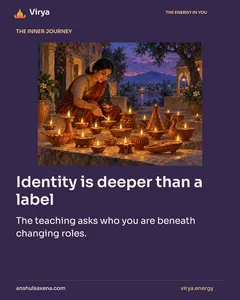
Identity is deeper than a label

Brihadaranyaka Upanishad

Identity is deeper than a label, card 1 of 7
Identity is deeper than a label, card 2 of 7
Identity is deeper than a label, card 3 of 7
Identity is deeper than a label, card 4 of 7
Identity is deeper than a label, card 5 of 7
Identity is deeper than a label, card 6 of 7
Identity is deeper than a label, card 7 of 7
Read as text

The Self is recognized as Brahman, the reality underlying existence. In the Advaita reading of this tradition, this is a discovery about the deepest Self, not a claim that the individual ego is superior to others.

In everyday life: Job titles, success, age, and other labels change. Treating them as your entire identity can narrow how you see yourself and how you value other people.

Try this: Describe yourself without using your occupation, possessions, achievements, or social status.

Which label has become too small for the way you understand yourself?

Virya, The Energy in You

Upanishads

Do not mistake a description for the whole

Brihadaranyaka Upanishad

Do not mistake a description for the whole, card 1 of 7
Do not mistake a description for the whole, card 2 of 7
Do not mistake a description for the whole, card 3 of 7
Do not mistake a description for the whole, card 4 of 7
Do not mistake a description for the whole, card 5 of 7
Do not mistake a description for the whole, card 6 of 7
Do not mistake a description for the whole, card 7 of 7
Read as text

Not this, not this withdraws the claim that any finite description fully captures Brahman. The teaching loosens attachment to limited forms and concepts without reducing reality to nothing.

In everyday life: A personality label, diagnosis, statistic, or online profile can convey something important without exhausting a person. Use categories carefully and remain open to what they leave out.

Try this: Take one label you use for someone. Add three details that make that label incomplete.

What useful description have you started treating as the complete truth?

Virya, The Energy in You

Upanishads

Ask what makes life deeply worthwhile

Brihadaranyaka Upanishad

Ask what makes life deeply worthwhile, card 1 of 7
Ask what makes life deeply worthwhile, card 2 of 7
Ask what makes life deeply worthwhile, card 3 of 7
Ask what makes life deeply worthwhile, card 4 of 7
Ask what makes life deeply worthwhile, card 5 of 7
Ask what makes life deeply worthwhile, card 6 of 7
Ask what makes life deeply worthwhile, card 7 of 7
Read as text

When offered a share of property, Maitreyi asks whether wealth can bring immortality. Yajnavalkya says it cannot, and the conversation turns toward listening, reflection, and knowledge of the Self.

In everyday life: Financial security matters, but it cannot answer every question about meaning, love, or identity. Make space for relationships and inquiry alongside material plans.

Try this: Write one question about a good life that cannot be answered only by earning or owning more.

What important question keeps getting postponed until you have more?

Virya, The Energy in You

Upanishads

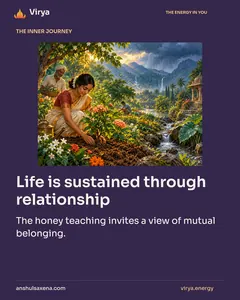
Life is sustained through relationship

Brihadaranyaka Upanishad

Life is sustained through relationship, card 1 of 7
Life is sustained through relationship, card 2 of 7
Life is sustained through relationship, card 3 of 7
Life is sustained through relationship, card 4 of 7
Life is sustained through relationship, card 5 of 7
Life is sustained through relationship, card 6 of 7
Life is sustained through relationship, card 7 of 7
Read as text

Earth is described as honey for living beings, and beings as honey for earth. The repeated image points beyond isolated things toward their shared Self and sustaining relationship.

In everyday life: Food, work, and daily comfort depend on many lives. Gratitude becomes more concrete when it changes how we treat workers, neighbors, land, and other living beings.

Try this: Name three relationships behind your next meal, then choose one way to care for one of them.

What do you receive each day that you rarely remember to acknowledge?

Virya, The Energy in You

Upanishads

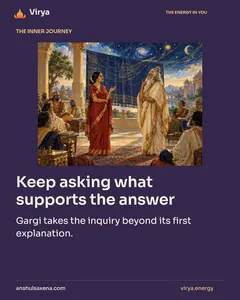
Keep asking what supports the answer

Brihadaranyaka Upanishad

Keep asking what supports the answer, card 1 of 7
Keep asking what supports the answer, card 2 of 7
Keep asking what supports the answer, card 3 of 7
Keep asking what supports the answer, card 4 of 7
Keep asking what supports the answer, card 5 of 7
Keep asking what supports the answer, card 6 of 7
Keep asking what supports the answer, card 7 of 7
Read as text

Gargi asks what the world, and then space itself, is woven upon. Yajnavalkya points to the imperishable, which cannot be captured by the ordinary properties of an object.

In everyday life: A confident explanation may still rest on assumptions. In study or public debate, asking about those assumptions can be more useful than simply repeating a conclusion.

Try this: When you hear a strong claim, ask what supports it and what that supporting claim depends on.

Which question would take a familiar explanation one level deeper?

Virya, The Energy in You

Upanishads

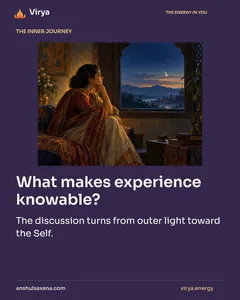
What makes experience knowable?

Brihadaranyaka Upanishad

What makes experience knowable?, card 1 of 7
What makes experience knowable?, card 2 of 7
What makes experience knowable?, card 3 of 7
What makes experience knowable?, card 4 of 7
What makes experience knowable?, card 5 of 7
What makes experience knowable?, card 6 of 7
What makes experience knowable?, card 7 of 7
Read as text

After considering sunlight, moonlight, fire, and speech, the dialogue asks what remains when these supports fall silent. The Self is named as the light through which experience and action are possible.

In everyday life: Our tools can measure or display many things, but an experience is still something known. The passage invites reflection on the difference between the contents of experience and the fact of awareness.

Try this: Notice a sound, a sensation, and a thought. Then consider the common fact that each is known to you.

What is common to seeing, hearing, remembering, and imagining?

Virya, The Energy in You

Upanishads

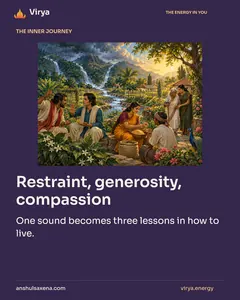
Restraint, generosity, compassion

Brihadaranyaka Upanishad

Restraint, generosity, compassion, card 1 of 7
Restraint, generosity, compassion, card 2 of 7
Restraint, generosity, compassion, card 3 of 7
Restraint, generosity, compassion, card 4 of 7
Restraint, generosity, compassion, card 5 of 7
Restraint, generosity, compassion, card 6 of 7
Restraint, generosity, compassion, card 7 of 7
Read as text

In the story of the three Da teachings, different listeners hear what they most need: self-restraint, giving, and compassion. The closing instruction brings all three together.

In everyday life: Public life needs limits on harmful impulses, willingness to share, and concern for others. These qualities matter in spending, disagreement, leadership, and ordinary encounters.

Try this: In one difficult situation, ask three questions: What should I restrain? What can I give? Whose experience should I understand?

Which of these three qualities needs your attention today?

Virya, The Energy in You

Upanishads

Begin with attention

Chandogya Upanishad

Begin with attention, card 1 of 7
Begin with attention, card 2 of 7
Begin with attention, card 3 of 7
Begin with attention, card 4 of 7
Begin with attention, card 5 of 7
Begin with attention, card 6 of 7
Begin with attention, card 7 of 7
Read as text

Begin with attention

The opening teaching asks the student to contemplate Om through the sacred chant. It turns an ordinary act of making sound into a deliberate inquiry into the reality the sound represents.

In everyday life: Notifications compete for our attention all day. One useful application is to give a conversation, a task, or a quiet moment your undivided attention before rushing to the next thing.

Try this: Spend one minute listening without reaching for your phone. If Om is part of your practice, let it be an object of attentive contemplation.

What becomes clearer when you stop dividing your attention?

Virya, The Energy in You

Upanishads

Let learning shape how you live

Chandogya Upanishad

Let learning shape how you live, card 1 of 7
Let learning shape how you live, card 2 of 7
Let learning shape how you live, card 3 of 7
Let learning shape how you live, card 4 of 7
Let learning shape how you live, card 5 of 7
Let learning shape how you live, card 6 of 7
Let learning shape how you live, card 7 of 7
Read as text

The passage names disciplined ways of life involving study, giving, sacred duty, and restraint. It then distinguishes their rewards from the deeper freedom of being established in Brahman.

In everyday life: A qualification can prove that you passed an exam. How you share knowledge, treat others, and use resources shows what your learning has become in practice.

Try this: Choose one thing you learned this week and turn it into a helpful action for someone else.

Which part of your learning is visible in your behavior?

Virya, The Energy in You

Upanishads

See more than separate things

Chandogya Upanishad

See more than separate things, card 1 of 7
See more than separate things, card 2 of 7
See more than separate things, card 3 of 7
See more than separate things, card 4 of 7
See more than separate things, card 5 of 7
See more than separate things, card 6 of 7
See more than separate things, card 7 of 7
Read as text

Brahman is presented as the origin, support, and destination of everything. The student is invited to contemplate that unity calmly and to examine the intention that shapes a life.

In everyday life: Before calling a purchase or decision purely personal, trace the people and natural resources that make it possible. A wider view can encourage care for consequences beyond immediate convenience.

Try this: Trace one everyday object back through the workers, materials, and living systems behind it.

What changes when you include the wider whole in a decision?

Virya, The Energy in You

Upanishads

Honesty opens the way to learning

Chandogya Upanishad

Honesty opens the way to learning, card 1 of 7
Honesty opens the way to learning, card 2 of 7
Honesty opens the way to learning, card 3 of 7
Honesty opens the way to learning, card 4 of 7
Honesty opens the way to learning, card 5 of 7
Honesty opens the way to learning, card 6 of 7
Honesty opens the way to learning, card 7 of 7
Read as text

Asked about his lineage, Satyakama reports what his mother honestly told him: she does not know it. The teacher recognizes his truthfulness and accepts him as a student.

In everyday life: In a classroom or workplace, pretending to know can hide a problem. Admitting uncertainty makes room for questions, correction, and genuine learning.

Try this: Replace one confident guess with a clear sentence: I do not know yet; here is how I will check.

Where would an honest admission help you learn faster?

Virya, The Energy in You

Upanishads

Notice what quietly supports you

Chandogya Upanishad

Notice what quietly supports you, card 1 of 7
Notice what quietly supports you, card 2 of 7
Notice what quietly supports you, card 3 of 7
Notice what quietly supports you, card 4 of 7
Notice what quietly supports you, card 5 of 7
Notice what quietly supports you, card 6 of 7
Notice what quietly supports you, card 7 of 7
Read as text

In a story, the faculties compete to be called the greatest. Their dependence on prana, the sustaining life principle, becomes clear when its departure threatens them all.

In everyday life: A successful team depends on maintenance, rest, coordination, and care as well as its most visible performers. Recognizing these supports can change how credit and resources are shared.

Try this: Name one person or routine that makes your work possible, and give it practical support today.

Which essential support receives the least attention in your life?

Virya, The Energy in You

Upanishads

What is real may be unseen

Chandogya Upanishad

What is real may be unseen, card 1 of 7
What is real may be unseen, card 2 of 7
What is real may be unseen, card 3 of 7
What is real may be unseen, card 4 of 7
What is real may be unseen, card 5 of 7
What is real may be unseen, card 6 of 7
What is real may be unseen, card 7 of 7
Read as text

Uddalaka asks Shvetaketu to taste water in which salt has dissolved. The unseen salt illustrates a subtle reality present throughout; the lesson culminates in the relation between the Self and the ground of existence.

In everyday life: A person's inner life is not visible in a profile, job title, or appearance. This teaching can inspire humility about what a quick judgment leaves out.

Try this: Before judging someone from one visible trait, name two important things about them you cannot know from that trait.

What do you overlook when you trust only first appearances?

Virya, The Energy in You

Upanishads

Can more ever become enough?

Chandogya Upanishad

Can more ever become enough?, card 1 of 7
Can more ever become enough?, card 2 of 7
Can more ever become enough?, card 3 of 7
Can more ever become enough?, card 4 of 7
Can more ever become enough?, card 5 of 7
Can more ever become enough?, card 6 of 7
Can more ever become enough?, card 7 of 7
Read as text

Sanatkumara tells Narada that lasting fullness belongs to the limitless, called Bhuma. The teaching asks the seeker to move beyond a life organized entirely around separate, finite objects.

In everyday life: Achievements and possessions can be useful without becoming a complete measure of life. Notice when a new target simply replaces the last one without answering what you truly seek.

Try this: Write down one goal and the deeper need you hope it will meet. Consider whether that need requires more than another acquisition.

Are you pursuing a meaningful goal or only postponing enough?

Virya, The Energy in You

Upanishads

Make room for inner inquiry

Chandogya Upanishad

Make room for inner inquiry, card 1 of 7
Make room for inner inquiry, card 2 of 7
Make room for inner inquiry, card 3 of 7
Make room for inner inquiry, card 4 of 7
Make room for inner inquiry, card 5 of 7
Make room for inner inquiry, card 6 of 7
Make room for inner inquiry, card 7 of 7
Read as text

The body is pictured as a city, with a lotus-like dwelling of the heart. The small space within it is offered for inquiry into a reality that cannot be measured by the body's size.

In everyday life: When life is organized around appearance and performance, inward reflection can be neglected. Taking time to examine motives and values can deepen how you participate in the world.

Try this: Sit quietly for a few minutes and ask: What am I seeking beneath today's most urgent demand?

What might you discover by looking inward with patience?

Virya, The Energy in You

Upanishads

Enjoy without grasping

Isha Upanishad

Enjoy without grasping, card 1 of 7
Enjoy without grasping, card 2 of 7
Enjoy without grasping, card 3 of 7
Enjoy without grasping, card 4 of 7
Enjoy without grasping, card 5 of 7
Enjoy without grasping, card 6 of 7
Enjoy without grasping, card 7 of 7
Read as text

Enjoy without grasping

The opening sees the world in relation to the Lord and joins renunciation with enjoyment or protection of the Self. Its practical warning is clear: do not covet what belongs to another.

In everyday life: Comparison can turn enough into never enough. Appreciating what you have need not require controlling everything or resenting another person's good fortune.

Try this: Enjoy something ordinary today without photographing, collecting, or comparing it.

What can you appreciate without needing to possess it?

Virya, The Energy in You

Upanishads

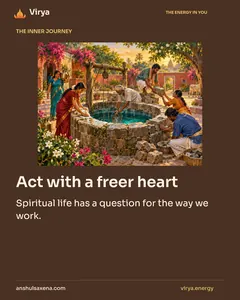
Act with a freer heart

Isha Upanishad

Act with a freer heart, card 1 of 7
Act with a freer heart, card 2 of 7
Act with a freer heart, card 3 of 7
Act with a freer heart, card 4 of 7
Act with a freer heart, card 5 of 7
Act with a freer heart, card 6 of 7
Act with a freer heart, card 7 of 7
Read as text

The verse speaks of living a full life while performing action, in a way that action does not bind. The supplied commentaries differ on how this relates to renunciation, but both take the quality of action seriously.

In everyday life: Work can be guided by care, competence, and responsibility while loosening the demand for constant praise. This changes the attitude brought to a task without removing accountability.

Try this: Do one useful task carefully even if nobody is likely to notice who did it.

What would you do well even without applause?

Virya, The Energy in You

Upanishads

See beyond the boundary of me

Isha Upanishad

See beyond the boundary of me, card 1 of 7
See beyond the boundary of me, card 2 of 7
See beyond the boundary of me, card 3 of 7
See beyond the boundary of me, card 4 of 7
See beyond the boundary of me, card 5 of 7
See beyond the boundary of me, card 6 of 7
See beyond the boundary of me, card 7 of 7
Read as text

The person who sees all beings in the Self and the Self in all beings no longer recoils from them in hatred. The following verse connects this vision of oneness with freedom from delusion and sorrow.

In everyday life: Disagreement need not erase another person's dignity. We can challenge harmful conduct while resisting the habit of reducing people to enemies or stereotypes.

Try this: In a disagreement, describe the other person's concern fairly before giving your response.

Can you disagree firmly without denying someone's humanity?

Virya, The Energy in You

Upanishads

Avoid an incomplete understanding

Isha Upanishad

Avoid an incomplete understanding, card 1 of 7
Avoid an incomplete understanding, card 2 of 7
Avoid an incomplete understanding, card 3 of 7
Avoid an incomplete understanding, card 4 of 7
Avoid an incomplete understanding, card 5 of 7
Avoid an incomplete understanding, card 6 of 7
Avoid an incomplete understanding, card 7 of 7
Read as text

The text asks the seeker to understand vidya and avidya together. In one reading, these mean spiritual practice and the actions that sustain ordinary life; in another, awareness of unity and multiplicity. Both readings resist a one-sided path.

In everyday life: Expertise can become narrow when it ignores the limits of its own approach. Reading more than one careful explanation can reveal assumptions that otherwise remain invisible.

Try this: Compare two thoughtful interpretations of a difficult idea. Record where they agree and where they genuinely differ.

Where might one useful approach have become your only approach?

Virya, The Energy in You

Upanishads

Look beyond what dazzles

Isha Upanishad

Look beyond what dazzles, card 1 of 7
Look beyond what dazzles, card 2 of 7
Look beyond what dazzles, card 3 of 7
Look beyond what dazzles, card 4 of 7
Look beyond what dazzles, card 5 of 7
Look beyond what dazzles, card 6 of 7
Look beyond what dazzles, card 7 of 7
Read as text

The seeker asks the sun to remove the golden covering that conceals truth. What is radiant or attractive may still stand between the seeker and deeper understanding.

In everyday life: Polished presentation can make a weak claim feel convincing. Reputation, design, and confidence deserve to be distinguished from evidence and substance.

Try this: Before sharing an impressive claim, check what supports it and whether its presentation is doing most of the persuading.

What has impressed you before you understood it?

Virya, The Energy in You

Upanishads

Let the path be worthy of the goal

Isha Upanishad

Let the path be worthy of the goal, card 1 of 7
Let the path be worthy of the goal, card 2 of 7
Let the path be worthy of the goal, card 3 of 7
Let the path be worthy of the goal, card 4 of 7
Let the path be worthy of the goal, card 5 of 7
Let the path be worthy of the goal, card 6 of 7
Let the path be worthy of the goal, card 7 of 7
Read as text

The seeker calls on Agni to lead by a good path and remove wrongdoing. The prayer brings aspiration together with humility about the way one proceeds.

In everyday life: A desirable outcome does not make every method acceptable. In leadership, work, and relationships, the way a result is reached shapes its value.

Try this: Before a difficult decision, ask who may be harmed and which choice you could explain honestly to those affected.

Is the route you are taking consistent with what you hope to reach?

Virya, The Energy in You

Upanishads

Do not trade the deepest question away

Katha Upanishad

Do not trade the deepest question away, card 1 of 7
Do not trade the deepest question away, card 2 of 7
Do not trade the deepest question away, card 3 of 7
Do not trade the deepest question away, card 4 of 7
Do not trade the deepest question away, card 5 of 7
Do not trade the deepest question away, card 6 of 7
Do not trade the deepest question away, card 7 of 7
Read as text

Do not trade the deepest question away

Yama offers wealth, long life, and pleasures instead of answering the question about death. Nachiketa recognizes their impermanence and continues to seek the knowledge that matters most to him.

In everyday life: Important questions are easily postponed by attractive distractions. Discernment includes knowing when an offer does not answer the need that brought you there.

Try this: Name one question you keep avoiding through busyness or consumption. Give it ten quiet minutes of serious attention.

What are you accepting in place of the answer you actually need?

Virya, The Energy in You

Upanishads

Choose what is good beyond the moment

Katha Upanishad

Choose what is good beyond the moment, card 1 of 7
Choose what is good beyond the moment, card 2 of 7
Choose what is good beyond the moment, card 3 of 7
Choose what is good beyond the moment, card 4 of 7
Choose what is good beyond the moment, card 5 of 7
Choose what is good beyond the moment, card 6 of 7
Choose what is good beyond the moment, card 7 of 7
Read as text

Yama distinguishes shreyas, the truly good, from preyas, the immediately pleasing. The discerning person examines both instead of letting attraction alone decide.

In everyday life: A tempting shortcut may conflict with a lasting commitment. This applies to attention, honesty, relationships, and the way we use our abilities.

Try this: Before one tempting choice, ask how it fits the person you are trying to become.

What feels good now but may work against what matters deeply?

Virya, The Energy in You

Upanishads

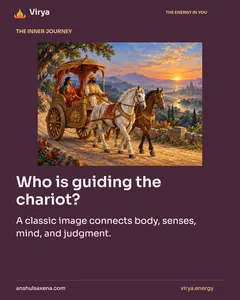
Who is guiding the chariot?

Katha Upanishad

Who is guiding the chariot?, card 1 of 7
Who is guiding the chariot?, card 2 of 7
Who is guiding the chariot?, card 3 of 7
Who is guiding the chariot?, card 4 of 7
Who is guiding the chariot?, card 5 of 7
Who is guiding the chariot?, card 6 of 7
Who is guiding the chariot?, card 7 of 7
Read as text

The body is the chariot, the senses are horses, the mind is the reins, and discernment is the driver. The Self is the traveler. A well-guided journey requires these functions to work together.

In everyday life: Attention is pulled by notifications, habits, and impulses. Clear priorities and thoughtful limits can help turn movement into a meaningful direction.

Try this: Choose one recurring distraction. Change one condition that makes it automatic, then decide when you actually want to engage with it.

Are your habits carrying you toward a destination you chose?

Virya, The Energy in You

Upanishads

Turn attention toward the knower

Katha Upanishad

Turn attention toward the knower, card 1 of 7
Turn attention toward the knower, card 2 of 7
Turn attention toward the knower, card 3 of 7
Turn attention toward the knower, card 4 of 7
Turn attention toward the knower, card 5 of 7
Turn attention toward the knower, card 6 of 7
Turn attention toward the knower, card 7 of 7
Read as text

The passage says the senses are directed outward, so people ordinarily look at external things. A discerning seeker turns inward to know the Self, seeking immortality.

In everyday life: Constant input leaves little room to examine motives and assumptions. A deliberate pause can reveal why a familiar pattern keeps repeating.

Try this: Set aside a brief quiet interval. Ask what you are seeking beneath your current activity or worry.

What do you notice when you stop adding more input?

Virya, The Energy in You

Upanishads

One reality, many expressions

Katha Upanishad

One reality, many expressions, card 1 of 7
One reality, many expressions, card 2 of 7
One reality, many expressions, card 3 of 7
One reality, many expressions, card 4 of 7
One reality, many expressions, card 5 of 7
One reality, many expressions, card 6 of 7
One reality, many expressions, card 7 of 7
Read as text

The verse compares the inner Self in all beings to one fire taking different forms. The Self is present through diverse appearances while also exceeding them.

In everyday life: People express life through different histories, capacities, and cultures. Recognizing common ground can coexist with respect for real differences.

Try this: Learn one detail about someone's experience that differs from yours, while noticing one concern you share.

Can you honor difference without making it a barrier to respect?

Virya, The Energy in You

Upanishads

Freedom from the heart's knots

Katha Upanishad

Freedom from the heart's knots, card 1 of 7
Freedom from the heart's knots, card 2 of 7
Freedom from the heart's knots, card 3 of 7
Freedom from the heart's knots, card 4 of 7
Freedom from the heart's knots, card 5 of 7
Freedom from the heart's knots, card 6 of 7
Freedom from the heart's knots, card 7 of 7
Read as text

When the desires lodged in the heart are released, the mortal realizes the immortal here. The next verse speaks of the heart's knots being undone, making freedom a matter of realization rather than acquiring more.

In everyday life: A desire can be noticed without becoming an order. Examining the belief that one more possession or approval will make us complete can loosen its hold.

Try this: When a strong want appears, ask what you hope it will give you and whether that need has another response.

Which demand on life has begun to feel like a knot?

Virya, The Energy in You

Upanishads

What makes knowing possible?

Kena Upanishad

What makes knowing possible?, card 1 of 7
What makes knowing possible?, card 2 of 7
What makes knowing possible?, card 3 of 7
What makes knowing possible?, card 4 of 7
What makes knowing possible?, card 5 of 7
What makes knowing possible?, card 6 of 7
What makes knowing possible?, card 7 of 7
Read as text

What makes knowing possible?

The student asks what directs the mind, breath, speech, eyes, and ears. The inquiry turns from the things we experience toward the underlying reality that enables experience.

In everyday life: We can become skilled at handling information without considering how we know or what assumptions shape attention. A basic question may reveal a deeper subject than a quick answer can reach.

Try this: Notice what currently holds your attention. Ask what drew it there and what it leaves outside the frame.

What question lies behind the question you usually ask?

Virya, The Energy in You

Upanishads

The ear of the ear

Kena Upanishad

The ear of the ear, card 1 of 7
The ear of the ear, card 2 of 7
The ear of the ear, card 3 of 7
The ear of the ear, card 4 of 7
The ear of the ear, card 5 of 7
The ear of the ear, card 6 of 7
The ear of the ear, card 7 of 7
Read as text

The teacher calls the underlying reality the ear of the ear and mind of the mind. The organs and thoughts are not the final explanation of the awareness through which they are known.

In everyday life: Tools can extend our abilities, but possessing a tool is not the same as understanding its use or our experience of it. The passage invites reflection on what is often taken for granted.

Try this: Listen to a sound without naming its source immediately. Notice the simple fact of hearing before adding a description.

What usually remains unnoticed because it is present in every experience?

Virya, The Energy in You

Upanishads

Words can point without containing

Kena Upanishad

Words can point without containing, card 1 of 7
Words can point without containing, card 2 of 7
Words can point without containing, card 3 of 7
Words can point without containing, card 4 of 7
Words can point without containing, card 5 of 7
Words can point without containing, card 6 of 7
Words can point without containing, card 7 of 7
Read as text

Brahman is described as that which speech cannot fully express, but through which speech itself becomes possible. The verse asks us not to confuse an object of description with the ground of knowing.

In everyday life: Definitions and models help us think. Trouble begins when we mistake their usefulness for completeness, especially when describing a person or a complex experience.

Try this: Choose a familiar definition. Write one important aspect of the subject that the definition leaves out.

Where have you confused a good description with complete understanding?

Virya, The Energy in You

Upanishads

Leave room for deeper understanding

Kena Upanishad

Leave room for deeper understanding, card 1 of 7
Leave room for deeper understanding, card 2 of 7
Leave room for deeper understanding, card 3 of 7
Leave room for deeper understanding, card 4 of 7
Leave room for deeper understanding, card 5 of 7
Leave room for deeper understanding, card 6 of 7
Leave room for deeper understanding, card 7 of 7
Read as text

The verse unsettles the claim that Brahman has been completely grasped as an object of thought. Recognizing the limits of that claim is closer to understanding than confident possession of a formula.

In everyday life: Saying I may be missing something can make a discussion more accurate. Humility matters most when it changes how you listen, investigate, and revise a view.

Try this: Name one subject on which you sound more certain than your evidence allows. Make your next statement more precise.

What would you learn if you loosened the need to sound certain?

Virya, The Energy in You

Upanishads

Success does not belong to the ego alone

Kena Upanishad

Success does not belong to the ego alone, card 1 of 7
Success does not belong to the ego alone, card 2 of 7
Success does not belong to the ego alone, card 3 of 7
Success does not belong to the ego alone, card 4 of 7
Success does not belong to the ego alone, card 5 of 7
Success does not belong to the ego alone, card 6 of 7
Success does not belong to the ego alone, card 7 of 7
Read as text

The gods claim a victory as their own. Agni and Vayu cannot master a single blade of grass set before them; Uma later tells Indra that the victory was Brahman's. Their pride meets a limit.

In everyday life: Achievement depends on conditions, help, and abilities we did not create alone. Acknowledging that support can make success more generous and less arrogant.

Try this: For one recent achievement, name the people and circumstances that made it possible. Give specific credit where it is due.

Whose contribution disappears when you tell the story of your success?

Virya, The Energy in You

Upanishads

Wisdom needs an ethical home

Kena Upanishad

Wisdom needs an ethical home, card 1 of 7
Wisdom needs an ethical home, card 2 of 7
Wisdom needs an ethical home, card 3 of 7
Wisdom needs an ethical home, card 4 of 7
Wisdom needs an ethical home, card 5 of 7
Wisdom needs an ethical home, card 6 of 7
Wisdom needs an ethical home, card 7 of 7
Read as text

The closing teaching names disciplined effort, self-restraint, and action as supports of knowledge. It gives the Vedas the place of its limbs and truth the place of its dwelling.

In everyday life: Insight loses credibility when conduct repeatedly contradicts it. Learning becomes more trustworthy when it shapes how we speak, work, and treat others.

Try this: Choose one principle you admire. Identify a small action today that would make it visible in your behavior.

Which value needs to become a habit rather than a statement?

Virya, The Energy in You

Upanishads

A sound that points to the whole

Mandukya Upanishad

A sound that points to the whole, card 1 of 7
A sound that points to the whole, card 2 of 7
A sound that points to the whole, card 3 of 7
A sound that points to the whole, card 4 of 7
A sound that points to the whole, card 5 of 7
A sound that points to the whole, card 6 of 7
A sound that points to the whole, card 7 of 7
Read as text

A sound that points to the whole

The opening identifies Om with all this: everything in the three times and what lies beyond them. The syllable is a contemplative doorway into the whole of reality.

In everyday life: Daily attention often becomes trapped in one urgent moment. A wider perspective can help place today's concern within a fuller life.

Try this: Think of one present concern. Consider its history, its possible future, and what matters beyond its immediate pressure.

What becomes visible when you widen the frame of attention?

Virya, The Energy in You

Upanishads

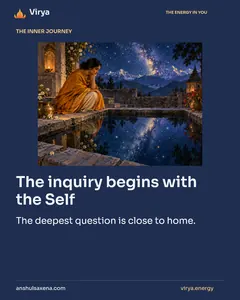
The inquiry begins with the Self

Mandukya Upanishad

The inquiry begins with the Self, card 1 of 7
The inquiry begins with the Self, card 2 of 7
The inquiry begins with the Self, card 3 of 7
The inquiry begins with the Self, card 4 of 7
The inquiry begins with the Self, card 5 of 7
The inquiry begins with the Self, card 6 of 7
The inquiry begins with the Self, card 7 of 7
Read as text

This Self is Brahman. The text then investigates the Self through four quarters, leading from familiar modes of experience toward what is not confined to them.

In everyday life: We often search only for new objects, experiences, or achievements. This teaching redirects attention toward the one to whom those experiences appear.

Try this: Sit quietly and notice one changing sensation and one changing thought. Ask what you mean when you say that you know them.

What do you mean when you say I?

Virya, The Energy in You

Upanishads

Waking and dreaming reveal different worlds

Mandukya Upanishad

Waking and dreaming reveal different worlds, card 1 of 7
Waking and dreaming reveal different worlds, card 2 of 7
Waking and dreaming reveal different worlds, card 3 of 7
Waking and dreaming reveal different worlds, card 4 of 7
Waking and dreaming reveal different worlds, card 5 of 7
Waking and dreaming reveal different worlds, card 6 of 7
Waking and dreaming reveal different worlds, card 7 of 7
Read as text

The waking condition knows external objects; the dreaming condition knows an inwardly presented world. The text studies both as modes of experience rather than treating the waking personality as the whole Self.

In everyday life: Memory, imagination, and direct observation can feel vivid in different ways. Distinguishing them helps us avoid treating every mental picture as a present fact.

Try this: Before reacting to a worry, ask whether it is something observed now, remembered, or imagined.

Which part of your experience is observed, and which part is imagined?

Virya, The Energy in You

Upanishads

Deep sleep is part of the inquiry

Mandukya Upanishad

Deep sleep is part of the inquiry, card 1 of 7
Deep sleep is part of the inquiry, card 2 of 7
Deep sleep is part of the inquiry, card 3 of 7
Deep sleep is part of the inquiry, card 4 of 7
Deep sleep is part of the inquiry, card 5 of 7
Deep sleep is part of the inquiry, card 6 of 7
Deep sleep is part of the inquiry, card 7 of 7
Read as text

Deep sleep is described as a condition without particular desire or dream, where differentiated experience is gathered together. The following mantra presents this causal condition in relation to the source and end of beings.

In everyday life: Rest has a place in life, but simply escaping stimulation does not answer every question about understanding. Quiet and insight are related without being identical.

Try this: Recall the difference between feeling rested and understanding a problem. What supports each in your own life?

When have you mistaken temporary quiet for a resolved question?

Virya, The Energy in You

Upanishads

Beyond the changing states

Mandukya Upanishad

Beyond the changing states, card 1 of 7
Beyond the changing states, card 2 of 7
Beyond the changing states, card 3 of 7
Beyond the changing states, card 4 of 7
Beyond the changing states, card 5 of 7
Beyond the changing states, card 6 of 7
Beyond the changing states, card 7 of 7
Read as text

After describing waking, dream, and deep sleep, the text points to the peaceful, auspicious, nondual Self. Called the fourth, it is not captured by the ordinary categories used for those states.

In everyday life: A mood can dominate the moment without defining the whole of who you are. The teaching invites a deeper inquiry than simply replacing an unpleasant state with a pleasant one.

Try this: Notice how a thought appears, changes, and passes. Let this observation become a question about what knows the change.

What in your identity have you tied too tightly to a passing state?

Virya, The Energy in You

Upanishads

Listen beyond the divisions

Mandukya Upanishad

Listen beyond the divisions, card 1 of 7
Listen beyond the divisions, card 2 of 7
Listen beyond the divisions, card 3 of 7
Listen beyond the divisions, card 4 of 7
Listen beyond the divisions, card 5 of 7
Listen beyond the divisions, card 6 of 7
Listen beyond the divisions, card 7 of 7
Read as text

The three sound elements of Om correspond to waking, dreaming, and deep sleep. The measureless aspect points to the nondual Self beyond these divisions and beyond ordinary transaction.

In everyday life: Silence can help us notice the habits hidden by constant input. It can serve as a space for inquiry, without becoming another achievement to display.

Try this: Listen to a gentle sound until it fades. Notice the quiet that follows without trying to force a special experience.

What do you notice when you stop filling every quiet moment?

Virya, The Energy in You

Upanishads

Learning has more than one horizon

Mundaka Upanishad

Learning has more than one horizon, card 1 of 7
Learning has more than one horizon, card 2 of 7
Learning has more than one horizon, card 3 of 7
Learning has more than one horizon, card 4 of 7
Learning has more than one horizon, card 5 of 7
Learning has more than one horizon, card 6 of 7
Learning has more than one horizon, card 7 of 7
Read as text

Learning has more than one horizon

The teacher names two kinds of knowledge. The lower includes sacred texts and supporting disciplines; the higher is that through which the imperishable is known. The distinction concerns their aim, not a rejection of learning.

In everyday life: Qualifications and information are useful. They may still leave questions about identity, meaning, and what deserves your deepest commitment unanswered.

Try this: List something you want to become skilled at and something you want to understand about living. Make time for both.

What question remains even after you collect more information?

Virya, The Energy in You

Upanishads

Choose a teacher with discernment

Mundaka Upanishad

Choose a teacher with discernment, card 1 of 7
Choose a teacher with discernment, card 2 of 7
Choose a teacher with discernment, card 3 of 7
Choose a teacher with discernment, card 4 of 7
Choose a teacher with discernment, card 5 of 7
Choose a teacher with discernment, card 6 of 7
Choose a teacher with discernment, card 7 of 7
Read as text

After examining what action can produce, the seeker recognizes that the uncreated cannot be manufactured by action. The passage then directs the student toward a teacher grounded in scripture and established in Brahman.

In everyday life: A good mentor helps you examine assumptions and develop judgment. Status or charisma alone does not establish wisdom, and learning still requires your active attention.

Try this: Before choosing a mentor, look for knowledge, integrity, and a willingness to welcome sincere questions.

Who helps you understand more clearly rather than merely depend on them?

Virya, The Energy in You

Upanishads

Many forms, one origin

Mundaka Upanishad

Many forms, one origin, card 1 of 7
Many forms, one origin, card 2 of 7
Many forms, one origin, card 3 of 7
Many forms, one origin, card 4 of 7
Many forms, one origin, card 5 of 7
Many forms, one origin, card 6 of 7
Many forms, one origin, card 7 of 7
Read as text

As countless sparks arise from a blazing fire, diverse beings arise from the imperishable and return to it. The image expresses a shared origin without denying the variety of living forms.

In everyday life: Differences in role, ability, and appearance need not become reasons for contempt. A sense of shared being can support humility in how we treat one another.

Try this: Notice one person you tend to reduce to a role. Consider the fuller life and experience behind that role.

What changes when difference no longer means separation in worth?

Virya, The Energy in You

Upanishads

Give attention a direction

Mundaka Upanishad

Give attention a direction, card 1 of 7
Give attention a direction, card 2 of 7
Give attention a direction, card 3 of 7
Give attention a direction, card 4 of 7
Give attention a direction, card 5 of 7
Give attention a direction, card 6 of 7
Give attention a direction, card 7 of 7
Read as text

Om is the bow, the self is the arrow, and Brahman is the target. Undistracted contemplation is compared to an arrow becoming one with its mark.

In everyday life: Scattered effort often follows scattered priorities. Choosing a meaningful direction can help align time, study, and action, even when progress is gradual.

Try this: Choose one worthwhile activity. Give it a short period of undivided attention, then notice what repeatedly pulls you away.

What deserves your undivided attention today?

Virya, The Energy in You

Upanishads

Notice the one who is noticing

Mundaka Upanishad

Notice the one who is noticing, card 1 of 7
Notice the one who is noticing, card 2 of 7
Notice the one who is noticing, card 3 of 7
Notice the one who is noticing, card 4 of 7
Notice the one who is noticing, card 5 of 7
Notice the one who is noticing, card 6 of 7
Notice the one who is noticing, card 7 of 7
Read as text

One bird eats the tree's fruit while the other watches without eating. The image contrasts the being caught in experience with the divine presence whose recognition releases sorrow.

In everyday life: During a strong reaction, noticing the feeling can create room for a thoughtful response. You can acknowledge an emotion without letting its first impulse decide everything.

Try this: Name a feeling in a simple sentence: anger is present, or worry is present. Pause before choosing your next action.

Can you notice a feeling before you act from it?

Virya, The Energy in You

Upanishads

Let truth guide the path

Mundaka Upanishad

Let truth guide the path, card 1 of 7
Let truth guide the path, card 2 of 7
Let truth guide the path, card 3 of 7
Let truth guide the path, card 4 of 7
Let truth guide the path, card 5 of 7
Let truth guide the path, card 6 of 7
Let truth guide the path, card 7 of 7
Read as text

The passage connects realization with truthfulness, disciplined living, and right knowledge. Truth opens the path toward the highest reality; falsehood cannot serve that same purpose.

In everyday life: Correcting an error may cost comfort or reputation in the moment. Honest communication builds the conditions in which learning and trust become possible.

Try this: Find one statement you have overstated. Restate it with the limits of what you actually know.

What would become simpler if you stopped defending an untruth?

Virya, The Energy in You

Upanishads

Life is described through complementary principles

Prashna Upanishad

Life is described through complementary principles, card 1 of 7
Life is described through complementary principles, card 2 of 7
Life is described through complementary principles, card 3 of 7
Life is described through complementary principles, card 4 of 7
Life is described through complementary principles, card 5 of 7
Life is described through complementary principles, card 6 of 7
Life is described through complementary principles, card 7 of 7
Read as text

Life is described through complementary principles

Pippalada describes Prajapati bringing forth rayi and prana as a pair. The teaching links nourishment or material form with vital activity, using the moon and sun as symbols.

In everyday life: Daily life depends on both resources and the activity that uses them. Good intentions need practical support, while resources need a thoughtful purpose.

Try this: Choose one project. Identify both the material support it needs and the human attention required to sustain it.

What essential partner is missing from something you want to bring to life?

Virya, The Energy in You

Upanishads

Remember what quietly sustains the whole

Prashna Upanishad

Remember what quietly sustains the whole, card 1 of 7
Remember what quietly sustains the whole, card 2 of 7
Remember what quietly sustains the whole, card 3 of 7
Remember what quietly sustains the whole, card 4 of 7
Remember what quietly sustains the whole, card 5 of 7
Remember what quietly sustains the whole, card 6 of 7
Remember what quietly sustains the whole, card 7 of 7
Read as text

When the faculties claim superiority, prana demonstrates their dependence on vital support. The teaching compares their relation to spokes resting in a wheel's hub.

In everyday life: Organizations often praise visible achievements while overlooking maintenance, care, and coordination. Recognizing these foundations makes shared work more respectful and resilient.

Try this: Identify one person or routine that keeps your daily life functioning. Give it the attention it deserves.

What essential support do you notice only when it is missing?

Virya, The Energy in You

Upanishads

Look beyond the immediate support

Prashna Upanishad

Look beyond the immediate support, card 1 of 7
Look beyond the immediate support, card 2 of 7
Look beyond the immediate support, card 3 of 7
Look beyond the immediate support, card 4 of 7
Look beyond the immediate support, card 5 of 7
Look beyond the immediate support, card 6 of 7
Look beyond the immediate support, card 7 of 7
Read as text

Prana is said to arise from the Self, like a shadow depends on the person casting it. What first seemed fundamental is placed within a deeper relation.

In everyday life: An explanation may solve one level of a problem while leaving another open. Tracing dependencies encourages deeper questions instead of stopping at the first useful answer.

Try this: Take one system you rely on. Ask what supports it, and then what supports that support.

What lies beneath the explanation you usually stop with?

Virya, The Energy in You

Upanishads

Where does experience come to rest?

Prashna Upanishad

Where does experience come to rest?, card 1 of 7
Where does experience come to rest?, card 2 of 7
Where does experience come to rest?, card 3 of 7
Where does experience come to rest?, card 4 of 7
Where does experience come to rest?, card 5 of 7
Where does experience come to rest?, card 6 of 7
Where does experience come to rest?, card 7 of 7
Read as text

As birds return to their resting tree, the faculties and their objects are said to rest in the supreme Self. The dialogue uses sleep to investigate the ground of changing experience.

In everyday life: A pause from activity can reveal how much of life is spent moving from one demand to another. Rest may become an occasion for reflection as well as recovery.

Try this: At the end of the day, set aside one unfinished demand briefly and notice the shift from doing to resting.

What do you carry into rest that could wait until tomorrow?

Virya, The Energy in You

Upanishads

Let a practice have a clear purpose

Prashna Upanishad

Let a practice have a clear purpose, card 1 of 7
Let a practice have a clear purpose, card 2 of 7
Let a practice have a clear purpose, card 3 of 7
Let a practice have a clear purpose, card 4 of 7
Let a practice have a clear purpose, card 5 of 7
Let a practice have a clear purpose, card 6 of 7
Let a practice have a clear purpose, card 7 of 7
Read as text

Om is presented as a support for contemplation of both higher and lower Brahman. The discussion distinguishes the results of different ways of meditating, rather than treating repetition as an automatic shortcut.

In everyday life: A practice is more useful when you understand what it is meant to cultivate. Repeating a habit without reflection can hide the difference between activity and learning.

Try this: Choose one practice you keep. Write its purpose in a sentence, then consider whether the way you do it serves that purpose.

Do you understand what your regular practice is helping you learn?

Virya, The Energy in You

Upanishads

Beyond the separate name

Prashna Upanishad

Beyond the separate name, card 1 of 7
Beyond the separate name, card 2 of 7
Beyond the separate name, card 3 of 7
Beyond the separate name, card 4 of 7
Beyond the separate name, card 5 of 7
Beyond the separate name, card 6 of 7
Beyond the separate name, card 7 of 7
Read as text

The sixteen aspects of the person are compared to rivers entering the ocean. Their separate names and forms cease to define them as they resolve into the Purusha, the underlying spiritual reality.

In everyday life: Roles and achievements are useful ways to describe a life, but they need not become a complete definition of a person. The image invites a wider sense of belonging.

Try this: List three roles you play. Ask what remains important about you when those roles change.

What in your life feels larger than the roles you currently occupy?

Virya, The Energy in You

Upanishads

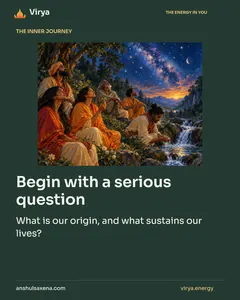
Begin with a serious question

Shvetashvatara Upanishad

Begin with a serious question, card 1 of 7
Begin with a serious question, card 2 of 7
Begin with a serious question, card 3 of 7
Begin with a serious question, card 4 of 7
Begin with a serious question, card 5 of 7
Begin with a serious question, card 6 of 7
Begin with a serious question, card 7 of 7
Read as text

Begin with a serious question

The sages ask about the cause of existence, the source of life, and the basis of pleasure and pain. They examine possible explanations before turning to contemplation of divine power.

In everyday life: Good inquiry begins by making the question clear. In a world of quick answers, asking what an explanation actually explains is a valuable habit.

Try this: Choose one large question. Write down what you know, what you assume, and what remains unresolved.

Which question deserves more patience than you have given it?

Virya, The Energy in You

Upanishads

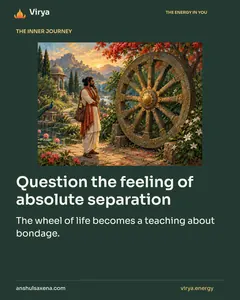
Question the feeling of absolute separation

Shvetashvatara Upanishad

Question the feeling of absolute separation, card 1 of 7
Question the feeling of absolute separation, card 2 of 7
Question the feeling of absolute separation, card 3 of 7
Question the feeling of absolute separation, card 4 of 7
Question the feeling of absolute separation, card 5 of 7
Question the feeling of absolute separation, card 6 of 7
Question the feeling of absolute separation, card 7 of 7
Read as text

The individual moves within the great wheel while regarding self and divine source as separate. Recognition of the divine and its favor are linked with freedom from that bondage.

In everyday life: An isolated view of life can hide how much support we receive. Remembering relationship can soften pride and invite responsibility toward others.

Try this: Name three forms of support that make your day possible. Act with care toward one of them.

Where do you act as though you stand entirely alone?

Virya, The Energy in You

Upanishads

Give contemplation a steady setting

Shvetashvatara Upanishad

Give contemplation a steady setting, card 1 of 7
Give contemplation a steady setting, card 2 of 7
Give contemplation a steady setting, card 3 of 7
Give contemplation a steady setting, card 4 of 7
Give contemplation a steady setting, card 5 of 7
Give contemplation a steady setting, card 6 of 7
Give contemplation a steady setting, card 7 of 7
Read as text

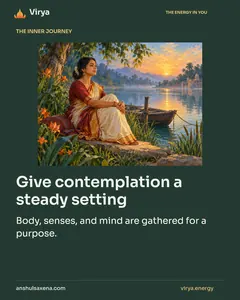
The verse describes an upright, balanced posture and the gathering of the senses through the mind. It compares Brahman to a raft for crossing the streams of fear.

In everyday life: A quieter setting can support careful thought. Reducing avoidable interruptions may help you respond with more clarity to a demanding situation.

Try this: Sit comfortably with support, let breathing remain natural, and spend a brief moment noticing where your attention goes.

What small change in your surroundings would help you pay attention?

Virya, The Energy in You

Upanishads

Light beyond ignorance

Shvetashvatara Upanishad

Light beyond ignorance, card 1 of 7
Light beyond ignorance, card 2 of 7
Light beyond ignorance, card 3 of 7
Light beyond ignorance, card 4 of 7
Light beyond ignorance, card 5 of 7
Light beyond ignorance, card 6 of 7
Light beyond ignorance, card 7 of 7
Read as text

The sage speaks of knowing the great Person, radiant like the sun and beyond darkness. This knowledge is presented as the way beyond death into spiritual freedom.

In everyday life: Insight can change how a difficulty is understood even before circumstances change. Learning and honest reflection can reveal possibilities hidden by confusion.

Try this: Identify one fear fed by uncertainty. Seek one reliable piece of understanding that can make the situation clearer.

What confusion would you most like to bring into the light?

Virya, The Energy in You

Upanishads

Nature points beyond itself

Shvetashvatara Upanishad

Nature points beyond itself, card 1 of 7
Nature points beyond itself, card 2 of 7
Nature points beyond itself, card 3 of 7
Nature points beyond itself, card 4 of 7
Nature points beyond itself, card 5 of 7
Nature points beyond itself, card 6 of 7
Nature points beyond itself, card 7 of 7
Read as text

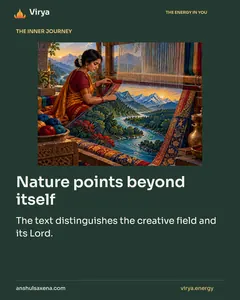
Prakriti, or nature, is called maya, and the great Lord is named as its wielder. The world of many forms is understood through its dependence on a deeper divine reality.

In everyday life: Seeing how things are formed can reduce careless attachment to appearances. A product, institution, or online image has conditions behind its polished surface.

Try this: Choose one thing you take for granted. Trace the materials, labor, and choices that help bring it into being.

What conditions are hidden behind an appearance you admire?

Virya, The Energy in You

Upanishads

Honor the presence within every life

Shvetashvatara Upanishad

Honor the presence within every life, card 1 of 7
Honor the presence within every life, card 2 of 7
Honor the presence within every life, card 3 of 7
Honor the presence within every life, card 4 of 7
Honor the presence within every life, card 5 of 7
Honor the presence within every life, card 6 of 7
Honor the presence within every life, card 7 of 7
Read as text

The one divine reality is all-pervading, the inner Self of beings, witness, and source of consciousness. Its hidden presence invites a view that reaches beneath outward difference.

In everyday life: Respect becomes deeper when it is not reserved for wealth, familiarity, or usefulness. This teaching can inspire care across the boundaries that divide public life.

Try this: Give full attention to someone whose work you usually overlook, and acknowledge their contribution with sincerity.

Who becomes easier to overlook when you judge only by appearances?

Virya, The Energy in You

Upanishads

Care begins with how we learn

Taittiriya Upanishad

Care begins with how we learn, card 1 of 7
Care begins with how we learn, card 2 of 7
Care begins with how we learn, card 3 of 7
Care begins with how we learn, card 4 of 7
Care begins with how we learn, card 5 of 7
Care begins with how we learn, card 6 of 7
Care begins with how we learn, card 7 of 7
Read as text

Care begins with how we learn

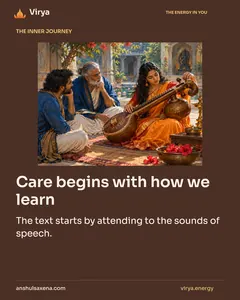
The lesson on pronunciation names sound, pitch, length, effort, balance, and continuity. Careful transmission matters because the form of an utterance helps preserve what is being taught.

In everyday life: Accuracy is a form of respect in learning and communication. Slowing down to hear, check, and practice can prevent a confident misunderstanding from spreading.

Try this: Read one difficult sentence aloud slowly. Check a word you have been using without fully understanding it.

Where would a little more precision improve your understanding?

Virya, The Energy in You

Upanishads

Keep learning, keep sharing

Taittiriya Upanishad

Keep learning, keep sharing, card 1 of 7
Keep learning, keep sharing, card 2 of 7
Keep learning, keep sharing, card 3 of 7
Keep learning, keep sharing, card 4 of 7
Keep learning, keep sharing, card 5 of 7
Keep learning, keep sharing, card 6 of 7
Keep learning, keep sharing, card 7 of 7
Read as text

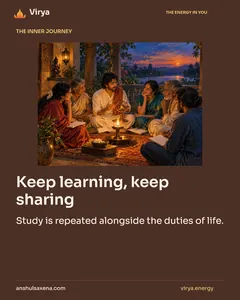
The passage returns again and again to study and teaching while naming truthfulness, discipline, hospitality, and household responsibilities. Learning is sustained within an ethical way of living.

In everyday life: Education need not end with a qualification. Explaining an idea carefully to someone else can reveal both what you understand and where you still need to learn.

Try this: Learn one useful idea, then explain it plainly to a willing listener. Welcome a question you cannot yet answer.

What knowledge could you share with care this week?

Virya, The Energy in You

Upanishads

Let education shape your conduct

Taittiriya Upanishad

Let education shape your conduct, card 1 of 7
Let education shape your conduct, card 2 of 7
Let education shape your conduct, card 3 of 7
Let education shape your conduct, card 4 of 7
Let education shape your conduct, card 5 of 7
Let education shape your conduct, card 6 of 7
Let education shape your conduct, card 7 of 7
Read as text

The teacher urges truthfulness, right conduct, continued study, respect, and thoughtful giving. The instruction asks the student to carry learning into relationships and responsibilities.

In everyday life: Skill without integrity can do harm. Work, family life, and public speech all ask whether what we know is matched by how we act.

Try this: Before one important statement, check that it is true, needed, and expressed with care.

What should someone be able to trust about the way you act?

Virya, The Energy in You

Upanishads

Reality, knowing, limitlessness

Taittiriya Upanishad

Reality, knowing, limitlessness, card 1 of 7
Reality, knowing, limitlessness, card 2 of 7
Reality, knowing, limitlessness, card 3 of 7
Reality, knowing, limitlessness, card 4 of 7
Reality, knowing, limitlessness, card 5 of 7
Reality, knowing, limitlessness, card 6 of 7
Reality, knowing, limitlessness, card 7 of 7
Read as text

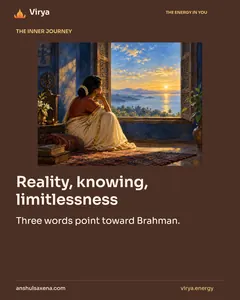
Brahman is described as truth or reality, knowledge, and infinity. In the Advaita commentaries, these words point beyond a limited object to the reality of the Self.

In everyday life: We often assume that everything valuable must be an object we can acquire. This teaching asks a different kind of question about the ground of existence and knowing.

Try this: Notice something you usually treat as an object of possession. Consider whether the most important part of the experience can actually be owned.

What changes when knowing is explored as more than collecting facts?

Virya, The Energy in You

Upanishads

Explore the layers of experience

Taittiriya Upanishad

Explore the layers of experience, card 1 of 7
Explore the layers of experience, card 2 of 7
Explore the layers of experience, card 3 of 7
Explore the layers of experience, card 4 of 7
Explore the layers of experience, card 5 of 7
Explore the layers of experience, card 6 of 7
Explore the layers of experience, card 7 of 7
Read as text

The text leads attention through successively inward selves associated with food, vital function, mind, discernment, and bliss. This sequence helps the seeker question a limited identification and recognize Brahman as the supporting reality.

In everyday life: A person cannot be understood only through appearance, mood, or intellect. Attending to several dimensions of life can make self-reflection and care more thoughtful.

Try this: Notice one bodily need, one emotion, and one belief influencing your day. Consider each without making any one of them your entire identity.

Which layer of your experience do you most often mistake for the whole?

Virya, The Energy in You

Upanishads

The source of joy

Taittiriya Upanishad

The source of joy, card 1 of 7
The source of joy, card 2 of 7
The source of joy, card 3 of 7
The source of joy, card 4 of 7
The source of joy, card 5 of 7
The source of joy, card 6 of 7
The source of joy, card 7 of 7
Read as text

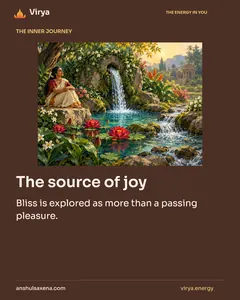
Brahman is called rasa, the essence or delight through which one becomes joyful. The passage places joy within its inquiry into the deepest support of life and freedom from fear.

In everyday life: Pleasure often depends on a changing event or object. Reflecting on a steadier sense of contentment can reveal how much we ask temporary experiences to provide.

Try this: Recall a moment of simple contentment. What was present besides getting something you wanted?

What kind of joy does not depend entirely on the next reward?

Virya, The Energy in You

Upanishads

Return to the question

Taittiriya Upanishad

Return to the question, card 1 of 7
Return to the question, card 2 of 7
Return to the question, card 3 of 7
Return to the question, card 4 of 7
Return to the question, card 5 of 7
Return to the question, card 6 of 7
Return to the question, card 7 of 7
Read as text

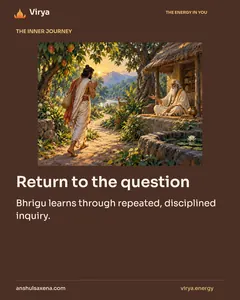
Bhrigu asks Varuna about Brahman and is directed toward contemplation. He explores food, life, mind, understanding, and bliss, returning to inquiry rather than treating his first insight as complete.

In everyday life: A first answer can be useful and still incomplete. Revisiting a question with experience and careful reflection is part of serious learning.

Try this: Choose an idea you learned recently. Explain why you believe it, then identify the next question it raises.

What worthwhile question are you ready to revisit?

Virya, The Energy in You

Upanishads

Treat nourishment with respect

Taittiriya Upanishad

Treat nourishment with respect, card 1 of 7
Treat nourishment with respect, card 2 of 7
Treat nourishment with respect, card 3 of 7
Treat nourishment with respect, card 4 of 7
Treat nourishment with respect, card 5 of 7
Treat nourishment with respect, card 6 of 7
Treat nourishment with respect, card 7 of 7
Read as text

The closing lessons ask that food not be despised or rejected, and that a person seeking shelter not be turned away. Reverence for life becomes visible in nourishment and welcome.

In everyday life: Food carries the work of land, growers, cooks, and communities. Reducing waste and sharing thoughtfully can turn gratitude into action.

Try this: Serve only what you expect to eat, value the effort behind the meal, and consider one practical way to support someone else's nourishment.

How could gratitude become visible at your next meal?

Virya, The Energy in You

Upanishads

Let humility begin the journey

Kaushitaki Brahmana Upanishad

Let humility begin the journey, card 1 of 7
Let humility begin the journey, card 2 of 7
Let humility begin the journey, card 3 of 7
Let humility begin the journey, card 4 of 7
Let humility begin the journey, card 5 of 7
Let humility begin the journey, card 6 of 7
Let humility begin the journey, card 7 of 7
Read as text

Let humility begin the journey

The story begins with an honest admission of not knowing. Learning becomes possible when status gives way to humility and teacher and student can walk together toward understanding.

In everyday life: Expertise can make it difficult to admit uncertainty. Yet honest questions create better decisions, safer institutions, and more trustworthy leadership.

Try this: Name one question you have been pretending to understand. Ask someone knowledgeable to explain it without defending your image.

Where could saying “I do not know yet” open a better path?

Virya, The Energy in You

Upanishads

Cross the river beyond opposites

Kaushitaki Brahmana Upanishad

Cross the river beyond opposites, card 1 of 7
Cross the river beyond opposites, card 2 of 7
Cross the river beyond opposites, card 3 of 7
Cross the river beyond opposites, card 4 of 7
Cross the river beyond opposites, card 5 of 7
Cross the river beyond opposites, card 6 of 7
Cross the river beyond opposites, card 7 of 7
Read as text

The river is a symbolic threshold. Crossing it suggests releasing the grip of achievement and failure, praise and blame, and the other opposites by which identity is usually measured.

In everyday life: Modern life constantly sorts us into winning and losing, admired and ignored. A steadier identity lets us respond to events without being entirely defined by them.

Try this: Notice one pair of opposites that controls your mood today. Name both, breathe slowly, and ask what remains present beneath either outcome.

Which judgment about your life have you mistaken for your whole identity?

Virya, The Energy in You

Upanishads

Identity reaches beyond separation

Kaushitaki Brahmana Upanishad

Identity reaches beyond separation, card 1 of 7
Identity reaches beyond separation, card 2 of 7
Identity reaches beyond separation, card 3 of 7
Identity reaches beyond separation, card 4 of 7
Identity reaches beyond separation, card 5 of 7
Identity reaches beyond separation, card 6 of 7
Identity reaches beyond separation, card 7 of 7
Read as text

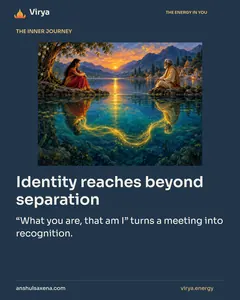
The declaration points from separate biographies toward a deeper shared reality. It does not erase individual lives; it asks whether the ground of awareness is less divided than our social identities suggest.

In everyday life: Polarized societies train us to reduce people to roles, camps, or labels. Seeing shared dignity can change how we disagree and how we use power.

Try this: Before a difficult conversation, silently remember: this person also seeks safety, meaning, and recognition. Then speak clearly without dehumanizing them.

Can you preserve difference while recognizing a deeper kinship?

Virya, The Energy in You

Upanishads

Life is more than a private possession

Kaushitaki Brahmana Upanishad

Life is more than a private possession, card 1 of 7
Life is more than a private possession, card 2 of 7
Life is more than a private possession, card 3 of 7
Life is more than a private possession, card 4 of 7
Life is more than a private possession, card 5 of 7
Life is more than a private possession, card 6 of 7
Life is more than a private possession, card 7 of 7
Read as text

Prana here is more than the physical breath. It names the living power through which mind, speech, sight, and hearing participate in a larger order.

In everyday life: We often treat energy and attention as private resources to exploit. This teaching invites gratitude for the networks, biological, social, and ecological, that sustain every action.

Try this: Take five unforced breaths. With each exhalation, name one condition that supports your life: air, food, care, knowledge, or community.

What changes when life is received as participation rather than possession?

Virya, The Energy in You

Upanishads

Life and awareness belong together

Kaushitaki Brahmana Upanishad

Life and awareness belong together, card 1 of 7
Life and awareness belong together, card 2 of 7
Life and awareness belong together, card 3 of 7
Life and awareness belong together, card 4 of 7
Life and awareness belong together, card 5 of 7
Life and awareness belong together, card 6 of 7
Life and awareness belong together, card 7 of 7
Read as text

The teaching links vitality with awareness. A fully human life is not mere continuation; it includes the capacity to know, attend, choose, and awaken to meaning.

In everyday life: Productivity can keep the body moving while attention becomes fragmented. Vitality deepens when energy and awareness are brought back into the same moment.

Try this: Choose one routine action, walking, eating, or listening. Do it for two minutes with full bodily presence and undivided attention.

Where is your energy going without your awareness accompanying it?

Virya, The Energy in You

Upanishads

Wholeness joins vitality and knowing

Kaushitaki Brahmana Upanishad

Wholeness joins vitality and knowing, card 1 of 7
Wholeness joins vitality and knowing, card 2 of 7
Wholeness joins vitality and knowing, card 3 of 7
Wholeness joins vitality and knowing, card 4 of 7
Wholeness joins vitality and knowing, card 5 of 7
Wholeness joins vitality and knowing, card 6 of 7
Wholeness joins vitality and knowing, card 7 of 7
Read as text

Life and knowing are presented as inseparable aspects of embodied experience. The teaching resists dividing a person into a machine-like body on one side and a detached mind on the other.

In everyday life: Health, work, and education suffer when bodily needs and conscious attention are treated separately. Sustainable effort requires sleep, breath, feeling, reflection, and purpose to work together.

Try this: Pause before your next task. Check your breath, posture, emotion, and intention, then make one small adjustment that brings them into alignment.

Which part of yourself have you excluded from the way you define intelligence?

Virya, The Energy in You

Upanishads

Know the knower, not only the object

Kaushitaki Brahmana Upanishad

Know the knower, not only the object, card 1 of 7
Know the knower, not only the object, card 2 of 7
Know the knower, not only the object, card 3 of 7
Know the knower, not only the object, card 4 of 7
Know the knower, not only the object, card 5 of 7
Know the knower, not only the object, card 6 of 7
Know the knower, not only the object, card 7 of 7
Read as text

Objects of experience matter, but they do not explain the experiencer. The passage invites inquiry into the awareness through which words, images, sounds, and feelings become known.

In everyday life: Data can multiply while self-understanding remains shallow. Reflection on who is interpreting the information helps expose bias, motive, and fear.

Try this: When a strong reaction appears, ask three questions: What am I noticing? What story am I adding? Who is aware of both?

When you say “I know,” what do you understand about the one who is knowing?

Virya, The Energy in You

Upanishads

Waking unfolds like sparks from fire

Kaushitaki Brahmana Upanishad

Waking unfolds like sparks from fire, card 1 of 7
Waking unfolds like sparks from fire, card 2 of 7
Waking unfolds like sparks from fire, card 3 of 7
Waking unfolds like sparks from fire, card 4 of 7
Waking unfolds like sparks from fire, card 5 of 7
Waking unfolds like sparks from fire, card 6 of 7
Waking unfolds like sparks from fire, card 7 of 7
Read as text

Deep sleep gathers speech, sight, hearing, and thought into an undivided condition; waking differentiates them again. The image asks us to notice experience arising rather than taking it for granted.

In everyday life: Each morning attention is rapidly claimed by messages and obligations. A brief pause can let you meet the returning world deliberately.

Try this: Before touching your phone tomorrow, notice one sound, one sensation, one breath, and the simple fact that experience has appeared again.

What is present in the first quiet moment before your daily identity rushes back?

Virya, The Energy in You

Upanishads

Let impermanence clarify what matters

Maitri (Maitreya) Upanishad

Let impermanence clarify what matters, card 1 of 7
Let impermanence clarify what matters, card 2 of 7
Let impermanence clarify what matters, card 3 of 7
Let impermanence clarify what matters, card 4 of 7
Let impermanence clarify what matters, card 5 of 7
Let impermanence clarify what matters, card 6 of 7
Let impermanence clarify what matters, card 7 of 7
Read as text

Let impermanence clarify what matters

Impermanence is not used to make life meaningless. It interrupts complacency and directs attention toward what may remain valuable when status, possession, and bodily strength change.

In everyday life: Careers, bodies, and institutions change. Remembering this can help us invest less in display and more in character, relationship, and understanding.

Try this: Imagine that one achievement you rely on will eventually pass. Write down the quality you still want to embody when it does.

If a title or possession disappeared, what value would you still want to live by?

Virya, The Energy in You

Upanishads

Discipline can make the mind clear

Maitri (Maitreya) Upanishad

Discipline can make the mind clear, card 1 of 7
Discipline can make the mind clear, card 2 of 7
Discipline can make the mind clear, card 3 of 7
Discipline can make the mind clear, card 4 of 7
Discipline can make the mind clear, card 5 of 7
Discipline can make the mind clear, card 6 of 7
Discipline can make the mind clear, card 7 of 7
Read as text

Tapas is disciplined effort that refines attention. The lesson is not harsh self-punishment; it is the steady removal of habits that keep the mind noisy and reactive.

In everyday life: Constant stimulation trains attention to scatter. Small, repeated limits, on screens, speech, consumption, or distraction, can restore choice.

Try this: Choose one ten-minute daily discipline for seven days: silent sitting, focused reading, walking without a phone, or completing one task without switching.

Which gentle discipline would make your mind more available to truth?

Virya, The Energy in You

Upanishads

The mind becomes what it repeatedly holds

Maitri (Maitreya) Upanishad

The mind becomes what it repeatedly holds, card 1 of 7
The mind becomes what it repeatedly holds, card 2 of 7
The mind becomes what it repeatedly holds, card 3 of 7
The mind becomes what it repeatedly holds, card 4 of 7
The mind becomes what it repeatedly holds, card 5 of 7
The mind becomes what it repeatedly holds, card 6 of 7
The mind becomes what it repeatedly holds, card 7 of 7
Read as text

Repeated attention forms tendencies. What we rehearse, resentment, comparison, gratitude, inquiry, gradually shapes how the world appears and how we act within it.

In everyday life: Feeds, outrage cycles, and repeated self-talk train perception. We cannot control every thought, but we can decide which patterns receive time and reinforcement.

Try this: For one day, mark every return of a recurring thought. Do not fight it; choose one healthier thought or action to rehearse instead.

What are you becoming through what you repeatedly give attention to?

Virya, The Energy in You

Upanishads

Serenity creates room for freedom

Maitri (Maitreya) Upanishad

Serenity creates room for freedom, card 1 of 7
Serenity creates room for freedom, card 2 of 7
Serenity creates room for freedom, card 3 of 7
Serenity creates room for freedom, card 4 of 7
Serenity creates room for freedom, card 5 of 7
Serenity creates room for freedom, card 6 of 7
Serenity creates room for freedom, card 7 of 7
Read as text

Prasada here suggests serenity and lucidity. When the mind is not clouded by compulsion, past conditioning loses some of its power to dictate the next action.

In everyday life: Urgency often disguises habit as necessity. Calm does not solve every problem, but it can create the pause in which a less conditioned response becomes possible.

Try this: When activated, delay one non-urgent response for three slow breaths. Let the body settle before choosing what to say or do.

Which recurring reaction weakens when you stop feeding its urgency?

Virya, The Energy in You

Upanishads

Make the heart a place of contemplation

Maitri (Maitreya) Upanishad

Make the heart a place of contemplation, card 1 of 7
Make the heart a place of contemplation, card 2 of 7
Make the heart a place of contemplation, card 3 of 7
Make the heart a place of contemplation, card 4 of 7
Make the heart a place of contemplation, card 5 of 7
Make the heart a place of contemplation, card 6 of 7
Make the heart a place of contemplation, card 7 of 7
Read as text

The heart-lotus is an inner image for concentrated devotion and insight. It turns attention from restless external acquisition toward a presence described as subtle, luminous, and beyond possession.

In everyday life: Many environments compete to occupy our inner life. Deliberate contemplation protects a space not governed by advertising, performance, or comparison.

Try this: Sit quietly and place attention near the heart. For five minutes, hold one quality, truth, compassion, or steadiness, without trying to produce an image or result.

What quality deserves a protected place at the center of your life?

Virya, The Energy in You

Upanishads

Treat the body as a temple

Maitri (Maitreya) Upanishad

Treat the body as a temple, card 1 of 7
Treat the body as a temple, card 2 of 7
Treat the body as a temple, card 3 of 7
Treat the body as a temple, card 4 of 7
Treat the body as a temple, card 5 of 7
Treat the body as a temple, card 6 of 7
Treat the body as a temple, card 7 of 7
Read as text

Calling the body a temple joins embodiment and spiritual life. Care, restraint, attention, and dignity become forms of worship rather than merely private maintenance.

In everyday life: Bodies are often judged, marketed, overworked, or ignored. Sacred regard supports nourishment, rest, consent, movement, and respect for other bodies.

Try this: Choose one act of bodily care today and perform it without criticizm: rest, eat attentively, stretch, seek help, or set a boundary.

What would change if care for the body came from reverence rather than appearance?

Virya, The Energy in You

Upanishads

Inner cleanliness means loosening habit

Maitri (Maitreya) Upanishad

Inner cleanliness means loosening habit, card 1 of 7
Inner cleanliness means loosening habit, card 2 of 7
Inner cleanliness means loosening habit, card 3 of 7
Inner cleanliness means loosening habit, card 4 of 7
Inner cleanliness means loosening habit, card 5 of 7
Inner cleanliness means loosening habit, card 6 of 7
Inner cleanliness means loosening habit, card 7 of 7
Read as text

External order can support practice, but it cannot replace examination of craving, fear, and identity. Inner cleanliness means recognizing a habit clearly and reducing its power.

In everyday life: It is easy to organize surfaces while avoiding the pattern causing harm. Insight names the pattern; detachment stops treating it as necessary for survival.

Try this: Choose one habit you want to loosen. Write its trigger, its promise, and its actual cost. Remove one cue that keeps it automatic.

What have you cleaned around yourself while leaving untouched within yourself?

Virya, The Energy in You

Upanishads

The inner light does not depend on the weather

Maitri (Maitreya) Upanishad

The inner light does not depend on the weather, card 1 of 7
The inner light does not depend on the weather, card 2 of 7
The inner light does not depend on the weather, card 3 of 7
The inner light does not depend on the weather, card 4 of 7
The inner light does not depend on the weather, card 5 of 7
The inner light does not depend on the weather, card 6 of 7
The inner light does not depend on the weather, card 7 of 7
Read as text

Thoughts, moods, and circumstances change like daylight and weather. The verse points toward the capacity for awareness in which those changes are noticed.

In everyday life: A difficult mood can feel total. Remembering that it is being noticed creates a little space between awareness and the passing state.

Try this: When a strong mood arises, say: “This is present, and it is changing.” Then notice the awareness that can name it without denying it.

Can you recognize a passing state without making it your entire identity?

Virya, The Energy in You

Upanishads

Wholeness is within and around you

Maitri (Maitreya) Upanishad

Wholeness is within and around you, card 1 of 7
Wholeness is within and around you, card 2 of 7
Wholeness is within and around you, card 3 of 7
Wholeness is within and around you, card 4 of 7
Wholeness is within and around you, card 5 of 7
Wholeness is within and around you, card 6 of 7
Wholeness is within and around you, card 7 of 7
Read as text

The image loosens the boundary between personal fullness and the larger reality that sustains it. Wholeness is not hoarding more; it is recognizing participation in what already surrounds us.

In everyday life: Belonging need not erase individuality. A person can keep a distinct voice while recognizing dependence on community, ecology, and shared consciousness.

Try this: Place a bowl of water inside a larger bowl. Sit with the image for a minute and name one boundary that protects you and one connection that sustains you.

Where do you mistake separation for independence?

Virya, The Energy in You

Upanishads

Let insight become lived experience

Maitri (Maitreya) Upanishad

Let insight become lived experience, card 1 of 7
Let insight become lived experience, card 2 of 7
Let insight become lived experience, card 3 of 7
Let insight become lived experience, card 4 of 7
Let insight become lived experience, card 5 of 7
Let insight become lived experience, card 6 of 7
Let insight become lived experience, card 7 of 7
Read as text

The text ends with a sequence of identity statements that strips away dependence on changing roles and categories. Its aim is not positive thinking but direct recognition of a deeper, undivided ground.

In everyday life: Affirmations are easy to repeat and difficult to embody. A teaching becomes credible when it changes how we meet praise, fear, conflict, and uncertainty.

Try this: Choose one line from this series. Repeat it slowly, then express it through one concrete action rather than another repetition.

What would make a spiritual idea visible in the way you live today?

Virya, The Energy in You