























50 posts · 300 cards

Chanakya Niti चाणक्य नीति

Fifty ideas for decisions, people, and power, each with a painting, the shloka, and a way to try it.

Chanakya Niti

Before you act, ask 6 questions

Painting for Before you act, ask 6 questions
Virya Chanakya Niti 01. Before you act, ask 6 questions. Good decisions begin with an honest look at your situation. Indigo background, gold accents, Sora typography, and the full lotus logo.
Shloka: कः कालः कानि मित्राणि को देशः कौ व्ययागमौ।
कस्याहं का च मे शक्तिरिति चिन्त्यं मुहुर्मुहुः॥ In simple words: Keep asking: Is the time right? Who are my allies? Where am I? What comes in and goes out? Whom do I belong to? What strength do I have?
Take stock before you commit. Time + place: Will this work here, under today’s conditions? People + resources: Who can help, and what will the effort require? Commitments + capacity: What do you already owe, and what can you actually do?
You are offered a new project. 1. Check the deadline and what success would require. 2. List your helpers, available time, and likely costs. 3. Check existing promises before saying yes.
Know your position. Then choose your move. Reflection: Which of the six questions do you usually skip? Save this idea and share it thoughtfully.
Read as text

Good decisions begin with an honest look at your situation.

In simple words: Keep asking: Is the time right? Who are my allies? Where am I? What comes in and goes out? Whom do I belong to? What strength do I have?

Take stock before you commit
• Time + place: Will this work here, under today’s conditions?
• People + resources: Who can help, and what will the effort require?
• Commitments + capacity: What do you already owe, and what can you actually do?

Try this: You are offered a new project.
1. Check the deadline and what success would require.
2. List your helpers, available time, and likely costs.
3. Check existing promises before saying yes.

Which of the six questions do you usually skip?

Context: This edition reads “kasyāham”: whose am I? It points to loyalties and obligations.

Original Sanskrit excerpt + English paraphrase. Everyday examples are modern reflections.
Source: Chanakya Neeti, Ashwani Prashar, Diamond Pocket Books (2015), 4.18; supplied PDF p. 60. Numbering follows this edition.

Chanakya Niti

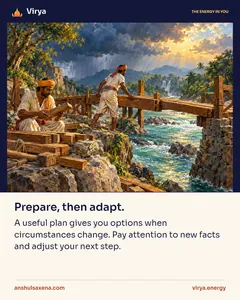
Plan ahead. Adapt when needed

Painting for Plan ahead. Adapt when needed
Virya Chanakya Niti 02. Plan ahead. Adapt when needed.. Preparation and quick thinking belong together. Indigo background, gold accents, Sora typography, and the full lotus logo.
Shloka: अनागतविधाता च प्रत्युत्पन्नमतिस्तथा। In simple words: One person prepares for what may come. Another thinks quickly when something happens. The verse values both abilities.
A plan needs room to change. Prepare: Think through the most likely obstacle. Notice: Look at what is happening, even when it differs from your plan. Respond: Change the next step when the facts change.
Your event venue cancels. 1. Keep a backup venue or online option ready. 2. Confirm the new facts before making announcements. 3. Choose the workable option and tell people clearly.
Preparation gives you options. Attention helps you use them. Reflection: What is one backup you could arrange today? Save this idea and share it thoughtfully.
Read as text

Preparation and quick thinking belong together.

In simple words: One person prepares for what may come. Another thinks quickly when something happens. The verse values both abilities.

A plan needs room to change
• Prepare: Think through the most likely obstacle.
• Notice: Look at what is happening, even when it differs from your plan.
• Respond: Change the next step when the facts change.

Try this: Your event venue cancels.
1. Keep a backup venue or online option ready.
2. Confirm the new facts before making announcements.
3. Choose the workable option and tell people clearly.

What is one backup you could arrange today?

Context: The rest of the verse contrasts both with simply leaving everything to fate.

Original Sanskrit excerpt + English paraphrase. Everyday examples are modern reflections.
Source: Chanakya Neeti, Ashwani Prashar, Diamond Pocket Books (2015), 13.6; supplied PDF p. 142. Numbering follows this edition.

Chanakya Niti

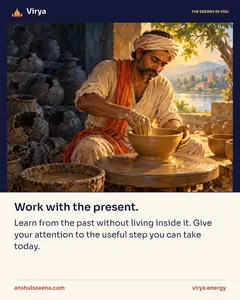
Work with the present

Painting for Work with the present
Virya Chanakya Niti 03. Work with the present. The next useful step is available now. Indigo background, gold accents, Sora typography, and the full lotus logo.
Shloka: वर्तमानेन कालेन प्रवर्तन्ते विचक्षणाः॥ In simple words: People with good judgment act according to the time they are in: the present.
Give today something useful. Learn from yesterday: Take the lesson without endlessly replaying the scene. Prepare for tomorrow: Make a practical plan for what you can influence. Act today: Choose one task that is within reach now.
You missed an opportunity. 1. Write down one thing you would do differently. 2. Find a smaller opportunity that is available now. 3. Take the first step before revisiting the old mistake.
Use the lesson. Take the next step. Reflection: What can you move forward today? Save this idea and share it thoughtfully.
Read as text

The next useful step is available now.

In simple words: People with good judgment act according to the time they are in: the present.

Give today something useful
• Learn from yesterday: Take the lesson without endlessly replaying the scene.
• Prepare for tomorrow: Make a practical plan for what you can influence.
• Act today: Choose one task that is within reach now.

Try this: You missed an opportunity.
1. Write down one thing you would do differently.
2. Find a smaller opportunity that is available now.
3. Take the first step before revisiting the old mistake.

What can you move forward today?

Context: The full verse contrasts present action with sorrow over the past and worry about the future.

Original Sanskrit excerpt + English paraphrase. Everyday examples are modern reflections.
Source: Chanakya Neeti, Ashwani Prashar, Diamond Pocket Books (2015), 13.2; supplied PDF p. 140. Numbering follows this edition.

Chanakya Niti

Borrow wisdom from future regret

Painting for Borrow wisdom from future regret
Virya Chanakya Niti 04. Borrow wisdom from future regret. Ask the hard question before the decision. Indigo background, gold accents, Sora typography, and the full lotus logo.
Shloka: उत्पन्नपश्चात्तापस्य बुद्धिर्भवति यादृशी।
तादृशी यदि पूर्वा स्यात्कस्य स्यान्न महोदयः॥ In simple words: After a mistake, we often see clearly. If we had that clarity beforehand, how much better could things go?
Rehearse the consequence. Imagine the outcome: If this goes badly, what will you wish you had checked? Find the weak point: Look for the assumption carrying the most weight. Add one safeguard: A small check now can prevent a bigger repair later.
You want to send an angry reply. 1. Imagine reading your message again tomorrow. 2. Remove claims you cannot support. 3. Send the version that still serves your purpose.
Pause before the choice becomes a regret. Reflection: What would tomorrow’s you ask you to check? Save this idea and share it thoughtfully.
Read as text

Ask the hard question before the decision.

In simple words: After a mistake, we often see clearly. If we had that clarity beforehand, how much better could things go?

Rehearse the consequence
• Imagine the outcome: If this goes badly, what will you wish you had checked?
• Find the weak point: Look for the assumption carrying the most weight.
• Add one safeguard: A small check now can prevent a bigger repair later.

Try this: You want to send an angry reply.
1. Imagine reading your message again tomorrow.
2. Remove claims you cannot support.
3. Send the version that still serves your purpose.

What would tomorrow’s you ask you to check?

Context: This is an invitation to think ahead, not a promise that every outcome can be controlled.

Original Sanskrit excerpt + English paraphrase. Everyday examples are modern reflections.
Source: Chanakya Neeti, Ashwani Prashar, Diamond Pocket Books (2015), 14.7; supplied PDF p. 150. Numbering follows this edition.

Chanakya Niti

Protect the plan. Do the work

Painting for Protect the plan. Do the work
Virya Chanakya Niti 05. Protect the plan. Do the work.. An idea needs thoughtful action before public applause. Indigo background, gold accents, Sora typography, and the full lotus logo.
Shloka: मनसा चिन्तितं कार्यं वाचा नैव प्रकाशयेत्।
मन्त्रेण रक्षयेद् गूढं कार्यं चाऽपि नियोजयेत्॥ In simple words: Do not announce every task you are planning. Protect it through careful counsel, then put it into action.
Choose the right audience. Get useful advice: Share with people who can improve the plan. Protect sensitive details: Be clear about what should stay private. Build evidence: Let completed work carry some of the message.
You are starting a side project. 1. Explain the idea to one trusted, relevant adviser. 2. Build a small version and test what works. 3. Share progress when you have something concrete.
Give your idea a chance to become real. Reflection: Who can help your plan before it goes public? Save this idea and share it thoughtfully.
Read as text

An idea needs thoughtful action before public applause.

In simple words: Do not announce every task you are planning. Protect it through careful counsel, then put it into action.

Choose the right audience
• Get useful advice: Share with people who can improve the plan.
• Protect sensitive details: Be clear about what should stay private.
• Build evidence: Let completed work carry some of the message.

Try this: You are starting a side project.
1. Explain the idea to one trusted, relevant adviser.
2. Build a small version and test what works.
3. Share progress when you have something concrete.

Who can help your plan before it goes public?

Context: “Mantra” here concerns counsel or deliberation. Trusted advice still has a place.

Original Sanskrit excerpt + English paraphrase. Everyday examples are modern reflections.
Source: Chanakya Neeti, Ashwani Prashar, Diamond Pocket Books (2015), 2.7; supplied PDF p. 31. Numbering follows this edition.

Chanakya Niti

Look before you let go

Painting for Look before you let go
Virya Chanakya Niti 06. Look before you let go. An uncertain promise deserves a careful check. Indigo background, gold accents, Sora typography, and the full lotus logo.
Shloka: यो ध्रुवाणि परित्यज्य ह्यध्रुवं परिसेवते।
ध्रुवाणि तस्य नश्यन्ति चाध्रुवं नष्टमेव तत्॥ In simple words: Someone who abandons what is secure for something uncertain may lose the secure thing and fail to gain the other.
Check the trade you are making. Name what is real: What do you already have or know? Name what is assumed: Which part of the new promise is untested? Keep a bridge: Look for a way to explore without losing every option.
A new commitment looks exciting. 1. Write down what you would have to give up. 2. Ask for evidence behind the promised benefit. 3. Try a limited version before making a full switch.
An attractive possibility is still a possibility. Reflection: What evidence would make your next risk a considered one? Save this idea and share it thoughtfully.
Read as text

An uncertain promise deserves a careful check.

In simple words: Someone who abandons what is secure for something uncertain may lose the secure thing and fail to gain the other.

Check the trade you are making
• Name what is real: What do you already have or know?
• Name what is assumed: Which part of the new promise is untested?
• Keep a bridge: Look for a way to explore without losing every option.

Try this: A new commitment looks exciting.
1. Write down what you would have to give up.
2. Ask for evidence behind the promised benefit.
3. Try a limited version before making a full switch.

What evidence would make your next risk a considered one?

Context: The warning is about an unexamined trade-off. Growth can still require a considered risk.

Original Sanskrit excerpt + English paraphrase. Everyday examples are modern reflections.
Source: Chanakya Neeti, Ashwani Prashar, Diamond Pocket Books (2015), 1.13; supplied PDF p. 21. Numbering follows this edition.

Chanakya Niti

When trouble comes, respond

Painting for When trouble comes, respond
Virya Chanakya Niti 07. When trouble comes, respond. Preparation matters. So does the moment of action. Indigo background, gold accents, Sora typography, and the full lotus logo.
Shloka: तावद् भयेषु भेतव्यं यावद्भयमनागतम्।
आगतं तु भयं दृष्ट्वा प्रहर्तव्यमशङ्कया॥ In simple words: Be cautious before a danger arrives. Once it is in front of you, face it with a decisive response.
Move from worry to response. Before: Notice risks and take reasonable precautions. During: Work out what needs attention first. After: Review the response and improve the preparation.
A presentation stops working. 1. Tell the audience what happened in one calm sentence. 2. Use your backup notes or explain the main idea aloud. 3. Deal with the technical cause after the session.
When the problem arrives, choose the next useful action. Reflection: What helps you act when your plan breaks? Save this idea and share it thoughtfully.
Read as text

Preparation matters. So does the moment of action.

In simple words: Be cautious before a danger arrives. Once it is in front of you, face it with a decisive response.

Move from worry to response
• Before: Notice risks and take reasonable precautions.
• During: Work out what needs attention first.
• After: Review the response and improve the preparation.

Try this: A presentation stops working.
1. Tell the audience what happened in one calm sentence.
2. Use your backup notes or explain the main idea aloud.
3. Deal with the technical cause after the session.

What helps you act when your plan breaks?

Context: The verse uses forceful language. The everyday example applies it to solving a problem.

Original Sanskrit excerpt + English paraphrase. Everyday examples are modern reflections.
Source: Chanakya Neeti, Ashwani Prashar, Diamond Pocket Books (2015), 5.3; supplied PDF p. 63. Numbering follows this edition.

Chanakya Niti

A lesson from the lion

Painting for A lesson from the lion
Virya Chanakya Niti 08. A lesson from the lion. Bring real effort to the task you choose. Indigo background, gold accents, Sora typography, and the full lotus logo.
Shloka: सर्वारम्भेण तत्कार्यं सिंहादेकं प्रचक्षते॥ In simple words: The lesson drawn from the lion is to undertake the task with full effort.
Give the task your attention. Choose deliberately: Decide what deserves your effort. Start properly: Set up the tools and attention the task needs. Work with care: A small job still deserves a reliable result.
You have a short task to finish. 1. Define what “finished” means. 2. Give it an uninterrupted block of time. 3. Check the result before moving on.
Small task. Whole attention. Reflection: What small job could you finish well today? Save this idea and share it thoughtfully.
Read as text

Bring real effort to the task you choose.

In simple words: The lesson drawn from the lion is to undertake the task with full effort.

Give the task your attention
• Choose deliberately: Decide what deserves your effort.
• Start properly: Set up the tools and attention the task needs.
• Work with care: A small job still deserves a reliable result.

Try this: You have a short task to finish.
1. Define what “finished” means.
2. Give it an uninterrupted block of time.
3. Check the result before moving on.

What small job could you finish well today?

Context: The preceding line includes tasks large and small. This is an animal analogy about effort.

Original Sanskrit excerpt + English paraphrase. Everyday examples are modern reflections.
Source: Chanakya Neeti, Ashwani Prashar, Diamond Pocket Books (2015), 6.15; supplied PDF p. 80. Numbering follows this edition.

Chanakya Niti

A lesson from the heron

Painting for A lesson from the heron
Virya Chanakya Niti 09. A lesson from the heron. Focus works best when it fits the situation. Indigo background, gold accents, Sora typography, and the full lotus logo.
Shloka: इन्द्रियाणि च संयम्य बकवत्पण्डितो नरः।
देशकालबलं ज्ञात्वा सर्वकार्याणि साधयेत्॥ In simple words: Like a heron, steady your senses. Act after understanding the place, the timing, and your strength.
Attention before movement. Steady yourself: Reduce the distraction pulling you in every direction. Read the situation: Notice the conditions that make action useful. Use your capacity: Choose a move you can support with the resources you have.
You need to raise a difficult issue. 1. Gather the facts without rehearsing an argument. 2. Choose a time when both people can listen. 3. Make one clear request that can be acted on.
Be still enough to notice. Be ready enough to act. Reflection: Where would better timing help you? Save this idea and share it thoughtfully.
Read as text

Focus works best when it fits the situation.

In simple words: Like a heron, steady your senses. Act after understanding the place, the timing, and your strength.

Attention before movement
• Steady yourself: Reduce the distraction pulling you in every direction.
• Read the situation: Notice the conditions that make action useful.
• Use your capacity: Choose a move you can support with the resources you have.

Try this: You need to raise a difficult issue.
1. Gather the facts without rehearsing an argument.
2. Choose a time when both people can listen.
3. Make one clear request that can be acted on.

Where would better timing help you?

Context: The bird is a model for patient attention and well-timed action.

Original Sanskrit excerpt + English paraphrase. Everyday examples are modern reflections.
Source: Chanakya Neeti, Ashwani Prashar, Diamond Pocket Books (2015), 6.16; supplied PDF p. 81. Numbering follows this edition.

Chanakya Niti

Strength also comes from thought

Painting for Strength also comes from thought
Virya Chanakya Niti 10. Strength also comes from thought. A better approach can change an uneven contest. Indigo background, gold accents, Sora typography, and the full lotus logo.
Shloka: बुद्धिर्यस्य बलं तस्य निर्बुद्धेस्तु कुतो बलम्।
वने सिंहो मदोन्मत्तः शशकेन निपातितः॥ In simple words: Intelligence is a source of strength. The verse recalls the proud lion defeated by a hare’s clever plan.
Look for a better method. Question the setup: Must the problem be solved in the obvious way? Find the constraint: What single obstacle is making everything difficult? Change the approach: Use a method that makes your available effort count.
Your small team has too much work. 1. Identify the repeated task taking the most time. 2. Simplify the process or create a reusable template. 3. Use the saved time for work that needs judgment.
A clearer method can multiply your effort. Reflection: Which problem needs a new approach rather than more effort? Save this idea and share it thoughtfully.
Read as text

A better approach can change an uneven contest.

In simple words: Intelligence is a source of strength. The verse recalls the proud lion defeated by a hare’s clever plan.

Look for a better method
• Question the setup: Must the problem be solved in the obvious way?
• Find the constraint: What single obstacle is making everything difficult?
• Change the approach: Use a method that makes your available effort count.

Try this: Your small team has too much work.
1. Identify the repeated task taking the most time.
2. Simplify the process or create a reusable template.
3. Use the saved time for work that needs judgment.

Which problem needs a new approach rather than more effort?

Context: The lion and hare belong to a teaching fable. The modern example concerns problem-solving.

Original Sanskrit excerpt + English paraphrase. Everyday examples are modern reflections.
Source: Chanakya Neeti, Ashwani Prashar, Diamond Pocket Books (2015), 10.16; supplied PDF p. 119. Numbering follows this edition.

Chanakya Niti

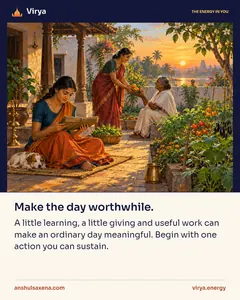
Learn a little. Use the day

Painting for Learn a little. Use the day
Virya Chanakya Niti 11. Learn a little. Use the day.. A useful day can begin with a very small act. Indigo background, gold accents, Sora typography, and the full lotus logo.
Shloka: अबन्ध्यं दिवसं कुर्याद् दानाध्ययनकर्मभिः॥ In simple words: Make the day fruitful through giving, studying, and worthwhile action.
Make progress small enough to begin. Learn: Understand one idea you did not know yesterday. Give: Offer a little time, help, or something useful. Do: Turn one good intention into an actual action.
You have ten spare minutes. 1. Read one short passage with attention. 2. Write its meaning in your own words. 3. Do one small thing that helps someone else.
A little learning. A little giving. A day well used. Reflection: What small act would make today feel worthwhile? Save this idea and share it thoughtfully.
Read as text

A useful day can begin with a very small act.

In simple words: Make the day fruitful through giving, studying, and worthwhile action.

Make progress small enough to begin
• Learn: Understand one idea you did not know yesterday.
• Give: Offer a little time, help, or something useful.
• Do: Turn one good intention into an actual action.

Try this: You have ten spare minutes.
1. Read one short passage with attention.
2. Write its meaning in your own words.
3. Do one small thing that helps someone else.

What small act would make today feel worthwhile?

Context: The first half mentions learning even a verse, part of a verse, or a letter.

Original Sanskrit excerpt + English paraphrase. Everyday examples are modern reflections.
Source: Chanakya Neeti, Ashwani Prashar, Diamond Pocket Books (2015), 2.13; supplied PDF p. 34. Numbering follows this edition.

Chanakya Niti

Knowledge is portable wealth

Painting for Knowledge is portable wealth
Virya Chanakya Niti 12. Knowledge is portable wealth. What you learn can travel with you. Indigo background, gold accents, Sora typography, and the full lotus logo.
Shloka: कामधेनुगुणा विद्या ह्यकाले फलदायिनी।
प्रवासे मातृसदृशा विद्या गुप्तं धनं स्मृतम्॥ In simple words: Knowledge is compared to a wish-fulfilling cow: it helps in difficult times, cares for you away from home, and is a hidden form of wealth.
Build what you can carry. A practical skill: Learn something that helps you solve a real problem. A way to understand: Learn how to ask questions and find reliable answers. A habit of learning: Keep building these abilities when life changes.
You are entering a new environment. 1. Learn the basic language, tools, or routines used there. 2. Ask someone experienced what beginners often miss. 3. Keep a short record of what you learn each week.
What you learn travels with you. Reflection: Which skill has helped you in an unfamiliar place? Save this idea and share it thoughtfully.
Read as text

What you learn can travel with you.

In simple words: Knowledge is compared to a wish-fulfilling cow: it helps in difficult times, cares for you away from home, and is a hidden form of wealth.

Build what you can carry
• A practical skill: Learn something that helps you solve a real problem.
• A way to understand: Learn how to ask questions and find reliable answers.
• A habit of learning: Keep building these abilities when life changes.

Try this: You are entering a new environment.
1. Learn the basic language, tools, or routines used there.
2. Ask someone experienced what beginners often miss.
3. Keep a short record of what you learn each week.

Which skill has helped you in an unfamiliar place?

Context: The verse uses traditional images to praise the lasting usefulness of learning.

Original Sanskrit excerpt + English paraphrase. Everyday examples are modern reflections.
Source: Chanakya Neeti, Ashwani Prashar, Diamond Pocket Books (2015), 4.5; supplied PDF p. 53. Numbering follows this edition.

Chanakya Niti

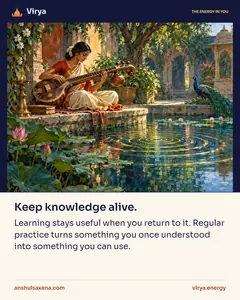
Keep knowledge alive with practice

Painting for Keep knowledge alive with practice
Virya Chanakya Niti 13. Keep knowledge alive with practice. Learning needs regular use. Indigo background, gold accents, Sora typography, and the full lotus logo.
Shloka: अभ्यासाद्धार्यते विद्या कुलं शीलेन धार्यते। In simple words: Knowledge is sustained by practice, just as a family’s standing is sustained by good conduct.
Return to what you learned. Recall: Try to explain the idea without looking at your notes. Use: Apply it to a small task. Correct: Notice the gap and practice that part again.
You finished an online lesson. 1. Close the video and summarise the main idea. 2. Try one exercise without following the demonstration. 3. Return to the step you could not complete.
Practice keeps learning within reach. Reflection: What have you learned recently but not yet used? Save this idea and share it thoughtfully.
Read as text

Learning needs regular use.

In simple words: Knowledge is sustained by practice, just as a family’s standing is sustained by good conduct.

Return to what you learned
• Recall: Try to explain the idea without looking at your notes.
• Use: Apply it to a small task.
• Correct: Notice the gap and practice that part again.

Try this: You finished an online lesson.
1. Close the video and summarise the main idea.
2. Try one exercise without following the demonstration.
3. Return to the step you could not complete.

What have you learned recently but not yet used?

Context: This excerpt links learning to repeated use and reputation to behavior.

Original Sanskrit excerpt + English paraphrase. Everyday examples are modern reflections.
Source: Chanakya Neeti, Ashwani Prashar, Diamond Pocket Books (2015), 5.8; supplied PDF p. 65. Numbering follows this edition.

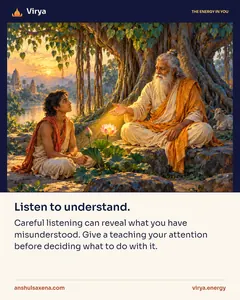
Chanakya Niti

Listen to understand

Painting for Listen to understand
Virya Chanakya Niti 14. Listen to understand. Learning begins when you make room to hear. Indigo background, gold accents, Sora typography, and the full lotus logo.
Shloka: श्रुत्वा धर्मं विजानाति श्रुत्वा त्यजति दुर्मतिम्।
श्रुत्वा ज्ञानमवाप्नोति श्रुत्वा मोक्षमवाप्नुयात्॥ In simple words: Through listening, a person learns right conduct, gives up mistaken thinking, gains knowledge, and may move toward liberation.
Let listening change something. Give attention: Let the other person finish the thought. Check meaning: Ask whether you understood correctly. Review your view: Keep room for a better explanation than your first one.
Someone explains why they disagree. 1. Listen for the reason behind their conclusion. 2. Restate that reason in your own words. 3. Ask what evidence would help resolve the difference.
A listening mind can become a learning mind. Reflection: When did listening last change your opinion? Save this idea and share it thoughtfully.
Read as text

Learning begins when you make room to hear.

In simple words: Through listening, a person learns right conduct, gives up mistaken thinking, gains knowledge, and may move toward liberation.

Let listening change something
• Give attention: Let the other person finish the thought.
• Check meaning: Ask whether you understood correctly.
• Review your view: Keep room for a better explanation than your first one.

Try this: Someone explains why they disagree.
1. Listen for the reason behind their conclusion.
2. Restate that reason in your own words.
3. Ask what evidence would help resolve the difference.

When did listening last change your opinion?

Context: Listening here includes hearing teachings. Moksha is a spiritual goal in the text.

Original Sanskrit excerpt + English paraphrase. Everyday examples are modern reflections.
Source: Chanakya Neeti, Ashwani Prashar, Diamond Pocket Books (2015), 6.1; supplied PDF p. 73. Numbering follows this edition.

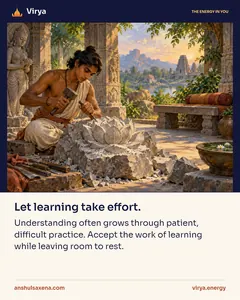
Chanakya Niti

Learning asks for effort

Painting for Learning asks for effort
Virya Chanakya Niti 15. Learning asks for effort. Some understanding comes only through doing the hard part. Indigo background, gold accents, Sora typography, and the full lotus logo.
Shloka: सुखार्थिनः कुतो विद्या कुतो विद्यार्थिनः सुखम्॥ In simple words: How can someone seeking only ease gain knowledge? How can a serious learner expect constant ease?
Accept the useful difficulty. Expect a challenge: Being new to something can feel awkward. Make it manageable: Break the difficult part into a smaller exercise. Keep a rhythm: Choose a pace you can return to tomorrow.
A new skill feels frustrating. 1. Choose one part to practice rather than the whole skill. 2. Work on it for a focused, manageable session. 3. Note one improvement and plan the next session.
Let effort be part of learning. Reflection: Which useful skill are you avoiding because it feels difficult? Save this idea and share it thoughtfully.
Read as text

Some understanding comes only through doing the hard part.

In simple words: How can someone seeking only ease gain knowledge? How can a serious learner expect constant ease?

Accept the useful difficulty
• Expect a challenge: Being new to something can feel awkward.
• Make it manageable: Break the difficult part into a smaller exercise.
• Keep a rhythm: Choose a pace you can return to tomorrow.

Try this: A new skill feels frustrating.
1. Choose one part to practice rather than the whole skill.
2. Work on it for a focused, manageable session.
3. Note one improvement and plan the next session.

Which useful skill are you avoiding because it feels difficult?

Context: The contrast is forceful. It praises effort; the daily-life application leaves room for rest.

Original Sanskrit excerpt + English paraphrase. Everyday examples are modern reflections.
Source: Chanakya Neeti, Ashwani Prashar, Diamond Pocket Books (2015), 10.3; supplied PDF p. 114. Numbering follows this edition.

Chanakya Niti

Read with your own judgment

Painting for Read with your own judgment
Virya Chanakya Niti 16. Read with your own judgment. A book can guide your thinking. You still need to think. Indigo background, gold accents, Sora typography, and the full lotus logo.
Shloka: यस्य नास्ति स्वयं प्रज्ञा शास्त्रं तस्य करोति किम्। In simple words: What can a text do for someone who does not bring their own understanding to it?
Ask three questions as you read. What does it mean?: Restate the claim in everyday language. When does it fit?: Look at the setting and assumptions behind it. How would I use it?: Try a concrete example and notice its limits.
You see a powerful quotation online. 1. Find where the quotation comes from. 2. Read enough surrounding text to understand it. 3. Decide whether its idea fits your situation.
Bring attention and judgment to the page. Reflection: What idea have you repeated without examining it? Save this idea and share it thoughtfully.
Read as text

A book can guide your thinking. You still need to think.

In simple words: What can a text do for someone who does not bring their own understanding to it?

Ask three questions as you read
• What does it mean?: Restate the claim in everyday language.
• When does it fit?: Look at the setting and assumptions behind it.
• How would I use it?: Try a concrete example and notice its limits.

Try this: You see a powerful quotation online.
1. Find where the quotation comes from.
2. Read enough surrounding text to understand it.
3. Decide whether its idea fits your situation.

What idea have you repeated without examining it?

Context: This excerpt asks the reader to engage with a teaching, rather than merely possess it.

Original Sanskrit excerpt + English paraphrase. Everyday examples are modern reflections.
Source: Chanakya Neeti, Ashwani Prashar, Diamond Pocket Books (2015), 10.9; supplied PDF p. 116. Numbering follows this edition.

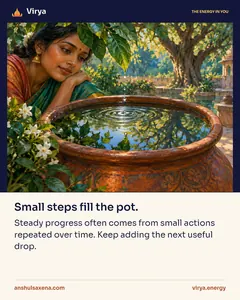
Chanakya Niti

Small steps fill the pot

Painting for Small steps fill the pot
Virya Chanakya Niti 17. Small steps fill the pot. Steady additions become something substantial. Indigo background, gold accents, Sora typography, and the full lotus logo.
Shloka: जलबिन्दुनिपातेन क्रमशः पूर्यते घटः। In simple words: A pot fills gradually as drops of water fall into it.
Build through repeated small acts. Choose a small unit: Make the step easy to understand and repeat. Return regularly: A single drop is small; the repeated act matters. Notice the accumulation: Look back occasionally to see what has grown.
You want to read more. 1. Keep one book somewhere you will see it. 2. Read a small amount at a regular time. 3. Write one sentence about what you understood.
One small act. Repeated with care. Reflection: What could you add one “drop” to today? Save this idea and share it thoughtfully.
Read as text

Steady additions become something substantial.

In simple words: A pot fills gradually as drops of water fall into it.

Build through repeated small acts
• Choose a small unit: Make the step easy to understand and repeat.
• Return regularly: A single drop is small; the repeated act matters.
• Notice the accumulation: Look back occasionally to see what has grown.

Try this: You want to read more.
1. Keep one book somewhere you will see it.
2. Read a small amount at a regular time.
3. Write one sentence about what you understood.

What could you add one “drop” to today?

Context: The second half applies the image to knowledge, right conduct, and wealth.

Original Sanskrit excerpt + English paraphrase. Everyday examples are modern reflections.
Source: Chanakya Neeti, Ashwani Prashar, Diamond Pocket Books (2015), 12.20; supplied PDF p. 139. Numbering follows this edition.

Chanakya Niti

A teacher helps. You still must dig

Painting for A teacher helps. You still must dig
Virya Chanakya Niti 18. A teacher helps. You still must dig.. Learning asks for active effort from the learner. Indigo background, gold accents, Sora typography, and the full lotus logo.
Shloka: यथा खनित्वा खनित्रेण भूतले वारि विन्दति।
तथा गुरुगतां विद्यां शुश्रूषुरधिगच्छति॥ In simple words: As digging brings water from the ground, attentive service and effort help a learner gain the knowledge held by a teacher.
Make guidance usable. Prepare: Arrive with a real question or an attempt. Listen closely: Understand the reason behind the correction. Try again: Apply the guidance while it is still fresh.
You have time with a mentor. 1. Bring a specific problem and the work you have tried. 2. Ask for feedback on the part you cannot yet solve. 3. Return with a revised attempt, not only another question.
Good guidance grows through your participation. Reflection: How could you make your next learning conversation more useful? Save this idea and share it thoughtfully.
Read as text

Learning asks for active effort from the learner.

In simple words: As digging brings water from the ground, attentive service and effort help a learner gain the knowledge held by a teacher.

Make guidance usable
• Prepare: Arrive with a real question or an attempt.
• Listen closely: Understand the reason behind the correction.
• Try again: Apply the guidance while it is still fresh.

Try this: You have time with a mentor.
1. Bring a specific problem and the work you have tried.
2. Ask for feedback on the part you cannot yet solve.
3. Return with a revised attempt, not only another question.

How could you make your next learning conversation more useful?

Context: Shushrusha includes attentive listening and a willingness to learn and serve.

Original Sanskrit excerpt + English paraphrase. Everyday examples are modern reflections.
Source: Chanakya Neeti, Ashwani Prashar, Diamond Pocket Books (2015), 13.16; supplied PDF p. 146. Numbering follows this edition.

Chanakya Niti

Give your skills good judgment

Painting for Give your skills good judgment
Virya Chanakya Niti 19. Give your skills good judgment. Ability shines when it is used thoughtfully. Indigo background, gold accents, Sora typography, and the full lotus logo.
Shloka: विवेकिनमनुप्राप्तो गुणो याति मनोज्ञताम्।
सुतरां रत्नमाभाति चामीकरनियोजितम्॥ In simple words: A good quality becomes more pleasing in a discerning person, like a jewel that shines when set in gold.
Skill needs a wise setting. Purpose: Know what the skill is meant to achieve. Timing: Use it when it can actually help. Care: Consider the people affected by how you use it.
You are good at spotting mistakes. 1. Check whether the person is ready for feedback. 2. Explain the most useful correction first. 3. Help them see how to improve the next attempt.
Use your ability with understanding. Reflection: Which of your strengths becomes better with a little more judgment? Save this idea and share it thoughtfully.
Read as text

Ability shines when it is used thoughtfully.

In simple words: A good quality becomes more pleasing in a discerning person, like a jewel that shines when set in gold.

Skill needs a wise setting
• Purpose: Know what the skill is meant to achieve.
• Timing: Use it when it can actually help.
• Care: Consider the people affected by how you use it.

Try this: You are good at spotting mistakes.
1. Check whether the person is ready for feedback.
2. Explain the most useful correction first.
3. Help them see how to improve the next attempt.

Which of your strengths becomes better with a little more judgment?

Context: The jewel is a comparison for ability supported by judgment.

Original Sanskrit excerpt + English paraphrase. Everyday examples are modern reflections.
Source: Chanakya Neeti, Ashwani Prashar, Diamond Pocket Books (2015), 16.9; supplied PDF p. 171. Numbering follows this edition.

Chanakya Niti

Make knowledge ready to use

Painting for Make knowledge ready to use
Virya Chanakya Niti 20. Make knowledge ready to use. A saved page is only a starting point. Indigo background, gold accents, Sora typography, and the full lotus logo.
Shloka: पुस्तकेषु च या विद्या परहस्तेषु च यद्धनम्।
उत्पन्नेषु च कार्येषु न सा विद्या न तद्धनम्॥ In simple words: Knowledge that remains only in books, like money held by someone else, may not help when the moment for action arrives.
Turn a reference into a resource. Understand it: Know the main idea beyond the saved quotation. Practice it: Try the process at least once. Find it easily: Keep useful references organized for the moment of need.
Your saved tutorials keep growing. 1. Choose one tutorial tied to a task you actually have. 2. Complete the task with your own example. 3. Keep a brief checklist of the steps you used.
Let what you know help with what you do. Reflection: Which saved lesson will you put into practice this week? Save this idea and share it thoughtfully.
Read as text

A saved page is only a starting point.

In simple words: Knowledge that remains only in books, like money held by someone else, may not help when the moment for action arrives.

Turn a reference into a resource
• Understand it: Know the main idea beyond the saved quotation.
• Practice it: Try the process at least once.
• Find it easily: Keep useful references organized for the moment of need.

Try this: Your saved tutorials keep growing.
1. Choose one tutorial tied to a task you actually have.
2. Complete the task with your own example.
3. Keep a brief checklist of the steps you used.

Which saved lesson will you put into practice this week?

Context: The point is usable access and understanding, not a rejection of books or learning aids.

Original Sanskrit excerpt + English paraphrase. Everyday examples are modern reflections.
Source: Chanakya Neeti, Ashwani Prashar, Diamond Pocket Books (2015), 16.20; supplied PDF p. 175. Numbering follows this edition.

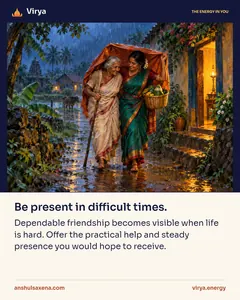
Chanakya Niti

Friendship shows up in difficulty

Painting for Friendship shows up in difficulty
Virya Chanakya Niti 21. Friendship shows up in difficulty. Support becomes visible when it asks something of us. Indigo background, gold accents, Sora typography, and the full lotus logo.
Shloka: आतुरे व्यसने प्राप्ते दुर्भिक्षे शत्रुसंकटे।
राजद्वारे श्मशाने च यस्तिष्ठति स बान्धवः॥ In simple words: A true companion stands beside you in illness, hardship, scarcity, danger, public trouble, and grief.
Care becomes concrete. Stay in contact: Do not let discomfort make you disappear. Offer something specific: A useful action is easier to accept than a vague promise. Follow through: Reliability matters after the first conversation too.
A friend is going through a hard week. 1. Ask what would help without demanding personal details. 2. Offer one specific task you can take care of. 3. Check back when you said you would.
Be someone who stays present. Reflection: Who has stood beside you when life was difficult? Save this idea and share it thoughtfully.
Read as text

Support becomes visible when it asks something of us.

In simple words: A true companion stands beside you in illness, hardship, scarcity, danger, public trouble, and grief.

Care becomes concrete
• Stay in contact: Do not let discomfort make you disappear.
• Offer something specific: A useful action is easier to accept than a vague promise.
• Follow through: Reliability matters after the first conversation too.

Try this: A friend is going through a hard week.
1. Ask what would help without demanding personal details.
2. Offer one specific task you can take care of.
3. Check back when you said you would.

Who has stood beside you when life was difficult?

Context: The verse names demanding situations to describe dependable companionship.

Original Sanskrit excerpt + English paraphrase. Everyday examples are modern reflections.
Source: Chanakya Neeti, Ashwani Prashar, Diamond Pocket Books (2015), 1.12; supplied PDF p. 20. Numbering follows this edition.

Chanakya Niti

Look beyond sweet words

Painting for Look beyond sweet words
Virya Chanakya Niti 22. Look beyond sweet words. Friendly speech and friendly conduct should agree. Indigo background, gold accents, Sora typography, and the full lotus logo.
Shloka: परोक्षे कार्यहन्तारं प्रत्यक्षे प्रियवादिनम्।
वर्जयेत्तादृशं मित्रं विषकुम्भं पयोमुखम्॥ In simple words: Avoid a supposed friend who speaks pleasantly to your face but harms your work behind your back: a pot of poison with milk at the top.
Look for consistent behavior. What is said: Notice the promise or praise. What is done: Check whether actions support those words. What repeats: Base trust on a pattern, not one uncomfortable moment.
Someone praises you but blocks your work. 1. Check the facts before deciding what happened. 2. Raise the specific behavior directly when appropriate. 3. Set a boundary if the harmful pattern continues.
Let trust grow from words and actions. Reflection: What behavior helps you recognize a dependable friend? Save this idea and share it thoughtfully.
Read as text

Friendly speech and friendly conduct should agree.

In simple words: Avoid a supposed friend who speaks pleasantly to your face but harms your work behind your back: a pot of poison with milk at the top.

Look for consistent behavior
• What is said: Notice the promise or praise.
• What is done: Check whether actions support those words.
• What repeats: Base trust on a pattern, not one uncomfortable moment.

Try this: Someone praises you but blocks your work.
1. Check the facts before deciding what happened.
2. Raise the specific behavior directly when appropriate.
3. Set a boundary if the harmful pattern continues.

What behavior helps you recognize a dependable friend?

Context: The strong image describes a pattern of hidden harm, not an ordinary disagreement.

Original Sanskrit excerpt + English paraphrase. Everyday examples are modern reflections.
Source: Chanakya Neeti, Ashwani Prashar, Diamond Pocket Books (2015), 2.5; supplied PDF p. 30. Numbering follows this edition.

Chanakya Niti

Trust can have boundaries

Painting for Trust can have boundaries
Virya Chanakya Niti 23. Trust can have boundaries. You can care for someone and still choose what to share. Indigo background, gold accents, Sora typography, and the full lotus logo.
Shloka: न विश्वसेत्कुमित्रे च मित्रे चापि न विश्वसेत्।
कदाचित्कुपितं मित्रं सर्वं गुह्यं प्रकाशयेत्॥ In simple words: Do not put complete trust in a harmful friend, or unguarded trust even in a friend: anger may lead them to reveal a secret.
Share with care. Your own story: Choose what you are comfortable making known. Someone else’s story: Their privacy is not yours to give away. A needed conversation: Find a trustworthy person when you need help or advice.
A conversation turns to private details. 1. Ask whether the information is yours to share. 2. Leave out details that serve no useful purpose. 3. State clearly when something is confidential.
Closeness can include respect for privacy. Reflection: What boundary makes trust easier for you? Save this idea and share it thoughtfully.
Read as text

You can care for someone and still choose what to share.

In simple words: Do not put complete trust in a harmful friend, or unguarded trust even in a friend: anger may lead them to reveal a secret.

Share with care
• Your own story: Choose what you are comfortable making known.
• Someone else’s story: Their privacy is not yours to give away.
• A needed conversation: Find a trustworthy person when you need help or advice.

Try this: A conversation turns to private details.
1. Ask whether the information is yours to share.
2. Leave out details that serve no useful purpose.
3. State clearly when something is confidential.

What boundary makes trust easier for you?

Context: This is a strongly cautious verse. The modern reflection focuses on thoughtful privacy.

Original Sanskrit excerpt + English paraphrase. Everyday examples are modern reflections.
Source: Chanakya Neeti, Ashwani Prashar, Diamond Pocket Books (2015), 2.6; supplied PDF p. 30. Numbering follows this edition.

Chanakya Niti

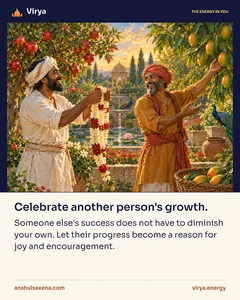
Celebrate someone else’s win

Painting for Celebrate someone else’s win
Virya Chanakya Niti 24. Celebrate someone else’s win. Your response to another person’s success reveals something. Indigo background, gold accents, Sora typography, and the full lotus logo.
Shloka: साधवः परसम्पत्तौ खलाः परविपत्तिषु॥ In simple words: Good people are pleased by another person’s prosperity; the malicious take pleasure in another’s misfortune.
Make room for shared joy. Notice the reaction: Envy can appear before you have chosen how to respond. Recognize the effort: Name something specific that the person did well. Return to your path: Their achievement need not decide your next step.
A colleague gets an opportunity you wanted. 1. Offer a sincere, specific congratulations. 2. Give yourself time to process your own disappointment. 3. Ask what you can learn for your next opportunity.
Someone else’s progress can be good news. Reflection: Whose recent achievement could you celebrate today? Save this idea and share it thoughtfully.
Read as text

Your response to another person’s success reveals something.

In simple words: Good people are pleased by another person’s prosperity; the malicious take pleasure in another’s misfortune.

Make room for shared joy
• Notice the reaction: Envy can appear before you have chosen how to respond.
• Recognize the effort: Name something specific that the person did well.
• Return to your path: Their achievement need not decide your next step.

Try this: A colleague gets an opportunity you wanted.
1. Offer a sincere, specific congratulations.
2. Give yourself time to process your own disappointment.
3. Ask what you can learn for your next opportunity.

Whose recent achievement could you celebrate today?

Context: This is the second half of a verse about what brings different beings joy.

Original Sanskrit excerpt + English paraphrase. Everyday examples are modern reflections.
Source: Chanakya Neeti, Ashwani Prashar, Diamond Pocket Books (2015), 7.9; supplied PDF p. 89. Numbering follows this edition.

Chanakya Niti

Keep your kindness. Use discernment

Painting for Keep your kindness. Use discernment
Virya Chanakya Niti 25. Keep your kindness. Use discernment.. Being openhearted still leaves room for boundaries. Indigo background, gold accents, Sora typography, and the full lotus logo.
Shloka: नात्यन्तं सरलेन भाव्यं गत्वा पश्य वनस्थलीम्।
छिद्यन्ते सरलास्तत्र कुब्जास्तिष्ठन्ति पादपाः॥ In simple words: Do not be excessively unguarded. The verse points to a forest: straight trees are cut, while crooked ones remain.
Be clear about your limits. Check the request: Understand what someone is actually asking of you. Notice the cost: Count the time and effort you would be promising. Answer honestly: A clear limit is more useful than a reluctant promise.
Someone repeatedly asks for unpaid help. 1. Decide what you can reasonably offer. 2. State that limit in a calm, direct sentence. 3. Suggest a workable alternative if you have one.
Kindness works better with clear limits. Reflection: Where would a clear boundary help you remain kind? Save this idea and share it thoughtfully.
Read as text

Being openhearted still leaves room for boundaries.

In simple words: Do not be excessively unguarded. The verse points to a forest: straight trees are cut, while crooked ones remain.

Be clear about your limits
• Check the request: Understand what someone is actually asking of you.
• Notice the cost: Count the time and effort you would be promising.
• Answer honestly: A clear limit is more useful than a reluctant promise.

Try this: Someone repeatedly asks for unpaid help.
1. Decide what you can reasonably offer.
2. State that limit in a calm, direct sentence.
3. Suggest a workable alternative if you have one.

Where would a clear boundary help you remain kind?

Context: The metaphor warns against being easily exploited. The modern application keeps honesty intact.

Original Sanskrit excerpt + English paraphrase. Everyday examples are modern reflections.
Source: Chanakya Neeti, Ashwani Prashar, Diamond Pocket Books (2015), 7.12; supplied PDF p. 90. Numbering follows this edition.

Chanakya Niti

Closeness is more than distance

Painting for Closeness is more than distance
Virya Chanakya Niti 26. Closeness is more than distance. Being remembered can matter more than being nearby. Indigo background, gold accents, Sora typography, and the full lotus logo.
Shloka: दूरस्थोऽपि न दूरस्थो यो यस्य मनसि स्थितः।
यो यस्य हृदये नास्ति समीपस्थोऽपि दूरतः॥ In simple words: Someone held in your mind is close even when far away. Someone absent from your heart can feel distant even while nearby.
Give attention a visible form. Remember: Notice what matters in the other person’s life. Reach out: Make contact without always waiting for a reason. Be present: Give the conversation your attention when it happens.
A close friend lives far away. 1. Ask about something they mentioned last time. 2. Choose a way to stay in touch that suits you both. 3. Keep one small promise from the conversation.
Distance can be large. Attention can still be close. Reflection: Who would appreciate hearing from you? Save this idea and share it thoughtfully.
Read as text

Being remembered can matter more than being nearby.

In simple words: Someone held in your mind is close even when far away. Someone absent from your heart can feel distant even while nearby.

Give attention a visible form
• Remember: Notice what matters in the other person’s life.
• Reach out: Make contact without always waiting for a reason.
• Be present: Give the conversation your attention when it happens.

Try this: A close friend lives far away.
1. Ask about something they mentioned last time.
2. Choose a way to stay in touch that suits you both.
3. Keep one small promise from the conversation.

Who would appreciate hearing from you?

Context: This verse speaks about emotional connection, rather than physical location.

Original Sanskrit excerpt + English paraphrase. Everyday examples are modern reflections.
Source: Chanakya Neeti, Ashwani Prashar, Diamond Pocket Books (2015), 14.9; supplied PDF p. 151. Numbering follows this edition.

Chanakya Niti

Keep your speech clear of slander

Painting for Keep your speech clear of slander
Virya Chanakya Niti 27. Keep your speech clear of slander. A conversation can be useful without putting someone down. Indigo background, gold accents, Sora typography, and the full lotus logo.
Shloka: यदीच्छसि वशीकर्तुं जगदेकेन कर्मणा।
परापवादशास्त्रेभ्यो गां चरन्तीं निवारय॥ In simple words: If you want to win people over through one practice, restrain your speech from running into slander of others.
Change the direction of the talk. Check what you know: Separate a fact from an assumption or rumour. Check the purpose: Will repeating it help anyone address the issue? Speak constructively: Discuss a specific action with someone able to respond.
A group chat starts mocking someone. 1. Avoid adding an unverified story. 2. Redirect the conversation to the actual issue. 3. If action is needed, raise the facts with the right person.
Give your words a better purpose. Reflection: What helps you steer a conversation away from gossip? Save this idea and share it thoughtfully.
Read as text

A conversation can be useful without putting someone down.

In simple words: If you want to win people over through one practice, restrain your speech from running into slander of others.

Change the direction of the talk
• Check what you know: Separate a fact from an assumption or rumour.
• Check the purpose: Will repeating it help anyone address the issue?
• Speak constructively: Discuss a specific action with someone able to respond.

Try this: A group chat starts mocking someone.
1. Avoid adding an unverified story.
2. Redirect the conversation to the actual issue.
3. If action is needed, raise the facts with the right person.

What helps you steer a conversation away from gossip?

Context: “Gau” can mean speech as well as a cow. The verse uses a roaming-cow image.

Original Sanskrit excerpt + English paraphrase. Everyday examples are modern reflections.
Source: Chanakya Neeti, Ashwani Prashar, Diamond Pocket Books (2015), 14.14; supplied PDF p. 153. Numbering follows this edition.

Chanakya Niti

Kind words cost little

Painting for Kind words cost little
Virya Chanakya Niti 28. Kind words cost little. The way you speak can make a difficult moment easier. Indigo background, gold accents, Sora typography, and the full lotus logo.
Shloka: प्रियवाक्यप्रदानेन सर्वे तुष्यन्ति मानवाः।
तस्मात् तदेव वक्तव्यं वचने का दरिद्रता॥ In simple words: Pleasant words bring people joy. So speak kindly: why be miserly with words?
Make kindness specific. Thank clearly: Name the effort you appreciated. Disagree respectfully: Address the idea without attacking the person. Ask considerately: Leave room for the other person’s circumstances.
You need someone to correct an error. 1. Describe the error in plain, neutral language. 2. Explain what needs to change and why. 3. Acknowledge their help when it is fixed.
A clear message can also be a kind one. Reflection: Where could a gentler sentence improve your day? Save this idea and share it thoughtfully.
Read as text

The way you speak can make a difficult moment easier.

In simple words: Pleasant words bring people joy. So speak kindly: why be miserly with words?

Make kindness specific
• Thank clearly: Name the effort you appreciated.
• Disagree respectfully: Address the idea without attacking the person.
• Ask considerately: Leave room for the other person’s circumstances.

Try this: You need someone to correct an error.
1. Describe the error in plain, neutral language.
2. Explain what needs to change and why.
3. Acknowledge their help when it is fixed.

Where could a gentler sentence improve your day?

Context: Pleasant speech can remain truthful. Empty flattery is not needed for the modern application.

Original Sanskrit excerpt + English paraphrase. Everyday examples are modern reflections.
Source: Chanakya Neeti, Ashwani Prashar, Diamond Pocket Books (2015), 16.17; supplied PDF p. 174. Numbering follows this edition.

Chanakya Niti

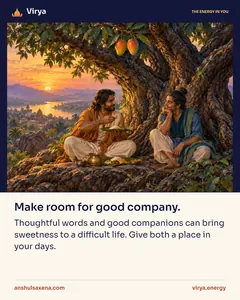
Two things that sweeten life

Painting for Two things that sweeten life
Virya Chanakya Niti 29. Two things that sweeten life. Good words and good company can make a hard world gentler. Indigo background, gold accents, Sora typography, and the full lotus logo.
Shloka: संसारकटुवृक्षस्य द्वे फले ह्यमृतोपमे।
सुभाषितं च सुस्वादुः संगतिः सज्जने जने॥ In simple words: On the bitter tree of worldly life are two sweet fruits: thoughtful words and the company of good people.
Choose what you spend time with. Words worth keeping: Read or hear something that deepens your understanding. People worth meeting: Make time for people whose conduct you respect. Something worth passing on: Share an idea that helps rather than merely provokes.
Your feed leaves you feeling drained. 1. Replace one unhelpful source with something thoughtful. 2. Arrange a conversation with someone you value. 3. Keep one useful idea from either experience.
Make room for good words and good people. Reflection: Which words or company have nourished you lately? Save this idea and share it thoughtfully.
Read as text

Good words and good company can make a hard world gentler.

In simple words: On the bitter tree of worldly life are two sweet fruits: thoughtful words and the company of good people.

Choose what you spend time with
• Words worth keeping: Read or hear something that deepens your understanding.
• People worth meeting: Make time for people whose conduct you respect.
• Something worth passing on: Share an idea that helps rather than merely provokes.

Try this: Your feed leaves you feeling drained.
1. Replace one unhelpful source with something thoughtful.
2. Arrange a conversation with someone you value.
3. Keep one useful idea from either experience.

Which words or company have nourished you lately?

Context: The tree and its fruit are an image for finding nourishment within ordinary life.

Original Sanskrit excerpt + English paraphrase. Everyday examples are modern reflections.
Source: Chanakya Neeti, Ashwani Prashar, Diamond Pocket Books (2015), 16.18; supplied PDF p. 175. Numbering follows this edition.

Chanakya Niti

Who helps you feel at home?

Painting for Who helps you feel at home?
Virya Chanakya Niti 30. Who helps you feel at home?. Relationships can offer shelter from a demanding world. Indigo background, gold accents, Sora typography, and the full lotus logo.
Shloka: संसारातपदग्धानां त्रयो विश्रान्तिहेतवः।
अपत्यं च कलत्रं च सतां संगतिरेव च॥ In simple words: For those scorched by life’s troubles, the verse names three sources of rest: children, a spouse, and good company.
Notice where you can rest. Safety: You can speak without being constantly on guard. Care: Someone notices how you are doing. Reciprocity: You also make room for the other person to be heard.
You have had an exhausting day. 1. Reach out to someone who usually listens with care. 2. Say whether you need advice, help, or simply company. 3. Make space to hear how they are doing too.
Cherish the people with whom you can exhale. Reflection: Who gives you a sense of rest and belonging? Save this idea and share it thoughtfully.
Read as text

Relationships can offer shelter from a demanding world.

In simple words: For those scorched by life’s troubles, the verse names three sources of rest: children, a spouse, and good company.

Notice where you can rest
• Safety: You can speak without being constantly on guard.
• Care: Someone notices how you are doing.
• Reciprocity: You also make room for the other person to be heard.

Try this: You have had an exhausting day.
1. Reach out to someone who usually listens with care.
2. Say whether you need advice, help, or simply company.
3. Make space to hear how they are doing too.

Who gives you a sense of rest and belonging?

Context: The verse reflects a householder’s setting. The modern reflection includes other caring relationships.

Original Sanskrit excerpt + English paraphrase. Everyday examples are modern reflections.
Source: Chanakya Neeti, Ashwani Prashar, Diamond Pocket Books (2015), 4.10; supplied PDF p. 55. Numbering follows this edition.

Chanakya Niti

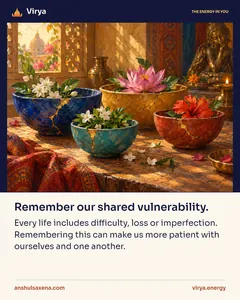
No life is free of difficulty

Painting for No life is free of difficulty
Virya Chanakya Niti 31. No life is free of difficulty. A difficult season does not make your life uniquely broken. Indigo background, gold accents, Sora typography, and the full lotus logo.
Shloka: कस्य दोषः कुले नास्ति व्याधिना को न पीडितः।
व्यसनं केन न प्राप्तं कस्य सौख्यं निरन्तरम्॥ In simple words: Which family has no faults? Who has never suffered illness or hardship? Whose happiness continues without interruption?
Meet difficulty without comparison. Remember the unseen: Other people’s full lives are larger than what they show. Name your need: Be specific about what is difficult right now. Accept support: Shared vulnerability can make asking for help easier.
Everyone else seems to be doing better. 1. Step back from the comparison for a moment. 2. Write down the problem you actually need to address. 3. Choose one person or practical step that could help.
Hardship is part of being human. Reflection: What changes when you stop treating difficulty as a personal failure? Save this idea and share it thoughtfully.
Read as text

A difficult season does not make your life uniquely broken.

In simple words: Which family has no faults? Who has never suffered illness or hardship? Whose happiness continues without interruption?

Meet difficulty without comparison
• Remember the unseen: Other people’s full lives are larger than what they show.
• Name your need: Be specific about what is difficult right now.
• Accept support: Shared vulnerability can make asking for help easier.

Try this: Everyone else seems to be doing better.
1. Step back from the comparison for a moment.
2. Write down the problem you actually need to address.
3. Choose one person or practical step that could help.

What changes when you stop treating difficulty as a personal failure?

Context: These rhetorical questions point to shared human vulnerability.

Original Sanskrit excerpt + English paraphrase. Everyday examples are modern reflections.
Source: Chanakya Neeti, Ashwani Prashar, Diamond Pocket Books (2015), 3.1; supplied PDF p. 40. Numbering follows this edition.

Chanakya Niti

Keep your values under pressure

Painting for Keep your values under pressure
Virya Chanakya Niti 32. Keep your values under pressure. Character matters most when keeping it is difficult. Indigo background, gold accents, Sora typography, and the full lotus logo.
Shloka: प्रलये भिन्नमर्यादा भवन्ति किल सागराः।
सागरा भेदमिच्छन्ति प्रलयेऽपि न साधवः॥ In simple words: Even oceans cross their boundaries at the world’s dissolution, but good people do not abandon theirs, even in upheaval.
Decide your limits early. Name the value: Know what matters before the pressure rises. Spot the excuse: Notice when urgency is being used to justify a wrong action. Find another route: Look for a way forward that preserves the value.
You are asked to hide an inconvenient mistake. 1. Check exactly what happened. 2. Explain the mistake and its likely effect clearly. 3. Help repair it and improve the process.
Pressure need not choose your principles. Reflection: Which value do you want to keep when things get difficult? Save this idea and share it thoughtfully.
Read as text

Character matters most when keeping it is difficult.

In simple words: Even oceans cross their boundaries at the world’s dissolution, but good people do not abandon theirs, even in upheaval.

Decide your limits early
• Name the value: Know what matters before the pressure rises.
• Spot the excuse: Notice when urgency is being used to justify a wrong action.
• Find another route: Look for a way forward that preserves the value.

Try this: You are asked to hide an inconvenient mistake.
1. Check exactly what happened.
2. Explain the mistake and its likely effect clearly.
3. Help repair it and improve the process.

Which value do you want to keep when things get difficult?

Context: This is poetic praise of moral steadiness. “Boundaries” here means limits of good conduct.

Original Sanskrit excerpt + English paraphrase. Everyday examples are modern reflections.
Source: Chanakya Neeti, Ashwani Prashar, Diamond Pocket Books (2015), 3.6; supplied PDF p. 43. Numbering follows this edition.

Chanakya Niti

4 signs of character

Painting for 4 signs of character
Virya Chanakya Niti 33. 4 signs of character. Look at what someone repeatedly brings to life. Indigo background, gold accents, Sora typography, and the full lotus logo.
Shloka: तथा चतुर्भिः पुरुषः परीक्ष्यते
त्यागेन शीलेन गुणेन कर्मणा॥ In simple words: A person is assessed through four things: generosity, conduct, good qualities, and actions.
Character leaves evidence. Generosity + conduct: What do they share, and how do they treat people? Good qualities: What strengths or virtues do they bring? Actions: What do they actually follow through on?
You are choosing a collaborator. 1. Ask about a real project and what they contributed. 2. Notice how they discuss people who helped them. 3. Start with a clear, limited commitment and review the result.
Look for character in repeated actions. Reflection: Which of the four signs matters most in your collaborations? Save this idea and share it thoughtfully.
Read as text

Look at what someone repeatedly brings to life.

In simple words: A person is assessed through four things: generosity, conduct, good qualities, and actions.

Character leaves evidence
• Generosity + conduct: What do they share, and how do they treat people?
• Good qualities: What strengths or virtues do they bring?
• Actions: What do they actually follow through on?

Try this: You are choosing a collaborator.
1. Ask about a real project and what they contributed.
2. Notice how they discuss people who helped them.
3. Start with a clear, limited commitment and review the result.

Which of the four signs matters most in your collaborations?

Context: The full verse compares this with testing gold. The four signs concern conduct, not appearance.

Original Sanskrit excerpt + English paraphrase. Everyday examples are modern reflections.
Source: Chanakya Neeti, Ashwani Prashar, Diamond Pocket Books (2015), 5.2; supplied PDF p. 62. Numbering follows this edition.

Chanakya Niti

Notice what burns within

Painting for Notice what burns within
Virya Chanakya Niti 34. Notice what burns within. Strong impulses can shape a decision before you notice. Indigo background, gold accents, Sora typography, and the full lotus logo.
Shloka: नास्ति कामसमो व्याधिर्नास्ति मोहसमो रिपुः।
नास्ति कोपसमो वह्निर्नास्ति ज्ञानात्परं सुखम्॥ In simple words: The verse compares craving to illness, delusion to an enemy, and anger to fire. It praises the happiness that comes from understanding.
Create space before reacting. Notice the pull: What do you urgently want to get or defend? Check the story: What have you assumed about the other person? Choose the response: What action would still make sense once you are calm?
A comment makes you angry. 1. Pause before replying or forwarding it. 2. Separate the actual words from your interpretation. 3. Choose a response that addresses the real issue.
Let understanding shape the response. Reflection: What helps you pause before anger becomes action? Save this idea and share it thoughtfully.
Read as text

Strong impulses can shape a decision before you notice.

In simple words: The verse compares craving to illness, delusion to an enemy, and anger to fire. It praises the happiness that comes from understanding.

Create space before reacting
• Notice the pull: What do you urgently want to get or defend?
• Check the story: What have you assumed about the other person?
• Choose the response: What action would still make sense once you are calm?

Try this: A comment makes you angry.
1. Pause before replying or forwarding it.
2. Separate the actual words from your interpretation.
3. Choose a response that addresses the real issue.

What helps you pause before anger becomes action?

Context: These are moral metaphors, not medical claims about emotions.

Original Sanskrit excerpt + English paraphrase. Everyday examples are modern reflections.
Source: Chanakya Neeti, Ashwani Prashar, Diamond Pocket Books (2015), 5.12; supplied PDF p. 67. Numbering follows this edition.

Chanakya Niti

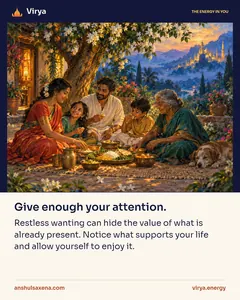
Practice enough

Painting for Practice enough
Virya Chanakya Niti 35. Practice enough. Peace becomes difficult when the finish line keeps moving. Indigo background, gold accents, Sora typography, and the full lotus logo.
Shloka: सन्तोषामृततृप्तानां यत्सुखं शान्तिरेव च।
न च तद्धनलुब्धानामितश्चेतश्च धावताम्॥ In simple words: Those satisfied by contentment find a happiness and peace that people endlessly chasing wealth do not.
Give “enough” a meaning. Name what matters: Work out which needs the extra effort is meant to meet. Notice what is present: Give attention to something already supporting your life. Choose your pace: Decide what is worth pursuing and what can wait.
Someone else’s purchase makes yours feel inadequate. 1. Ask what your current possession still does well. 2. Separate your actual need from the comparison. 3. Wait before deciding whether a change is useful.
Enough deserves some attention too. Reflection: What already serves you well? Save this idea and share it thoughtfully.
Read as text

Peace becomes difficult when the finish line keeps moving.

In simple words: Those satisfied by contentment find a happiness and peace that people endlessly chasing wealth do not.

Give “enough” a meaning
• Name what matters: Work out which needs the extra effort is meant to meet.
• Notice what is present: Give attention to something already supporting your life.
• Choose your pace: Decide what is worth pursuing and what can wait.

Try this: Someone else’s purchase makes yours feel inadequate.
1. Ask what your current possession still does well.
2. Separate your actual need from the comparison.
3. Wait before deciding whether a change is useful.

What already serves you well?

Context: The verse criticizes restless greed. It does not deny practical needs or hardship.

Original Sanskrit excerpt + English paraphrase. Everyday examples are modern reflections.
Source: Chanakya Neeti, Ashwani Prashar, Diamond Pocket Books (2015), 7.3; supplied PDF p. 86. Numbering follows this edition.

Chanakya Niti

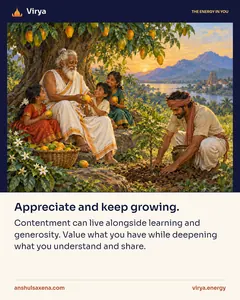
Be content. Keep growing

Painting for Be content. Keep growing
Virya Chanakya Niti 36. Be content. Keep growing.. Contentment and continued effort can live together. Indigo background, gold accents, Sora typography, and the full lotus logo.
Shloka: सन्तोषस्त्रिषु कर्तव्यः स्वदारे भोजने धने।
त्रिषु चैव न कर्तव्योऽध्ययने जपदानयोः॥ In simple words: The verse encourages contentment with one’s spouse, food, and wealth, while urging continued study, sacred recitation, and giving.
Choose where to keep reaching. Appreciate: Notice the good already present in ordinary life. Learn: Keep making room for a deeper understanding. Give: Let growth include what you contribute to others.
You want more purpose in your routine. 1. Name one thing you appreciate about your current life. 2. Choose a small learning practice. 3. Plan one act of help that fits your capacity.
Appreciate what you have. Keep deepening what you give. Reflection: Where could you pair gratitude with continued effort? Save this idea and share it thoughtfully.
Read as text

Contentment and continued effort can live together.

In simple words: The verse encourages contentment with one’s spouse, food, and wealth, while urging continued study, sacred recitation, and giving.

Choose where to keep reaching
• Appreciate: Notice the good already present in ordinary life.
• Learn: Keep making room for a deeper understanding.
• Give: Let growth include what you contribute to others.

Try this: You want more purpose in your routine.
1. Name one thing you appreciate about your current life.
2. Choose a small learning practice.
3. Plan one act of help that fits your capacity.

Where could you pair gratitude with continued effort?

Context: Its household and devotional setting is retained here. The modern example focuses on learning and generosity.

Original Sanskrit excerpt + English paraphrase. Everyday examples are modern reflections.
Source: Chanakya Neeti, Ashwani Prashar, Diamond Pocket Books (2015), 7.4; supplied PDF p. 87. Numbering follows this edition.

Chanakya Niti

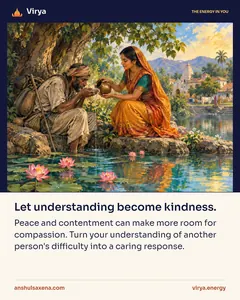
Make room for compassion

Painting for Make room for compassion
Virya Chanakya Niti 37. Make room for compassion. A thoughtful life includes how you respond to suffering. Indigo background, gold accents, Sora typography, and the full lotus logo.
Shloka: शान्तितुल्यं तपो नास्ति न सन्तोषात्परं सुखम्।
न तृष्णया परो व्याधिर्न च धर्मो दयापरः॥ In simple words: The verse praises peace as discipline, contentment as happiness, and compassion as the highest duty. It compares endless craving to illness.
Let care affect the next step. Notice: Look beyond the inconvenience to the person experiencing it. Understand: Ask what would actually help. Respond: Offer a useful action within your ability.
Someone is struggling with a simple task. 1. Pause before labelling them careless. 2. Ask which part is making the task difficult. 3. Offer a clear explanation or practical help.
Let understanding become kindness. Reflection: Where could a little compassion change your response? Save this idea and share it thoughtfully.
Read as text

A thoughtful life includes how you respond to suffering.

In simple words: The verse praises peace as discipline, contentment as happiness, and compassion as the highest duty. It compares endless craving to illness.

Let care affect the next step
• Notice: Look beyond the inconvenience to the person experiencing it.
• Understand: Ask what would actually help.
• Respond: Offer a useful action within your ability.

Try this: Someone is struggling with a simple task.
1. Pause before labelling them careless.
2. Ask which part is making the task difficult.
3. Offer a clear explanation or practical help.

Where could a little compassion change your response?

Context: The illness comparison is a metaphor. Daya means compassion or mercy.

Original Sanskrit excerpt + English paraphrase. Everyday examples are modern reflections.
Source: Chanakya Neeti, Ashwani Prashar, Diamond Pocket Books (2015), 8.13; supplied PDF p. 100. Numbering follows this edition.

Chanakya Niti

5 qualities to practice

Painting for 5 qualities to practice
Virya Chanakya Niti 38. 5 qualities to practice. Forgiveness, honesty, compassion, purity, and truth. Indigo background, gold accents, Sora typography, and the full lotus logo.
Shloka: क्षमाऽऽर्जवदयाशौचं सत्यं पीयूषवत् पिब॥ In simple words: Drink in forgiveness, straightforwardness, compassion, purity, and truth as though they were nectar.
Turn a virtue into a choice. Forgiveness + honesty: Release needless retaliation and speak without deceit. Compassion + purity: Reduce harm and keep your conduct clean. Truth: Check what you know before presenting it as fact.
A small disagreement needs resolving. 1. Describe what happened without adding an accusation. 2. Acknowledge your own part where appropriate. 3. Agree on one fair next step.
Values become visible in ordinary choices. Reflection: Which of the five qualities will you practice today? Save this idea and share it thoughtfully.
Read as text

Forgiveness, honesty, compassion, purity, and truth.

In simple words: Drink in forgiveness, straightforwardness, compassion, purity, and truth as though they were nectar.

Turn a virtue into a choice
• Forgiveness + honesty: Release needless retaliation and speak without deceit.
• Compassion + purity: Reduce harm and keep your conduct clean.
• Truth: Check what you know before presenting it as fact.

Try this: A small disagreement needs resolving.
1. Describe what happened without adding an accusation.
2. Acknowledge your own part where appropriate.
3. Agree on one fair next step.

Which of the five qualities will you practice today?

Context: This excerpt follows advice about spiritual freedom. Shaucha includes cleanliness and purity of conduct.

Original Sanskrit excerpt + English paraphrase. Everyday examples are modern reflections.
Source: Chanakya Neeti, Ashwani Prashar, Diamond Pocket Books (2015), 9.1; supplied PDF p. 105. Numbering follows this edition.

Chanakya Niti

Be proud of the work. Stay humble

Painting for Be proud of the work. Stay humble
Virya Chanakya Niti 39. Be proud of the work. Stay humble.. There is always more excellence in the world than we have seen. Indigo background, gold accents, Sora typography, and the full lotus logo.
Shloka: दाने तपसि शौर्ये च विज्ञाने विनये नये।
विस्मयो न हि कर्तव्यो बहुरत्ना वसुन्धरा॥ In simple words: Do not become conceited about giving, discipline, courage, knowledge, humility, or wisdom. The earth holds many jewels.
Let achievement keep you open. Recognize the work: Acknowledge what went well. Recognize the help: Remember the people and conditions that supported it. Keep learning: Look for someone whose example can stretch you.
Your work receives praise. 1. Accept the praise with a simple thank you. 2. Give specific credit to people who helped. 3. Choose one aspect you still want to improve.
Achievement can grow alongside humility. Reflection: Whose excellence keeps you curious? Save this idea and share it thoughtfully.
Read as text

There is always more excellence in the world than we have seen.

In simple words: Do not become conceited about giving, discipline, courage, knowledge, humility, or wisdom. The earth holds many jewels.

Let achievement keep you open
• Recognize the work: Acknowledge what went well.
• Recognize the help: Remember the people and conditions that supported it.
• Keep learning: Look for someone whose example can stretch you.

Try this: Your work receives praise.
1. Accept the praise with a simple thank you.
2. Give specific credit to people who helped.
3. Choose one aspect you still want to improve.

Whose excellence keeps you curious?

Context: The jewels stand for the many admirable people and qualities in the world.

Original Sanskrit excerpt + English paraphrase. Everyday examples are modern reflections.
Source: Chanakya Neeti, Ashwani Prashar, Diamond Pocket Books (2015), 14.8; supplied PDF p. 151. Numbering follows this edition.

Chanakya Niti

A high seat is not greatness

Painting for A high seat is not greatness
Virya Chanakya Niti 40. A high seat is not greatness. Position means more when conduct earns it. Indigo background, gold accents, Sora typography, and the full lotus logo.
Shloka: गुणैरुत्तमतां यान्ति नोच्चैरासनसंस्थितैः। In simple words: People rise in worth through their qualities, not merely by sitting in a high position.
Give the role substance. Competence: Learn what the responsibility requires. Conduct: Treat people well while carrying it out. Contribution: Make the work better for the people it serves.
You are given a leadership role. 1. Ask what your team needs from the role. 2. Make one responsibility and its owner clear. 3. Follow through on the promise you make.
Let your conduct give weight to your role. Reflection: What quality do you want people to associate with your leadership? Save this idea and share it thoughtfully.
Read as text

Position means more when conduct earns it.

In simple words: People rise in worth through their qualities, not merely by sitting in a high position.

Give the role substance
• Competence: Learn what the responsibility requires.
• Conduct: Treat people well while carrying it out.
• Contribution: Make the work better for the people it serves.

Try this: You are given a leadership role.
1. Ask what your team needs from the role.
2. Make one responsibility and its owner clear.
3. Follow through on the promise you make.

What quality do you want people to associate with your leadership?

Context: The next line compares a crow on a palace roof with Garuda. Height alone changes neither.

Original Sanskrit excerpt + English paraphrase. Everyday examples are modern reflections.
Source: Chanakya Neeti, Ashwani Prashar, Diamond Pocket Books (2015), 16.6; supplied PDF p. 170. Numbering follows this edition.

Chanakya Niti

Choose a place where you can grow

Painting for Choose a place where you can grow
Virya Chanakya Niti 41. Choose a place where you can grow. A good environment supports more than survival. Indigo background, gold accents, Sora typography, and the full lotus logo.
Shloka: यस्मिन् देशे न सम्मानो न वृत्तिर्न च बान्धवाः।
न च विद्यागमोऽप्यस्ति वासस्तत्र न कारयेत्॥ In simple words: The verse advises against settling where there is no respect, livelihood, supportive kin, or opportunity to learn.
Look at the whole environment. Dignity + livelihood: Can you be treated respectfully and support yourself? Connection: Are there people you can turn to? Learning: Is there room to develop your understanding and abilities?
You are considering a new workplace. 1. Ask how people learn and receive support there. 2. Notice how current staff describe everyday treatment. 3. Weigh the full environment alongside the role itself.
Choose surroundings that support your life. Reflection: Which condition would most improve your current environment? Save this idea and share it thoughtfully.
Read as text

A good environment supports more than survival.

In simple words: The verse advises against settling where there is no respect, livelihood, supportive kin, or opportunity to learn.

Look at the whole environment
• Dignity + livelihood: Can you be treated respectfully and support yourself?
• Connection: Are there people you can turn to?
• Learning: Is there room to develop your understanding and abilities?

Try this: You are considering a new workplace.
1. Ask how people learn and receive support there.
2. Notice how current staff describe everyday treatment.
3. Weigh the full environment alongside the role itself.

Which condition would most improve your current environment?

Context: It names conditions to look for in a place. The modern example applies the idea to a work environment.

Original Sanskrit excerpt + English paraphrase. Everyday examples are modern reflections.
Source: Chanakya Neeti, Ashwani Prashar, Diamond Pocket Books (2015), 1.8; supplied PDF p. 17. Numbering follows this edition.

Chanakya Niti

Give where it can help

Painting for Give where it can help
Virya Chanakya Niti 42. Give where it can help. Usefulness matters in generosity. Indigo background, gold accents, Sora typography, and the full lotus logo.
Shloka: वृथा वृष्टिः समुद्रेषु वृथा तृप्तेषु भोजनम्।
वृथा दानं धनाढ्येषु वृथा दीपो दिवापि च॥ In simple words: Rain over the sea, food for the already full, gifts to the wealthy, and a lamp in daylight are images of help given where it adds little.
Match help to the need. Ask first: The useful gift may differ from the one you planned. Check the fit: Think about timing, access, and whether it can be used. Respect the person: Offer help in a way that preserves their dignity.
You want to support a community project. 1. Ask what the project currently needs most. 2. Offer something suitable within your capacity. 3. Check whether your contribution reached its purpose.
Generosity becomes useful when it meets a real need. Reflection: Who could help you understand where your contribution is most useful? Save this idea and share it thoughtfully.
Read as text

Usefulness matters in generosity.

In simple words: Rain over the sea, food for the already full, gifts to the wealthy, and a lamp in daylight are images of help given where it adds little.

Match help to the need
• Ask first: The useful gift may differ from the one you planned.
• Check the fit: Think about timing, access, and whether it can be used.
• Respect the person: Offer help in a way that preserves their dignity.

Try this: You want to support a community project.
1. Ask what the project currently needs most.
2. Offer something suitable within your capacity.
3. Check whether your contribution reached its purpose.

Who could help you understand where your contribution is most useful?

Context: The verse asks the giver to notice need and usefulness.

Original Sanskrit excerpt + English paraphrase. Everyday examples are modern reflections.
Source: Chanakya Neeti, Ashwani Prashar, Diamond Pocket Books (2015), 5.16; supplied PDF p. 69. Numbering follows this edition.

Chanakya Niti

Let resources serve a purpose

Painting for Let resources serve a purpose
Virya Chanakya Niti 43. Let resources serve a purpose. What you have can do good beyond being stored. Indigo background, gold accents, Sora typography, and the full lotus logo.
Shloka: उपार्जितानां वित्तानां त्याग एव हि रक्षणम्। In simple words: The verse makes a paradoxical claim: giving from what you have earned is a way of preserving its value.
Think about what resources can do. Support life: Use what you have for worthwhile needs. Enable others: Share in a way that helps someone act or learn. Keep a purpose: Let care guide use instead of accumulation alone.
Useful materials are sitting unused. 1. Identify what you are realiztically no longer using. 2. Find someone or a group that could put it to work. 3. Offer it in good condition with any needed instructions.
Resources gain meaning through thoughtful use. Reflection: What could serve someone better than it serves your storage shelf? Save this idea and share it thoughtfully.
Read as text

What you have can do good beyond being stored.

In simple words: The verse makes a paradoxical claim: giving from what you have earned is a way of preserving its value.

Think about what resources can do
• Support life: Use what you have for worthwhile needs.
• Enable others: Share in a way that helps someone act or learn.
• Keep a purpose: Let care guide use instead of accumulation alone.

Try this: Useful materials are sitting unused.
1. Identify what you are realiztically no longer using.
2. Find someone or a group that could put it to work.
3. Offer it in good condition with any needed instructions.

What could serve someone better than it serves your storage shelf?

Context: The full verse compares this with water flowing out of a reservoir. This is ethical reflection, not an investment rule.

Original Sanskrit excerpt + English paraphrase. Everyday examples are modern reflections.
Source: Chanakya Neeti, Ashwani Prashar, Diamond Pocket Books (2015), 7.14; supplied PDF p. 91. Numbering follows this edition.

Chanakya Niti

Let your strengths become useful

Painting for Let your strengths become useful
Virya Chanakya Niti 44. Let your strengths become useful. Potential matters more when it enters daily life. Indigo background, gold accents, Sora typography, and the full lotus logo.
Shloka: गुणो भूषयते रूपं शीलं भूषयते कुलम्।
सिद्धिर्भूषयते विद्यां भोगो भूषयते धनम्॥ In simple words: Good qualities adorn beauty; conduct adorns family standing; accomplishment adorns knowledge; use and enjoyment adorn wealth.
Bring the quality into action. Ability: Use a strength to meet a real need. Knowledge: Complete something with what you understand. Resources: Let useful things support a worthwhile purpose.
You have a skill others often ask about. 1. Choose one common problem your skill can solve. 2. Create a clear example or short explanation. 3. Share it with someone who can use it.
Give your strengths something worthwhile to do. Reflection: Which ability could you put to better use this week? Save this idea and share it thoughtfully.
Read as text

Potential matters more when it enters daily life.

In simple words: Good qualities adorn beauty; conduct adorns family standing; accomplishment adorns knowledge; use and enjoyment adorn wealth.

Bring the quality into action
• Ability: Use a strength to meet a real need.
• Knowledge: Complete something with what you understand.
• Resources: Let useful things support a worthwhile purpose.

Try this: You have a skill others often ask about.
1. Choose one common problem your skill can solve.
2. Create a clear example or short explanation.
3. Share it with someone who can use it.

Which ability could you put to better use this week?

Context: The verse links what we possess with the qualities or actions that give it value.

Original Sanskrit excerpt + English paraphrase. Everyday examples are modern reflections.
Source: Chanakya Neeti, Ashwani Prashar, Diamond Pocket Books (2015), 8.15; supplied PDF p. 101. Numbering follows this edition.

Chanakya Niti

6 companions for a thoughtful life

Painting for 6 companions for a thoughtful life
Virya Chanakya Niti 45. 6 companions for a thoughtful life. Imagine your values as people who stay beside you. Indigo background, gold accents, Sora typography, and the full lotus logo.
Shloka: सत्यं माता पिता ज्ञानं धर्मो भ्राता दया सखा।
शान्तिः पत्नी क्षमा पुत्रः षडेते मम बान्धवाः॥ In simple words: Truth is imagined as mother, knowledge as father, duty as brother, compassion as friend, peace as wife, and forgiveness as son.
Keep these qualities close. Truth + knowledge: Seek what is accurate and try to understand it. Duty + compassion: Carry your responsibilities with care for others. Peace + forgiveness: Make room for calm and the possibility of repair.
You are preparing for a difficult conversation. 1. Check the facts and what you still do not know. 2. Be clear about your responsibility and the other person’s needs. 3. Aim for a fair resolution you can both live with.
Let your values keep you company. Reflection: Which of these six companions do you need most today? Save this idea and share it thoughtfully.
Read as text

Imagine your values as people who stay beside you.

In simple words: Truth is imagined as mother, knowledge as father, duty as brother, compassion as friend, peace as wife, and forgiveness as son.

Keep these qualities close
• Truth + knowledge: Seek what is accurate and try to understand it.
• Duty + compassion: Carry your responsibilities with care for others.
• Peace + forgiveness: Make room for calm and the possibility of repair.

Try this: You are preparing for a difficult conversation.
1. Check the facts and what you still do not know.
2. Be clear about your responsibility and the other person’s needs.
3. Aim for a fair resolution you can both live with.

Which of these six companions do you need most today?

Context: This is a poetic family of virtues. The relationships express closeness, not rules about gender.

Original Sanskrit excerpt + English paraphrase. Everyday examples are modern reflections.
Source: Chanakya Neeti, Ashwani Prashar, Diamond Pocket Books (2015), 12.11; supplied PDF p. 135. Numbering follows this edition.

Chanakya Niti

Your example sets a tone

Painting for Your example sets a tone
Virya Chanakya Niti 46. Your example sets a tone. People notice what leaders repeatedly do. Indigo background, gold accents, Sora typography, and the full lotus logo.
Shloka: राजानमनुवर्तन्ते यथा राजा तथा प्रजाः॥ In simple words: People follow the ruler: as the ruler behaves, so the people tend to behave.
Model the behavior you ask for. Honesty: Be open about an error before demanding transparency. Respect: Show how disagreement can happen without humiliation. Reliability: Keep the same standard for your own promises.
You want your team to raise problems earlier. 1. Mention a mistake you caught in your own work. 2. Thank the person who brings a problem to your attention. 3. Focus the discussion on the next useful action.
Make the behavior you want visible. Reflection: What does your daily example invite others to do? Save this idea and share it thoughtfully.
Read as text

People notice what leaders repeatedly do.

In simple words: People follow the ruler: as the ruler behaves, so the people tend to behave.

Model the behavior you ask for
• Honesty: Be open about an error before demanding transparency.
• Respect: Show how disagreement can happen without humiliation.
• Reliability: Keep the same standard for your own promises.

Try this: You want your team to raise problems earlier.
1. Mention a mistake you caught in your own work.
2. Thank the person who brings a problem to your attention.
3. Focus the discussion on the next useful action.

What does your daily example invite others to do?

Context: The original setting is kingship. Applying it to a team is a modern analogy.

Original Sanskrit excerpt + English paraphrase. Everyday examples are modern reflections.
Source: Chanakya Neeti, Ashwani Prashar, Diamond Pocket Books (2015), 13.7; supplied PDF p. 142. Numbering follows this edition.

Chanakya Niti

3 treasures close at hand

Painting for 3 treasures close at hand
Virya Chanakya Niti 47. 3 treasures close at hand. Some of life’s most valuable things are ordinary. Indigo background, gold accents, Sora typography, and the full lotus logo.
Shloka: पृथिव्यां त्रीणि रत्नानि अन्नमापः सुभाषितम्। In simple words: There are three treasures on earth: food, water, and good words.
Value what sustains life. Food: Notice the work and care behind a meal. Water: Treat an everyday necessity with respect. Good words: Offer speech that is useful, thoughtful, or comforting.
An ordinary meal becomes a moment of attention. 1. Take what you can reasonably use. 2. Notice who helped make the meal possible. 3. Offer a sincere word of appreciation.
Value the things that sustain us. Reflection: Which ordinary treasure did you appreciate today? Save this idea and share it thoughtfully.
Read as text

Some of life’s most valuable things are ordinary.

In simple words: There are three treasures on earth: food, water, and good words.

Value what sustains life
• Food: Notice the work and care behind a meal.
• Water: Treat an everyday necessity with respect.
• Good words: Offer speech that is useful, thoughtful, or comforting.

Try this: An ordinary meal becomes a moment of attention.
1. Take what you can reasonably use.
2. Notice who helped make the meal possible.
3. Offer a sincere word of appreciation.

Which ordinary treasure did you appreciate today?

Context: The second half contrasts these with stones that people call jewels.

Original Sanskrit excerpt + English paraphrase. Everyday examples are modern reflections.
Source: Chanakya Neeti, Ashwani Prashar, Diamond Pocket Books (2015), 14.1; supplied PDF p. 148. Numbering follows this edition.

Chanakya Niti

Match the group to the task

Painting for Match the group to the task
Virya Chanakya Niti 48. Match the group to the task. Some work needs quiet. Some work needs other people. Indigo background, gold accents, Sora typography, and the full lotus logo.
Shloka: एकाकिना तपो द्वाभ्यां पठनं गायनं त्रिभिः।
चतुर्भिर्गमनं क्षेत्रं पञ्चभिर्बहुभिः रणम्॥ In simple words: The verse gives different group sizes for different tasks: one for discipline, two for study, three for singing, four for travel, five for farming, and many for battle.
Choose how to work together. Alone: Make room for quiet concentration. With a partner: Use conversation to test understanding. With a team: Bring several people when the work needs different contributions.
You are organizing a project meeting. 1. Decide what must be achieved during the meeting. 2. Invite people whose input is needed for that decision. 3. Leave focused work for a smaller group or an individual.
Let the work shape the collaboration. Reflection: Which task would benefit from fewer people, or one more? Save this idea and share it thoughtfully.
Read as text

Some work needs quiet. Some work needs other people.

In simple words: The verse gives different group sizes for different tasks: one for discipline, two for study, three for singing, four for travel, five for farming, and many for battle.

Choose how to work together
• Alone: Make room for quiet concentration.
• With a partner: Use conversation to test understanding.
• With a team: Bring several people when the work needs different contributions.

Try this: You are organizing a project meeting.
1. Decide what must be achieved during the meeting.
2. Invite people whose input is needed for that decision.
3. Leave focused work for a smaller group or an individual.

Which task would benefit from fewer people, or one more?

Context: These are historical prescriptions, not a universal formula for modern teams.

Original Sanskrit excerpt + English paraphrase. Everyday examples are modern reflections.
Source: Chanakya Neeti, Ashwani Prashar, Diamond Pocket Books (2015), 4.12; supplied PDF p. 57. Numbering follows this edition.

Chanakya Niti

Let compassion reach every being

Painting for Let compassion reach every being
Virya Chanakya Niti 49. Let compassion reach every being. Care gives spiritual practice a living expression. Indigo background, gold accents, Sora typography, and the full lotus logo.
Shloka: यस्य चित्तं द्रवीभूतं कृपया सर्वजन्तुषु। In simple words: The person described here has a heart softened by compassion toward all living beings.
Notice who is affected. Look wider: Consider people and living beings outside your immediate circle. Reduce avoidable harm: Change a small habit where you can. Offer practical care: Choose an action suited to the situation.
Someone with little power is being overlooked. 1. Notice whether they have had a chance to speak. 2. Ask what they need without speaking over them. 3. Use your position to make a fair response possible.
Let care extend beyond your own circle. Reflection: Who is easy to overlook in your everyday routine? Save this idea and share it thoughtfully.
Read as text

Care gives spiritual practice a living expression.

In simple words: The person described here has a heart softened by compassion toward all living beings.

Notice who is affected
• Look wider: Consider people and living beings outside your immediate circle.
• Reduce avoidable harm: Change a small habit where you can.
• Offer practical care: Choose an action suited to the situation.

Try this: Someone with little power is being overlooked.
1. Notice whether they have had a chance to speak.
2. Ask what they need without speaking over them.
3. Use your position to make a fair response possible.

Who is easy to overlook in your everyday routine?

Context: The full verse gives compassion priority over outward marks of spiritual practice.

Original Sanskrit excerpt + English paraphrase. Everyday examples are modern reflections.
Source: Chanakya Neeti, Ashwani Prashar, Diamond Pocket Books (2015), 15.1; supplied PDF p. 158. Numbering follows this edition.

Chanakya Niti

Give your values a visible form

Painting for Give your values a visible form
Virya Chanakya Niti 50. Give your values a visible form. What we do can matter more than what we display. Indigo background, gold accents, Sora typography, and the full lotus logo.
Shloka: दानेन पाणिर्न तु कंकणेन स्नानेन शुद्धिर्न तु चन्दनेन।
मानेन तृप्तिर्न तु भोजनेन ज्ञानेन मुक्तिर्न तु मण्डनेन॥ In simple words: The hand is adorned by giving, not a bracelet; cleanliness comes from bathing, not perfume; dignity satisfies beyond food; understanding frees beyond outward decoration.
Let the action carry the message. Generosity: Help in a way the other person can actually use. Respect: Treat someone’s dignity as part of their need. Understanding: Look beneath appearances to what changes a life.
You want to express a value you believe in. 1. Choose one person or situation where the value matters. 2. Do one useful act without making recognition the goal. 3. Ask what you can continue, not just perform once.
Let your conduct make your values visible. Reflection: What quiet action could express your values today? Save this idea and share it thoughtfully.
Read as text

What we do can matter more than what we display.

In simple words: The hand is adorned by giving, not a bracelet; cleanliness comes from bathing, not perfume; dignity satisfies beyond food; understanding frees beyond outward decoration.

Let the action carry the message
• Generosity: Help in a way the other person can actually use.
• Respect: Treat someone’s dignity as part of their need.
• Understanding: Look beneath appearances to what changes a life.

Try this: You want to express a value you believe in.
1. Choose one person or situation where the value matters.
2. Do one useful act without making recognition the goal.
3. Ask what you can continue, not just perform once.

What quiet action could express your values today?

Context: The verse uses contrasts to praise meaningful action. The modern reflection concerns living one’s values.

Original Sanskrit excerpt + English paraphrase. Everyday examples are modern reflections.
Source: Chanakya Neeti, Ashwani Prashar, Diamond Pocket Books (2015), 17.11; supplied PDF p. 181. Numbering follows this edition.