20 posts · 120 cards

Vidura Niti विदुर नीति

Twenty counsels Vidura gave a king who could not sleep.

Vidura Niti

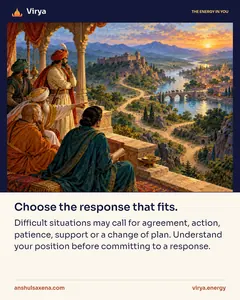
Who Lies Awake At Night

A king can't sleep. His advisor names the people who can't

Who Lies Awake At Night, card 1 of 6
Who Lies Awake At Night, card 2 of 6
Who Lies Awake At Night, card 3 of 6
Who Lies Awake At Night, card 4 of 6
Who Lies Awake At Night, card 5 of 6
Who Lies Awake At Night, card 6 of 6
Read as text

विदुर नीति · प्रजागर पर्व, अध्याय 33, श्लोक 13, "Who Lies Awake At Night"

अभियुक्तं बलवता दुर्बलं हीनसाधनम्।
हृतस्वं कामिनं चोरमाविशन्ति प्रजागराः॥ १३ ॥
abhiyuktaṁ balavatā durbalaṁ hīnasādhanam,
hṛtasvaṁ kāminaṁ coram āviśanti prājāgarāḥ.

Sleeplessness enters the weak man attacked by a stronger one, the man stripped of everything he had, the lecher, and the thief.

Insomnia is a moral instrument. It tells you which of the four positions you have taken: the outmatched, the dispossessed, the man ruled by appetite, or the man holding something he took.

How the text gets there:
1. The king reports a symptom, sleeplessness, and expects reassurance.
2. Vidura refuses to treat it as a medical fact and treats it as evidence.
3. He lists the states that produce it, all of them positions in a conflict.
4. He then asks, without accusing, which one the king occupies. The list was the accusation.

Today: The 3am wake-up is rarely random. Run Vidura's list against yourself before you reach for a remedy: are you in a fight you cannot win, have you just lost something, are you being run by an appetite, or are you holding something that is not yours. The answer usually names the problem faster than any amount of rest will.

Which of the four is keeping you awake? Tell me below.

Vidura Niti

What Actually Makes A Pandita

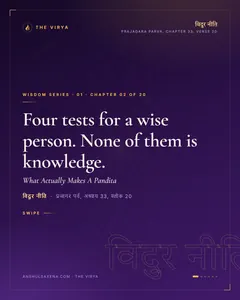
Four tests for a wise person. None of them is knowledge

What Actually Makes A Pandita, card 1 of 6
What Actually Makes A Pandita, card 2 of 6
What Actually Makes A Pandita, card 3 of 6
What Actually Makes A Pandita, card 4 of 6
What Actually Makes A Pandita, card 5 of 6
What Actually Makes A Pandita, card 6 of 6
Read as text

विदुर नीति · प्रजागर पर्व, अध्याय 33, श्लोक 20, "What Actually Makes A Pandita"

आत्मज्ञानं समारम्भस्तितिक्षा धर्मनित्यता।
यमर्थान्नापकर्षन्ति स वै पण्डित उच्यते॥ २० ॥
ātmajñānaṁ samārambhas titikṣā dharmanityatā,
yam arthān nāpakarṣanti sa vai paṇḍita ucyate.

Self-knowledge, initiative, the capacity to endure, and steadiness in duty. He whom no gain can pull away from these is called a pandita.

Wisdom is not what you know. It is the set of behaviors that stay intact when someone makes you a better offer.

How the text gets there:
1. Vidura defines the pandita by conduct rather than by learning.
2. He names four qualities, three of them active and one of them endurance.
3. He then makes profit the test: the qualities count only if gain cannot detach them.
4. So the definition is a list of things with a price attached, and the pandita is the one who has not sold them.

Today: Most competence frameworks measure capability. This one measures capability under offer. The useful question in a hiring loop or a promotion decision is not whether someone knows their worth and finishes what they start, but whether they still did when it cost them money.

Which of your four would go first if the offer were large enough? Tell me below.

Vidura Niti

Not Interrupted By Weather

Heat, cold, fear, pleasure, wealth, ruin. None of them stops the work

Not Interrupted By Weather, card 1 of 6
Not Interrupted By Weather, card 2 of 6
Not Interrupted By Weather, card 3 of 6
Not Interrupted By Weather, card 4 of 6
Not Interrupted By Weather, card 5 of 6
Not Interrupted By Weather, card 6 of 6
Read as text

विदुर नीति · प्रजागर पर्व, अध्याय 33, श्लोक 24, "Not Interrupted By Weather"

यस्य कृत्यं न विघ्नन्ति शीतमुष्णं भयं रतिः।
समृद्धिरसमृद्धिर्वा स वै पण्डित उच्यते॥ २४ ॥
yasya kṛtyaṁ na vighnanti śītam uṣṇaṁ bhayaṁ ratiḥ,
samṛddhir asamṛddhir vā sa vai paṇḍita ucyate.

He whose work is not interrupted by cold or heat, by fear or pleasure, by prosperity or its absence, is called a pandita.

Most people are consistent in one direction only. They keep working through difficulty and stop working through comfort. The verse closes both exits.

How the text gets there:
1. Six interruptions are named, arranged in three opposed pairs.
2. Pairing them removes the usual defense that one was an exception.
3. Prosperity appears alongside ruin, which makes success an interruption too.
4. What survives all six is not toughness but a decoupling of work from circumstance.

Today: Look at your output over the last year and mark the gaps. Then mark what was happening. If the gaps cluster around good weeks rather than bad ones, you have the more common failure, and it is the one nobody warns you about because it looks like a reward.

Does your work stop more often in bad conditions or in good ones? Tell me below.

Vidura Niti

They Do Not Chase, They Do Not Grieve

Three refusals: the unreachable, the lost, and the panic

They Do Not Chase, They Do Not Grieve, card 1 of 6
They Do Not Chase, They Do Not Grieve, card 2 of 6
They Do Not Chase, They Do Not Grieve, card 3 of 6
They Do Not Chase, They Do Not Grieve, card 4 of 6
They Do Not Chase, They Do Not Grieve, card 5 of 6
They Do Not Chase, They Do Not Grieve, card 6 of 6
Read as text

विदुर नीति · प्रजागर पर्व, अध्याय 33, श्लोक 28, "They Do Not Chase, They Do Not Grieve"

नाप्राप्यमभिवाञ्छन्ति नष्टं नेच्छन्ति शोचितुम्।
आपत्सु च न मुह्यन्ति नराः पण्डितबुद्धयः॥ २८ ॥
nāprāpyam abhivāñchanti naṣṭaṁ necchanti śocitum,
āpatsu ca na muhyanti narāḥ paṇḍitabuddhayaḥ.

Those of a pandita's intelligence do not desire the unattainable, do not wish to grieve for what is lost, and are not bewildered in calamity.

Attention leaks in three directions: forward into what is out of reach, backward into what is gone, and sideways into panic. All three feel like engagement. None of them is.

How the text gets there:
1. The verse takes three postures and rejects each in turn.
2. Two of them, craving and grief, are about time: the unreachable future and the irrecoverable past.
3. The third is about the present, and the word used is bewilderment, not pain.
4. So the claim is narrow and defensible: you will feel the blow, and you must still be able to think.

Today: In a bad quarter the three failures show up as a plan built on a market that does not exist, a post-mortem run for the fourth time, and a room where nobody can hold a thought. Grief and ambition both have their place. Neither belongs in the hour when a decision has to be made.

Which of the three is currently taking most of your attention? Tell me below.

Vidura Niti

Decide First. Then Do Not Stop

He does not camp inside the work

Decide First. Then Do Not Stop., card 1 of 6
Decide First. Then Do Not Stop., card 2 of 6
Decide First. Then Do Not Stop., card 3 of 6
Decide First. Then Do Not Stop., card 4 of 6
Decide First. Then Do Not Stop., card 5 of 6
Decide First. Then Do Not Stop., card 6 of 6
Read as text

विदुर नीति · प्रजागर पर्व, अध्याय 33, श्लोक 29, "Decide First. Then Do Not Stop."

निश्चित्य यः प्रक्रमते नान्तर्वसति कर्मणः।
अबन्ध्यकालो वश्यात्मा स वै पण्डित उच्यते॥ २९ ॥
niścitya yaḥ prakramate nāntarvasati karmaṇaḥ,
abandhyakālo vaśyātmā sa vai paṇḍita ucyate.

He who begins after deciding and does not settle down in the middle of the work, whose time is never barren, who has mastered himself, is called a pandita.

Most work does not fail at the start or the finish. It fails in the middle, where deliberation reappears disguised as diligence and the project turns into an address.

How the text gets there:
1. The order is fixed: decide, then begin. Not begin, then decide.
2. The named failure is dwelling in the middle, not slowness.
3. Barren time follows directly, because re-deciding produces nothing.
4. Self-mastery is listed last, as the thing that makes the sequence possible rather than a separate virtue.

Today: Audit the projects that have been running longest. In most cases the decision was never actually closed, so every review re-opens it and the work has become somewhere the team lives. Close the decision or kill the project. The middle is not a place to stay.

Which of your projects have you moved into rather than through? Tell me below.

Vidura Niti

A Deep Pool In The Ganges

Praise does not lift him. Insult does not sink him

A Deep Pool In The Ganges, card 1 of 6
A Deep Pool In The Ganges, card 2 of 6
A Deep Pool In The Ganges, card 3 of 6
A Deep Pool In The Ganges, card 4 of 6
A Deep Pool In The Ganges, card 5 of 6
A Deep Pool In The Ganges, card 6 of 6
Read as text

विदुर नीति · प्रजागर पर्व, अध्याय 33, श्लोक 31, "A Deep Pool In The Ganges"

न हृष्यत्यात्मसम्माने नावमानेन तप्यते।
गाङ्गो ह्रद इवाक्षोभ्यो यः स पण्डित उच्यते॥ ३१ ॥
na hṛṣyaty ātmasammāne nāvamānena tapyate,
gāṅgo hrada ivākṣobhyo yaḥ sa paṇḍita ucyate.

He who is not elated at his own honor, is not scorched by disrespect, and is unshakeable like a deep pool in the Ganges, is called a pandita.

If praise moves you, blame will move you by exactly the same amount. You cannot accept the first and decline the second. They are one sensitivity.

How the text gets there:
1. Two reactions are named, elation and being burned, and they are treated as one mechanism.
2. Accepting praise therefore commits you to feeling the insult.
3. The image chosen is a pool in a fast river, not still water.
4. So the quality is depth in a current, not withdrawal from it.

Today: The person who is visibly delighted by good reviews is the same person who will be unusable for a week after a bad one, and you can predict the second from the first. If you want the criticizm to stop landing, notice how hard you are working to enjoy the praise.

How long did the last compliment stay with you, and the last criticizm? Tell me below.

Vidura Niti

The Portrait Of A Fool

Unread and swollen. Broke and grand. Wanting wealth without work

The Portrait Of A Fool, card 1 of 6
The Portrait Of A Fool, card 2 of 6
The Portrait Of A Fool, card 3 of 6
The Portrait Of A Fool, card 4 of 6
The Portrait Of A Fool, card 5 of 6
The Portrait Of A Fool, card 6 of 6
Read as text

विदुर नीति · प्रजागर पर्व, अध्याय 33, श्लोक 35, "The Portrait Of A Fool"

अश्रुतश्च समुन्नद्धो दरिद्रश्च महामनाः।
अर्थांश्चाकर्मणा प्रेप्सुर्मूढ इत्युच्यते बुधैः॥ ३५ ॥
aśrutaś ca samunnaddho daridraś ca mahāmanāḥ,
arthāṁś cākarmaṇā prepsur mūḍha ity ucyate budhaiḥ.

Unlearned yet puffed up, poor yet grandiose, wanting wealth without action. The wise call such a man a fool.

Foolishness here is not a lack of intelligence. It is a fixed gap between your actual position and your picture of it, held open by the refusal to do the work that would close it.

How the text gets there:
1. Three clauses, each pairing a real state with a contradicting self-image.
2. The contradiction is never resolved by improving the state.
3. The final clause supplies the reason: the desired outcome is wanted without the action.
4. So the fool is not mistaken about the world. He is unwilling to pay for the version of himself he already believes in.

Today: This is the failure mode of the confident beginner and it is expensive because it is invisible from the inside. The correction is simple and uncomfortable: name the gap between where you are and where you talk from, then name the specific work that closes it. If you cannot name the work, the gap is the point.

Where are you speaking from a position you have not paid for? Tell me below.

Vidura Niti

The Arrow And The Counsel

An arrow may kill one man. Advice can kill a kingdom

The Arrow And The Counsel, card 1 of 6
The Arrow And The Counsel, card 2 of 6
The Arrow And The Counsel, card 3 of 6
The Arrow And The Counsel, card 4 of 6
The Arrow And The Counsel, card 5 of 6
The Arrow And The Counsel, card 6 of 6
Read as text

विदुर नीति · प्रजागर पर्व, अध्याय 33, श्लोक 48, "The Arrow And The Counsel"

एकं हन्यान्न वा हन्यादिषुर्मुक्तो धनुष्मता।
बुद्धिर्बुद्धिमतोत्सृष्टा हन्याद् राष्ट्रं सराजकम्॥ ४८ ॥
ekaṁ hanyān na vā hanyād iṣur mukto dhanuṣmatā,
buddhir buddhimatotsṛṣṭā hanyād rāṣṭraṁ sarājakam.

An arrow loosed by an archer may kill one man or may kill none. Intelligence loosed by an intelligent man can destroy a kingdom together with its king.

Advice scales in a way violence does not. The archer's damage is capped by physics. The advisor's is capped by nothing, and unlike the archer he will not be counted among the causes.

How the text gets there:
1. Two actors are set side by side, one armed and one not.
2. The armed man's maximum damage is stated honestly and it is small, possibly zero.
3. The same verb is then applied to counsel, with the kingdom and the king as its object.
4. The asymmetry is the argument: the dangerous man in the room is not the one holding the weapon.

Today: Organizations audit the people who execute and rarely audit the people who advise, because advice leaves no fingerprints. Whoever shapes the options shapes the outcome more than whoever chooses among them. Ask who framed the decision, not just who signed it.

Whose advice has the most reach in your organization, and who checks it? Tell me below.

Vidura Niti

Four Things Not To Do Alone

Don't feast alone. Don't decide alone. Don't walk alone. Don't stay awake alone

Four Things Not To Do Alone, card 1 of 6
Four Things Not To Do Alone, card 2 of 6
Four Things Not To Do Alone, card 3 of 6
Four Things Not To Do Alone, card 4 of 6
Four Things Not To Do Alone, card 5 of 6
Four Things Not To Do Alone, card 6 of 6
Read as text

विदुर नीति · प्रजागर पर्व, अध्याय 33, श्लोक 51, "Four Things Not To Do Alone"

एकः स्वादु न भुंजीत एकश्चार्थान्न चिन्तयेत्।
एको न गच्छेदध्वानं नैकः सुप्तेषु जागृयात्॥ ५१ ॥
ekaḥ svādu na bhuñjīta ekaś cārthān na cintayet,
eko na gacched adhvānaṁ naikaḥ supteṣu jāgṛyāt.

Do not eat delicacies alone. Do not deliberate on matters alone. Do not travel a road alone. Do not stay awake alone among sleepers.

Solitude has a cost that changes with the activity. Pleasure taken alone corrodes generosity. Judgement made alone loses correction. Vigilance kept alone becomes suspicion.

How the text gets there:
1. Four situations are named and the same word, alone, is applied to each.
2. They ascend from the trivial to the serious rather than sitting flat.
3. Deliberation is placed second, treated as needing company for the same reason a road does.
4. The last is deliberately ambiguous, since the sleepless watcher may be protecting the group or plotting against it.

Today: The decisions that go worst are usually made between meetings, alone, by someone senior enough not to be asked. A decision made alone is not faster, it is just uncorrected. Name one person who is allowed to tell you it is wrong before it ships.

Which of your recent decisions was made with nobody in the room? Tell me below.

Vidura Niti

The Weak Man's Virtue, The Strong Man's Ornament

Forgiveness looks like weakness. Vidura says that is the only thing wrong with it

The Weak Man's Virtue, The Strong Man's Ornament, card 1 of 6
The Weak Man's Virtue, The Strong Man's Ornament, card 2 of 6
The Weak Man's Virtue, The Strong Man's Ornament, card 3 of 6
The Weak Man's Virtue, The Strong Man's Ornament, card 4 of 6
The Weak Man's Virtue, The Strong Man's Ornament, card 5 of 6
The Weak Man's Virtue, The Strong Man's Ornament, card 6 of 6
Read as text

विदुर नीति · प्रजागर पर्व, अध्याय 33, श्लोक 54, "The Weak Man's Virtue, The Strong Man's Ornament"

सोऽस्य दोषो न मन्तव्यः क्षमा हि परमं बलम्।
क्षमा गुणो ह्यशक्तानां शक्तानां भूषणं क्षमा॥ ५४ ॥
so 'sya doṣo na mantavyaḥ kṣamā hi paramaṁ balam,
kṣamā guṇo hy aśaktānāṁ śaktānāṁ bhūṣaṇaṁ kṣamā.

That should not be considered a fault in it, for forgiveness is the highest strength. Forgiveness is a virtue in the powerless; in the powerful it is an ornament.

Forgiveness only reads as strength when retaliation was genuinely available. Otherwise it is just the name we give to having no other move.

How the text gets there:
1. The objection is granted rather than argued with: it does look like weakness.
2. The verse then separates the actor into two cases, powerless and powerful.
3. For the powerless it is a virtue, since it is the only path open.
4. For the powerful it becomes an ornament, because the capacity to retaliate is what gives the restraint its meaning.

Today: This is why forgiveness from a junior colleague reads as accommodation and the same words from someone who could have escalated read as authority. If you want restraint to count, it has to be visible that you had the option. And if you had no option, be honest that you are making peace with a fact rather than granting anything.

The last time you let something go, could you actually have done otherwise? Tell me below.

Vidura Niti

Three Gates, One Room

Desire, anger, greed. Three doors into the same place

Three Gates, One Room, card 1 of 6
Three Gates, One Room, card 2 of 6
Three Gates, One Room, card 3 of 6
Three Gates, One Room, card 4 of 6
Three Gates, One Room, card 5 of 6
Three Gates, One Room, card 6 of 6
Read as text

विदुर नीति · प्रजागर पर्व, अध्याय 33, श्लोक 71, "Three Gates, One Room"

त्रिविधं नरकस्येदं द्वारं नाशनमात्मनः।
कामः क्रोधस्तथा लोभस्तस्मादेतत्त्रयं त्यजेत्॥ ७१ ॥
trividhaṁ narakasyedaṁ dvāraṁ nāśanam ātmanaḥ,
kāmaḥ krodhas tathā lobhas tasmād etat trayaṁ tyajet.

This gate of hell is threefold and destroys the self: desire, anger, and greed. Therefore one should abandon these three.

These are not three vices to be fought separately. They are one impulse at three stages, which is why fighting the last one always fails. You cannot cure greed while leaving desire intact.

How the text gets there:
1. The gate is described as one thing with three forms, not as three gates.
2. The three are ordered in a natural sequence rather than listed at random.
3. Desire blocked turns into anger; desire satisfied turns into greed.
4. So abandoning the three means addressing the root, since the two downstream states regenerate from it.

Today: The person trying to manage their temper while leaving the wanting untouched is treating the symptom. Anger in a meeting is almost always a desire that hit an obstacle thirty seconds earlier. Find what you wanted and the anger explains itself.

What did you want, just before you got angry? Tell me below.

Vidura Niti

The Six Happinesses

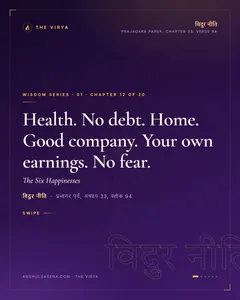
Health. No debt. Home. Good company. Your own earnings. No fear

The Six Happinesses, card 1 of 6
The Six Happinesses, card 2 of 6
The Six Happinesses, card 3 of 6
The Six Happinesses, card 4 of 6
The Six Happinesses, card 5 of 6
The Six Happinesses, card 6 of 6
Read as text

विदुर नीति · प्रजागर पर्व, अध्याय 33, श्लोक 94, "The Six Happinesses"

आरोग्यमानृण्यमविप्रवासः
सद्भिर्मनुष्यैः सह सम्प्रयोगः।
स्वप्रत्यया वृत्तिरभीतवासः
षड् जीवलोकस्य सुखानि राजन्॥ ९४ ॥
ārogyam ānṛṇyam avipravāsaḥ
sadbhir manuṣyaiḥ saha samprayogaḥ,
svapratyayā vṛttir abhītavāsaḥ
ṣaḍ jīvalokasya sukhāni rājan.

Health, freedom from debt, not living away from home, association with good people, a livelihood you can rely on yourself for, and living without fear. These six, O king, are the happinesses of the living world.

Happiness here is a list of things not going wrong. That sounds thin until you notice how much of what people chase is an attempt to compensate for one of the six being missing.

How the text gets there:
1. Six conditions are named and each is the absence of a specific harm.
2. Nothing on the list is an acquisition, so none of it can be purchased.
3. The livelihood clause specifies self-reliance rather than amount.
4. The list is addressed to a king, who has wealth and lacks several of the six.

Today: Score yourself out of six before the next time you decide that more income is the fix. In most cases the missing item is debt, dependence, or fear, and a raise that increases any of those is a bad trade even when the number goes up.

How many of the six do you actually have? Tell me below.

Vidura Niti

The Fish And The Hook

It sees the bait. It never sees the hook

The Fish And The Hook, card 1 of 6
The Fish And The Hook, card 2 of 6
The Fish And The Hook, card 3 of 6
The Fish And The Hook, card 4 of 6
The Fish And The Hook, card 5 of 6
The Fish And The Hook, card 6 of 6
Read as text

विदुर नीति · अध्याय 34, श्लोक 13, "The Fish And The Hook"

भक्ष्योत्तमप्रतिच्छन्नं मत्स्यो वडिशमायसम्।
लोभाभिपाती ग्रसते नानुबन्धमवेक्षते॥ १३ ॥
bhakṣyottamapraticchannaṁ matsyo vaḍiśam āyasam,
lobhābhipātī grasate nānubandham avekṣate.

The fish, rushing at it out of greed, swallows the iron hook concealed by excellent food, and does not look at what is attached.

Most bad deals are not disguised. The attractive part is genuinely attractive. The failure is not being deceived about the bait; it is not asking what the bait is attached to.

How the text gets there:
1. The bait is described as genuinely excellent, not as a trick.
2. The hook is not hidden by cleverness but simply covered by the thing being wanted.
3. The fish's error is named precisely: it does not look at the attachment.
4. So the failure is one of scope rather than of perception, which is why intelligence does not protect against it.

Today: The term sheet, the counter-offer, the acquisition. The headline number is usually honest. What kills you is the clause it is attached to, and the reason you did not read it is that you were looking at the number. Before accepting anything unusually good, write down what comes with it.

On your best current offer, what is attached that you have not read? Tell me below.

Vidura Niti

The Unripe Fruit

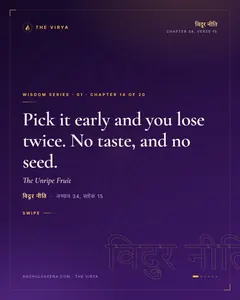
Pick it early and you lose twice. No taste, and no seed

The Unripe Fruit, card 1 of 6
The Unripe Fruit, card 2 of 6
The Unripe Fruit, card 3 of 6
The Unripe Fruit, card 4 of 6
The Unripe Fruit, card 5 of 6
The Unripe Fruit, card 6 of 6
Read as text

विदुर नीति · अध्याय 34, श्लोक 15, "The Unripe Fruit"

वनस्पतेरपक्वानि फलानि प्रचिनोति यः।
स नाप्नोति रसं तेभ्यो बीजं चास्य विनश्यति॥ १५ ॥
vanaspater apakvāni phalāni pracinoti yaḥ,
sa nāpnoti rasaṁ tebhyo bījaṁ cāsya vinaśyati.

He who picks unripe fruits from a tree does not obtain their juice, and the seed within them is destroyed as well.

Impatience is usually priced as a worse version of the same outcome. It is more often two losses, and the second one does not show up in this period's numbers.

How the text gets there:
1. Picking early produces an immediate, visible loss of quality.
2. A second loss is named that is invisible at the moment of picking: the seed.
3. The seed is the mechanism of the next cycle, so the loss compounds rather than being one-off.
4. The following verse states the alternative, which yields both the fruit and the next tree.

Today: Shipping before it is ready costs you the release and, more expensively, the trust that would have carried the next three. Promoting someone a year early costs you a manager and the individual contributor they used to be. Ask what the seed is in your case, then check whether your timeline destroys it.

What are you about to pick early, and what seed is inside it? Tell me below.

Vidura Niti

How A Bee Takes Honey

Take everything you need. Leave the flower standing

How A Bee Takes Honey, card 1 of 6
How A Bee Takes Honey, card 2 of 6
How A Bee Takes Honey, card 3 of 6
How A Bee Takes Honey, card 4 of 6
How A Bee Takes Honey, card 5 of 6
How A Bee Takes Honey, card 6 of 6
Read as text

विदुर नीति · अध्याय 34, श्लोक 17, "How A Bee Takes Honey"

यथा मधु समादत्ते रक्षन् पुष्पाणि षट्पदः।
तद्वदर्थान्मनुष्येभ्य आदद्यादविहिंसया॥ १७ ॥
yathā madhu samādatte rakṣan puṣpāṇi ṣaṭpadaḥ,
tadvad arthān manuṣyebhya ādadyād avihiṁsayā.

As the bee gathers honey while protecting the flowers, so should one take wealth from people without injury.

The constraint is not how much you take. It is whether the thing you took it from still works afterwards.

How the text gets there:
1. The bee is used as a model of extraction, not of restraint.
2. It takes what it needs and the flower is unharmed, so the source persists.
3. The paired verse contrasts the gardener with the charcoal-burner, who extracts once and totally.
4. The difference between them is not quantity but whether the system regenerates.

Today: Applies directly to how you use a high performer, a supplier, or a customer base. Extraction that leaves the source able to regenerate is not generosity, it is the only version that compounds. The charcoal-burner's numbers look better for exactly one quarter.

What are you currently extracting from that will not grow back? Tell me below.

Vidura Niti

Birth Is Not Evidence

A good family is no defense for a bad man

Birth Is Not Evidence, card 1 of 6
Birth Is Not Evidence, card 2 of 6
Birth Is Not Evidence, card 3 of 6
Birth Is Not Evidence, card 4 of 6
Birth Is Not Evidence, card 5 of 6
Birth Is Not Evidence, card 6 of 6
Read as text

विदुर नीति · अध्याय 34, श्लोक 41, "Birth Is Not Evidence"

न कुलं वृत्तहीनस्य प्रमाणमिति मे मतिः।
अन्तेष्वपि हि जातानां वृत्तमेव विशिष्यते॥ ४१ ॥
na kulaṁ vṛttahīnasya pramāṇam iti me matiḥ,
anteṣv api hi jātānāṁ vṛttam eva viśiṣyate.

In my view, family is no proof in the case of a man without conduct. Even among those born at the lowest, it is conduct alone that distinguishes.

Origin is a fact about someone. Conduct is a claim about them. Only one of the two supports a prediction, and people routinely use the first because it is easier to look up.

How the text gets there:
1. The claim is marked as personal opinion, which is unusual in the text.
2. The word chosen is pramana, proof, so the issue is evidentiary rather than moral.
3. Birth is then ruled inadmissible for a man whose conduct is absent.
4. The second line completes the reversal: at the bottom of the order, conduct still distinguishes, so it works everywhere birth does not.

Today: The modern forms of kula are the school, the last employer, the surname. Each is genuinely correlated with something and none is evidence about the person in front of you. Where you have conduct available, the pedigree adds nothing. Where you do not, notice that you are guessing.

In your last hiring decision, how much weight went on origin rather than conduct? Tell me below.

Vidura Niti

The Body Is A Chariot

You are not the chariot. You are not the horses either

The Body Is A Chariot, card 1 of 6
The Body Is A Chariot, card 2 of 6
The Body Is A Chariot, card 3 of 6
The Body Is A Chariot, card 4 of 6
The Body Is A Chariot, card 5 of 6
The Body Is A Chariot, card 6 of 6
Read as text

विदुर नीति · अध्याय 34, श्लोक 59, "The Body Is A Chariot"

रथः शरीरं पुरुषस्य राजन्
नात्मा नियतेन्द्रियाण्यस्य चाश्वाः।
तैरप्रमत्तः कुशली सदश्वै-
र्दान्तैः सुखं याति रथीव धीरः॥ ५९ ॥
rathaḥ śarīraṁ puruṣasya rājan
nātmā niyatendriyāṇy asya cāśvāḥ,
tair apramattaḥ kuśalī sadaśvair
dāntaiḥ sukhaṁ yāti rathīva dhīraḥ.

The body is a man's chariot, O king, and not the self; the disciplined senses are its horses. Vigilant and skilled with those well-trained horses, the steady man travels happily, like a charioteer.

The senses are the engine, not the enemy. A chariot with no horses does not become safe. It becomes stationary.

How the text gets there:
1. The body is assigned to the vehicle and explicitly denied the role of the self.
2. The senses become horses, which makes them the source of motion rather than an obstacle.
3. The requirement placed on the driver is vigilance, since horses are steered continuously and not once.
4. Training is the operative word, so the goal is a working system rather than a suppressed one.

Today: Every regime built on eliminating appetite fails for the reason this image predicts: you have unhitched the horses. Ambition, hunger and desire are what move you. The work is training and steering, which is daily, unglamorous, and never finished.

Are you trying to train your horses or unhitch them? Tell me below.

Vidura Niti

Two Fish Tear The Net

Alone, either one is manageable. Together they take your judgement

Two Fish Tear The Net, card 1 of 6
Two Fish Tear The Net, card 2 of 6
Two Fish Tear The Net, card 3 of 6
Two Fish Tear The Net, card 4 of 6
Two Fish Tear The Net, card 5 of 6
Two Fish Tear The Net, card 6 of 6
Read as text

विदुर नीति · अध्याय 34, श्लोक 66, "Two Fish Tear The Net"

क्षुद्राक्षेणेव जालेन झषावपिहितावुरू।
कामश्च राजन् क्रोधश्च तौ प्रज्ञानं विलुम्पतः॥ ६६ ॥
kṣudrākṣeṇeva jālena jhaṣāv apihitāv urū,
kāmaś ca rājan krodhaś ca tau prajñānaṁ vilumpataḥ.

As two great fish caught in a net of small mesh will tear it, so desire and anger, O king, plunder wisdom.

Judgement rarely fails against a single strong impulse. It fails when two pull at once, because the mind is built to resist force in one direction, not tension in two.

How the text gets there:
1. The net is specified as fine-meshed, which makes it adequate for normal loads.
2. Two large fish are placed in it, pulling in opposite directions.
3. The failure is structural rather than a matter of strength.
4. Desire and anger are then mapped onto the two fish, which explains why judgement collapses when both are present.

Today: The negotiation where you badly want the deal and are furious with the other side is the one you will handle worst, and it will not feel like either emotion is in control. When you notice both at once, the correct move is to postpone the decision, not to try harder.

Where are you currently wanting something and angry about it at the same time? Tell me below.

Vidura Niti

The Forest Grows Back

Arrows and axes heal. The thing you said does not

The Forest Grows Back, card 1 of 6
The Forest Grows Back, card 2 of 6
The Forest Grows Back, card 3 of 6
The Forest Grows Back, card 4 of 6
The Forest Grows Back, card 5 of 6
The Forest Grows Back, card 6 of 6
Read as text

विदुर नीति · अध्याय 34, श्लोक 78, "The Forest Grows Back"

रोहते सायकैर्विद्धं वनं परशुना हतम्।
वाचा दुरुक्तं बीभत्सं न संरोहति वाक्क्षतम्॥ ७८ ॥
rohate sāyakair viddhaṁ vanaṁ paraśunā hatam,
vācā duruktaṁ bībhatsaṁ na saṁrohati vākkṣatam.

A forest pierced by arrows and cut down by an axe grows again. A hideous wound made by an ill-spoken word does not heal.

Physical damage heals because the body has a process for it. Words leave no object to remove, which is why apology so often fails. There is nothing to pull out.

How the text gets there:
1. Two levels of physical damage are named, and both are conceded to be survivable.
2. The forest regrowing establishes that scale is not what makes damage permanent.
3. The verbal wound is then set against that baseline and denied healing.
4. The following verse supplies the reason: an arrow can be extracted, a word cannot.

Today: People remember the sentence for a decade and forget the decision within a month. In a hard conversation, the content is usually recoverable and the phrasing is not. Spend the extra thirty seconds on the wording, because that is the part with no repair path.

What sentence said to you years ago can you still quote exactly? Tell me below.

Vidura Niti

The Verdict Against His Own Son

His son bet his life. His father was asked to judge

The Verdict Against His Own Son, card 1 of 6
The Verdict Against His Own Son, card 2 of 6
The Verdict Against His Own Son, card 3 of 6
The Verdict Against His Own Son, card 4 of 6
The Verdict Against His Own Son, card 5 of 6
The Verdict Against His Own Son, card 6 of 6
Read as text

विदुर नीति · अध्याय 35, श्लोक 35-37, "The Verdict Against His Own Son"

मत्तः श्रेयानङ्गिरा वै सुधन्वा त्वद्विरोचन।
मातास्य श्रेयसी मातुस्तस्मात्त्वं तेन वै जितः॥ ३५ ॥
mattaḥ śreyān aṅgirā vai sudhanvā tvad virocana,
mātāsya śreyasī mātus tasmāt tvaṁ tena vai jitaḥ.

Angira is greater than I am; Sudhanva is greater than you, Virochana; and his mother is greater than your mother. Therefore you have indeed been defeated by him.

The story is not about the verdict. It is about the fact that ruling honestly was what saved the son. Prahlada's only path to keeping the boy ran through giving him up.

How the text gets there:
1. A dispute is referred to the one judge with the largest possible conflict of interest.
2. Prahlada declares the conflict openly instead of concealing it or recusing himself.
3. Sudhanva first establishes the penalty for a false ruling, making the cost of the lie explicit before the verdict.
4. The honest verdict costs Prahlada his son on paper and returns him in fact, because the winner's respect was contingent on the honesty.

Today: The reference check on someone you like. The post-mortem on your own project. Everyone can see the conflict, which means the ruling is being read as a statement about you rather than about the facts. Prahlada's move is the usable one: name the conflict out loud, then rule anyway.

Where are you the judge in a case you have a stake in? Tell me below.