






















30 posts · 184 cards

Shukra Niti शुक्र नीति

Thirty lessons from the teacher of the asuras on rule, counsel, and character.

Shukra Niti

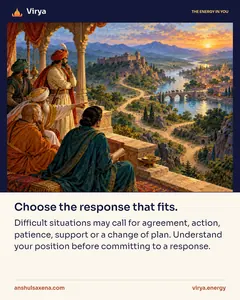
6 ways to face an enemy

Painting for 6 ways to face an enemy
6 ways to face an enemy, card 1 of 8
6 ways to face an enemy, card 2 of 8
6 ways to face an enemy, card 3 of 8
6 ways to face an enemy, card 4 of 8
6 ways to face an enemy, card 5 of 8
6 ways to face an enemy, card 6 of 8
6 ways to face an enemy, card 7 of 8
6 ways to face an enemy, card 8 of 8
Read as text

Shukra Niti’s six policies for dealing with rival rulers.

Sandhi: make an agreement, Sandhi means using an agreement to turn a powerful rival into a friend. Negotiation can change the relationship before a conflict grows.

Vigraha: confront the rival, Vigraha is active hostility intended to weaken or subdue an enemy. The text asks the ruler to consider it carefully with advisers.

Yana: move into action, Yana means marching against an enemy to achieve an objective. In its original setting, this is a military move, with resources committed to action.

Asana: hold your position, Asana means staying in a position that protects one’s side and disadvantages the enemy. Holding back can be a deliberate policy.

Samashraya: seek support, A weaker ruler seeks protection that makes them stronger. The text later describes help from powerful rulers, allies, and strongholds.

Dvaidhibhava: keep options open, Here it means placing one’s forces in separate groups. Later, the text also describes concealing intentions while responding to events. This is a policy of flexibility and strategic ambiguity.

Context: These are historical policies for rulers and armies. Modern reflections are analogies, not literal instructions for personal relationships.

Which is hardest for you: negotiating, acting, waiting, or asking for help?

Original Sanskrit excerpts + English paraphrases. Everyday examples are modern reflections.
Source: Shukraniti, Vidyotini Hindi edition (B. Mishra, Chowkhamba, 1968), book p. 363 / PDF p. 449; book p. 364 / PDF p. 450.

Shukra Niti

4 ways to influence a rival

Painting for 4 ways to influence a rival
4 ways to influence a rival, card 1 of 6
4 ways to influence a rival, card 2 of 6
4 ways to influence a rival, card 3 of 6
4 ways to influence a rival, card 4 of 6
4 ways to influence a rival, card 5 of 6
4 ways to influence a rival, card 6 of 6
Read as text

Sama, dana, bheda, danda: what the words actually mean.

Sama: begin with dialogue, Sama is conciliation: tell the rival that neither side should wish harm on the other and that cooperation is possible.

Dana: offer a concession, Dana can mean a gift or concession used to satisfy a rival. The examples here include tribute or land given to a stronger ruler.

Bheda: weaken their unity, Bheda works by creating differences within an opponent’s side or changing the balance among rival powers. It is a divisive statecraft tactic.

Danda: use coercive force, Danda means coercion or punishment. This passage includes harassing an enemy through raiders and weakening their wealth and grain supplies. The next page places it after other measures, when life is at risk.

Context: The book varies these methods by relationship and circumstances. It does not treat friends and enemies alike.

Can a clear conversation resolve a conflict you have been avoiding?

Original Sanskrit excerpts + English paraphrases. Everyday examples are modern reflections.
Source: Shukraniti, Vidyotini Hindi edition (B. Mishra, Chowkhamba, 1968), book p. 186 / PDF p. 272.

Shukra Niti

What is niti, really?

Painting for What is niti, really?
What is niti, really?, card 1 of 5
What is niti, really?, card 2 of 5
What is niti, really?, card 3 of 5
What is niti, really?, card 4 of 5
What is niti, really?, card 5 of 5
Read as text

Practical judgement for keeping a society functioning.

Wisdom has a public purpose, The text presents niti as knowledge that supports people’s lives and helps society remain stable. It is concerned with how conduct and decisions affect a whole community.

Judgement needs practice, A ruler is asked to study niti continually and with effort. Good judgement is something to develop through repeated learning.

Context: A thematic introduction to a historical Sanskrit work of ethics, governance, and statecraft.

Who will live with the consequences of your next decision?

Original Sanskrit excerpts + English paraphrases. Everyday examples are modern reflections.
Source: Shukraniti, Vidyotini Hindi edition (B. Mishra, Chowkhamba, 1968), book p. 1 / PDF p. 87; book p. 2 / PDF p. 88.

Shukra Niti

Lead your own mind first

Painting for Lead your own mind first
Lead your own mind first, card 1 of 5
Lead your own mind first, card 2 of 5
Lead your own mind first, card 3 of 5
Lead your own mind first, card 4 of 5
Lead your own mind first, card 5 of 5
Read as text

Self-control comes before authority over others.

Your first responsibility is within, If a ruler cannot govern even their own mind, how can they govern a vast territory? The question turns ambition back toward self-mastery.

Do not punish in anger, A ruler should not let anger drive punishment of their own people. Being responsible for others requires control over one’s reactions.

Context: The examples on the reflection card are contemporary applications.

What helps you regain control before you respond?

Original Sanskrit excerpts + English paraphrases. Everyday examples are modern reflections.
Source: Shukraniti, Vidyotini Hindi edition (B. Mishra, Chowkhamba, 1968), book p. 16 / PDF p. 102; book p. 19 / PDF p. 105.

Shukra Niti

Power should support people

Painting for Power should support people
Power should support people, card 1 of 5
Power should support people, card 2 of 5
Power should support people, card 3 of 5
Power should support people, card 4 of 5
Power should support people, card 5 of 5
Read as text

A ruler’s qualities matter because people feel their effects.

Use resources to sustain others, As Varuna nourishes through water, the ruler is compared to one who nourishes people through public resources.

Character should be felt in action, The moon brings delight through its rays; a ruler should bring well-being through qualities and deeds. The comparison links authority with the experience of the people.

Context: The original passage compares a king with divine functions; the team example is an analogy.

What became easier for others because you were in charge?

Original Sanskrit excerpts + English paraphrases. Everyday examples are modern reflections.
Source: Shukraniti, Vidyotini Hindi edition (B. Mishra, Chowkhamba, 1968), book p. 12 / PDF p. 98.

Shukra Niti

Good governance is built into roads

Painting for Good governance is built into roads
Good governance is built into roads, card 1 of 5
Good governance is built into roads, card 2 of 5
Good governance is built into roads, card 3 of 5
Good governance is built into roads, card 4 of 5
Good governance is built into roads, card 5 of 5
Read as text

Water, drainage, and places to rest also belong to niti.

Provide for the traveler, The text calls for a protected travelers’ rest house with good access to water. Public care appears in practical arrangements for ordinary movement.

Plan where the water will go, Roads should have side channels so water can drain away. The passage treats safe, usable infrastructure as a matter of governance.

Context: The reflection translates a planning principle; it is not a modern engineering specification.

What small design change would make a shared space easier to use?

Original Sanskrit excerpts + English paraphrases. Everyday examples are modern reflections.
Source: Shukraniti, Vidyotini Hindi edition (B. Mishra, Chowkhamba, 1968), book p. 38 / PDF p. 124; book p. 39 / PDF p. 125.

Shukra Niti

Can you hear criticizm calmly?

Painting for Can you hear criticizm calmly?
Can you hear criticizm calmly?, card 1 of 5
Can you hear criticizm calmly?, card 2 of 5
Can you hear criticizm calmly?, card 3 of 5
Can you hear criticizm calmly?, card 4 of 5
Can you hear criticizm calmly?, card 5 of 5
Read as text

A leader needs information that praise cannot provide.

Find the fault and correct it, After learning what people say about their faults, rulers should give those faults up and should not insult the people. Criticizm becomes a reason to improve.

Do not silence the critic, Even a powerful ruler is told not to kill or punish the person who criticizes them. Authority does not make retaliation wise.

What criticizm have you dismissed too quickly?

Original Sanskrit excerpts + English paraphrases. Everyday examples are modern reflections.
Source: Shukraniti, Vidyotini Hindi edition (B. Mishra, Chowkhamba, 1968), book p. 21 / PDF p. 107.

Shukra Niti

Leave the desk. See for yourself

Painting for Leave the desk. See for yourself
Leave the desk. See for yourself, card 1 of 5
Leave the desk. See for yourself, card 2 of 5
Leave the desk. See for yourself, card 3 of 5
Leave the desk. See for yourself, card 4 of 5
Leave the desk. See for yourself, card 5 of 5
Read as text

Reports matter. So does direct knowledge of people’s lives.

Visit the places you govern, The ruler is asked to inspect villages, towns, and regions personally each year. Governing requires contact with what is happening on the ground.

Ask who is helped and who is hurt, When examining officials’ treatment of people, the ruler should not simply take the officials’ side. The public’s experience should guide the inquiry.

Whose first-hand experience is missing from your reports?

Original Sanskrit excerpts + English paraphrases. Everyday examples are modern reflections.
Source: Shukraniti, Vidyotini Hindi edition (B. Mishra, Chowkhamba, 1968), book p. 54 / PDF p. 140.

Shukra Niti

Wise leaders do not decide alone

Painting for Wise leaders do not decide alone
Wise leaders do not decide alone, card 1 of 5
Wise leaders do not decide alone, card 2 of 5
Wise leaders do not decide alone, card 3 of 5
Wise leaders do not decide alone, card 4 of 5
Wise leaders do not decide alone, card 5 of 5
Read as text

Different people notice different things.

Expertise does not remove blind spots, Even a ruler skilled in many fields and in deliberation should consult ministers before deciding. Knowledge does not make consultation unnecessary.

No one can know it all, One person cannot know every aspect of affairs. The king should therefore choose helpers for the state’s development.

Who sees a part of this problem that you do not?

Original Sanskrit excerpts + English paraphrases. Everyday examples are modern reflections.
Source: Shukraniti, Vidyotini Hindi edition (B. Mishra, Chowkhamba, 1968), book p. 57 / PDF p. 143.

Shukra Niti

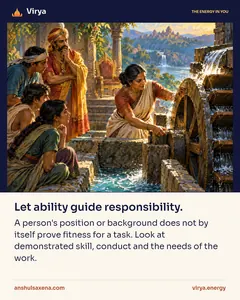
Give responsibility to the capable

Painting for Give responsibility to the capable
Give responsibility to the capable, card 1 of 5
Give responsibility to the capable, card 2 of 5
Give responsibility to the capable, card 3 of 5
Give responsibility to the capable, card 4 of 5
Give responsibility to the capable, card 5 of 5
Read as text

Look at conduct, qualities, and fitness for the work.

Status alone does not prove worth, This passage says excellence is not obtained merely through birth or family. It places value on work, conduct, and qualities.

Match the person to the role, Appoint someone after seeing that they are capable of that responsibility. A title should follow demonstrated ability.

Context: The selection highlights a specific criterion for appointment, not a modern equality doctrine attributed to the entire book.

What evidence shows that someone is ready for the responsibility?

Original Sanskrit excerpts + English paraphrases. Everyday examples are modern reflections.
Source: Shukraniti, Vidyotini Hindi edition (B. Mishra, Chowkhamba, 1968), book p. 65 / PDF p. 151; book p. 73 / PDF p. 159.

Shukra Niti

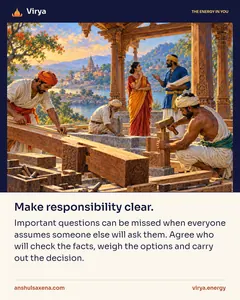
Clear roles make better decisions

Painting for Clear roles make better decisions
Clear roles make better decisions, card 1 of 5
Clear roles make better decisions, card 2 of 5
Clear roles make better decisions, card 3 of 5
Clear roles make better decisions, card 4 of 5
Clear roles make better decisions, card 5 of 5
Read as text

The book gives different advisers different questions to answer.

Give someone the job of checking facts, The pradhana is asked to examine whether reported actions are true or false. This role centers on verifying what has actually happened.

Give someone the job of weighing options, After considering which policy fits, when to use it, and its likely results, the minister should report a considered recommendation.

Which question in your team currently belongs to nobody?

Original Sanskrit excerpts + English paraphrases. Everyday examples are modern reflections.
Source: Shukraniti, Vidyotini Hindi edition (B. Mishra, Chowkhamba, 1968), book p. 70 / PDF p. 156; book p. 71 / PDF p. 157.

Shukra Niti

Service begins with honesty

Painting for Service begins with honesty
Service begins with honesty, card 1 of 5
Service begins with honesty, card 2 of 5
Service begins with honesty, card 3 of 5
Service begins with honesty, card 4 of 5
Service begins with honesty, card 5 of 5
Read as text

Truthfulness and helping others are standards for public work.

Keep truth and help together, Truth and helping others are praised as especially worthy. The ruler is told to retain people who bring those qualities to their work.

Do not use work as an excuse to exploit, A ruler should not distress the people under the pretext of official work. A public task is not an excuse for abuse.

Does your process serve its users as well as its operators?

Original Sanskrit excerpts + English paraphrases. Everyday examples are modern reflections.
Source: Shukraniti, Vidyotini Hindi edition (B. Mishra, Chowkhamba, 1968), book p. 87 / PDF p. 173; book p. 91 / PDF p. 177.

Shukra Niti

Why put it in writing?

Painting for Why put it in writing?
Why put it in writing?, card 1 of 5
Why put it in writing?, card 2 of 5
Why put it in writing?, card 3 of 5
Why put it in writing?, card 4 of 5
Why put it in writing?, card 5 of 5
Read as text

Memory fades. Clear records help decisions stand up to scrutiny.

People can make mistakes, Because human beings can err, a written record is presented as an important means of settling uncertainty.

Make approval identifiable, Those responsible should place their own seal at the end of the document. A record should show who approved it.

Context: This is a historical explanation of recordkeeping, not legal advice about a particular contract.

Which verbal agreement would benefit from a short written record?

Original Sanskrit excerpts + English paraphrases. Everyday examples are modern reflections.
Source: Shukraniti, Vidyotini Hindi edition (B. Mishra, Chowkhamba, 1968), book p. 101 / PDF p. 187; book p. 113 / PDF p. 199.

Shukra Niti

Pay people on time

Painting for Pay people on time
Pay people on time, card 1 of 5
Pay people on time, card 2 of 5
Pay people on time, card 3 of 5
Pay people on time, card 4 of 5
Pay people on time, card 5 of 5
Read as text

Compensation, rest, and support are part of managing people.

Do not withhold or delay pay, The text tells the ruler not to withhold wages or delay their payment. The surrounding verses also discuss pay sufficient to support dependants.

Leave time for life outside work, Workers are to receive time during the day for household duties. The passage also provides for rest at night.

Context: The edition also contains unequal pay rules tied to caste. These selected verses do not describe a universal modern labor code.

What part of your team’s working life needs more predictability?

Original Sanskrit excerpts + English paraphrases. Everyday examples are modern reflections.
Source: Shukraniti, Vidyotini Hindi edition (B. Mishra, Chowkhamba, 1968), book p. 118 / PDF p. 204; book p. 119 / PDF p. 205.

Shukra Niti

Speak so people can hear you

Painting for Speak so people can hear you
Speak so people can hear you, card 1 of 5
Speak so people can hear you, card 2 of 5
Speak so people can hear you, card 3 of 5
Speak so people can hear you, card 4 of 5
Speak so people can hear you, card 5 of 5
Read as text

Timing, brevity, and kindness all belong to good speech.

Choose the time and the words, Speak at the right time. Make the words useful, measured, consistent with the matter, and pleasant. Effective speech is more than saying whatever comes to mind.

Sharp words can undo a long friendship, Even a friend treated well for years can become hostile after cutting words. Long-standing goodwill does not make every remark harmless.

Could you say the same truth with fewer, better words?

Original Sanskrit excerpts + English paraphrases. Everyday examples are modern reflections.
Source: Shukraniti, Vidyotini Hindi edition (B. Mishra, Chowkhamba, 1968), book p. 127 / PDF p. 213; book p. 164 / PDF p. 250.

Shukra Niti

Think ahead. Then act

Painting for Think ahead. Then act
Think ahead. Then act, card 1 of 5
Think ahead. Then act, card 2 of 5
Think ahead. Then act, card 3 of 5
Think ahead. Then act, card 4 of 5
Think ahead. Then act, card 5 of 5
Read as text

Foresight and timely action work together.

Look at the likely result, The far-sighted person examines what a task may lead to before undertaking it. The verse’s commentary stresses considering good and bad outcomes in advance.

A lucky outcome does not justify haste, A rash act may sometimes succeed, and a carefully considered act may sometimes fail. The next lines still caution against acting without thought.

What assumption should you check before you proceed?

Original Sanskrit excerpts + English paraphrases. Everyday examples are modern reflections.
Source: Shukraniti, Vidyotini Hindi edition (B. Mishra, Chowkhamba, 1968), book p. 137 / PDF p. 223; book p. 138 / PDF p. 224.

Shukra Niti

Learning should make you humbler

Painting for Learning should make you humbler
Learning should make you humbler, card 1 of 5
Learning should make you humbler, card 2 of 5
Learning should make you humbler, card 3 of 5
Learning should make you humbler, card 4 of 5
Learning should make you humbler, card 5 of 5
Read as text

Knowledge is valuable for what it changes in you.

Success can become pride or discipline, The qualities that make some people arrogant can make a good person more disciplined. Learning, strength, and status do not have to feed the ego.

The fruit of learning is knowledge and humility, The commentary explains: learning should produce knowledge and humility; wealth should support sacrifice and giving; strength should protect good people.

Did your last achievement make you more helpful or more dismissive?

Original Sanskrit excerpts + English paraphrases. Everyday examples are modern reflections.
Source: Shukraniti, Vidyotini Hindi edition (B. Mishra, Chowkhamba, 1968), book p. 141 / PDF p. 227.

Shukra Niti

Trust grows through conduct

Painting for Trust grows through conduct
Trust grows through conduct, card 1 of 5
Trust grows through conduct, card 2 of 5
Trust grows through conduct, card 3 of 5
Trust grows through conduct, card 4 of 5
Trust grows through conduct, card 5 of 5
Read as text

Friendship needs both affection and discernment.

Get to know the person, Someone who makes a person a friend without understanding them properly can undermine the very purpose of the friendship. Familiarity is not the same as knowledge of character.

Allow room for a small mistake, Once someone has proved trustworthy, the text says a small loss should be forgiven. Discernment need not become constant suspicion.

Are you judging a whole relationship by one small failure?

Original Sanskrit excerpts + English paraphrases. Everyday examples are modern reflections.
Source: Shukraniti, Vidyotini Hindi edition (B. Mishra, Chowkhamba, 1968), book p. 138 / PDF p. 224; book p. 139 / PDF p. 225.

Shukra Niti

Two kinds of wealth

Painting for Two kinds of wealth
Two kinds of wealth, card 1 of 5
Two kinds of wealth, card 2 of 5
Two kinds of wealth, card 3 of 5
Two kinds of wealth, card 4 of 5
Two kinds of wealth, card 5 of 5
Read as text

Build resources for the future, and knowledge you can share.

Keep resources for future needs, The text asks people to protect wealth that can sustain them in the future. It connects accumulation with the ability to support life over time.

Knowledge grows when given, Knowledge is praised as a higher wealth: other resources can arise from it, sharing increases it, and it is not a burden to carry.

What skill are you steadily adding to your resources?

Original Sanskrit excerpts + English paraphrases. Everyday examples are modern reflections.
Source: Shukraniti, Vidyotini Hindi edition (B. Mishra, Chowkhamba, 1968), book p. 155 / PDF p. 241.

Shukra Niti

Make generosity a practice

Painting for Make generosity a practice
Make generosity a practice, card 1 of 5
Make generosity a practice, card 2 of 5
Make generosity a practice, card 3 of 5
Make generosity a practice, card 4 of 5
Make generosity a practice, card 5 of 5
Read as text

Giving belongs in ordinary life, not only in grand gestures.

Do not let every day be only about taking, The wise person is asked not to let a day pass without giving something. The emphasis is on a regular habit of generosity.

Giving can soften hostility, The text says that gifts can turn even hostile people into friends. Giving has a social effect: it can change how people relate to one another.

Context: The modern reflection expands the practice into everyday forms of help.

What can you share today without waiting for a special occasion?

Original Sanskrit excerpts + English paraphrases. Everyday examples are modern reflections.
Source: Shukraniti, Vidyotini Hindi edition (B. Mishra, Chowkhamba, 1968), book p. 160 / PDF p. 246.

Shukra Niti

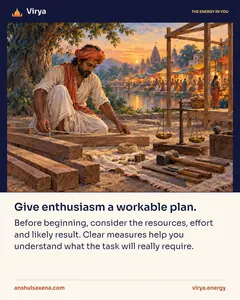
Before you start, count the cost

Painting for Before you start, count the cost
Before you start, count the cost, card 1 of 5
Before you start, count the cost, card 2 of 5
Before you start, count the cost, card 3 of 5
Before you start, count the cost, card 4 of 5
Before you start, count the cost, card 5 of 5
Read as text

A promising idea still needs a workable plan.

Examine the work and its means, The wise person considers the task, its means, its beginning and end, and the likely outcome before acting, even on a small undertaking.

Keep your measures honest, The text calls for accurate attention to the price and measure of goods. Judgement about a venture rests on knowing what is actually being exchanged.

Which hidden cost have you not counted yet?

Original Sanskrit excerpts + English paraphrases. Everyday examples are modern reflections.
Source: Shukraniti, Vidyotini Hindi edition (B. Mishra, Chowkhamba, 1968), book p. 169 / PDF p. 255; book p. 170 / PDF p. 256.

Shukra Niti

What is a treasury for?

Painting for What is a treasury for?
What is a treasury for?, card 1 of 5
What is a treasury for?, card 2 of 5
What is a treasury for?, card 3 of 5
What is a treasury for?, card 4 of 5
What is a treasury for?, card 5 of 5
Read as text

Public resources should sustain and protect the community.

Give public wealth a public purpose, The treasury is described as supporting defense, the protection of the people, and sacrificial duties. Its purpose reaches beyond a ruler’s private enjoyment.

Pay for what you take, The commentary explains that a king should not take merchants’ goods without payment. The suffering caused to the people can bring harm to the ruler and the ruling house.

Can you explain who benefits from the way you use shared resources?

Original Sanskrit excerpts + English paraphrases. Everyday examples are modern reflections.
Source: Shukraniti, Vidyotini Hindi edition (B. Mishra, Chowkhamba, 1968), book p. 201 / PDF p. 287; book p. 205 / PDF p. 291.

Shukra Niti

Knowledge lives in the hands too

Painting for Knowledge lives in the hands too
Knowledge lives in the hands too, card 1 of 5
Knowledge lives in the hands too, card 2 of 5
Knowledge lives in the hands too, card 3 of 5
Knowledge lives in the hands too, card 4 of 5
Knowledge lives in the hands too, card 5 of 5
Read as text

Shukra Niti gives crafts a place beside learned disciplines.

Learning has more than one form, Knowledge and arts are described as too numerous to count. The text then organizes important fields into a list of 32 vidyas and 64 kalas.

Making useful things is an art, The surrounding lines recognize work in clay, wood, stone, and metal as distinct arts, and drawing as an art too. Practical skill belongs within cultivated knowledge.

Which craft would you like to understand by trying it?

Original Sanskrit excerpts + English paraphrases. Everyday examples are modern reflections.
Source: Shukraniti, Vidyotini Hindi edition (B. Mishra, Chowkhamba, 1968), book p. 225 / PDF p. 311; book p. 234 / PDF p. 320.

Shukra Niti

How an image expresses an idea

Painting for How an image expresses an idea
How an image expresses an idea, card 1 of 5
How an image expresses an idea, card 2 of 5
How an image expresses an idea, card 3 of 5
How an image expresses an idea, card 4 of 5
How an image expresses an idea, card 5 of 5
Read as text

Posture, gesture, and proportion carry meaning in sacred art.

A calm image communicates reassurance, The passage describes a sattvic image through a composed posture and hands offering blessing and freedom from fear. The form is linked to the quality it expresses.

Proportion gives the form an order, In the nine-tala scheme, the face measures one tala. The following verses explain how other parts relate to that overall measure.

Which detail changes how you understand an image?

Original Sanskrit excerpts + English paraphrases. Everyday examples are modern reflections.
Source: Shukraniti, Vidyotini Hindi edition (B. Mishra, Chowkhamba, 1968), book p. 249 / PDF p. 335; book p. 251 / PDF p. 337.

Shukra Niti

A fair hearing starts with fairness

Painting for A fair hearing starts with fairness
A fair hearing starts with fairness, card 1 of 5
A fair hearing starts with fairness, card 2 of 5
A fair hearing starts with fairness, card 3 of 5
A fair hearing starts with fairness, card 4 of 5
A fair hearing starts with fairness, card 5 of 5
Read as text

Who listens, and how they listen, matters.

Treat friend and rival with the same standard, People appointed to judge should treat an enemy and a friend alike. The passage also asks for knowledge, truthfulness, and control over anger and greed.

Understand the claim before answering it, The claimant’s account is to be considered carefully and accurately. The following lines describe asking about omissions and correcting excess before completing the record.

Context: This is a reading of selected court principles. The wider text includes historical social restrictions and procedures unlike modern law.

Would you judge this differently if a friend were involved?

Original Sanskrit excerpts + English paraphrases. Everyday examples are modern reflections.
Source: Shukraniti, Vidyotini Hindi edition (B. Mishra, Chowkhamba, 1968), book p. 271 / PDF p. 357; book p. 283 / PDF p. 369.

Shukra Niti

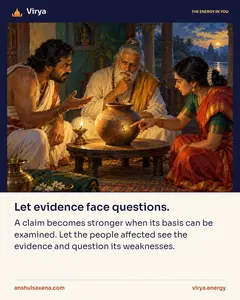
Evidence should be open to challenge

Painting for Evidence should be open to challenge
Evidence should be open to challenge, card 1 of 5
Evidence should be open to challenge, card 2 of 5
Evidence should be open to challenge, card 3 of 5
Evidence should be open to challenge, card 4 of 5
Evidence should be open to challenge, card 5 of 5
Read as text

A decision is stronger when both sides can examine its basis.

Show the evidence to both sides, The king should show the evidence in the presence of both claimant and respondent. The following line says not to receive it outside their view.

Examine its weaknesses, The parties should be able to point out defects in the evidence. The surrounding passage asks qualified adjudicators to examine what is hidden and make it clear.

Context: The same legal section also discusses ordeals. These selected lines explain its procedures for presenting and examining evidence; they are not a statement of modern law.

What context would you need before accepting this claim?

Original Sanskrit excerpts + English paraphrases. Everyday examples are modern reflections.
Source: Shukraniti, Vidyotini Hindi edition (B. Mishra, Chowkhamba, 1968), book p. 295 / PDF p. 381.

Shukra Niti

Justice needs a steady mind

Painting for Justice needs a steady mind
Justice needs a steady mind, card 1 of 5
Justice needs a steady mind, card 2 of 5
Justice needs a steady mind, card 3 of 5
Justice needs a steady mind, card 4 of 5
Justice needs a steady mind, card 5 of 5
Read as text

Anger, greed, and silence can distort a judgement.

Set personal impulses aside, Before imposing punishment, the ruler is told to set aside desire, anger, and greed. The point is to stop private impulses from controlling public decisions.

Advisers must challenge wrongdoing, Members of the court should not ignore a ruler acting unjustly. Their duty includes speaking up when authority goes wrong.

Context: These are historical ethical principles, not a modern criminal-justice framework.

When has silence made a decision seem more acceptable than it was?

Original Sanskrit excerpts + English paraphrases. Everyday examples are modern reflections.
Source: Shukraniti, Vidyotini Hindi edition (B. Mishra, Chowkhamba, 1968), book p. 191 / PDF p. 277; book p. 313 / PDF p. 399.

Shukra Niti

Strength has more than one source

Painting for Strength has more than one source
Strength has more than one source, card 1 of 5
Strength has more than one source, card 2 of 5
Strength has more than one source, card 3 of 5
Strength has more than one source, card 4 of 5
Strength has more than one source, card 5 of 5
Read as text

The book looks beyond muscle, and beyond walls.

There are six forms of strength, The list names bodily strength, courage, military strength, weapon strength, intelligence, and length of life. No single quality exhausts what it means to be strong.

A fort also needs capable support, A fort supported by allies is called better. The surrounding verses also stress defenders, supplies, food, and funds. Walls alone do not make a place secure.

Context: The original setting is military. The project checklist is a modern analogy.

Which resource is missing from your idea of being ready?

Original Sanskrit excerpts + English paraphrases. Everyday examples are modern reflections.
Source: Shukraniti, Vidyotini Hindi edition (B. Mishra, Chowkhamba, 1968), book p. 325 / PDF p. 411; book p. 327 / PDF p. 413.

Shukra Niti

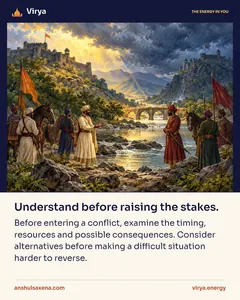
Before a conflict, weigh the situation

Painting for Before a conflict, weigh the situation
Before a conflict, weigh the situation, card 1 of 5
Before a conflict, weigh the situation, card 2 of 5
Before a conflict, weigh the situation, card 3 of 5
Before a conflict, weigh the situation, card 4 of 5
Before a conflict, weigh the situation, card 5 of 5
Read as text

Timing, resources, alternatives, and consequences belong together.

Look at more than your own resolve, Before war, the ruler should examine time, place, the enemy’s strength, and their own. The next line adds methods, policies, and counsel.

Use the alternatives before the last resort, The passage asks the ruler to consider available methods and the six policies for both sides. It then permits war when life or everything one has is in danger.

Context: The everyday reflection is about judgement in disagreement, not equating ordinary people with military enemies.

What alternative have you not yet considered?

Original Sanskrit excerpts + English paraphrases. Everyday examples are modern reflections.
Source: Shukraniti, Vidyotini Hindi edition (B. Mishra, Chowkhamba, 1968), book p. 361 / PDF p. 447; book p. 374 / PDF p. 460.

Shukra Niti

Finish what you begin

Painting for Finish what you begin
Finish what you begin, card 1 of 5
Finish what you begin, card 2 of 5
Finish what you begin, card 3 of 5
Finish what you begin, card 4 of 5
Finish what you begin, card 5 of 5
Read as text

The closing chapter warns against scattering your effort.

Too many beginnings divide attention, Starting many tasks at once does not bring ease. The text advises completing what has been begun before taking up another task.

Choose a task you can bring to completion, Undertake work with a path to completion. The surrounding lines explain that constantly moving to another task can leave both the earlier and the later work unfinished.

Context: Final post in a thematic tour of the book’s major subjects, not a translation of every verse.

What will you finish before you begin something new?

Original Sanskrit excerpts + English paraphrases. Everyday examples are modern reflections.
Source: Shukraniti, Vidyotini Hindi edition (B. Mishra, Chowkhamba, 1968), book p. 408 / PDF p. 494; book p. 409 / PDF p. 495.