20 posts · 120 cards

Adi Shankaracharya आदि शङ्कराचार्य

Twenty teachings of Advaita: the rope and the snake, neti neti, and the nature of the self.

Adi Shankaracharya

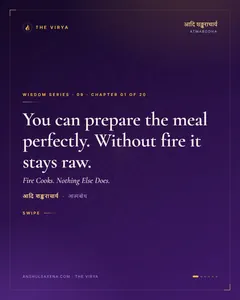
Fire Cooks. Nothing Else Does

You can prepare the meal perfectly. Without fire it stays raw

Fire Cooks. Nothing Else Does., card 1 of 6
Fire Cooks. Nothing Else Does., card 2 of 6
Fire Cooks. Nothing Else Does., card 3 of 6
Fire Cooks. Nothing Else Does., card 4 of 6
Fire Cooks. Nothing Else Does., card 5 of 6
Fire Cooks. Nothing Else Does., card 6 of 6
Read as text

आदि शङ्कराचार्य · आत्मबोध, "Fire Cooks. Nothing Else Does."

Bodho'nyasadhanebhyo hi sakshanmokshaikasadhanam |
Pakasya vahnivajjnanam vina moksho na sidhyati ||

As fire is the direct cause of cooking, so knowledge and not any other form of discipline is the direct cause of liberation; for liberation cannot be attained without knowledge.

Preparation and cause are different categories. Confusing them produces a lifetime of excellent preparation with the transforming step never applied.

How the text gets there:
1. Cooking requires many operations, of which only one transforms the food.
2. The others are necessary and none of them substitutes for fire.
3. Knowledge is placed in the position of fire, as the direct cause.
4. Other disciplines are therefore preparatory rather than causal, which is why more of them cannot produce the result.

Today: Ask of any long practice what the fire is. In most fields there is one operation that actually converts, and a great deal of supporting activity that feels like progress. Knowing which is which tells you whether you are close or merely busy.

In what you are working on, what is the chopping and what is the fire? Tell me below.

Adi Shankaracharya

Real Until You Wake

Nothing in the dream tells you it is a dream

Real Until You Wake, card 1 of 6
Real Until You Wake, card 2 of 6
Real Until You Wake, card 3 of 6
Real Until You Wake, card 4 of 6
Real Until You Wake, card 5 of 6
Real Until You Wake, card 6 of 6
Read as text

आदि शङ्कराचार्य · आत्मबोध, "Real Until You Wake"

Samsarah svapnatulyo hi ragadveshadisankulah |
Svakale satyavadbhati prabodhe satyasadbhavet ||

The world, filled with attachments and aversions and the rest, is like a dream; it appears to be real as long as one is ignorant, but becomes unreal when one is awake.

The claim is not that the world feels unreal to the attentive. It is that no amount of internal checking can settle the question from inside, which is exactly what makes the analogy work.

How the text gets there:
1. A dream is fully convincing while it is running.
2. Its unreality is established only from the waking state, never from within.
3. So no test conducted inside can determine the status of what is being experienced.
4. Attachment and aversion are named as what fills the dream and supplies its urgency.

Today: Everyone has woken from an anxiety that was total at 3am and unremarkable by 9. That is a small instance of the structure. Whatever currently feels most inarguably urgent has the same relationship to a state you are not in.

What felt absolutely real last year that you cannot now reconstruct? Tell me below.

Adi Shankaracharya

The Rope And The Snake

The fear was real. The snake was not

The Rope And The Snake, card 1 of 6
The Rope And The Snake, card 2 of 6
The Rope And The Snake, card 3 of 6
The Rope And The Snake, card 4 of 6
The Rope And The Snake, card 5 of 6
The Rope And The Snake, card 6 of 6
Read as text

आदि शङ्कराचार्य · आत्मबोध, "The Rope And The Snake"

Rajjusarpavadatmanam jivam jnatva bhayam vahet |
Naham jivah paratmeti jnatashchennirbhayo bhavet ||

The soul, regarding itself as a jiva, is overcome by fear, just like the man who regards a rope as a snake. It regains fearlessness on realizing that it is not a jiva but the supreme soul.

The fear was correct given the misidentification. That is why courage is the wrong remedy and accurate seeing is the right one, and why the removal is instantaneous when it comes.

How the text gets there:
1. A rope is misperceived as a snake.
2. The resulting fear is genuine and proportionate to the perceived object.
3. Correcting the perception removes the fear without any act of courage.
4. Applied to the self, taking oneself for a limited jiva produces fear that accurate identification dissolves.

Today: Useful for distinguishing two kinds of fear. Some respond to reassurance and some only dissolve when you see the situation accurately. Effort spent being brave about a rope is effort spent on the wrong operation.

What are you being brave about that you should be looking at more closely? Tell me below.

Adi Shankaracharya

Not This, Not This

The method is subtraction. You never arrive at a description

Not This, Not This, card 1 of 6
Not This, Not This, card 2 of 6
Not This, Not This, card 3 of 6
Not This, Not This, card 4 of 6
Not This, Not This, card 5 of 6
Not This, Not This, card 6 of 6
Read as text

आदि शङ्कराचार्य · नेति नेति, "Not This, Not This"

Nishidhya nikhilopadhinneti netiti vakyatah |
Vidyadaikyam mahavakyairjivatmaparamatmanoh ||

By negating all the upadhis through the scriptural statement 'it is not this, it is not this', realize the oneness of the individual soul and the supreme soul by means of the great Vedic aphorisms.

Any positive description of the self would name a property, and every property is an upadhi. So negation is not modesty about language. It is the only operation available.

How the text gets there:
1. The self is covered by limiting adjuncts that appear to define it.
2. Every nameable property falls into that category.
3. A positive description would therefore describe a covering rather than the thing.
4. Negation is the only remaining method, applied repeatedly rather than once.

Today: The technique generalises to anything defined by its limits rather than its content: a role, a relationship, an identity. Listing what it is not is often more informative than the definitions people offer, and it is available when they are not.

What are you left with after removing everything you could name about yourself? Tell me below.

Adi Shankaracharya

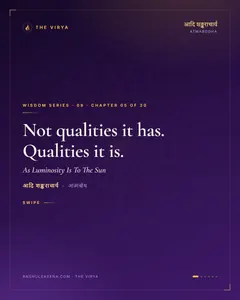
As Luminosity Is To The Sun

Not qualities it has. Qualities it is

As Luminosity Is To The Sun, card 1 of 6
As Luminosity Is To The Sun, card 2 of 6
As Luminosity Is To The Sun, card 3 of 6
As Luminosity Is To The Sun, card 4 of 6
As Luminosity Is To The Sun, card 5 of 6
As Luminosity Is To The Sun, card 6 of 6
Read as text

आदि शङ्कराचार्य · आत्मबोध, "As Luminosity Is To The Sun"

Prakasho'rkasya toyasya shaityamagneryathoshnata |
Svabhavah sacchidanandanityanirmalatatmanah ||

The nature of Atman is eternity, purity, reality, consciousness and bliss, just as luminosity is the nature of the sun, coolness of water and heat of fire.

If these are svabhava rather than qualities, then no practice increases them and no failure diminishes them. Whatever spiritual practice is for, it is not for making the self more of what it already is.

How the text gets there:
1. Three examples are given in which a property is inseparable from its bearer.
2. Removing the property in each case removes the thing itself.
3. The self's characteriztics are placed in this same category.
4. So they are not subject to increase or loss, and practice cannot be aimed at acquiring them.

Today: Changes what a bad stretch means. If what you are seeking is your own nature rather than an accumulation, then a period of not experiencing it is a period of obstruction, not depletion, and nothing has to be rebuilt.

Are you trying to acquire something or to stop obstructing it? Tell me below.

Adi Shankaracharya

Neither One Is What You Think

The self never changes. The intellect never knows. You believe both do

Neither One Is What You Think, card 1 of 6
Neither One Is What You Think, card 2 of 6
Neither One Is What You Think, card 3 of 6
Neither One Is What You Think, card 4 of 6
Neither One Is What You Think, card 5 of 6
Neither One Is What You Think, card 6 of 6
Read as text

आदि शङ्कराचार्य · आत्मबोध, "Neither One Is What You Think"

Atmano vikriya nasti buddherbodho na jatviti |
Jivah sarvamalam jnatva jnata drashteti muhyati ||

Atman never undergoes change, and the buddhi is never endowed with consciousness. But man believes Atman to be identical with the buddhi and falls under such delusions as that he is the seer and the knower.

The sense of being the knower is treated as the symptom of the confusion rather than as evidence about the self. It is what a changeless thing and an unconscious thing produce when they are taken for one.

How the text gets there:
1. The self is denied change and the intellect is denied consciousness.
2. Neither, taken alone, can be the knower.
3. The two are nonetheless identified with each other in ordinary experience.
4. The sense of being seer and knower is the product of that identification rather than a report on either.

Today: Sits under the ordinary experience of intellectual pride. The feeling of being the one who understands is exactly what this verse classifies as a delusion, which makes it an unusually direct challenge to anyone who works with their mind.

Who is the one who knows what you know? Tell me below.

Adi Shankaracharya

The Conclusion, Stated Flatly

Six adjectives, then the identification

The Conclusion, Stated Flatly, card 1 of 6
The Conclusion, Stated Flatly, card 2 of 6
The Conclusion, Stated Flatly, card 3 of 6
The Conclusion, Stated Flatly, card 4 of 6
The Conclusion, Stated Flatly, card 5 of 6
The Conclusion, Stated Flatly, card 6 of 6
Read as text

आदि शङ्कराचार्य · आत्मबोध, "The Conclusion, Stated Flatly"

Nityashuddhavimuktaikamakhandanandamadvayam |
Satyam jnanamanantam yatparam brahmahameva tat ||

I am verily that supreme Brahman, which is eternal, stainless, free, one, undivided bliss, non-dual, truth, knowledge and infinite.

The whole distance of the Advaita claim is in one word. Not like that, not part of that, not moving toward that. That.

How the text gets there:
1. A series of attributes is given, all of them describing the ultimate reality.
2. The accumulation establishes it as maximally remote from an individual.
3. The final clause identifies the speaker with it directly.
4. The particle eva forecloses any weaker reading such as similarity or participation.

Today: This is the sentence that makes Advaita difficult rather than comforting. It is not an encouragement about human potential. It is a claim that removes the individual entirely, and most people who quote it approvingly have not sat with what it deletes.

Do you find that claim inspiring or threatening, and why? Tell me below.

Adi Shankaracharya

The Wave And The Water

A wave is a shape water is doing

The Wave And The Water, card 1 of 6
The Wave And The Water, card 2 of 6
The Wave And The Water, card 3 of 6
The Wave And The Water, card 4 of 6
The Wave And The Water, card 5 of 6
The Wave And The Water, card 6 of 6
Read as text

आदि शङ्कराचार्य · विवेकचूडामणि, "The Wave And The Water"

As the wave, the foam, the whirlpool, the bubble, are all in essence but water, so the universe is nothing but Brahman.

The apparently distinct forms of the world are modifications of one substance, as wave and foam are of water.

The image does not call the world an illusion in the sense of not occurring. It calls it a modification, which means the wave is real and the wave-as-a-separate-thing is not.

How the text gets there:
1. Four water phenomena are named, all genuinely observable.
2. None is composed of anything other than water.
3. A whirlpool has no matter of its own at all, only a persisting form.
4. So the forms are granted while their independent substance is denied.

Today: Useful against the lazy reading of maya as everything being fake. The wave will still knock you over. What the image denies is that it is a thing in its own right with a career of its own, which is a much more precise and more interesting claim.

What in your life is a wave you have been treating as a separate object? Tell me below.

Adi Shankaracharya

Complete, Not Reduced

Not less ego. The complete cessation of it

Complete, Not Reduced, card 1 of 6
Complete, Not Reduced, card 2 of 6
Complete, Not Reduced, card 3 of 6
Complete, Not Reduced, card 4 of 6
Complete, Not Reduced, card 5 of 6
Complete, Not Reduced, card 6 of 6
Read as text

आदि शङ्कराचार्य · विवेकचूडामणि, "Complete, Not Reduced"

Through the complete cessation of Egoism, through the stoppage of the diverse mental waves due to it, and through the discrimination of the inner Reality, one realizes that Reality as 'I am This'.

Realization follows from the total ending of egoism, the consequent stilling of the mental modifications it produces, and discrimination of the inner reality.

Placing the mental waves downstream of egoism explains why direct attempts to calm the mind fail. You are working on the output while the generator runs.

How the text gets there:
1. Three conditions are stated in a fixed order.
2. Egoism must cease completely, not merely diminish.
3. The mental modifications are attributed to egoism, so they stop as a consequence.
4. Discrimination then operates on what remains, making the sequence causal rather than parallel.

Today: Explains why meditation aimed at quieting thoughts often plateaus. The thoughts are symptoms of something upstream, and treating them directly is sustainable but not transforming. Which is uncomfortable, because the upstream item is not one you can approach with a technique.

Are you calming the waves or looking at what makes them? Tell me below.

Adi Shankaracharya

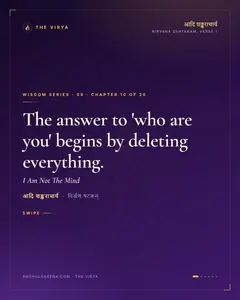
I Am Not The Mind

The answer to 'who are you' begins by deleting everything

I Am Not The Mind, card 1 of 6
I Am Not The Mind, card 2 of 6
I Am Not The Mind, card 3 of 6
I Am Not The Mind, card 4 of 6
I Am Not The Mind, card 5 of 6
I Am Not The Mind, card 6 of 6
Read as text

आदि शङ्कराचार्य · निर्वाण षटकम्, "I Am Not The Mind"

Manobuddhyahankaracittani naham
na cha shrotrajihve na cha ghranetre |
Na cha vyoma bhumirna tejo na vayus
chidanandarupah shivo'ham shivo'ham ||

I am neither the mind, intelligence, ego, nor chitta; neither the ears nor the tongue, nor the senses of smell and sight; neither ether nor air, nor fire nor water nor earth. I am eternal bliss and awareness. I am Shiva, I am Shiva.

The negations move outward from the subtlest to the grossest, so by the time the elements are reached, everything a person would offer as identity has already been removed.

How the text gets there:
1. The question asked is who the speaker is.
2. The answer begins with the internal instruments of cognition.
3. It then proceeds outward through the senses to the physical elements.
4. Every conventional component of identity is exhausted before the positive assertion is made.

Today: Try the exercise with the modern list: not my role, not my history, not my opinions, not my body. It is more disorienting than it sounds, and the disorientation is roughly the point of the composition.

What is left when you have removed everything you would list? Tell me below.

Adi Shankaracharya

Not Even Liberation

He deletes the vices, then the virtues, then the goal

Not Even Liberation, card 1 of 6
Not Even Liberation, card 2 of 6
Not Even Liberation, card 3 of 6
Not Even Liberation, card 4 of 6
Not Even Liberation, card 5 of 6
Not Even Liberation, card 6 of 6
Read as text

आदि शङ्कराचार्य · निर्वाण षटकम्, "Not Even Liberation"

Na me dweshraagau na me lobhamohau
mado naiva me naiva matsaryabhavah |
Na dharmo na chartho na kamo na mokshas
chidanandarupah shivo'ham shivo'ham ||

Neither greed nor delusion, loathing nor liking, have I; nothing of pride or ego, of dharma or liberation; neither desire of the mind nor object for its desiring. I am eternal bliss and awareness. I am Shiva, I am Shiva.

Including moksha is the move that makes the verse Advaita rather than piety. If liberation is something you could lack and then obtain, it is a state of a limited thing, and the speaker has already denied being one.

How the text gets there:
1. The verse first negates a standard list of faults.
2. That alone would constitute a claim of moral attainment.
3. It then negates the four legitimate goals, including liberation.
4. Since liberation would be a change of state, denying it asserts that the speaker is not the kind of thing that has states.

Today: The structure catches the subtlest form of spiritual acquisitiveness, in which the goal has become one more thing to obtain. This verse removes the goal along with the vices, and does not treat that as a loss.

Have you made your goal into another possession? Tell me below.

Adi Shankaracharya

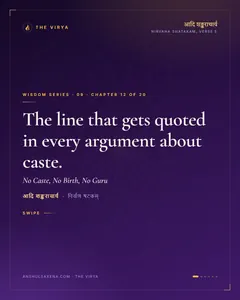
No Caste, No Birth, No Guru

The line that gets quoted in every argument about caste

No Caste, No Birth, No Guru, card 1 of 6
No Caste, No Birth, No Guru, card 2 of 6
No Caste, No Birth, No Guru, card 3 of 6
No Caste, No Birth, No Guru, card 4 of 6
No Caste, No Birth, No Guru, card 5 of 6
No Caste, No Birth, No Guru, card 6 of 6
Read as text

आदि शङ्कराचार्य · निर्वाण षटकम्, "No Caste, No Birth, No Guru"

Na mrityurna shanka na me jatibhedah
pita naiva me naiva mata na janma |
Na bandhurna mitram gururnaiva shishyash-
chidanandarupah shivo'ham shivo'ham ||

Death or fear I have none, nor any distinction of castes; neither father nor mother, nor even a birth, have I; neither friend nor comrade, neither disciple nor guru. I am eternal bliss and awareness. I am Shiva, I am Shiva.

The denial of caste is not a social position bolted onto the metaphysics. It falls out of it, because caste is transmitted by birth and birth has already been denied two lines earlier.

How the text gets there:
1. The verse negates death and fear, then caste distinction.
2. It then negates parents and birth itself.
3. Caste is transmitted through birth, so denying birth removes it necessarily.
4. The final negation of guru and disciple applies the same logic to the relationships the author himself institutionalised.

Today: Worth noting for how the argument is made. The caste claim is not asserted as a value and defended; it is derived from a premise stated for other reasons. Positions reached that way are considerably harder to dislodge.

Which of your convictions are values you hold, and which are consequences of something else you believe? Tell me below.

Adi Shankaracharya

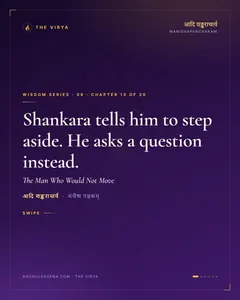
The Man Who Would Not Move

Shankara tells him to step aside. He asks a question instead

The Man Who Would Not Move, card 1 of 6
The Man Who Would Not Move, card 2 of 6
The Man Who Would Not Move, card 3 of 6
The Man Who Would Not Move, card 4 of 6
The Man Who Would Not Move, card 5 of 6
The Man Who Would Not Move, card 6 of 6
Read as text

आदि शङ्कराचार्य · मनीषा पञ्चकम्, "The Man Who Would Not Move"

The chandala instead asked Shankara how can there be any social discrimination when all human beings, and, indeed, the entire universe, is nothing but the same Brahman.

Shankara's own doctrine is turned back on him by a man he has just asked to move out of the way, and he accepts the correction.

The story survives because Shankara loses it. A tradition that wanted to protect its founder would not preserve an account of him being corrected on his own doctrine by someone he had just insulted.

How the text gets there:
1. Shankara acts on a social convention that contradicts his philosophy.
2. The contradiction is pointed out by the person the convention disadvantages.
3. The argument used is Shankara's own, not an external appeal.
4. He composes five verses of firm conviction in response, recording the correction rather than the rebuttal.

Today: The pattern is worth watching for: the gap between what someone argues and how they behave, and who is positioned to notice it. It is almost never the peers. It is the person on the receiving end of the inconsistency.

Who has pointed out a gap between what you argue and how you act? Tell me below.

Adi Shankaracharya

Proved In Deep Sleep

The one state where everything else is gone and something remains

Proved In Deep Sleep, card 1 of 6
Proved In Deep Sleep, card 2 of 6
Proved In Deep Sleep, card 3 of 6
Proved In Deep Sleep, card 4 of 6
Proved In Deep Sleep, card 5 of 6
Proved In Deep Sleep, card 6 of 6
Read as text

आदि शङ्कराचार्य · दशश्लोकी, "Proved In Deep Sleep"

Na bhumirna toyam na tejo na vayur
Na kham nendriyam va na tesham samuhah |
Anekantikatvat sushuptyekasiddha
Tadeko'vashishtah shivah kevalo'ham ||

I am not the earth nor water, neither fire nor air, I am not space, nor any of the faculties nor their aggregate, as they are all uncertain. I am proved however in the sole experience of deep sleep. That one, the residue, the auspicious, the only one, am I.

Deep sleep functions as a controlled experiment. Everything variable is switched off nightly, and the same procedure runs on everyone, which makes the residue the only candidate that survives the test.

How the text gets there:
1. Candidates for the self are rejected for being inconstant.
2. Deep sleep removes body, senses and mind from experience entirely.
3. Something is nonetheless established in that state.
4. What remains after all variable elements are absent is identified as the residue and the self.

Today: It is the most empirical argument in the tradition and it runs every night. Whatever account you hold of what you are has to explain the sense of having persisted through a period containing no experience whatever.

What of you was present last night that you cannot name? Tell me below.

Adi Shankaracharya

Not Even Meditation

Not the castes, not the duties, and not the spiritual practices either

Not Even Meditation, card 1 of 6
Not Even Meditation, card 2 of 6
Not Even Meditation, card 3 of 6
Not Even Meditation, card 4 of 6
Not Even Meditation, card 5 of 6
Not Even Meditation, card 6 of 6
Read as text

आदि शङ्कराचार्य · दशश्लोकी, "Not Even Meditation"

Na varna na varnashramacharadharma
Na me dharanadhyanayogadayopi |
Anatmashrayaham-mama-dhyasahanat
Tadeko'vashishtah shivah kevalo'ham ||

The castes are not for me, nor the observances and duties attached to the castes and the stages of life. Even concentration, meditation and self-communion are not for me. For the mistaken senses of I and mine, which rested on the non-self, have been abandoned.

The practices are not dismissed as ineffective. They are described as having no remaining subject, because the one who was doing them was the misidentification they were meant to correct.

How the text gets there:
1. Social duties and spiritual practices are both negated.
2. The reason given is the abandonment of the senses of I and mine.
3. Those senses were superimposed on what is not the self.
4. Practices predicated on them therefore lose their subject rather than their efficacy.

Today: Worth holding alongside any serious practice. It is entirely possible to have made the practice a possession of the very self it was meant to dissolve, and the signal is usually how you feel when you miss a day.

Who is it that does your practice? Tell me below.

Adi Shankaracharya

No Direction At All

Above, below, inside, outside, east, west. None of them

No Direction At All, card 1 of 6
No Direction At All, card 2 of 6
No Direction At All, card 3 of 6
No Direction At All, card 4 of 6
No Direction At All, card 5 of 6
No Direction At All, card 6 of 6
Read as text

आदि शङ्कराचार्य · दशश्लोकी, "No Direction At All"

Na chordhvam na chadho na chantarna bahyam
Na madhyam na tiryak na purva'para dik |
Viyadvyapakatvadakhandaikarupam
Tadeko'vashishtah shivah kevalo'ham ||

There is neither above nor below, neither inside nor outside, no middle nor crosswise, no direction east or west. For it is all-pervasive like space, partless and homogeneous in its nature.

Spatial language fails here not from inadequacy but from structure. Every direction word needs two things, and the subject of this verse is one thing without parts.

How the text gets there:
1. Each spatial term named is relational, requiring two relata.
2. The subject is described as partless and homogeneous.
3. A partless thing offers nothing for a relation to hold between.
4. So directional language fails structurally rather than through imprecision.

Today: A useful check on your own metaphors for the deepest things. Higher self, inner voice, going deeper: every one imports a direction, and the direction is doing more work in your thinking than you have noticed.

Which of your spatial metaphors have you mistaken for descriptions? Tell me below.

Adi Shankaracharya

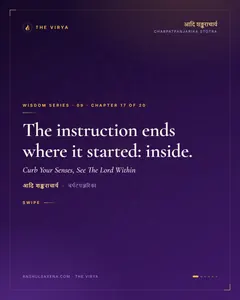
Curb Your Senses, See The Lord Within

The instruction ends where it started: inside

Curb Your Senses, See The Lord Within, card 1 of 6
Curb Your Senses, See The Lord Within, card 2 of 6
Curb Your Senses, See The Lord Within, card 3 of 6
Curb Your Senses, See The Lord Within, card 4 of 6
Curb Your Senses, See The Lord Within, card 5 of 6
Curb Your Senses, See The Lord Within, card 6 of 6
Read as text

आदि शङ्कराचार्य · चर्पटपञ्जरिका, "Curb Your Senses, See The Lord Within"

Gurucharanambujanirbharabhaktah samsaradaciradbhava muktah |
Indriyamanasaniyamadevam drakshyasi nijahridayastham devam ||

Cherish your guru's lotus feet and free yourself without delay from the enslavement of this world; curb your senses and your mind and see the Lord within your heart.

The teacher is the entry point and not the destination. The sequence starts outside and ends inside, which is why the verse can begin with such strong devotional language without contradiction.

How the text gets there:
1. Three instructions are given in order.
2. The first is directed at an external figure, the teacher.
3. The second concerns one's relationship to the surrounding world.
4. The third is wholly internal, and the object found is located in one's own heart.

Today: Resolves a tension people feel about teachers. Deference that never turns inward becomes dependence, and refusing the entry point altogether means starting from nothing. The verse puts the guru first and the heart last, in that order.

Has your teacher become the destination? Tell me below.

Adi Shankaracharya

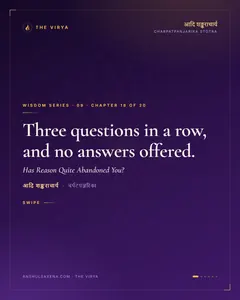
Has Reason Quite Abandoned You?

Three questions in a row, and no answers offered

Has Reason Quite Abandoned You?, card 1 of 6
Has Reason Quite Abandoned You?, card 2 of 6
Has Reason Quite Abandoned You?, card 3 of 6
Has Reason Quite Abandoned You?, card 4 of 6
Has Reason Quite Abandoned You?, card 5 of 6
Has Reason Quite Abandoned You?, card 6 of 6
Read as text

आदि शङ्कराचार्य · चर्पटपञ्जरिका, "Has Reason Quite Abandoned You?"

Ka te'shtadashadeshe chinta vatula kim tava nasti niyanta |
Yastvam haste sudhanibaddham bodhayati prabhavadiviruddham ||

Why do all things distress your mind? Has reason quite abandoned you? Have you no guide to hold you firm, instructing you of life and death?

Framing anxiety as reason having gone absent is unusual and useful. It does not say the worry is unfounded. It says the faculty that would have assessed whether it was has stopped being applied.

How the text gets there:
1. The listener is addressed as distracted rather than as at fault.
2. The first question addresses the distress itself.
3. The second locates the failure in reason having withdrawn.
4. The third asks whether any instruction is being held, which is the remedy for the second.

Today: The check is simple and rarely run. When something has been troubling you for days, ask what your actual reasoning about it is, written out. Most persistent worry turns out never to have been examined, only revisited.

What have you been worrying about without once reasoning about it? Tell me below.

Adi Shankaracharya

Blest Is The Wearer Of The Loincloth

One possession. A beggar's meal. Shankara calls this fortunate

Blest Is The Wearer Of The Loincloth, card 1 of 6
Blest Is The Wearer Of The Loincloth, card 2 of 6
Blest Is The Wearer Of The Loincloth, card 3 of 6
Blest Is The Wearer Of The Loincloth, card 4 of 6
Blest Is The Wearer Of The Loincloth, card 5 of 6
Blest Is The Wearer Of The Loincloth, card 6 of 6
Read as text

आदि शङ्कराचार्य · कौपीन पञ्चकम्, "Blest Is The Wearer Of The Loincloth"

Vedantavakyeshu sada ramanto
Bhikshannamatrena cha tushtimantah |
Vishokamantahkarane charantah
Kaupinavantah khalu bhagyavantah ||

Roaming ever in the grove of Vedanta, ever pleased with his beggar's morsel, wandering onward, his heart free from sorrow: blest indeed is the wearer of the loincloth.

Calling this fortunate rather than admirable is the interesting move. Admirable would concede that something was given up. Fortunate says the arrangement is enviable on its own terms.

How the text gets there:
1. The word used for the renunciate is the ordinary word for the fortunate.
2. It is applied to a state with a single possession and no assured food.
3. The contentment described is with the morsel itself rather than despite it.
4. The surrounding text records that this was not prescribed for others, which makes it a report rather than a standard.

Today: The distinction between a personal choice and a general prescription is one most systems fail to hold. Shankara chose the extreme version and explicitly declined to require it, which is a rarer combination than either half alone.

What do you practice personally that you have quietly started prescribing? Tell me below.

Adi Shankaracharya

Beginningless And Indescribable

Where did the ignorance come from? The system declines to say

Beginningless And Indescribable, card 1 of 6
Beginningless And Indescribable, card 2 of 6
Beginningless And Indescribable, card 3 of 6
Beginningless And Indescribable, card 4 of 6
Beginningless And Indescribable, card 5 of 6
Beginningless And Indescribable, card 6 of 6
Read as text

आदि शङ्कराचार्य · आत्मबोध, "Beginningless And Indescribable"

Anadyavidyanirvachya karanopadhirucyate |
Upadhitritayadanyamatmanamavadharayet ||

Avidya, or nescience, indescribable and beginningless, is called the cause, which is an upadhi superimposed on Atman. Know for certain that Atman is other than the three upadhis.

The honest move is admitting the category is indescribable rather than manufacturing an account. A system that says one thing exists cannot then explain where the appearance of many came from without contradicting itself.

How the text gets there:
1. Ignorance is assigned as the cause of the superimposition.
2. Calling it real would establish a second reality alongside Brahman.
3. Calling it unreal would leave the appearance of the world unexplained.
4. Both descriptions are therefore refused, and the enquiry is redirected to what the self is not.

Today: There is something worth borrowing in a system marking its own unanswerable question rather than covering it. Most frameworks have one, and the ones that name it are more trustworthy than the ones with an answer for everything.

What is the question your own worldview cannot answer? Tell me below.