20 posts · 120 cards

Yoga Sutras योगसूत्र

Patanjali on stilling the mind, in twenty sutras.

Yoga Sutras

The Definition, In Four Words

Yoga is not the posture. Patanjali defines it in the second sentence

The Definition, In Four Words, card 1 of 6
The Definition, In Four Words, card 2 of 6
The Definition, In Four Words, card 3 of 6
The Definition, In Four Words, card 4 of 6
The Definition, In Four Words, card 5 of 6
The Definition, In Four Words, card 6 of 6
Read as text

योग दर्शन · समाधिपाद, सूत्र १.२, "The Definition, In Four Words"

योगश्चित्तवृत्तिनिरोधः ॥ २ ॥
yogaś-citta-vṛtti-nirodhaḥ

Yoga is the restriction of the turnings of the mind-stuff.

The definition contains no posture, no breath, no deity and no ethics. Everything else in the book is method. This one sentence is the thing itself.

How the text gets there:
1. The subject is the mind-stuff, which is treated as an instrument rather than as the self.
2. Its activity is described as taking shapes, so a thought is a form the mind assumes.
3. Yoga is then defined as the restriction of that shape-taking.
4. The commentary notes the deliberate omission of the word all, which admits both kinds of yoga rather than only the highest.

Today: Whatever you call your practice, the test in this sutra is narrow: is the mind taking fewer shapes than it did. Not calmer, not happier, not more productive. Fewer turnings. Most practices marketed as yoga do not claim to do this and should not be judged as if they did.

How many shapes did your mind take in the last ten minutes? Tell me below.

Yoga Sutras

Then, And Only Then

The whole payoff of the book is one word: then

Then, And Only Then, card 1 of 6
Then, And Only Then, card 2 of 6
Then, And Only Then, card 3 of 6
Then, And Only Then, card 4 of 6
Then, And Only Then, card 5 of 6
Then, And Only Then, card 6 of 6
Read as text

योग दर्शन · समाधिपाद, सूत्र १.३, "Then, And Only Then"

तदा द्रष्टुः स्वरूपेऽवस्थानम् ॥ ३ ॥
tadā draṣṭuḥ svarūpe 'vasthānam

Then the seer abides in its own form.

The goal is not attainment. It is subtraction. The seer was always in its own nature; the turnings were what made that unavailable.

How the text gets there:
1. The sutra begins with then, so it is entirely conditional on the previous one.
2. The verb is abiding, not becoming or arriving.
3. The location is its own form, which was never elsewhere.
4. So the practice removes an obstruction rather than producing a result.

Today: This reframes what practice is for. You are not building a better self on top of the current one. You are clearing something that is already there and currently obscured. That distinction changes how you read a bad session: nothing was lost, because nothing was being accumulated.

Are you trying to become something, or to stop obscuring something? Tell me below.

Yoga Sutras

The Two Instruments

Two tools. Only two. One pushes, one lets go

The Two Instruments, card 1 of 6
The Two Instruments, card 2 of 6
The Two Instruments, card 3 of 6
The Two Instruments, card 4 of 6
The Two Instruments, card 5 of 6
The Two Instruments, card 6 of 6
Read as text

योग दर्शन · समाधिपाद, सूत्र १.१२, "The Two Instruments"

अभ्यासवैराग्याभ्यां तन्निरोधः ॥ १२ ॥
abhyāsa-vairāgyābhyāṁ tan-nirodhaḥ

The restriction of those turnings comes through practice and non-attachment.

Discipline and letting go look like opposites and are one operation. You are cutting a channel and blocking a channel, and the water has to go somewhere.

How the text gets there:
1. Two means are named and the sutra makes both necessary, not alternative.
2. The commentary's river runs in two directions simultaneously.
3. Practice deepens the channel toward discernment.
4. Non-attachment dries the channel toward objects, so the flow has only one route left.

Today: Anyone who has tried to build a habit by effort alone has met this. You can add the new practice and keep every existing pull intact, and the pulls win because they are older. The second instrument is the unglamorous one: deciding what you are going to stop wanting.

You have added the practice. What have you stopped wanting? Tell me below.

Yoga Sutras

Three Conditions For Practice

Long time. No gaps. Taken seriously. All three, or it does not set

Three Conditions For Practice, card 1 of 6
Three Conditions For Practice, card 2 of 6
Three Conditions For Practice, card 3 of 6
Three Conditions For Practice, card 4 of 6
Three Conditions For Practice, card 5 of 6
Three Conditions For Practice, card 6 of 6
Read as text

योग दर्शन · समाधिपाद, सूत्र १.१४, "Three Conditions For Practice"

स तु दीर्घकालनैरन्तर्यसत्कारासेवितो दृढभूमिः ॥ १४ ॥
sa tu dīrghakāla-nairantarya-satkārāsevito dṛḍhabhūmiḥ

That practice becomes firmly grounded when it is attended to for a long time, without interruption, and with earnest regard.

The gap is more expensive than the duration. A shorter unbroken practice beats a longer one with holes in it, because each interruption lets the older pattern reassert itself.

How the text gets there:
1. Three conditions are attached to practice and all three are required.
2. Continuity is stated as the absence of an interval, which is stricter than regularity.
3. Earnest regard rules out going through the motions.
4. The commentary allows that the required duration varies by person, which makes only the conditions fixed, not the timeline.

Today: This is why the streak matters more than the session length, and why 'I will do a long one at the weekend' does not work. Ten minutes daily and unbroken beats two hours on Sunday, and the sutra gives the reason: what you are fighting is continuous, so the counter-force has to be.

Where is the gap in your practice, and what fills it? Tell me below.

Yoga Sutras

Four People, Four Responses

The happy, the suffering, the good, the wicked. A different attitude for each

Four People, Four Responses, card 1 of 6
Four People, Four Responses, card 2 of 6
Four People, Four Responses, card 3 of 6
Four People, Four Responses, card 4 of 6
Four People, Four Responses, card 5 of 6
Four People, Four Responses, card 6 of 6
Read as text

योग दर्शन · समाधिपाद, सूत्र १.३३, "Four People, Four Responses"

मैत्रीकरुणामुदितोपेक्षाणां सुखदुःखपुण्यापुण्यविषयाणां
भावनातश्चित्तप्रसादनम् ॥ ३३ ॥
maitrī-karuṇā-muditopekṣāṇāṁ
sukha-duḥkha-puṇyāpuṇya-viṣayāṇāṁ
bhāvanātaś citta-prasādanam

The mind becomes clear and settled through cultivating friendliness toward the happy, compassion toward the suffering, gladness toward the virtuous, and equanimity toward the non-virtuous.

This is not an ethics of how to treat people. It is a technique for keeping your own mind usable, and the four responses are chosen because they are the ones that do not disturb the practitioner.

How the text gets there:
1. Four categories of people are named, covering the fortunate, the unfortunate, the good and the bad.
2. One attitude is assigned to each, and each blocks a specific corrosive reaction.
3. The hardest assignment is equanimity toward the wicked, since indignation feels justified.
4. The stated result is the clarity of the practitioner's own mind, which makes this a practice rather than a moral rule.

Today: Run the matrix on your last week. Envy at someone's good news, contempt for someone struggling, resentment at someone doing well, and agitation about someone behaving badly. Each is a turning of your mind and each costs you the same thing. The fourth is the one worth watching, because it comes dressed as a virtue.

Which of the four costs you the most, and who triggered it this week? Tell me below.

Yoga Sutras

Yoga For People With Restless Minds

Book one was for the already steady. Book two starts here, for everyone else

Yoga For People With Restless Minds, card 1 of 6
Yoga For People With Restless Minds, card 2 of 6
Yoga For People With Restless Minds, card 3 of 6
Yoga For People With Restless Minds, card 4 of 6
Yoga For People With Restless Minds, card 5 of 6
Yoga For People With Restless Minds, card 6 of 6
Read as text

योग दर्शन · साधनपाद, सूत्र २.१, "Yoga For People With Restless Minds"

तपःस्वाध्यायेश्वरप्रणिधानानि क्रियायोगः ॥ १ ॥
tapaḥ-svādhyāyeśvarapraṇidhānāni kriyā-yogaḥ

Discipline, self-study, and surrender of the fruits to the Lord constitute the yoga of action.

The three are ordered by difficulty and each removes a different obstacle: tapas handles the body's objections, svadhyaya handles ignorance, and surrender handles the grip on outcome.

How the text gets there:
1. The chapter opens by identifying its audience as those whose minds are not yet steady.
2. Three practices are named and all three are actions rather than states.
3. Tapas is defined as bearing opposites, which makes it endurance rather than austerity.
4. Surrender is defined as not wanting the worldly fruit, which separates it from devotional feeling.

Today: The useful part is that kriya yoga is what you do when you are not in a fit state to practice. It assumes the scattered mind rather than requiring the collected one. Bear the discomfort, keep studying, stop demanding the result. None of that needs a good day.

Which of the three do you skip when you are not in the mood? Tell me below.

Yoga Sutras

The Five Afflictions

Not knowing. I-am-ness. Wanting. Hating. Clinging to life

The Five Afflictions, card 1 of 6
The Five Afflictions, card 2 of 6
The Five Afflictions, card 3 of 6
The Five Afflictions, card 4 of 6
The Five Afflictions, card 5 of 6
The Five Afflictions, card 6 of 6
Read as text

योग दर्शन · साधनपाद, सूत्र २.३, "The Five Afflictions"

अविद्याऽस्मिता रागद्वेषाभिनिवेशाः पञ्च क्लेशाः ॥ ३ ॥
avidyā-'smitā-rāga-dveṣābhiniveśāḥ pañca kleśāḥ

Ignorance, egoism, attachment, aversion, and clinging to life are the five afflictions.

Four of the five are downstream of the first. Attacking attachment or aversion directly is treating branches. The commentary is clear that the root is a knowledge problem, not a willpower problem.

How the text gets there:
1. Five afflictions are listed, and ignorance is placed first.
2. The commentary treats the other four as growing in the field of the first.
3. Egoism produces the pair of attraction and aversion, which are its two directions.
4. Clinging to life is placed last and is noted as persisting even in the learned, so it is the deepest-seated.

Today: This explains why insight sometimes dissolves a craving that discipline could not touch. When the wanting is downstream of a false idea about who is doing the wanting, correcting the idea does more than resisting the want. It also explains why willpower against a want that is still fully believed in usually loses.

Which of the five is doing the most work in your life right now? Tell me below.

Yoga Sutras

Why Pleasure Counts As Pain

To the one who sees clearly, even the good parts are suffering

Why Pleasure Counts As Pain, card 1 of 6
Why Pleasure Counts As Pain, card 2 of 6
Why Pleasure Counts As Pain, card 3 of 6
Why Pleasure Counts As Pain, card 4 of 6
Why Pleasure Counts As Pain, card 5 of 6
Why Pleasure Counts As Pain, card 6 of 6
Read as text

योग दर्शन · साधनपाद, सूत्र २.१५, "Why Pleasure Counts As Pain"

परिणामतापसंस्कारदुःखैर्गुणवृत्तिविरोधाच्च
दुःखमेव सर्वं विवेकिनः ॥ १५ ॥
pariṇāma-tāpa-saṁskāra-duḥkhair
guṇa-vṛtti-virodhāc ca duḥkham eva sarvaṁ vivekinaḥ

Because of the suffering of change, of anxiety, and of past impressions, and because of the conflict among the movements of the gunas, everything is suffering for the discerning one.

The claim is not that pleasure feels bad. It is that pleasure has three costs attached, and someone paying attention can see all three while it is still happening.

How the text gets there:
1. Three sources of suffering are named and each attaches to a different point in time.
2. Change makes the pleasure already ending; anxiety accompanies it; the impression follows it.
3. A fourth cause is structural, arising from conflict within the gunas rather than from experience.
4. The verse is explicitly limited to the discerning, which makes it an observation rather than a doctrine.

Today: Notice this the next time something good arrives. The enjoyment, the low hum of wanting to keep it, and afterwards the raised baseline that makes the same thing less effective next time. Nothing here says to refuse the pleasure. It says to stop being surprised by the bill.

What did you enjoy this week that left you needing more of it? Tell me below.

Yoga Sutras

Only The Future Is Available

Four words that decide where all your effort should go

Only The Future Is Available, card 1 of 6
Only The Future Is Available, card 2 of 6
Only The Future Is Available, card 3 of 6
Only The Future Is Available, card 4 of 6
Only The Future Is Available, card 5 of 6
Only The Future Is Available, card 6 of 6
Read as text

योग दर्शन · साधनपाद, सूत्र २.१६, "Only The Future Is Available"

हेयं दुःखमनागतम् ॥ १६ ॥
heyaṁ duḥkham anāgatam

The suffering that has not yet come is what is to be avoided.

Two-thirds of what people work on is unavailable. The past cannot be changed and the present is already here. Every unit of usable effort belongs to the part that has not happened.

How the text gets there:
1. Suffering is divided into past, present and future.
2. Past suffering is already consumed and so cannot be avoided.
3. Present suffering is already occurring and so is equally unavailable.
4. Only future suffering remains in the category of the avoidable, which is where the entire practice is aimed.

Today: This is a scoping rule for effort. Regret is work on a closed period. Resistance is work on an event already in progress. The only place intervention pays is the harm that is still forming, which is also the least emotionally satisfying place to put attention.

How much of this week's worrying was about something still preventable? Tell me below.

Yoga Sutras

As The Impurity Thins, The Light Comes Up

Knowledge is not added. It is uncovered, in proportion

As The Impurity Thins, The Light Comes Up, card 1 of 6
As The Impurity Thins, The Light Comes Up, card 2 of 6
As The Impurity Thins, The Light Comes Up, card 3 of 6
As The Impurity Thins, The Light Comes Up, card 4 of 6
As The Impurity Thins, The Light Comes Up, card 5 of 6
As The Impurity Thins, The Light Comes Up, card 6 of 6
Read as text

योग दर्शन · साधनपाद, सूत्र २.२८, "As The Impurity Thins, The Light Comes Up"

योगाङ्गानुष्ठानादशुद्धिक्षये
ज्ञानदीप्तिराविवेकख्यातेः ॥ २८ ॥
yogāṅgānuṣṭhānād aśuddhi-kṣaye
jñāna-dīptir ā-vivekakhyāteḥ

From the practice of the limbs of yoga, impurity dwindles and the light of knowledge grows, up to discriminative discernment.

Nothing is being added by the practice. Something is being removed, and the light was always at full strength behind it. This is why progress is gradual and why it does not feel like acquisition.

How the text gets there:
1. A proportional relationship is stated between practice and the thinning of impurity.
2. The light of knowledge rises in the same proportion rather than in steps.
3. Two kinds of causation are distinguished, generative and removing.
4. Practice is assigned to the removing kind, like an axe, so nothing new is being manufactured.

Today: It explains the shape of the progress curve. There is no breakthrough to wait for, because there is nothing to break through to. There is an obstruction thinning at the rate you work on it, which means the honest question is not how far along you are but whether you did the practice today.

Are you trying to gain something, or to thin something? Tell me below.

Yoga Sutras

The Eight Limbs, In Order

Posture is the third of eight. Two things come before it

The Eight Limbs, In Order, card 1 of 6
The Eight Limbs, In Order, card 2 of 6
The Eight Limbs, In Order, card 3 of 6
The Eight Limbs, In Order, card 4 of 6
The Eight Limbs, In Order, card 5 of 6
The Eight Limbs, In Order, card 6 of 6
Read as text

योग दर्शन · साधनपाद, सूत्र २.२९, "The Eight Limbs, In Order"

यमनियमासनप्राणायामप्रत्याहारधारणाध्यान-
समाधयोऽष्टावङ्गानि ॥ २९ ॥
yama-niyamāsana-prāṇāyāma-pratyāhāra-
dhāraṇā-dhyāna-samādhayo 'ṣṭāv aṅgāni

Restraints, observances, posture, breath-regulation, withdrawal of the senses, concentration, meditation, and absorption are the eight limbs.

The order is the argument. Yama and niyama are not a preface to the practice; they are the first two limbs, and the six that follow assume they are in place.

How the text gets there:
1. Eight limbs are named in a fixed sequence.
2. The first five are classified as external aids and the last three as internal.
3. Ethical restraint occupies the first two positions, before any physical practice.
4. An objection proposing six limbs is recorded and answered from scripture, so the count of eight is defended rather than assumed.

Today: Anyone who has met a technically excellent practitioner who is unpleasant to deal with has seen what happens when limbs three onward are built on nothing. The system does not treat conduct as a bonus. It treats it as the first two-eighths of the method.

Which limb did you start at? Tell me below.

Yoga Sutras

The Five Restraints

Non-harm, truth, non-stealing, continence, non-possession

The Five Restraints, card 1 of 6
The Five Restraints, card 2 of 6
The Five Restraints, card 3 of 6
The Five Restraints, card 4 of 6
The Five Restraints, card 5 of 6
The Five Restraints, card 6 of 6
Read as text

योग दर्शन · साधनपाद, सूत्र २.३०, "The Five Restraints"

अहिंसासत्यास्तेयब्रह्मचर्यापरिग्रहा यमाः ॥ ३० ॥
ahiṁsā-satyāsteya-brahmacaryāparigrahā yamāḥ

Non-injury, truthfulness, non-stealing, continence, and non-possessiveness are the restraints.

Truth is not defined as accuracy. A factually correct sentence spoken to injure is classified here as sin in the costume of virtue, because the four other restraints exist to serve the first.

How the text gets there:
1. Five restraints are listed and non-injury is placed first.
2. The commentary makes the other four dependent on the first rather than parallel to it.
3. Truth is defined as correspondence between the thing, the mind and the speech.
4. The limit case is then stated: true speech used to harm fails the test, since ahimsa governs.

Today: The clause about harmful truth is the one worth carrying into a workplace. 'But it's true' is not a defense in this system. If the accurate sentence exists to damage someone, the text has a name for it, and the name is not honesty.

When did you last use an accurate sentence as a weapon? Tell me below.

Yoga Sutras

The Five Observances

Cleanliness, contentment, discipline, self-study, surrender

The Five Observances, card 1 of 6
The Five Observances, card 2 of 6
The Five Observances, card 3 of 6
The Five Observances, card 4 of 6
The Five Observances, card 5 of 6
The Five Observances, card 6 of 6
Read as text

योग दर्शन · साधनपाद, सूत्र २.३२, "The Five Observances"

शौचसन्तोषतपःस्वाध्यायेश्वरप्रणिधानानि नियमाः ॥ ३२ ॥
śauca-santoṣa-tapaḥ-svādhyāyeśvarapraṇidhānāni niyamāḥ

Cleanliness, contentment, discipline, self-study, and surrender to the Lord are the observances.

Contentment defined as not wanting more means is a much narrower and more testable claim than contentment as a feeling. You can audit it against your actual acquisitions.

How the text gets there:
1. Five observances are named, as positive counterparts to the five restraints.
2. Cleanliness is divided into the physical and the mental.
3. Contentment is defined as the absence of a desire to acquire beyond present means.
4. The last three overlap exactly with kriya yoga from 2.1, so the entry practice reappears inside the eight limbs.

Today: Test santosha against your purchases rather than your mood. The upgrade bought because the current one is inadequate is a different act from the upgrade bought because a better one exists. The second is the one this observance names.

What did you acquire recently that your existing means could have covered? Tell me below.

Yoga Sutras

When The Bad Thought Comes

Don't fight it. Build the opposite next to it

When The Bad Thought Comes, card 1 of 6
When The Bad Thought Comes, card 2 of 6
When The Bad Thought Comes, card 3 of 6
When The Bad Thought Comes, card 4 of 6
When The Bad Thought Comes, card 5 of 6
When The Bad Thought Comes, card 6 of 6
Read as text

योग दर्शन · साधनपाद, सूत्र २.३३, "When The Bad Thought Comes"

वितर्कबाधने प्रतिपक्षभावनम् ॥ ३३ ॥
vitarka-bādhane pratipakṣa-bhāvanam

When obstructed by improper thoughts, cultivate the opposite.

The instruction is not to suppress the thought and not to argue with it. It is to construct and hold its opposite, so the mind has somewhere else to be.

How the text gets there:
1. The obstruction is a thought, and the sutra does not ask for it to be suppressed.
2. The prescribed move is bhavana, cultivation, which is generative rather than repressive.
3. The commentary's counter-thought is a reminder of what was already renounced, not a moral argument.
4. The image of the dog returning to its vomit makes the relapse vivid rather than abstract, which is what gives the counter-thought its force.

Today: Suppression fails because it keeps the thought as the object of attention. Cultivating the opposite gives the mind a competing occupation. It works better when the counter-thought is concrete and personal, as it is here, rather than a general principle you already agree with and are ignoring.

What recurring thought are you fighting instead of replacing? Tell me below.

Yoga Sutras

Hostility Stops Near Him

Not that he stops fighting. That fighting stops around him

Hostility Stops Near Him, card 1 of 6
Hostility Stops Near Him, card 2 of 6
Hostility Stops Near Him, card 3 of 6
Hostility Stops Near Him, card 4 of 6
Hostility Stops Near Him, card 5 of 6
Hostility Stops Near Him, card 6 of 6
Read as text

योग दर्शन · साधनपाद, सूत्र २.३५, "Hostility Stops Near Him"

अहिंसाप्रतिष्ठायां तत्सन्निधौ वैरत्यागः ॥ ३५ ॥
ahiṁsā-pratiṣṭhāyāṁ tat-sannidhau vaira-tyāgaḥ

When non-injury is firmly established, hostility is abandoned in that presence.

The commentary explicitly denies the proximity effect it might seem to promise. The influence travels through understanding and imitation, not through presence.

How the text gets there:
1. The condition is that non-injury be established rather than practiced.
2. The effect is stated as occurring in the presence of such a person.
3. The commentary limits the range to those who grasp the teaching and act on it.
4. It then denies the magical reading outright, so the mechanism is influence rather than aura.

Today: The reading that survives scrutiny is unremarkable and useful: a person who genuinely does not enter conflicts changes the conflict behavior of people who understand what they are doing and copy it. It does not pacify a room by walking into it, and the text says so.

Does conflict decrease around you, or just move out of your sight? Tell me below.

Yoga Sutras

Steady And Comfortable

Patanjali's complete instruction on posture is three words

Steady And Comfortable, card 1 of 6
Steady And Comfortable, card 2 of 6
Steady And Comfortable, card 3 of 6
Steady And Comfortable, card 4 of 6
Steady And Comfortable, card 5 of 6
Steady And Comfortable, card 6 of 6
Read as text

योग दर्शन · साधनपाद, सूत्र २.४६, "Steady And Comfortable"

स्थिरसुखमासनम् ॥ ४६ ॥
sthira-sukham āsanam

Posture is that which is steady and comfortable.

Both conditions have to hold at once, and the list ends with 'whichever is comfortable', which means the specific posture was never the point.

How the text gets there:
1. The definition contains two requirements and no more.
2. Steadiness alone would permit strain, which cannot be sustained.
3. Comfort alone would permit collapse, which does not hold the mind.
4. The commentary's list of named postures ends with whichever is comfortable, making the form secondary to the two conditions.

Today: Applies past the mat. A working setup, a routine, a commitment all have to pass both tests. If it is sustainable but slack, nothing happens. If it is rigorous but painful, it ends. Almost every abandoned discipline failed one of these two and its owner usually knows which.

Is your current routine failing on steady, or on comfortable? Tell me below.

Yoga Sutras

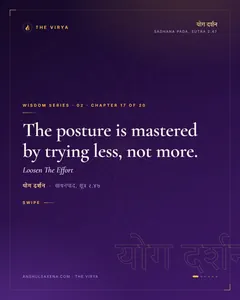
Loosen The Effort

The posture is mastered by trying less, not more

Loosen The Effort, card 1 of 6
Loosen The Effort, card 2 of 6
Loosen The Effort, card 3 of 6
Loosen The Effort, card 4 of 6
Loosen The Effort, card 5 of 6
Loosen The Effort, card 6 of 6
Read as text

योग दर्शन · साधनपाद, सूत्र २.४७, "Loosen The Effort"

प्रयत्नशैथिल्यानन्तसमापत्तिभ्याम् ॥ ४७ ॥
prayatna-śaithilyānanta-samāpattibhyām

Posture is perfected by the loosening of effort and by absorption in the infinite.

Two routes to the same place. Stop generating movement directly, or attend to something that does not move and let the stillness transfer.

How the text gets there:
1. The sutra names two means and the commentary clarifies the first against a likely misreading.
2. Loosening effort means ceasing restless activity, not doing less work.
3. The second means is absorption in the infinite.
4. The mechanism given is that the meditator takes on the character of what is attended to, and the infinite is motionless.

Today: The point about the object of attention generalises past posture. Whatever you attend to persistently, you start to resemble, in tempo if nothing else. Attend to a feed that refreshes every few seconds and you will not be able to sit still. The mechanism runs the same way in both directions.

What do you attend to most, and what tempo has it given you? Tell me below.

Yoga Sutras

Tying The Mind To One Place

Concentration is defined physically. A place, and a rope

Tying The Mind To One Place, card 1 of 6
Tying The Mind To One Place, card 2 of 6
Tying The Mind To One Place, card 3 of 6
Tying The Mind To One Place, card 4 of 6
Tying The Mind To One Place, card 5 of 6
Tying The Mind To One Place, card 6 of 6
Read as text

योग दर्शन · विभूतिपाद, सूत्र ३.१, "Tying The Mind To One Place"

देशबन्धश्चित्तस्य धारणा ॥ १ ॥
deśa-bandhaś cittasya dhāraṇā

Concentration is the binding of the mind-stuff to a place.

Concentration is defined as a location plus a tether. Not as intensity, not as clarity. Choose the spot, then keep tying the mind back to it.

How the text gets there:
1. The definition uses two concrete nouns, a place and a binding.
2. The commentary's list of places is physical and specific rather than conceptual.
3. External objects are permitted alongside internal ones, so the spot matters less than the fixing.
4. This is the first internal limb, and the two that follow depend on something already being held.

Today: The useful part is that the definition includes the rope. A bound thing pulls away, which means the mind wandering is not evidence of failure but the condition the technique was designed for. The practice is the re-tying, done as many times as it takes.

What is the one place you keep bringing your attention back to? Tell me below.

Yoga Sutras

When The Knower Disappears

Meditation becomes absorption when the meditator drops out

When The Knower Disappears, card 1 of 6
When The Knower Disappears, card 2 of 6
When The Knower Disappears, card 3 of 6
When The Knower Disappears, card 4 of 6
When The Knower Disappears, card 5 of 6
When The Knower Disappears, card 6 of 6
Read as text

योग दर्शन · विभूतिपाद, सूत्र ३.३, "When The Knower Disappears"

तदेवार्थमात्रनिर्भासं स्वरूपशून्यमिव समाधिः ॥ ३ ॥
tad evārtha-mātra-nirbhāsaṁ svarūpa-śūnyam iva samādhiḥ

That same meditation, when it shines forth as the object alone and is as though empty of its own nature, is absorption.

The difference between meditation and absorption is a count. Meditation has three things in it. Absorption has one, and the sutra hedges even that with 'as though'.

How the text gets there:
1. Meditation is described as containing three distinct appearances: knower, knowing and known.
2. In absorption, only the object's own nature is illuminated.
3. The knowing aspect becomes empty of its own form.
4. The word as though prevents the claim that the mind has actually been annihilated.

Today: Everyone has had a small version of this, in work or music or a hard problem, where the self-monitoring stopped and only the task was left. Patanjali's contribution is not the experience but the account of it: what left was one of three components, and it can be induced rather than waited for.

When did you last lose the sense of watching yourself do something? Tell me below.

Yoga Sutras

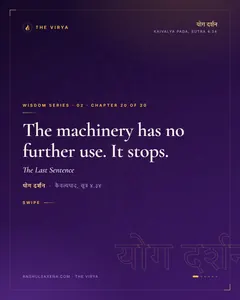
The Last Sentence

The machinery has no further use. It stops

The Last Sentence, card 1 of 6
The Last Sentence, card 2 of 6
The Last Sentence, card 3 of 6
The Last Sentence, card 4 of 6
The Last Sentence, card 5 of 6
The Last Sentence, card 6 of 6
Read as text

योग दर्शन · कैवल्यपाद, सूत्र ४.३४, "The Last Sentence"

पुरुषार्थशून्यानां गुणानां प्रतिप्रसवः कैवल्यं
स्वरूपप्रतिष्ठा वा चितिशक्तिरिति ॥ ३४ ॥
puruṣārtha-śūnyānāṁ guṇānāṁ pratiprasavaḥ kaivalyaṁ
svarūpa-pratiṣṭhā vā citi-śaktir iti

Isolation is the return of the gunas to their origin, they being now empty of purpose for the self; or it is the power of consciousness established in its own nature.

Nothing is destroyed at the end. The machinery is dismissed because it has completed its work, and what remains is what was there in sutra 1.3, now with nothing in front of it.

How the text gets there:
1. The gunas are described as having become empty of purpose, so the reason for their activity is gone.
2. Their return is a counter-flow back into their own cause rather than a destruction.
3. A second formulation is offered as an alternative statement of the same state.
4. That second formulation restates sutra 1.3, so the book ends where its third sentence pointed.

Today: The structure is worth borrowing even outside the metaphysics. A system built for a purpose, once the purpose is served, should be allowed to wind down rather than kept running out of attachment to it. Most people find this harder than building the system was.

What in your life is still running after its purpose was served? Tell me below.