
20 posts · 120 cards

Bhaja Govindam भज गोविन्दम्

Shankara’s verses on what learning cannot protect you from.

Bhaja Govindam

Grammar Will Not Protect You

An old man is drilling grammar rules. Shankara asks him one question

Grammar Will Not Protect You, card 1 of 6
Grammar Will Not Protect You, card 2 of 6
Grammar Will Not Protect You, card 3 of 6
Grammar Will Not Protect You, card 4 of 6
Grammar Will Not Protect You, card 5 of 6
Grammar Will Not Protect You, card 6 of 6
Read as text

भज गोविन्दम् · श्लोक १, "Grammar Will Not Protect You"

Bhaja Govindam Bhaja Govindam Govindam
Bhaja Mudhamate Samprapte Sannihite
Kale Na Hi Na Hi Raksati Dukrñ Karane

Oh, foolish one! Seek Govinda, seek Govinda. When the appointed time comes, grammar rules surely will not protect you.

The verse does not attack study. It attacks the assumption that competence in one domain will be admissible in a situation from a different one, which is the most common form of misplaced confidence there is.

How the text gets there:
1. The scholar is engaged in genuine and difficult work.
2. A situation is named in which that work has no application at all.
3. The instruction is not to stop seeking but to redirect what is being sought.
4. So the fault identified is a category error about scope, not the effort itself.

Today: Everyone has a domain where they are formidable, and everyone tends to face unrelated problems with that same instrument. The engineer's approach to a family crisis, the lawyer's to grief. The question in this verse is worth asking about your own strongest skill: where will it be no help at all?

What are you excellent at that will not help you with what is coming? Tell me below.

Bhaja Govindam

Rejoice In What You Honestly Earned

Not give up wealth. Give up the thirst for it

Rejoice In What You Honestly Earned, card 1 of 6
Rejoice In What You Honestly Earned, card 2 of 6
Rejoice In What You Honestly Earned, card 3 of 6
Rejoice In What You Honestly Earned, card 4 of 6
Rejoice In What You Honestly Earned, card 5 of 6
Rejoice In What You Honestly Earned, card 6 of 6
Read as text

भज गोविन्दम् · श्लोक २, "Rejoice In What You Honestly Earned"

Mudha Jahihi Dhanagamatrsnam
Kuru Sadbuddhim Manasi Vitrsnam
Yallabhase Nijakarmopattam
Vittam Tena Vinodaya Cittam

Oh, foolish one! Give up the passion to possess wealth. Create in your mind a state devoid of that thirst. With whatever you get out of honest actions, rejoice and be content.

You can hold the same amount of money with or without the thirst, and the two states are indistinguishable from outside. That is why this instruction cannot be performed, only done.

How the text gets there:
1. The object of renunciation is named as thirst rather than as wealth.
2. Honest earning is explicitly retained and endorsed.
3. Contentment is directed at what that earning produces, whatever the amount.
4. So the change is internal, and no external observation can confirm or refute it.

Today: The test is what happens when the number goes up. If the satisfaction arrives and then resets to the previous baseline within a month, the thirst is intact and the wealth was never the variable. Most people have run this experiment several times without recording the result.

When your income last rose, how long did the satisfaction last? Tell me below.

Bhaja Govindam

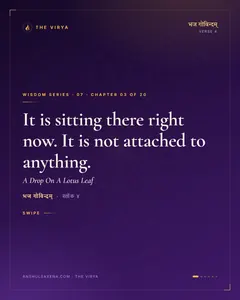
A Drop On A Lotus Leaf

It is sitting there right now. It is not attached to anything

A Drop On A Lotus Leaf, card 1 of 6
A Drop On A Lotus Leaf, card 2 of 6
A Drop On A Lotus Leaf, card 3 of 6
A Drop On A Lotus Leaf, card 4 of 6
A Drop On A Lotus Leaf, card 5 of 6
A Drop On A Lotus Leaf, card 6 of 6
Read as text

भज गोविन्दम् · श्लोक ४, "A Drop On A Lotus Leaf"

Nalinidalagatajalamatitaralam
Tadvajjivitamatisayacapalam
Viddhi Vyadhyabhimanagrastam
Lokam Sokahatam Ca Samastam

The water drop resting on a lotus petal has a very uncertain existence; so also is life ever unstable. Understand that the whole world is caught by disease and pride and is filled with sorrow.

The instability is not visible in the drop. It looks settled, and the precariousness is a fact about the relationship between it and the surface rather than about how it appears.

How the text gets there:
1. The drop is described as resting, so it appears stable at any instant.
2. The surface it rests on cannot be adhered to.
3. Its continuation therefore depends entirely on nothing moving.
4. Life is placed in the same position, which makes its apparent stability a property of the moment rather than of the arrangement.

Today: Applies to any arrangement that has been fine for long enough to feel permanent: the job, the health, the relationship that has never been tested. Nothing about how settled it looks is evidence about how attached it is.

What in your life is resting rather than attached? Tell me below.

Bhaja Govindam

As Long As You Can Earn

Later, in an infirm body, nobody at home asks you a word

As Long As You Can Earn, card 1 of 6
As Long As You Can Earn, card 2 of 6
As Long As You Can Earn, card 3 of 6
As Long As You Can Earn, card 4 of 6
As Long As You Can Earn, card 5 of 6
As Long As You Can Earn, card 6 of 6
Read as text

भज गोविन्दम् · श्लोक ५, "As Long As You Can Earn"

Yavadvittoparjanasakta
Stavannijaparivaro Raktah
Pascajjivati Jarjaradehe
Vartam Kopi Na Prchhati gehe

As long as there is the capability to earn, so long the kith and kin are attached to you. Later on, when you come to live with an infirm body, no one at home cares to speak even a word with you.

The verse is not asking you to distrust anyone. It is pointing out that the affection you currently receive has never been tested against the absence of what you provide, so you do not yet know what it is made of.

How the text gets there:
1. Attachment from family is observed while earning capacity is present.
2. Attentiveness is observed to fall away when that capacity does.
3. The correlation is stated as a sequence rather than as an accusation.
4. So the quality of the attachment cannot be known until the variable it tracks is removed.

Today: The uncomfortable version for anyone whose identity is built on being the provider: some of what you receive is for you and some is for the function, and you currently have no way to tell the proportions. It is also an argument for finding out earlier rather than later.

How much of the attention you get is for what you provide? Tell me below.

Bhaja Govindam

The Same Body, Now Feared

The breath leaves. Nothing else about the body has changed yet

The Same Body, Now Feared, card 1 of 6
The Same Body, Now Feared, card 2 of 6
The Same Body, Now Feared, card 3 of 6
The Same Body, Now Feared, card 4 of 6
The Same Body, Now Feared, card 5 of 6
The Same Body, Now Feared, card 6 of 6
Read as text

भज गोविन्दम् · श्लोक ६, "The Same Body, Now Feared"

Yavatpavano Nivasati Dehe
Tavatprcchati Kusalam gehe
Gatavati Vayau Dehapaye
Bharya Bibhyati Tasminkaye

As long as breath resides in the body, so long they enquire after your well-being at home. Once the breath leaves and the body decays, even your wife fears that very same body.

The reversal is instantaneous and total while the object is unchanged, which is a clean demonstration that the object was never what mattered.

How the text gets there:
1. Enquiry and care are directed at a person while breath is present.
2. Breath departs and nothing else about the body changes in that instant.
3. The response nonetheless inverts from care to fear.
4. So what was being related to was not the body, since the body remains and the relation does not.

Today: Sits under the ordinary question of what you actually are. Everything visible about you can remain while the thing people were relating to is gone, which suggests the identity you defend so carefully is not the one that carries the relationships.

If everything visible about you stayed and something else left, what would be missing? Tell me below.

Bhaja Govindam

Attached To Play, Then To Passion, Then To Worry

Three ages, three attachments. The fourth thing never gets one

Attached To Play, Then To Passion, Then To Worry, card 1 of 6
Attached To Play, Then To Passion, Then To Worry, card 2 of 6
Attached To Play, Then To Passion, Then To Worry, card 3 of 6
Attached To Play, Then To Passion, Then To Worry, card 4 of 6
Attached To Play, Then To Passion, Then To Worry, card 5 of 6
Attached To Play, Then To Passion, Then To Worry, card 6 of 6
Read as text

भज गोविन्दम् · श्लोक ७, "Attached To Play, Then To Passion, Then To Worry"

Balastavatkridasaktah
Tarunastavattarunisaktah
Vrddhastavaccintasaktah
Parame Brahmani Kopi Na Saktah

During childhood one is attached to play, during youth one is attached to passion, in old age one is attached to anxiety. Yet no one is attached to the supreme Brahman.

The third item is the sharp one. Old age is not described as the stage where attachment ends but as the stage where it transfers to worry, so the pattern never breaks by itself. Waiting for it to is the mistake.

How the text gets there:
1. One verb of attachment is applied identically across three life stages.
2. The capacity is therefore constant and only its object varies.
3. Old age is shown to redirect the attachment rather than dissolve it.
4. The fourth line reports an absence of allocation rather than an absence of opportunity.

Today: The common plan is to attend to the deeper thing once the current preoccupation subsides. The verse says the preoccupation does not subside, it is replaced, and the replacement in the last stage is anxiety. If it is going to be allocated deliberately, it has to be now.

What is your attachment currently pointed at, and did you choose it? Tell me below.

Bhaja Govindam

Who Are You? Reflect On That

He does not answer. He asks, and then calls you brother

Who Are You? Reflect On That., card 1 of 6
Who Are You? Reflect On That., card 2 of 6
Who Are You? Reflect On That., card 3 of 6
Who Are You? Reflect On That., card 4 of 6
Who Are You? Reflect On That., card 5 of 6
Who Are You? Reflect On That., card 6 of 6
Read as text

भज गोविन्दम् · श्लोक ८, "Who Are You? Reflect On That."

Kasya Tvam Kah Kuta Ayatah
Tattvam Cintaya Tadiha Bhratah

Who is your wife? Who is your son? Very wonderful indeed is this samsara. Who are you? From where have you come? Oh, brother! Reflect on that truth here.

A statement can be accepted and shelved. A question stays open, and this verse is constructed entirely out of questions, which is why it cannot be agreed with and disposed of.

How the text gets there:
1. The verse consists of questions rather than claims.
2. The address shifts from teacher to brother, removing the hierarchy.
3. No answer is supplied, so nothing can be accepted and set aside.
4. The instruction locates the reflection here, in present conditions, rather than deferring it.

Today: Notice how much easier it is to agree with a proposition about identity than to sit with the question for a minute. The verse is built to block the first move, and the discomfort of doing it properly is the entire content.

Who are you, and where did you come from? Tell me below.

Bhaja Govindam

Four Links To Freedom

Good company. Then non-attachment. Then clarity. Then freedom

Four Links To Freedom, card 1 of 6
Four Links To Freedom, card 2 of 6
Four Links To Freedom, card 3 of 6
Four Links To Freedom, card 4 of 6
Four Links To Freedom, card 5 of 6
Four Links To Freedom, card 6 of 6
Read as text

भज गोविन्दम् · श्लोक ९, "Four Links To Freedom"

Satsangatve Nissangatvam
Nihsangatve Nirmohatvam
Nirmohatve Niscalatattvam
Niscalatattve Jivanmuktih

Through the company of the wise arises non-attachment. Through non-attachment, freedom from delusion. When there is freedom from delusion, the unchanging reality. On experiencing that, there comes liberation while living.

The chain begins with the one link you can act on this week. Everything after it is a consequence, and the verse offers no way to enter the sequence further along.

How the text gets there:
1. Four states are linked so that each arises from the one before.
2. The chaining is reflected in the grammar, with each line beginning where the last ended.
3. The first link is company, which is an arrangement rather than an achievement.
4. So the only actionable entry point is the choice of whom you are around.

Today: The most practical claim in the hymn, and the least spiritual. Who you spend your hours with sets what becomes conceivable, and it is the one variable in the chain you can change deliberately and immediately.

Who are the five people setting what is normal for you? Tell me below.

Bhaja Govindam

Where Is The Lake?

Three things vanish when their condition goes. The fourth is the point

Where Is The Lake?, card 1 of 6
Where Is The Lake?, card 2 of 6
Where Is The Lake?, card 3 of 6
Where Is The Lake?, card 4 of 6
Where Is The Lake?, card 5 of 6
Where Is The Lake?, card 6 of 6
Read as text

भज गोविन्दम् · श्लोक १०, "Where Is The Lake?"

Vayasi Gate Kah Kamavikarah
Suske Nire Kah Kasarah
Ksine Vitte Kah Parivaro
Jnate Tattve Kah Samsarah

When youth has passed, where is lust? When the water has dried, where is the lake? When wealth is gone, where is the retinue? When the truth is known, where is samsara?

The lake is the clearest of the three because there is no lake left over after the water. It was never a container that held water; it was the water, in a shape.

How the text gets there:
1. Three cases are given in which a thing disappears with its underlying condition.
2. In each, what looked like an object turns out to have been a state.
3. The same grammatical form is applied to samsara.
4. The implication is that samsara is likewise a condition, ending when knowledge replaces ignorance.

Today: Worth running against whatever currently feels most solidly like a thing in your life. The problem, the identity, the situation. Ask what condition it depends on, and whether anything would be left if that condition were removed.

What feels like an object in your life that is actually a condition? Tell me below.

Bhaja Govindam

Time Takes All Of It In A Moment

Wealth, people, youth. Nimesha: the time it takes to blink

Time Takes All Of It In A Moment, card 1 of 6
Time Takes All Of It In A Moment, card 2 of 6
Time Takes All Of It In A Moment, card 3 of 6
Time Takes All Of It In A Moment, card 4 of 6
Time Takes All Of It In A Moment, card 5 of 6
Time Takes All Of It In A Moment, card 6 of 6
Read as text

भज गोविन्दम् · श्लोक ११, "Time Takes All Of It In A Moment"

Ma Kuru Dhananjayauvanagarvam
Harati Nimesatkalah Sarvam
Mayamayamidamakhilam Buddhva
Brahmapadam Tvam Pravisa Viditva

Take no pride in wealth, in people, or in youth. Time snatches all these away in a moment. Knowing all this to be illusion, enter into the state of Brahman.

Pride is a claim of authorship over something whose removal you demonstrably do not control. Gratitude makes the same acknowledgment of the thing without the false claim attached.

How the text gets there:
1. Three sources of pride are named, all of them slow to acquire.
2. Their removal is placed in the span of a blink.
3. The asymmetry between acquisition and loss shows that control was never held.
4. Pride asserts an authorship the asymmetry disproves, which is why gratitude is substituted.

Today: The practical difference shows up in how you handle a reversal. Pride makes losing the thing an attack on who you are. Gratitude makes it the end of something you were given, which is survivable and also happens to be more accurate.

Are you proud of it or grateful for it? Tell me below.

Bhaja Govindam

Time Plays, Life Goes

Day and night keep returning. You do not

Time Plays, Life Goes, card 1 of 6
Time Plays, Life Goes, card 2 of 6
Time Plays, Life Goes, card 3 of 6
Time Plays, Life Goes, card 4 of 6
Time Plays, Life Goes, card 5 of 6
Time Plays, Life Goes, card 6 of 6
Read as text

भज गोविन्दम् · श्लोक १२, "Time Plays, Life Goes"

Dinayaminyau Sayam Pratah
Sisiravasantau Punarayatah
Kalah Kridati Gacchatyayuh
Tadapi Na Muncatyasavayuh

Day and night, evening and morning, winter and spring come and go again and again. Time plays on, life ebbs away, and yet one does not let go of the gusts of desire.

The seasons returning is what makes the loss invisible. Everything around you is cycling, so it takes deliberate attention to notice that you are not.

How the text gets there:
1. Two motions are described together, one cyclical and one linear.
2. The cycles return and are therefore reassuring.
3. Life is given a verb of simple departure with no return.
4. The visible recurrence masks the irreversible movement running alongside it.

Today: This is why another year passing registers as a repeat rather than as a subtraction. The calendar returns to January and nothing in the environment marks the difference. The verse's contribution is noticing that the two clocks are not the same clock.

How many of your years have felt like the same year? Tell me below.

Bhaja Govindam

One Boat Across

In all three worlds, there is exactly one vessel

One Boat Across, card 1 of 6
One Boat Across, card 2 of 6
One Boat Across, card 3 of 6
One Boat Across, card 4 of 6
One Boat Across, card 5 of 6
One Boat Across, card 6 of 6
Read as text

भज गोविन्दम् · श्लोक १३, "One Boat Across"

Ka Te Kanta Dhanagatacinta
Vatula Kim Tava Nasti Niyanta
Trijagati Sajjanasangatireka
Bhavati Bhavarnavatarane Nauka

Oh distracted one! Why worry about wife and wealth? Is there not for you the one who ordains? In the three worlds, the association with wise people alone serves as a boat to cross the sea of change.

Verse nine put good company first in a sequence. This one says it is the only vessel there is, which turns a starting point into the entire means of transport.

How the text gets there:
1. The person is addressed as distracted rather than as wrongdoing.
2. The worry about wife and wealth is met with the existence of one who ordains.
3. A single means of crossing is then named, with eka marking exclusivity.
4. That means is the company of the wise, restating verse nine's first link as the whole vehicle.

Today: Two verses in the same hymn point at the same lever, which is worth taking as emphasis rather than repetition. If you were going to change one thing on the strength of this text, the company is what it keeps naming.

Is the company you keep a boat or ballast? Tell me below.

Bhaja Govindam

Different Costumes, Same Stomach

Matted locks, shaven head, ochre robes. Shankara counts them all

Different Costumes, Same Stomach, card 1 of 6
Different Costumes, Same Stomach, card 2 of 6
Different Costumes, Same Stomach, card 3 of 6
Different Costumes, Same Stomach, card 4 of 6
Different Costumes, Same Stomach, card 5 of 6
Different Costumes, Same Stomach, card 6 of 6
Read as text

भज गोविन्दम् · श्लोक १४, "Different Costumes, Same Stomach"

Jatilo Mundi Luncitakesah
Kasayambarabahukrtavesah
Pasyannapi Ca Na Pasyati Mudho
Hyudaranimittam Bahukrtavesah

One with matted locks, one with a shaven head, one with hair pulled out one by one, another in ochre robes. These are fools who, though seeing, do not see. The many disguises are only for the belly's sake.

The criticizm is directed at the class the author belongs to, using the markers he himself wears, which is the only position from which it can be made without hypocrisy.

How the text gets there:
1. Four distinct renunciate appearances are listed, covering the visible options.
2. All are grouped together regardless of their differences.
3. The failure named is having sight without seeing, so the capacity is present and unused.
4. The motive is identified as sustenance, which makes the appearances functional rather than devotional.

Today: Every field has its markers of seriousness, and they are all available without the substance they signal. The uncomfortable move is Shankara's: apply the test to the costume you personally wear, since that is the one you can neither see nor take off.

What is your costume, and what does it get you? Tell me below.

Bhaja Govindam

Everything Has Gone. Not That

Body worn out, hair gray, teeth gone. The desires are intact

Everything Has Gone. Not That., card 1 of 6
Everything Has Gone. Not That., card 2 of 6
Everything Has Gone. Not That., card 3 of 6
Everything Has Gone. Not That., card 4 of 6
Everything Has Gone. Not That., card 5 of 6
Everything Has Gone. Not That., card 6 of 6
Read as text

भज गोविन्दम् · श्लोक १५, "Everything Has Gone. Not That."

Angam Galitam Palitam Mundam
Dasanavihinam Jatam Tundam
Vrddho Yati Grhitva Dandam
Tadapi Na Muncatyasapindam

The body has decayed, the hair has turned gray, the teeth have fallen out. The old man moves about leaning on his staff. Even then he does not let go of the bundle of desires.

The verse establishes that desire is not a function of capacity. Everything required to act on it has already gone, and it is still there, which means it was never sustained by the possibility of satisfaction.

How the text gets there:
1. Four physical faculties are itemised as lost.
2. The losses are complete, removing the ability to pursue what is wanted.
3. Desire is nonetheless described as still carried.
4. So desire does not depend on the capacity to fulfill it, and will not end when that capacity does.

Today: Anyone waiting for wanting to subside on its own has an answer here, and it is no. If it were tied to capability it would already be diminishing. It has to be addressed directly or it accompanies you the whole way.

What are you still carrying that you can no longer use? Tell me below.

Bhaja Govindam

A Hundred Lifetimes Of Correct Behavior

Pilgrimage, vows, charity. All done. None of it counts

A Hundred Lifetimes Of Correct Behavior, card 1 of 6
A Hundred Lifetimes Of Correct Behavior, card 2 of 6
A Hundred Lifetimes Of Correct Behavior, card 3 of 6
A Hundred Lifetimes Of Correct Behavior, card 4 of 6
A Hundred Lifetimes Of Correct Behavior, card 5 of 6
A Hundred Lifetimes Of Correct Behavior, card 6 of 6
Read as text

भज गोविन्दम् · श्लोक १७, "A Hundred Lifetimes Of Correct Behavior"

Kurute Gangasagaragamanam
Vrataparipalanamathava Danam
Jnanavihinah Sarvamatena
Bhajati Na Muktim Janmasatena

One may go where the Ganges meets the ocean, or observe vows, or give in charity. Bereft of realization, according to all schools of thought, he attains no liberation even in a hundred lives.

The verse denies that correct action accumulates into realization. A hundred lifetimes of it produces a hundred lifetimes of correct action, and the missing ingredient is of a different kind entirely.

How the text gets there:
1. Three respected practices are named rather than trivial ones.
2. Their performance is granted in full.
3. Multiplying them across a hundred lives is shown to change nothing.
4. So the deficiency is categorical rather than quantitative, and cannot be closed by more of the same.

Today: Applies to any program of correct activity that is not producing the change it was meant to. Doing more of it is the natural response and this verse says it is the wrong one, because the shortfall was never in the amount.

What are you doing more of, hoping the quantity will fix it? Tell me below.

Bhaja Govindam

He Alone Enjoys

Yoga or pleasure. Crowds or solitude. The verse does not care

He Alone Enjoys, card 1 of 6
He Alone Enjoys, card 2 of 6
He Alone Enjoys, card 3 of 6
He Alone Enjoys, card 4 of 6
He Alone Enjoys, card 5 of 6
He Alone Enjoys, card 6 of 6
Read as text

भज गोविन्दम् · श्लोक १९, "He Alone Enjoys"

Yogarato Va Bhogarato Va
Sangarato Va Sangavihinah
Yasya Brahmani Ramate Cittam
Nandati Nandati Nandatyeva

Let one revel in yoga or in pleasure, let one delight in company or in solitude. He whose mind revels in Brahman, he enjoys, surely he alone enjoys.

The verse voids the entire lifestyle question. Which of the four you occupy is not the variable, and someone in the ascetic option can be as far from the condition as someone in the indulgent one.

How the text gets there:
1. Two standard oppositions are presented, covering practice and social arrangement.
2. Each is offered with or, marking them as equally acceptable.
3. A single condition is substituted, concerning where the mind rests.
4. The threefold repetition places all the emphasis on that condition rather than on the choices.

Today: Useful against the assumption that the arrangement is the achievement. The retreat, the minimalism, the discipline: all are compatible with the condition and none produces it, and the verse is explicit that the indulgent option is equally compatible.

Are you optimizing the arrangement or the thing it was for? Tell me below.

Bhaja Govindam

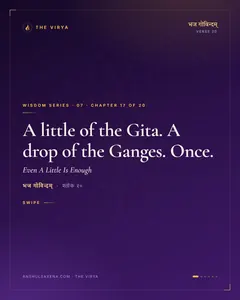
Even A Little Is Enough

A little of the Gita. A drop of the Ganges. Once

Even A Little Is Enough, card 1 of 6
Even A Little Is Enough, card 2 of 6
Even A Little Is Enough, card 3 of 6
Even A Little Is Enough, card 4 of 6
Even A Little Is Enough, card 5 of 6
Even A Little Is Enough, card 6 of 6
Read as text

भज गोविन्दम् · श्लोक २०, "Even A Little Is Enough"

Bhagavadgita Kincidadhita
Ganga Jalalavakanika Pita
Sakrdapi Yena Murarisamarca
Kriyate Tasya Yamena Na Carca

To one who has studied the Bhagavad Gita even a little, who has sipped even a drop of Ganges water, who has worshiped Murari even once, there is no argument with Yama, the lord of death.

The smallness is the point and it sits deliberately against the surrounding severity. The hymn that says a hundred lifetimes of ritual achieve nothing also says a drop is sufficient, which locates the difference in kind rather than quantity.

How the text gets there:
1. Three requirements are named and each is qualified to its smallest possible amount.
2. This directly follows verses in which large quantities of correct action achieved nothing.
3. The contrast establishes that the operative variable is not quantity.
4. The outcome is described as the absence of a case to argue, which is a change of standing rather than a reward earned.

Today: For anyone who has decided they are too far behind to begin, this verse removes the threshold argument. The amount required to be in a different category from not having begun is very small, and it is not proportional to what follows.

What have you not started because the required amount looked large? Tell me below.

Bhaja Govindam

You Are Getting Angry With Yourself

The verse names the reader's impatience while they are reading it

You Are Getting Angry With Yourself, card 1 of 6
You Are Getting Angry With Yourself, card 2 of 6
You Are Getting Angry With Yourself, card 3 of 6
You Are Getting Angry With Yourself, card 4 of 6
You Are Getting Angry With Yourself, card 5 of 6
You Are Getting Angry With Yourself, card 6 of 6
Read as text

भज गोविन्दम् · श्लोक २४, "You Are Getting Angry With Yourself"

Tvayi Mayi Canyatraiko Visnuh
Vyartham Kupyasi Mayyasahisnuh
Bhava Samacittah Sarvatra tvam
Vanchasyaciradyadi Visnutvam

In you, in me, and everywhere else there is but one all-pervading reality. Being impatient, you are needlessly getting angry with me. If you wish to attain that state, be equal-minded everywhere.

The anger is turned into the demonstration. If one reality is in both of us, then being angry at me is structurally odd, and the annoyance you are currently feeling is the exhibit.

How the text gets there:
1. One reality is asserted to be present in speaker, listener and everywhere.
2. The listener's present irritation is named directly and in the present tense.
3. Under the first claim, that irritation is directed at the same reality it comes from.
4. The instruction to be equal-minded follows as the consequence rather than as a separate command.

Today: The move is worth borrowing in any disagreement: naming the other person's live reaction rather than continuing to argue past it. It is disarming precisely because it stops being about the content for a moment.

Who are you angry with, and what do you share with them? Tell me below.

Bhaja Govindam

Fear Even From Your Own Son

The wealthier the man, the longer the list of people he watches

Fear Even From Your Own Son, card 1 of 6
Fear Even From Your Own Son, card 2 of 6
Fear Even From Your Own Son, card 3 of 6
Fear Even From Your Own Son, card 4 of 6
Fear Even From Your Own Son, card 5 of 6
Fear Even From Your Own Son, card 6 of 6
Read as text

भज गोविन्दम् · श्लोक २९, "Fear Even From Your Own Son"

Arthamanartham Bhavaya Nityam
Nasti Tatah Sukhalesah Satyam
Putradapi Dhanabhajam Bhitih
Sarvatraisa Vihita Ritih

Reflect constantly that wealth is calamitous; in truth, there is not the least happiness to be had from it. For the wealthy there is fear even from one's own son. This is the way with wealth everywhere.

Choosing the son makes the case unanswerable by better arrangements. If the person with the most aligned interests becomes a source of fear, the fear is produced by the wealth rather than by who is nearby.

How the text gets there:
1. Wealth and calamity are identified using words separated by a single syllable.
2. The evidence chosen is the relationship with the most naturally aligned interests.
3. Fear appearing even there rules out explanations based on bad relationships.
4. The claim is universalised, making the effect a property of the wealth itself.

Today: Look at what expands alongside net worth: the security, the structures, the number of people whose motives now require assessment. None of that was in the plan, and the verse's claim is that it was never optional.

What did you start watching more carefully once you had something to lose? Tell me below.

Bhaja Govindam

Perform These With Care

The last instruction repeats one word twice

Perform These With Care, card 1 of 6
Perform These With Care, card 2 of 6
Perform These With Care, card 3 of 6
Perform These With Care, card 4 of 6
Perform These With Care, card 5 of 6
Perform These With Care, card 6 of 6
Read as text

भज गोविन्दम् · श्लोक ३०, "Perform These With Care"

Pranayamam Pratyaharam
Nityanityavivekavicaram
Japyasameta Samadhividhanam
Kurvavadhanam Mahadavadhanam

The practice of pranayama, the withdrawal of the senses, enquiry into the permanent and the impermanent, along with japa and the practice of inner silence: perform these with care, with great care.

The list is unremarkable and the qualifier is not. The same four practices done without attention are the ochre robes of verse fourteen, which is presumably why the emphasis falls where it does.

How the text gets there:
1. Four practices are named without elaboration or promised results.
2. The only intensification in the verse falls on the manner of performance.
3. Care is stated and then restated as great care.
4. So the operative variable is attention rather than the selection of practices.

Today: The distinction between doing the practice and performing it applies to everything you do daily. Same actions, same duration, and one version compounds while the other becomes a costume. The difference is not visible from outside and is completely obvious from inside.

Which of your daily practices are you performing rather than doing? Tell me below.