20 posts · 120 cards

Practical Spirituality अध्यात्म

Twenty ideas for a spiritual life that works on a weekday.

Practical Spirituality

Whose Practical?

Five Americans build a company in five hours. Hundreds of Indians stand on one leg for twelve years

Whose Practical?, card 1 of 6
Whose Practical?, card 2 of 6
Whose Practical?, card 3 of 6
Whose Practical?, card 4 of 6
Whose Practical?, card 5 of 6
Whose Practical?, card 6 of 6
Read as text

व्यावहारिक अध्यात्म · व्याख्यान एक, "Whose Practical?"

So, you see, the word practical is also relative.

What counts as practical is set by what a culture has decided is worth doing, not by any neutral standard.

Practical is not a property of an action. It is a measure of how efficiently the action reaches a goal, and the goal is chosen elsewhere. Two cultures with different goals will each look impractical to the other.

How the text gets there:
1. Two cultures are compared on speed of execution and the comparison reverses depending on the task.
2. One is efficient at commercial organization, the other at sustained austerity.
3. The obvious explanation, that one group is simply unintelligent, is closed off explicitly.
4. What remains is that each is efficient toward a different goal, which makes practical a relative term.

Today: Before calling a decision impractical, name the goal you are measuring against and check whether the other party shares it. Most cross-cultural and cross-departmental contempt is this error: efficiency toward an objective you have not noticed is different from yours.

What have you called impractical that was efficient toward a goal you do not hold? Tell me below.

Practical Spirituality

The Cannon And The Surgeon

The man who charges a cannon flinches at a scalpel

The Cannon And The Surgeon, card 1 of 6
The Cannon And The Surgeon, card 2 of 6
The Cannon And The Surgeon, card 3 of 6
The Cannon And The Surgeon, card 4 of 6
The Cannon And The Surgeon, card 5 of 6
The Cannon And The Surgeon, card 6 of 6
Read as text

व्यावहारिक अध्यात्म · व्याख्यान एक, "The Cannon And The Surgeon"

The same man who would rush to the mouth of a cannon shrinks from the knife of the surgeon; and another man who never dares to face a gun will calmly bear a severe surgical operation, if need be.

Courage is not a general trait of a person but a specific relationship between that person and a particular kind of danger.

Character words that sound like descriptions of a person are usually descriptions of a pairing between a person and a situation, and the pairing does not transfer.

How the text gets there:
1. Courage is normally used as a general trait attached to a person.
2. Two examples are given in which the trait appears and vanishes for the same person.
3. Since the person is constant and the behavior is not, the variable must be the situation.
4. The practical consequence is that a judgement of courage must specify against which danger.

Today: Performance reviews and reference checks are full of this error. Someone is bold or cautious, and the label travels to a new context where it does not hold. The useful sentence names the pairing: bold in front of clients, cautious about technical risk. That predicts something. The bare adjective does not.

Where are you brave, and where does that bravery not reach? Tell me below.

Practical Spirituality

No Wave Without A Hollow

The most wicked person may have some good quality you entirely lack

No Wave Without A Hollow, card 1 of 6
No Wave Without A Hollow, card 2 of 6
No Wave Without A Hollow, card 3 of 6
No Wave Without A Hollow, card 4 of 6
No Wave Without A Hollow, card 5 of 6
No Wave Without A Hollow, card 6 of 6
Read as text

व्यावहारिक अध्यात्म · व्याख्यान एक, "No Wave Without A Hollow"

The whole universe is only a wave and a hollow; there can be no wave without a hollow. Balance everywhere. You have one thing great, your neighbor has another thing great.

Every height in one place is paid for by a depth in another, so no person or thing is uniformly superior.

The wave-and-hollow image makes superiority structurally impossible rather than merely impolite. A raised area exists because material was taken from somewhere adjacent.

How the text gets there:
1. A physical image is chosen in which the peak and the trough are the same event.
2. This makes uniform elevation impossible rather than just rare.
3. The principle is applied to persons: your greatness in one place implies a lack in another.
4. He tests it on himself, offering to trade his intellect for another man's health, which shows the exchange running in the unflattering direction.

Today: When you find yourself clearly better than someone, look for the trough. The extremely capable operator with no inner life, the deeply reflective person who cannot ship. The comparison you are making is almost always along the one axis where you happen to be the wave.

What is your hollow, and who around you has a wave there? Tell me below.

Practical Spirituality

The Power Of Doing, The Power Of Bearing

If woman cannot act, neither can man suffer

The Power Of Doing, The Power Of Bearing, card 1 of 6
The Power Of Doing, The Power Of Bearing, card 2 of 6
The Power Of Doing, The Power Of Bearing, card 3 of 6
The Power Of Doing, The Power Of Bearing, card 4 of 6
The Power Of Doing, The Power Of Bearing, card 5 of 6
The Power Of Doing, The Power Of Bearing, card 6 of 6
Read as text

व्यावहारिक अध्यात्म · व्याख्यान एक, "The Power Of Doing, The Power Of Bearing"

The one has developed the power of doing; the other, the power of suffering. If woman cannot act, neither can man suffer. The whole universe is one of perfect balance.

Two different capacities are being compared on one scale, which produces a false result in whichever direction it is run.

The unfairness is not in the conclusion. It is in the method. Any comparison that measures one dimension and reports a total will always favor whoever chose the dimension.

How the text gets there:
1. A comparison is made using a single axis, physical exertion.
2. One party is shown at its strongest on that axis and the other at its weakest.
3. A second axis is introduced on which the ranking inverts.
4. So the original result reflected the choice of axis rather than any total ordering.

Today: This is the structure of most bad benchmarking, between people, teams, and companies. Whoever picks the metric has already picked the winner. The honest version requires naming the axis out loud and admitting what it leaves out.

In your last comparison, who chose the axis? Tell me below.

Practical Spirituality

There Are Priests Of Physical Law Too

Be as careful with the scientists as with the priests

There Are Priests Of Physical Law Too, card 1 of 6
There Are Priests Of Physical Law Too, card 2 of 6
There Are Priests Of Physical Law Too, card 3 of 6
There Are Priests Of Physical Law Too, card 4 of 6
There Are Priests Of Physical Law Too, card 5 of 6
There Are Priests Of Physical Law Too, card 6 of 6
Read as text

व्यावहारिक अध्यात्म · व्याख्यान एक, "There Are Priests Of Physical Law Too"

True science asks us to be cautious. Just as we should be careful with the priests, so we should be with the scientists. Begin with disbelief. Analyze, test, prove everything, and then take it.

Deference to scientific authority is the same mental habit as deference to religious authority, and requires the same caution.

The failure mode is not believing wrong things. It is the shape of the belief. A name cited to end a discussion is functioning as scripture, whatever field it comes from.

How the text gets there:
1. A parallel is drawn between religious priests and scientific authorities.
2. The point of comparison is the audience's behavior, not the content of the claims.
3. In both cases a name is invoked and inquiry stops.
4. The remedy prescribed is the scientific method itself, applied to claims made in science's name.

Today: Watch for the sentence that ends with a citation and no mechanism. Studies show, experts agree, the science is settled. Each may be true and each is being used to close a question rather than answer it. Ask what was measured and how.

What do you believe because of who said it rather than why? Tell me below.

Practical Spirituality

Two Circles

Same circle. The only difference is where the center is

Two Circles, card 1 of 6
Two Circles, card 2 of 6
Two Circles, card 3 of 6
Two Circles, card 4 of 6
Two Circles, card 5 of 6
Two Circles, card 6 of 6
Read as text

व्यावहारिक अध्यात्म · व्याख्यान एक, "Two Circles"

Man is an infinite circle whose circumference is nowhere, but the center is located in one spot; and God is an infinite circle whose circumference is nowhere, but whose center is everywhere.

The difference between the human and the divine is described as the location of the center, not as a difference of substance or size.

Framed this way, the gap is not one of magnitude. Nothing needs to be added and nothing needs to grow. What changes is how many places you are centerd in.

How the text gets there:
1. Two definitions are given that are identical in every clause but one.
2. Both are infinite, so the difference cannot be size.
3. The only variable is the location of the center, single or everywhere.
4. The path between them is therefore multiplication of centers rather than expansion of the self.

Today: A workable reading for anyone uninterested in the metaphysics: the person who can genuinely center in another's position is operating with more centers than the person who cannot, and it shows in every negotiation and every piece of design.

How many places can you genuinely center yourself in? Tell me below.

Practical Spirituality

A Light Moving Along A Line

Consciousness is not the line. It's the lit part

A Light Moving Along A Line, card 1 of 6
A Light Moving Along A Line, card 2 of 6
A Light Moving Along A Line, card 3 of 6
A Light Moving Along A Line, card 4 of 6
A Light Moving Along A Line, card 5 of 6
A Light Moving Along A Line, card 6 of 6
Read as text

व्यावहारिक अध्यात्म · व्याख्यान एक, "A Light Moving Along A Line"

Let us say that here is an infinite line amid darkness. We do not see the line, but on it there is one luminous point which moves on. As it moves along the line, it lights up its different parts in succession, and all that is left behind becomes dark again.

Consciousness illuminates a small moving region of a much larger continuous structure, and what it leaves behind continues to exist unlit.

If everything automatic was once deliberate, then the unconscious is not a separate basement. It is the same line, unlit, and it was written in the light.

How the text gets there:
1. An infinite line in darkness is posited, with one moving luminous point.
2. Only the lit region is available to awareness at any moment.
3. Regions left behind go dark but remain and continue to exert influence.
4. Every automatic action is traced back to an originally conscious one, which makes the dark region a record rather than a foreign territory.

Today: This is why habits feel involuntary and are not. Every automatic reaction you have was assembled in the light, one deliberate repetition at a time. That is discouraging about how they formed and encouraging about whether they can be reformed.

Which of your automatic reactions did you once perform on purpose? Tell me below.

Practical Spirituality

Every Ethical System Has The Same Hole

They all say do not steal. None of them says how

Every Ethical System Has The Same Hole, card 1 of 6
Every Ethical System Has The Same Hole, card 2 of 6
Every Ethical System Has The Same Hole, card 3 of 6
Every Ethical System Has The Same Hole, card 4 of 6
Every Ethical System Has The Same Hole, card 5 of 6
Every Ethical System Has The Same Hole, card 6 of 6
Read as text

व्यावहारिक अध्यात्म · व्याख्यान एक, "Every Ethical System Has The Same Hole"

The great error in all ethical systems, without exception, has been the failure of teaching the means by which man could refrain from doing evil. All the systems of ethics teach, "Do not steal!" Very good; but why does a man steal?

Ethical systems reliably specify the target behavior and reliably omit the mechanism for reaching it.

Every ethical system issues instructions to a decision-maker. If the behavior has become automatic, there is no decision-maker at that point in the process for the instruction to reach.

How the text gets there:
1. All ethical systems are observed to specify prohibited actions.
2. None of them supplies the means of refraining.
3. The behaviors in question are shown to be automatic rather than chosen.
4. An instruction addressed to a chooser therefore cannot operate on a behavior that bypasses choosing.

Today: Explains the failure rate of resolutions, codes of conduct and compliance training. They all address the moment of decision, and the behaviors they target mostly do not have one. What works instead operates before the automation runs, on the conditions rather than the choice.

What are you trying to decide your way out of that is no longer a decision? Tell me below.

Practical Spirituality

No Credit For Being Good

You are good because you cannot help it

No Credit For Being Good, card 1 of 6
No Credit For Being Good, card 2 of 6
No Credit For Being Good, card 3 of 6
No Credit For Being Good, card 4 of 6
No Credit For Being Good, card 5 of 6
No Credit For Being Good, card 6 of 6
Read as text

व्यावहारिक अध्यात्म · व्याख्यान एक, "No Credit For Being Good"

What are you but mere machines until you are free? Should you be proud because you are good? Certainly not. You are good because you cannot help it. Another is bad because he cannot help it. If you were in his position, who knows what you would have been?

If conduct is automatic, then virtue is as unchosen as vice and neither deserves credit or blame.

Most people accept the excusing half of this argument for others and quietly decline the deflating half for themselves. The symmetry is the whole point.

How the text gets there:
1. Conduct has been established as largely automatic rather than chosen.
2. The argument is applied to bad conduct, which reduces blame.
3. The identical argument is then applied to good conduct, which reduces credit.
4. Since neither party selected their conditioning, the correct posture is charity rather than moral ranking.

Today: A useful check on the satisfaction of being the reasonable person in a conflict. If your steadiness is temperament plus circumstance rather than achievement, it is a fortunate inheritance, not a score. That changes how it is reasonable to speak to the person who lacks it.

How much of your good character did you actually build? Tell me below.

Practical Spirituality

Both Sides Of The Shield

My salutation goes to the feet of the saintly and to the feet of the wicked

Both Sides Of The Shield, card 1 of 6
Both Sides Of The Shield, card 2 of 6
Both Sides Of The Shield, card 3 of 6
Both Sides Of The Shield, card 4 of 6
Both Sides Of The Shield, card 5 of 6
Both Sides Of The Shield, card 6 of 6
Read as text

व्यावहारिक अध्यात्म · व्याख्यान एक, "Both Sides Of The Shield"

All the thieves and the murderers, all the unjust, the weakest, the wickedest, the devils, they all are my Christ! ... My salutation goes to the feet of the good, the saintly, and to the feet of the wicked and the devilish! They are all my teachers.

Those who fall are absorbing a cost that the comfortable are not paying, which makes them contributors to a condition they do not share.

The claim is not that wrongdoing is fine. It is that the ledger is joint, and reading someone else's failure as evidence of your merit misreads a distribution as an achievement.

How the text gets there:
1. Conduct has been shown to follow from conditions rather than from unconditioned choice.
2. The conditions that produce failure and those that produce virtue belong to one system.
3. Nobody selected which set they received.
4. So the fallen carry a cost within a system the comfortable also inhabit, which makes contempt an error about causation rather than only a lack of kindness.

Today: The workable version is narrow and does not require the theology. Before contempt, ask what conditions you did not have to face, and whether your record would survive them. It is not an argument against accountability. It is an argument against the pleasure taken in it.

Whose failure have you used as evidence of your own merit? Tell me below.

Practical Spirituality

The Cause Is Below The Deed

The evil deed is conscious. What produced it was not

The Cause Is Below The Deed, card 1 of 6
The Cause Is Below The Deed, card 2 of 6
The Cause Is Below The Deed, card 3 of 6
The Cause Is Below The Deed, card 4 of 6
The Cause Is Below The Deed, card 5 of 6
The Cause Is Below The Deed, card 6 of 6
Read as text

व्यावहारिक अध्यात्म · व्याख्यान एक, "The Cause Is Below The Deed"

The evil deed is, no doubt, on the conscious plane; but the cause which produced the evil deed was far beyond in the realms of the unconscious, unseen, and therefore more potent.

The visible act sits at the end of a causal chain whose operative part is not available to inspection.

The unconscious is potent precisely because it is unseen. Its material is not exotic; it is ordinary old content that stopped being reviewed and went bad in storage.

How the text gets there:
1. The visible act is placed at the end of a causal chain.
2. The operative cause lies in the unconscious and is therefore not inspected.
3. Being uninspected is what makes it more potent, not any special power.
4. Because that material was originally conscious, it remains in principle reachable.

Today: Argues for periodic review rather than crisis response. Assumptions and grudges you formed years ago and never revisited are still running, and their age is what makes them dangerous. Something you looked at last month cannot rot in the same way.

What is in your pocket that you have not taken out in years? Tell me below.

Practical Spirituality

Two Directions From Here

Below consciousness is one region. Above it is another

Two Directions From Here, card 1 of 6
Two Directions From Here, card 2 of 6
Two Directions From Here, card 3 of 6
Two Directions From Here, card 4 of 6
Two Directions From Here, card 5 of 6
Two Directions From Here, card 6 of 6
Read as text

व्यावहारिक अध्यात्म · व्याख्यान एक, "Two Directions From Here"

Just as unconscious work is beneath consciousness, so there is another work which is above consciousness. When this superconscious state is reached, man becomes free and divine.

The work is twofold: bring the region below awareness under control, and then move past awareness itself.

Two regions lie outside awareness and they are commonly confused. Below is old conscious material gone dark. Above is something that was never conscious in the first place, and the route runs through the basement.

How the text gets there:
1. Consciousness is placed between two regions rather than at one end.
2. Below it lies petrified old conscious content that now runs automatically.
3. Above it lies a state that has never been conscious.
4. The order is fixed because unaddressed automatic causes would continue operating under anything built above them.

Today: The common error in practice is skipping the basement. People pursue peak states while their reactive patterns run untouched, and are then surprised that the states do not hold. The unglamorous work comes first for a structural reason, not a moral one.

Are you reaching upward while the basement runs unattended? Tell me below.

Practical Spirituality

Making The Candle

Striking a light takes a second. Making the candle takes months

Making The Candle, card 1 of 6
Making The Candle, card 2 of 6
Making The Candle, card 3 of 6
Making The Candle, card 4 of 6
Making The Candle, card 5 of 6
Making The Candle, card 6 of 6
Read as text

व्यावहारिक अध्यात्म · व्याख्यान एक, "Making The Candle"

How long does it take to strike a light? Only a second; but how long it takes to make the candle! How long does it take to eat a dinner? Perhaps half an hour. But hours to prepare the food! We want to strike the light in a second, but we forget that the making of the candle is the chief thing.

The visible event is brief and the preparation that makes it possible is long, and attention goes to the wrong one.

The ratio between preparation and event is not a discouragement. It is the specification. If your preparation is proportionate to the moment you want, you have misunderstood the moment.

How the text gets there:
1. The desired outcome is identified as brief and dramatic.
2. Two everyday examples establish that preparation vastly exceeds the event.
3. In both, the preparation is what determines whether the event can occur at all.
4. So attention given to the moment rather than the preparation is aimed at the wrong term.

Today: The insight, the pitch, the performance, the breakthrough. Each is short, and the whole quality is set beforehand. If you are working on the moment itself, you are working on the second that gets struck rather than the candle that makes striking possible.

Are you polishing the moment or building the thing that makes it possible? Tell me below.

Practical Spirituality

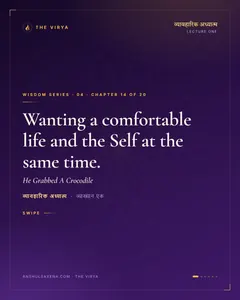
He Grabbed A Crocodile

Wanting a comfortable life and the Self at the same time

He Grabbed A Crocodile, card 1 of 6
He Grabbed A Crocodile, card 2 of 6
He Grabbed A Crocodile, card 3 of 6
He Grabbed A Crocodile, card 4 of 6
He Grabbed A Crocodile, card 5 of 6
He Grabbed A Crocodile, card 6 of 6
Read as text

व्यावहारिक अध्यात्म · व्याख्यान एक, "He Grabbed A Crocodile"

He who desires a comfortable and nice life and at the same time wants to realize the Self is like the fool who, wanting to cross the river, caught hold of a crocodile, mistaking it for a log of wood.

Two aims are named that cannot be pursued with the same instrument, and mistaking one for the other is fatal rather than merely inefficient.

The dangerous mistakes are the ones that look right and work initially. A crocodile floats. That is exactly why the error is available.

How the text gets there:
1. Two aims are set side by side: comfort and self-realization.
2. The image supplies a means that resembles the correct one and floats like it.
3. The resemblance is what makes the error possible rather than obvious.
4. The consequence is not inefficiency but destruction, since the false means is itself the hazard.

Today: Generalises to any pursuit where the comfortable version is available and looks the same. The course instead of the practice, the reading instead of the doing. Both float. Only one gets you across, and you find out in the middle of the river.

What are you holding that resembles the means and is actually the obstacle? Tell me below.

Practical Spirituality

Of Which I Am The Witness

The universe as a series of paintings. You are not in them

Of Which I Am The Witness, card 1 of 6
Of Which I Am The Witness, card 2 of 6
Of Which I Am The Witness, card 3 of 6
Of Which I Am The Witness, card 4 of 6
Of Which I Am The Witness, card 5 of 6
Of Which I Am The Witness, card 6 of 6
Read as text

व्यावहारिक अध्यात्म · व्याख्यान एक, "Of Which I Am The Witness"

That is the secret: To think that I am the spirit and not the body, and that the whole of this universe with all its relations, with all its good and all its evil, is but as a series of paintings -- scenes on a canvas -- of which I am the witness.

The identification with the body is what makes experience binding, and the witness position removes the binding without removing the experience.

The good and the evil are both listed as paintings. It is a position, not an evaluation, which is why it does not collapse into calling difficulty unreal.

How the text gets there:
1. Misery is attributed to identification rather than to the content of events.
2. The proposed shift is from participant to witness.
3. Both good and evil are included among the scenes, so nothing is being denied.
4. Meditation is named as the operation that produces the shift, without external dependence.

Today: The practical residue survives without any metaphysics. The gap between what happened and what it means about you is where nearly all suffering sits, and it can be widened deliberately. That is a skill and it is trainable.

What are you identified with that is actually just happening? Tell me below.

Practical Spirituality

Only One Method

Every science, inner and outer, runs on the same single operation

Only One Method, card 1 of 6
Only One Method, card 2 of 6
Only One Method, card 3 of 6
Only One Method, card 4 of 6
Only One Method, card 5 of 6
Only One Method, card 6 of 6
Read as text

व्यावहारिक अध्यात्म · व्याख्यान दो · एकाग्रता, "Only One Method"

All knowledge that we have, either of the external or internal world, is obtained through only one method -- by the concentration of the mind. No knowledge can be had of any science unless we can concentrate our minds upon the subject.

Concentration is not one method among several but the sole mechanism by which knowledge of any kind is acquired.

If concentration is the only method, then it is not a study skill sitting alongside the subjects. It is the single instrument, and everything else is a lens attached to it.

How the text gets there:
1. Knowledge of both external and internal worlds is considered together.
2. In every case the operation is concentration directed through some instrument.
3. The instruments differ between sciences but the operation does not.
4. Studying the mind uses the same operation, turned back on itself rather than outward.

Today: Puts attention in a different category from the skills people list beside it. If it is the only instrument, then degrading it degrades everything downstream, which is a stronger claim than saying distraction makes you less productive.

If attention is the only instrument you have, what condition is yours in? Tell me below.

Practical Spirituality

We Are All Geniuses If We Try

The only difference between one mind and another

We Are All Geniuses If We Try, card 1 of 6
We Are All Geniuses If We Try, card 2 of 6
We Are All Geniuses If We Try, card 3 of 6
We Are All Geniuses If We Try, card 4 of 6
We Are All Geniuses If We Try, card 5 of 6
We Are All Geniuses If We Try, card 6 of 6
Read as text

व्यावहारिक अध्यात्म · व्याख्यान दो · एकाग्रता, "We Are All Geniuses If We Try"

The difference in this world between mind and mind is simply the fact of concentration. One, more concentrated than the other, gets more knowledge. ... The science of Yoga tells us that we are all geniuses if we try hard to be.

Differences in intellectual attainment are attributed to differences in concentration rather than to differences in innate capacity.

Genius is reclassified from a category of person to a quantity of a trainable variable. That makes the difference in speed real and the difference in ceiling imaginary.

How the text gets there:
1. Great achievement is observed to correlate with sustained concentration.
2. The audience attributes this to an innate category, genius.
3. The concession made is only about rate, that some are better fitted and go quicker.
4. The ceiling is denied, since the underlying power is held to be present in everyone.

Today: The claim is testable and mostly holds in practice: sustained attention on one problem for years beats scattered brilliance almost every time. It also removes the most comfortable excuse available, since a difference in rate can be paid for with time and a difference in kind cannot.

Is what you lack capacity, or years of attention on one thing? Tell me below.

Practical Spirituality

The Snake Charmer Dies Of Snakebite

Power reached by shortcut turns on the one who reached it

The Snake Charmer Dies Of Snakebite, card 1 of 6
The Snake Charmer Dies Of Snakebite, card 2 of 6
The Snake Charmer Dies Of Snakebite, card 3 of 6
The Snake Charmer Dies Of Snakebite, card 4 of 6
The Snake Charmer Dies Of Snakebite, card 5 of 6
The Snake Charmer Dies Of Snakebite, card 6 of 6
Read as text

व्यावहारिक अध्यात्म · व्याख्यान दो · एकाग्रता, "The Snake Charmer Dies Of Snakebite"

The men who, by the power of magic, control serpents will be killed by serpents. ... The man who attains any extraordinary powers will in the long run succumb to those powers.

Capability acquired without the corresponding preparation eventually destroys the person who acquired it.

The danger is a mismatch, not a moral penalty. A capacity that outruns the structure carrying it will break the structure, and the fact that it arrived quickly is what guarantees the mismatch.

How the text gets there:
1. Cases are cited of power obtained outside gradual training.
2. The reported outcomes are breakdown rather than benefit.
3. The cause is located in the method of acquisition, not in the power itself.
4. The remedy is therefore pace: scientific, slow and peaceful development so the structure grows with the capacity.

Today: The pattern is familiar wherever capability arrives faster than the structure to hold it. Sudden wealth, sudden authority, sudden audience. The failure is rarely the thing acquired. It is that everything meant to carry it was sized for someone smaller.

What have you been given faster than you built the structure to hold? Tell me below.

Practical Spirituality

The Bees Come By Themselves

Ramakrishna's answer to everyone who is working on being noticed

The Bees Come By Themselves, card 1 of 6
The Bees Come By Themselves, card 2 of 6
The Bees Come By Themselves, card 3 of 6
The Bees Come By Themselves, card 4 of 6
The Bees Come By Themselves, card 5 of 6
The Bees Come By Themselves, card 6 of 6
Read as text

व्यावहारिक अध्यात्म · व्याख्यान दो · एकाग्रता, "The Bees Come By Themselves"

My old master used to say, "When the lotus of the heart has bloomed, the bees will come by themselves." Men like that are there yet. They need not talk.

What is genuinely developed attracts without any effort at attracting, so promotion is a symptom of incompleteness.

The image gives no way to summon bees. If they are absent, the flower has not bloomed, which redirects every effort spent on attraction back to the thing itself.

How the text gets there:
1. The flower's blooming is the only action in the image.
2. The bees arrive as a consequence, with no work directed at them.
3. Their absence therefore reports on the flower rather than on the bees.
4. So effort spent attracting is effort not spent on the one thing that produces attraction.

Today: Sits awkwardly against a culture of building in public, and the tension is real rather than resolvable in one direction. Some work genuinely needs distribution. But if the promotion consistently exceeds the thing being promoted, the image has already diagnosed it.

Are you working on the flower or on the bees? Tell me below.

Practical Spirituality

The Camphor Evaporated

The contents are gone. The argument about the container continues

The Camphor Evaporated, card 1 of 6
The Camphor Evaporated, card 2 of 6
The Camphor Evaporated, card 3 of 6
The Camphor Evaporated, card 4 of 6
The Camphor Evaporated, card 5 of 6
The Camphor Evaporated, card 6 of 6
Read as text

व्यावहारिक अध्यात्म · व्याख्यान दो · एकाग्रता, "The Camphor Evaporated"

In all religions everything degenerates upon being practiced by the ignorant. The camphor in the bottle evaporated, and they are fighting over the bottle.

When the substance of a practice is lost, the container remains and becomes the object of the dispute.

Camphor is chosen because it sublimates without residue. Nothing spills and nothing breaks, so from outside the bottle looks unchanged, and the fight is fully sincere.

How the text gets there:
1. The substance is described as evaporating rather than being destroyed.
2. The container remains intact and unchanged in appearance.
3. Disputes then attach to the container, since it is what is still there to dispute about.
4. The intensity of the quarrel is therefore no evidence that anything remains inside.

Today: The organizational form of this is a process whose purpose everyone has forgotten and whose details are defended fiercely. The heat of the argument feels like evidence that something is at stake. Ask what the process was for. If nobody can say, you are holding the bottle.

Which of your fiercest positions is about a bottle? Tell me below.