
20 posts · 120 cards

Basics of Vedanta वेदान्त

The whole system laid out in order, with the technical terms kept.

Basics of Vedanta

What The Word Actually Means

Veda plus anta. Knowledge, and the end of it

What The Word Actually Means, card 1 of 6
What The Word Actually Means, card 2 of 6
What The Word Actually Means, card 3 of 6
What The Word Actually Means, card 4 of 6
What The Word Actually Means, card 5 of 6
What The Word Actually Means, card 6 of 6
Read as text

वेदान्त · वेदान्त, "What The Word Actually Means"

Composed of Veda = knowledge and Anta = end; literally refers to "the end of the Vedas or final conclusion of knowledge". ... The Vedanta is technically classified as Uttara-Mimamsa.

Vedanta names both the closing sections of the Vedas and the final conclusion drawn from them.

The name commits the system to being a conclusion rather than a starting assumption, which means it is offered as the end of an argument and can be examined as one.

How the text gets there:
1. The compound splits into knowledge and end.
2. Positionally this locates the Upanishads at the close of each Veda.
3. Logically it makes their content the conclusion drawn from what preceded.
4. The technical name reinforces this by classing the whole thing as an investigation.

Today: Worth knowing before you encounter Vedanta as vague spirituality. The tradition names itself after the end of an argument, which means it expects to be reasoned about rather than merely felt, and it supplies the reasoning.

Do you treat your deepest beliefs as conclusions or as starting points? Tell me below.

Basics of Vedanta

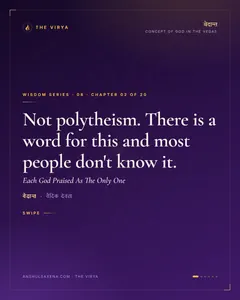
Each God Praised As The Only One

Not polytheism. There is a word for this and most people don't know it

Each God Praised As The Only One, card 1 of 6
Each God Praised As The Only One, card 2 of 6
Each God Praised As The Only One, card 3 of 6
Each God Praised As The Only One, card 4 of 6
Each God Praised As The Only One, card 5 of 6
Each God Praised As The Only One, card 6 of 6
Read as text

वेदान्त · वैदिक देवता, "Each God Praised As The Only One"

In the hymns of the Veda each of these devas was praised and extolled with the same epithets and declared to be `the Supreme'. ... henotheism = election of one among many gods as supreme.

Each deity in turn is addressed as the supreme being and creator, which is a distinct position rather than inconsistency.

The apparent contradiction is a category error on the reader's side. Henotheism is not confused polytheism; it is a coherent third position, in which whoever is being addressed is the whole thing.

How the text gets there:
1. Multiple deities are each addressed with identical supreme epithets.
2. Under polytheism this would be inconsistent, since supremacy is exclusive.
3. The portfolios are shown to move with the poet's devotion rather than being fixed.
4. So supremacy attaches to whoever is being addressed, which is a distinct structure with its own name.

Today: A useful correction to the standard summary of Hinduism as many gods. The structure of the earliest layer is closer to one reality addressed under many names, and the reallocation of portfolios is the evidence rather than a later apologetic.

Have you been reading a coherent system as a confused one? Tell me below.

Basics of Vedanta

The Law The Gods Are Under

The devas preside over nature. Something else regulates them

The Law The Gods Are Under, card 1 of 6
The Law The Gods Are Under, card 2 of 6
The Law The Gods Are Under, card 3 of 6
The Law The Gods Are Under, card 4 of 6
The Law The Gods Are Under, card 5 of 6
The Law The Gods Are Under, card 6 of 6
Read as text

वेदान्त · ऋत, "The Law The Gods Are Under"

Nature, though presided over by different devas, is subject to the cosmic law (called Rta), which regulates the whole world, the laws and processes of nature and all living beings.

Rta is an order governing the whole of nature and all beings, to which even the presiding deities are subject.

Placing law above the gods means the world is not governed by negotiation. You cannot petition your way around rta, because the beings you would petition are inside it too.

How the text gets there:
1. The devas are identified as the powers governing natural phenomena.
2. Rta is then said to regulate the whole world and all living beings.
3. The devas fall within that scope rather than outside it.
4. So the order is a condition on divine action rather than a product of it.

Today: The idea that regularity outranks agency is the same intuition that makes science possible. It is also a fairly stern position on prayer: the parts of the world that run on law are not the parts that respond to requests.

Where are you negotiating with something that runs on law? Tell me below.

Basics of Vedanta

Hear It, Argue With It, Live In It

Three stages. Most people stop after the first

Hear It, Argue With It, Live In It, card 1 of 6
Hear It, Argue With It, Live In It, card 2 of 6
Hear It, Argue With It, Live In It, card 3 of 6
Hear It, Argue With It, Live In It, card 4 of 6
Hear It, Argue With It, Live In It, card 5 of 6
Hear It, Argue With It, Live In It, card 6 of 6
Read as text

वेदान्त · श्रवण मनन निदिध्यासन, "Hear It, Argue With It, Live In It"

1. Shravana -- attentive listening to the teachings. 2. Manana -- reflection upon what has been heard. 3. Nididhyasana -- contemplation upon the teachings and their assimilation.

The prescribed method has three sequential stages: receiving the teaching, subjecting it to reason, and assimilating it through sustained practice.

Naming the filters at stage one changes what the later stages are for. You are not reasoning about the teaching; you are reasoning about the teaching as it arrived through your particular distortion.

How the text gets there:
1. Three stages are given in a fixed order.
2. The first is qualified by an admission that objective listening barely occurs.
3. Three specific filters are named that condition what any hearer receives.
4. The later stages therefore operate on an already conditioned version, which is why reflection is not optional.

Today: The common failure is treating exposure as understanding. You heard it, so you have it. The three filters explain why two people leave the same talk with different content, and why the second stage is where the work starts.

What have you heard but never actually argued with? Tell me below.

Basics of Vedanta

Four Tests For Any Teaching

True, beneficial, beautiful, peace-producing. Run all four

Four Tests For Any Teaching, card 1 of 6
Four Tests For Any Teaching, card 2 of 6
Four Tests For Any Teaching, card 3 of 6
Four Tests For Any Teaching, card 4 of 6
Four Tests For Any Teaching, card 5 of 6
Four Tests For Any Teaching, card 6 of 6
Read as text

वेदान्त · मनन, "Four Tests For Any Teaching"

Nothing should be accepted unexamined. ... Satyam -- is the teaching logical, rational, reasonable? Shivam -- is the teaching universally beneficial? Sundaram -- is it aesthetical, does it contribute to culture? Shanti -- does it contribute to universal peace?

Four independent criteria are applied to test any teaching, covering its logic, its benefit, its beauty and its effect on peace.

A teaching can pass one test and fail another, which is why four are needed. Something can be strictly true and produce no peace, or beautiful and not survive scrutiny.

How the text gets there:
1. Unexamined acceptance is ruled out as a category.
2. Four criteria are supplied and stated to apply to all schools including the reader's own.
3. The criteria are independent, so passing one does not imply passing another.
4. A teaching therefore has to be assessed on four separate axes rather than on truth alone.

Today: Most modern evaluation runs on the first test alone. Adding the other three catches things logic misses: the framework that is defensible and corrosive, or the argument that is sound and leaves everyone worse off. That is not softness, it is a wider instrument.

Which of the four does the idea you most rely on fail? Tell me below.

Basics of Vedanta

Four Sentences, One From Each Veda

Consciousness is Brahman. I am Brahman. That thou art. This self is Brahman

Four Sentences, One From Each Veda, card 1 of 6
Four Sentences, One From Each Veda, card 2 of 6
Four Sentences, One From Each Veda, card 3 of 6
Four Sentences, One From Each Veda, card 4 of 6
Four Sentences, One From Each Veda, card 5 of 6
Four Sentences, One From Each Veda, card 6 of 6
Read as text

वेदान्त · महावाक्य, "Four Sentences, One From Each Veda"

1. Prajnanam Brahma -- `Consciousness is Brahman.' 2. Aham Brahma Asmi -- `I Am Brahman.' 3. Tat tvam Asi -- `That Thou Art.' 4. Ayam Atma Brahma -- `This Self is Brahman.'

The four great pronouncements, one from each Veda, each stating the identity of the individual self with the ultimate reality from a different standpoint.

The four map a sequence: definition, meditation, transmission, realization. The same identity is stated four times because it has to be encountered four different ways.

How the text gets there:
1. Four statements are drawn one from each Veda.
2. Each is assigned a distinct technical function rather than treated as a variant.
3. The functions correspond to definition, sustained attention, instruction and realized experience.
4. So the set describes a process, which is why one statement would not suffice.

Today: The distinction between the definition, the thing you hold in mind, what a teacher can hand you, and what you have actually experienced applies to anything worth learning. Most people have the first and mistake it for the fourth.

Which of the four do you have: the definition, or the experience? Tell me below.

Basics of Vedanta

The One The Teacher Uses

Of the four, only one is spoken from teacher to student

The One The Teacher Uses, card 1 of 6
The One The Teacher Uses, card 2 of 6
The One The Teacher Uses, card 3 of 6
The One The Teacher Uses, card 4 of 6
The One The Teacher Uses, card 5 of 6
The One The Teacher Uses, card 6 of 6
Read as text

वेदान्त · तत् त्वम् असि, "The One The Teacher Uses"

Of these four Maha-vakyas, Tat tvam asi is of greater importance. It is known as the Upadesha-Vakya. The Guru initiates the disciple into spiritual knowledge only through this statement.

That thou art is the instructional sentence, the one through which transmission from teacher to student actually occurs.

The distinguishing feature is that it is spoken to somebody. A statement in the second person does something the same content in the third person cannot, which is why this one carries the transmission.

How the text gets there:
1. Four statements express the same identity.
2. Three of them are formulated in the first or third person, as descriptions.
3. This one alone is addressed directly to a listener.
4. Being addressed is what makes it instruction rather than information, which is why initiation runs through it.

Today: The difference between reading that a capacity exists and having someone tell you that you have it is not sentimental. The second is an act performed on you. It is why teachers are not fully replaceable by texts, in any field.

What has someone told you about yourself that you could not have read? Tell me below.

Basics of Vedanta

Why The Rules Come Before The Truth

Injunctions, prohibitions, then the highest truth. In that order

Why The Rules Come Before The Truth, card 1 of 6
Why The Rules Come Before The Truth, card 2 of 6
Why The Rules Come Before The Truth, card 3 of 6
Why The Rules Come Before The Truth, card 4 of 6
Why The Rules Come Before The Truth, card 5 of 6
Why The Rules Come Before The Truth, card 6 of 6
Read as text

वेदान्त · विधि निषेध, "Why The Rules Come Before The Truth"

The function of the first two is to purify the aspirant and make him fit to understand and assimilate the third; for, only in a morally purified mind will intuition dawn.

Scriptural statements fall into injunctions, prohibitions, and declarations of the highest truth, with the first two functioning as preparation for the third.

The claim is that conduct is a precondition of a kind of seeing, not a prerequisite for admission. An unrestrained mind is being described as an instrument that cannot resolve the object, however well informed it is.

How the text gets there:
1. Scriptural statements are divided into three classes with distinct functions.
2. The first two govern conduct and the third states the truth.
3. The first two are assigned a preparatory role rather than an independent one.
4. Learning is explicitly excluded as a substitute, which makes the condition perceptual rather than social.

Today: Applies wherever people expect information to do work that only a settled mind can do. You can read the material on a subject in a fortnight. Whether you can see anything in it is decided by something else entirely, and it is not intelligence.

Is your instrument steady enough to resolve what you are studying? Tell me below.

Basics of Vedanta

Waking, Dreaming, Deep Sleep, And One More

You already experience three of them every day

Waking, Dreaming, Deep Sleep, And One More, card 1 of 6
Waking, Dreaming, Deep Sleep, And One More, card 2 of 6
Waking, Dreaming, Deep Sleep, And One More, card 3 of 6
Waking, Dreaming, Deep Sleep, And One More, card 4 of 6
Waking, Dreaming, Deep Sleep, And One More, card 5 of 6
Waking, Dreaming, Deep Sleep, And One More, card 6 of 6
Read as text

वेदान्त · चार अवस्थाएँ, "Waking, Dreaming, Deep Sleep, And One More"

1. Jagrata, the externalized consciousness. 2. Svapna, the dreaming consciousness. 3. Sushupti, the consciousness in deep sleep, after waking from which one remembers nothing other than "I was." 4. Turiya, the active universal consciousness.

Consciousness is analyzed into four states, three of them ordinary and daily, the fourth transcending the subject-object structure of the others.

Deep sleep is the everyday evidence. Everyone wakes with the sense of having existed through a period in which nothing whatever was experienced, and that pairing has to be accounted for.

How the text gets there:
1. Three states are named that everyone occupies daily.
2. Deep sleep contains awareness with no content whatever.
3. The report on waking is nevertheless that one existed, so something persisted.
4. Awareness therefore separates from content, which makes a state beyond the subject-object structure conceivable.

Today: The dreamless-sleep argument is available to anyone tonight, and it is a genuinely odd fact once you look at it. You are prepared to assert that you existed during a period from which you have no experience at all.

How do you know you existed during dreamless sleep? Tell me below.

Basics of Vedanta

The Screen Nobody Looks At

Everything you see requires it. Nobody has ever seen it

The Screen Nobody Looks At, card 1 of 6
The Screen Nobody Looks At, card 2 of 6
The Screen Nobody Looks At, card 3 of 6
The Screen Nobody Looks At, card 4 of 6
The Screen Nobody Looks At, card 5 of 6
The Screen Nobody Looks At, card 6 of 6
Read as text

वेदान्त · साक्षी, "The Screen Nobody Looks At"

Consciousness, Atman, which is our true essence -- like a movie screen which is unseen while the movie is being projected onto it. ... The Self is the subject which sees and not the object seen.

The self is the constant witness, never appearing as an object, and is therefore unavailable to the kind of looking that finds everything else.

The rule is ruthless and completely consistent. Every candidate you locate for the self is thereby an object, and the one thing that cannot be located is the only one that qualifies.

How the text gets there:
1. The self is defined as the subject that sees rather than anything seen.
2. Anything appearing as an object is therefore excluded from being the self.
3. The screen is unseen not by concealment but because it is what the image appears on.
4. So the search for the self fails by construction, and its failure is the evidence.

Today: Explains why introspection returns thoughts, sensations and feelings and never the one having them. That is not a failure of technique. Under this analysis it is the correct and only possible result.

Have you ever found the one who is looking? Tell me below.

Basics of Vedanta

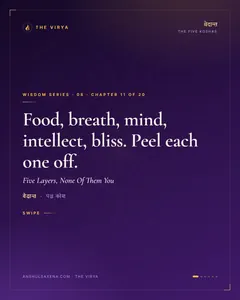
Five Layers, None Of Them You

Food, breath, mind, intellect, bliss. Peel each one off

Five Layers, None Of Them You, card 1 of 6
Five Layers, None Of Them You, card 2 of 6
Five Layers, None Of Them You, card 3 of 6
Five Layers, None Of Them You, card 4 of 6
Five Layers, None Of Them You, card 5 of 6
Five Layers, None Of Them You, card 6 of 6
Read as text

वेदान्त · पञ्च कोश, "Five Layers, None Of Them You"

1. Anna-maya-kosha: existence, birth, growth, change, decay and death. 2. Prana-maya-kosha: hunger and thirst, heat and cold. 3. Mano-maya-kosha: thinking and doubting, anger, desire, grief. 4. Vijnana-maya-kosha: discrimination and decision, agency and enjoyership. 5. Ananda-maya-kosha: the three degrees of empirical bliss.

Five progressively subtler sheaths are identified, each defined by the specific functions that belong to it and not to the self.

Agency is assigned to the fourth sheath, not to the self. The feeling of being the one who decides is itself a layer, which is a far stronger claim than putting the body outside.

How the text gets there:
1. Five sheaths are defined by their characteriztic functions rather than by location.
2. Each function belongs to its sheath and is therefore not a property of the self.
3. Agency and enjoyership are assigned to the fourth sheath.
4. Even bliss appears as the fifth, so pleasant states are also covering rather than core.

Today: The list works as a diagnostic. When you are unwell, agitated, indecisive or elated, you can name which layer is reporting. The identification does not fix anything, and it does stop the report being taken as news about who you are.

Which sheath is doing the talking right now? Tell me below.

Basics of Vedanta

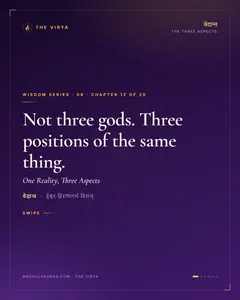
One Reality, Three Aspects

Not three gods. Three positions of the same thing

One Reality, Three Aspects, card 1 of 6
One Reality, Three Aspects, card 2 of 6
One Reality, Three Aspects, card 3 of 6
One Reality, Three Aspects, card 4 of 6
One Reality, Three Aspects, card 5 of 6
One Reality, Three Aspects, card 6 of 6
Read as text

वेदान्त · ईश्वर हिरण्यगर्भ विराज्, "One Reality, Three Aspects"

1. Ishvara. 2. Hiranya-garbha. 3. Viraj.

The ultimate reality is described under three aspects: as the governing intelligence, as the cosmic subtle body, and as the manifest universe.

The scheme lets a tradition speak of a personal God and an impersonal absolute without contradiction. They are the same reality at different levels of description, in the way a person and their body are not two things.

How the text gets there:
1. One reality is described from three standpoints rather than divided into three.
2. The standpoints descend from intelligence to subtle aggregate to manifest matter.
3. Each is the same subject viewed at a different level of manifestation.
4. Personal and impersonal descriptions therefore refer to one thing at different resolutions.

Today: Resolves an argument people spend a lot of time on. Whether ultimate reality is personal or impersonal may be a question about which level you are describing rather than about what is the case, and both answers can be accurate at their own level.

Are you and the person you disagree with describing different levels? Tell me below.

Basics of Vedanta

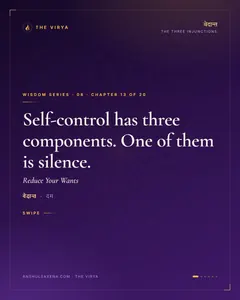
Reduce Your Wants

Self-control has three components. One of them is silence

Reduce Your Wants, card 1 of 6
Reduce Your Wants, card 2 of 6
Reduce Your Wants, card 3 of 6
Reduce Your Wants, card 4 of 6
Reduce Your Wants, card 5 of 6
Reduce Your Wants, card 6 of 6
Read as text

वेदान्त · दम, "Reduce Your Wants"

Dama is self-control. We should reduce our wants and be prepared to suffer in the interests of truth. Tapas - austerity, Brahmacarya - continence, and Mauna - silence are the ways to attain self-control.

Self-control is achieved through austerity, disciplined studentship, and the vow of silence, and consists first in reducing what one wants.

Silence is listed as a discipline of the same order as austerity and continence, and the reason given is not spiritual atmosphere. It is that a specific class of harm has only one exit.

How the text gets there:
1. Self-control is defined first as the reduction of wants.
2. Three means are given, covering the body, the way of life and speech.
3. Brahmacharya is glossed broadly as studentship rather than narrowly as abstinence.
4. Silence is justified by the particular harms that pass through speech, which makes it functional rather than symbolic.

Today: The grouping of flattery with backbiting is the interesting part, since one is meant to be pleasant. Both are named as excesses of the tongue, which suggests that the test is not whether the speech is kind but whether it is true.

Which of your recent words were flattery? Tell me below.

Basics of Vedanta

Six Rules For Giving

Give with conviction. Also with fear

Six Rules For Giving, card 1 of 6
Six Rules For Giving, card 2 of 6
Six Rules For Giving, card 3 of 6
Six Rules For Giving, card 4 of 6
Six Rules For Giving, card 5 of 6
Six Rules For Giving, card 6 of 6
Read as text

वेदान्त · दान, "Six Rules For Giving"

The Taittiriya Upanishad regulates the skill of giving: one should give with conviction, one should not give without conviction, one should give liberally, with modesty, with fear (of consequences), with empathy.

Generosity is treated as a skill with specific conditions attached to how it is performed, not only that it is performed.

Including a prohibition inside an instruction to give makes generosity conditional on its manner. The transfer is not the whole act, and an unconvinced transfer is excluded rather than counted.

How the text gets there:
1. Giving is classified as a skill, so it can be performed well or badly.
2. A positive condition and its explicit negation are both stated.
3. Four further conditions govern manner rather than amount.
4. The inclusion of fear implies that giving can produce harm, which is why manner is regulated.

Today: Cuts against the common view that any giving is good giving. Under this account the reluctant donation, the one made to end the conversation, does not qualify, and the difference is in what it does to the giver rather than to the recipient.

When did you last give without conviction? Tell me below.

Basics of Vedanta

A Test For Whether You Have Forgiven

One sentence, and it is uncomfortably easy to check

A Test For Whether You Have Forgiven, card 1 of 6
A Test For Whether You Have Forgiven, card 2 of 6
A Test For Whether You Have Forgiven, card 3 of 6
A Test For Whether You Have Forgiven, card 4 of 6
A Test For Whether You Have Forgiven, card 5 of 6
A Test For Whether You Have Forgiven, card 6 of 6
Read as text

वेदान्त · दया, "A Test For Whether You Have Forgiven"

As long as we remember an injustice, we have not forgiven either the person or the action. It is by the cultivation of compassion as a proactive attempt to liberate others from suffering that we can overcome our narrow self-interest.

Continued remembrance of an injustice is offered as evidence that forgiveness has not occurred, and compassion is defined as active rather than merely felt.

Using memory as the criterion makes forgiveness unfakeable. You cannot decide to have forgotten, which means the state either exists or it does not, and you can check it in a second.

How the text gets there:
1. Forgiveness is given an observable criterion rather than a felt one.
2. The criterion is whether the injustice is still remembered.
3. Memory cannot be produced or suppressed by decision, so the test cannot be gamed.
4. Compassion is then defined as proactive action, which locates the remedy in doing rather than feeling.

Today: Most people have a grievance they can recite with dates. Under this test that is the answer, and it is not a reproach so much as information: the work has not been done, and knowing that is more useful than believing it has.

What injustice can you still recite in detail? Tell me below.

Basics of Vedanta

Four Stages, Four Freedoms

Each stage is named by what it frees you from

Four Stages, Four Freedoms, card 1 of 6
Four Stages, Four Freedoms, card 2 of 6
Four Stages, Four Freedoms, card 3 of 6
Four Stages, Four Freedoms, card 4 of 6
Four Stages, Four Freedoms, card 5 of 6
Four Stages, Four Freedoms, card 6 of 6
Read as text

वेदान्त · मुक्ति की चार अवस्थाएँ, "Four Stages, Four Freedoms"

1. Salokya -- freedom from the idea that the world... 2. Sarupya or sadharmya... 3. Samipya -- intimacy, freedom from self-effort to achieve... 4. Sayujya -- communion.

Liberation is described in four progressive stages, each defined by a specific freedom rather than by an attainment.

Defining each stage by its freedom rather than its acquisition changes what progress looks like. You would know you had advanced by something dropping away, not by something arriving.

How the text gets there:
1. Four stages are given in order of increasing closeness.
2. Each is paired with a specific freedom rather than a specific gain.
3. The freedoms include the notion of difference and the need for self-effort.
4. So progress is registered as subtraction, which is why it can go unnoticed.

Today: Worth applying to any long development. If you only measure by what you have gained, you will miss the more reliable signal, which is what has stopped being necessary. The things you no longer have to do deliberately are the record.

What did you once have to do deliberately that now happens by itself? Tell me below.

Basics of Vedanta

Four Roads, Chosen By Temperament

Action, knowledge, devotion, surrender. Not a ranking

Four Roads, Chosen By Temperament, card 1 of 6
Four Roads, Chosen By Temperament, card 2 of 6
Four Roads, Chosen By Temperament, card 3 of 6
Four Roads, Chosen By Temperament, card 4 of 6
Four Roads, Chosen By Temperament, card 5 of 6
Four Roads, Chosen By Temperament, card 6 of 6
Read as text

वेदान्त · चार योग, "Four Roads, Chosen By Temperament"

1. Karma Yoga -- the yoga of action. 2. Jnana Yoga -- the way of knowledge. 3. Bhakti Yoga -- yoga of devotion. 4. Prapatti / Sharanagati -- surrender.

Four paths are set out, corresponding to the different faculties a person may lead with: doing, knowing, feeling, and giving over.

The four exist because people differ in what they lead with, not because some are advanced. Publishing the requirements of the knowledge path is the clearest evidence that it is not being ranked above the others.

How the text gets there:
1. Four paths are presented in parallel rather than as a hierarchy.
2. Each corresponds to a different human faculty.
3. The requirements of the knowledge path are stated in full and are severe.
4. That severity blocks the assumption that the intellectual route is the shortcut.

Today: The useful question is not which path is highest but which faculty you actually lead with, and then whether you have chosen accordingly. Many people pick the one that flatters their self-image rather than the one matching how they are built.

Which path have you chosen, and does it match how you actually operate? Tell me below.

Basics of Vedanta

Discrimination, Then Dispassion

You cannot let go of what you have not yet distinguished

Discrimination, Then Dispassion, card 1 of 6
Discrimination, Then Dispassion, card 2 of 6
Discrimination, Then Dispassion, card 3 of 6
Discrimination, Then Dispassion, card 4 of 6
Discrimination, Then Dispassion, card 5 of 6
Discrimination, Then Dispassion, card 6 of 6
Read as text

वेदान्त · विवेक वैराग्य, "Discrimination, Then Dispassion"

1. Viveka -- right discrimination between the eternal and non-eternal, the real and the unreal. This comes from proper study and reflection. 2. Vairagya -- right dispassion and indifference to the unreal and transitory.

The fourfold discipline begins with the ability to distinguish the lasting from the passing, and only then with indifference toward the passing.

Attempting dispassion without discrimination produces indifference toward the wrong things, which is why detachment practiced early so often looks like numbness rather than freedom.

How the text gets there:
1. Discrimination is placed first and attributed to study and reflection.
2. Dispassion is directed specifically at what is unreal and transitory.
3. Identifying that category is the output of the first discipline.
4. So dispassion attempted first has no principled target and lands indiscriminately.

Today: Explains a common failure in people who have adopted detachment as a stance. Without the discriminating work, the letting go applies uniformly, including to things that mattered, and the result is flatness rather than freedom.

Have you distinguished what is passing, or just stopped caring? Tell me below.

Basics of Vedanta

The Six You Need In Place

Calm, restraint, tolerance, forbearance, conviction, attentiveness

The Six You Need In Place, card 1 of 6
The Six You Need In Place, card 2 of 6
The Six You Need In Place, card 3 of 6
The Six You Need In Place, card 4 of 6
The Six You Need In Place, card 5 of 6
The Six You Need In Place, card 6 of 6
Read as text

वेदान्त · षट्सम्पत्, "The Six You Need In Place"

Sama -- tranquillity. Dama -- self-restraint. Uparati -- tolerance and renunciation of all sectarian religious observances with the object of acquiring wisdom. Titiksha -- forbearance. Shraddha -- conviction grounded on logic. Samadhana -- balanced mental equipoise, freedom from torpor, laziness and carelessness.

Right conduct is broken into six specific acquirements covering the mind, the senses, ritual attachment, endurance, conviction and sustained attention.

Faith and ritual, the two things an outsider would assume such a list requires, appear here as an item to be given up and an item that must be justified by reason.

How the text gets there:
1. Six acquirements are listed as components of right conduct.
2. One of them requires renouncing sectarian ritual as a means to liberation.
3. Faith is redefined as conviction grounded on logic rather than as belief.
4. So the list places reasoned confidence above observance, inside a religious system.

Today: Shraddha as reasoned conviction is the transferable one. It is not belief without evidence; it is the working confidence that a practice will produce results, held long enough for the results to arrive. Without it nobody completes anything difficult.

Is your conviction grounded in reason or in habit? Tell me below.

Basics of Vedanta

One Goal, Or None

The last requirement is that nothing else competes with it

One Goal, Or None, card 1 of 6
One Goal, Or None, card 2 of 6
One Goal, Or None, card 3 of 6
One Goal, Or None, card 4 of 6
One Goal, Or None, card 5 of 6
One Goal, Or None, card 6 of 6
Read as text

वेदान्त · मुमुक्षुत्व, "One Goal, Or None"

Mumukshutva -- right aspiration, which consists of earnestness to know the Ultimate Principle and thereby to attain Liberation. This will come when one dedicates one's entire life to this single goal.

The fourth qualification is an undivided aspiration, arising only when the whole of life is dedicated to that one end.

Placing the strongest requirement last means the preceding three are preparation for wanting it properly, rather than steps toward getting it. The difficulty is not achieving the goal but arriving at an undivided desire for it.

How the text gets there:
1. The fourth qualification concerns the aspiration itself rather than any capacity.
2. Its condition is dedication of the entire life to one goal.
3. This is more demanding than the three preceding qualifications.
4. Aspirants are then graded by intensity, so the degree of undividedness determines the result.

Today: The general form holds outside any religious frame. Anything genuinely difficult tends to require an undivided want, and most unfinished ambitions were not defeated by circumstances. They were competing with three other ambitions for the same person.

What is competing with the thing you say you want most? Tell me below.