20 posts · 120 cards

Practical Vedanta व्यावहारिक वेदान्त

Vivekananda on bringing Vedanta into work and daily life.

Practical Vedanta

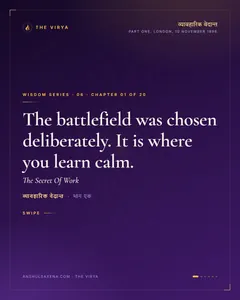
The Secret Of Work

The battlefield was chosen deliberately. It is where you learn calm

The Secret Of Work, card 1 of 6
The Secret Of Work, card 2 of 6
The Secret Of Work, card 3 of 6
The Secret Of Work, card 4 of 6
The Secret Of Work, card 5 of 6
The Secret Of Work, card 6 of 6
Read as text

व्यावहारिक वेदान्त · भाग एक, "The Secret Of Work"

The doctrine which stands out luminously in every page of the Gita is intense activity, but in the midst of it, eternal calmness. This is the secret of work, to attain which is the goal of the Vedanta.

The goal is neither activity nor stillness but the combination, activity carried out from an undisturbed center.

Stillness is not an achievement. Rocks have it. What is difficult, and what the setting was chosen to demonstrate, is holding it while fully in motion.

How the text gets there:
1. The Gita's teaching occurs in the most active possible setting, a battlefield.
2. Inactivity is rejected as the goal by reductio: inert objects would then be the wisest.
3. Activity combined with passion is also rejected, since agitation is not the missing ingredient.
4. What remains is activity plus an undisturbed center, which the setting was chosen to illustrate.

Today: The retreat where you feel calm is not evidence of anything, because the conditions were doing the work. The test is whether the calm survives contact with your inbox, and if it does not, you have been training in the absence of the thing you needed to train against.

Is your calm a property of you, or of your conditions? Tell me below.

Practical Vedanta

Passion Is Not Fuel

He believed the opposite when he was younger. Experience changed his mind

Passion Is Not Fuel, card 1 of 6
Passion Is Not Fuel, card 2 of 6
Passion Is Not Fuel, card 3 of 6
Passion Is Not Fuel, card 4 of 6
Passion Is Not Fuel, card 5 of 6
Passion Is Not Fuel, card 6 of 6
Read as text

व्यावहारिक वेदान्त · भाग एक, "Passion Is Not Fuel"

The less passion there is, the better we work. ... The energy which ought to have gone out as work is spent as mere feeling, which counts for nothing.

Emotional intensity consumes the same energy that work requires, so it reduces output rather than driving it.

This inverts the usual model in which passion powers the work. Here they draw on one account, so intensity of feeling and volume of output are in competition.

How the text gets there:
1. The common belief that passion drives work is stated and attributed to his younger self.
2. Energy is treated as a single budget spent either as feeling or as work.
3. Feeling is therefore not fuel but an alternative expenditure.
4. The prediction is checked against the lives of prolific workers, who are found to be calm.

Today: Notice what happens to your actual output on the days you feel most strongly about the work. The feeling is real and it is being consumed on itself. The people who ship most are rarely the people in the room who care most visibly.

How much of this week's intensity turned into anything? Tell me below.

Practical Vedanta

Which Direction Do You Move?

Bring the ideal down to your life, or bring your life up. One is a temptation

Which Direction Do You Move?, card 1 of 6
Which Direction Do You Move?, card 2 of 6
Which Direction Do You Move?, card 3 of 6
Which Direction Do You Move?, card 4 of 6
Which Direction Do You Move?, card 5 of 6
Which Direction Do You Move?, card 6 of 6
Read as text

व्यावहारिक वेदान्त · भाग एक, "Which Direction Do You Move?"

There are two tendencies in human nature: one to harmonize the ideal with the life, and the other to elevate the life to the ideal. It is a great thing to understand this, for the former tendency is the temptation of our lives.

Reconciling the standard to your conduct and raising your conduct to the standard both close the gap, and only one of them is growth.

Both movements produce agreement between your ideal and your life, so the feeling of alignment tells you nothing about which one happened.

How the text gets there:
1. Two ways of closing the gap between ideal and conduct are identified.
2. Both end with the two matching, so the resulting comfort is identical.
3. The downward move is preferred because it requires nothing.
4. It is disguised as an assessment of practicality rather than presented as a choice.

Today: Watch the moment a standard starts to feel unrealiztic to you. Sometimes it is. But the feeling arrives on exactly the same schedule whether the standard is wrong or you have simply stopped meeting it, and the second case is much more common.

Which standard have you recently decided was unrealiztic? Tell me below.

Practical Vedanta

Practical Means What I Do

If you are a thief, stealing is the practical pursuit

Practical Means What I Do, card 1 of 6
Practical Means What I Do, card 2 of 6
Practical Means What I Do, card 3 of 6
Practical Means What I Do, card 4 of 6
Practical Means What I Do, card 5 of 6
Practical Means What I Do, card 6 of 6
Read as text

व्यावहारिक वेदान्त · भाग एक, "Practical Means What I Do"

"My doxy is orthodoxy; your doxy is heterodoxy." So with practicality. ... If I am a shopkeeper, I think shopkeeping the only practical pursuit in the world. If I am a thief, I think stealing is the best means of being practical.

Practicality is used as a description of what the speaker already does, dressed as an objective standard.

Words that sound like measurements often just report the speaker's position. Practical is the most useful one to catch, because it ends arguments while appearing to have made one.

How the text gets there:
1. A known example is cited in which a word plainly means agreement with the speaker.
2. The same structure is claimed for practicality, which appears neutral.
3. Two examples with opposite moral content produce the same usage.
4. So the word is reporting the speaker's own capability rather than any external standard.

Today: The next time someone calls a proposal impractical, ask what specifically would fail. Sometimes there is an answer. Often the word is being used to mean 'this is not what we do here', which may still be a good reason and is a completely different one.

What have you dismissed as impractical that is simply unfamiliar? Tell me below.

Practical Vedanta

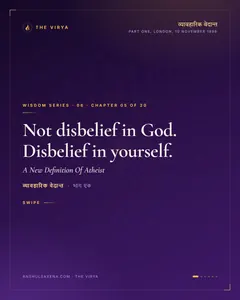
A New Definition Of Atheist

Not disbelief in God. Disbelief in yourself

A New Definition Of Atheist, card 1 of 6
A New Definition Of Atheist, card 2 of 6
A New Definition Of Atheist, card 3 of 6
A New Definition Of Atheist, card 4 of 6
A New Definition Of Atheist, card 5 of 6
A New Definition Of Atheist, card 6 of 6
Read as text

व्यावहारिक वेदान्त · भाग एक, "A New Definition Of Atheist"

As certain religions of the world say that a man who does not believe in a Personal God outside of himself is an atheist, so the Vedanta says, a man who does not believe in himself is an atheist. Not believing in the glory of our own soul is what the Vedanta calls atheism.

If the divine is identical with the self, then denying your own nature is the precise equivalent of denying God.

The reframing costs nothing in logic and everything in comfort, because self-deprecation stops being modesty and becomes the specific thing the tradition forbids.

How the text gets there:
1. The conventional definition of atheism is stated accurately.
2. Vedanta's premise relocates the divine from outside to the self.
3. The definition is applied without alteration to the new location.
4. Denying one's own nature therefore satisfies the original definition exactly.

Today: There is a habit of running yourself down that reads as humility and functions as insurance. This reframing removes the cover. It does not license arrogance either, since the claim is about a shared nature and not about your ranking within it.

What do you say about yourself that you would not accept about anyone else? Tell me below.

Practical Vedanta

Crying That It Is Dark

Nothing needs to be switched on. Something needs to be moved

Crying That It Is Dark, card 1 of 6
Crying That It Is Dark, card 2 of 6
Crying That It Is Dark, card 3 of 6
Crying That It Is Dark, card 4 of 6
Crying That It Is Dark, card 5 of 6
Crying That It Is Dark, card 6 of 6
Read as text

व्यावहारिक वेदान्त · भाग एक, "Crying That It Is Dark"

All the powers in the universe are already ours. It is we who have put our hands before our eyes and cry that it is dark. Know that there is no darkness around us. Take the hands away and there is the light which was from the beginning.

The obstruction is self-produced and adjacent, so removing it requires no acquisition and no distance.

If the obstruction is your own hands, then it is both entirely under your control and the last thing you will think to check, because you are looking through it rather than at it.

How the text gets there:
1. The light is stated to be present already and from the beginning.
2. The obstruction is identified as the person's own hands.
3. Its position directly against the eyes makes it the least likely thing to be noticed.
4. So the remedy is removal rather than acquisition, and the difficulty is detection rather than effort.

Today: Useful whenever you are searching for a missing capability. The question is not always what you lack. Sometimes it is what you are holding in place, and the reason you have not spotted it is that everything you see is already coming through it.

What are you holding in front of your own eyes? Tell me below.

Practical Vedanta

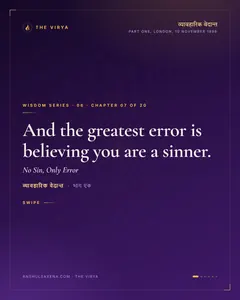
No Sin, Only Error

And the greatest error is believing you are a sinner

No Sin, Only Error, card 1 of 6
No Sin, Only Error, card 2 of 6
No Sin, Only Error, card 3 of 6
No Sin, Only Error, card 4 of 6
No Sin, Only Error, card 5 of 6
No Sin, Only Error, card 6 of 6
Read as text

व्यावहारिक वेदान्त · भाग एक, "No Sin, Only Error"

The Vedanta recognizes no sin, it only recognizes error. And the greatest error, says the Vedanta, is to say that you are weak, that you are a sinner, a miserable creature, and that you have no power and you cannot do this and that.

Wrongdoing is classed as a mistake about what you are, and the deepest mistake is the belief in your own incapacity.

Under this account, self-condemnation is not the antidote to wrongdoing. It is the same mechanism running one level deeper, and it produces exactly what it laments.

How the text gets there:
1. Sin is replaced by error, which changes the required remedy from forgiveness to correction.
2. The greatest error is then located in a belief rather than in an act.
3. That belief is the conviction of one's own weakness and worthlessness.
4. Since acts follow from the self-description, condemning yourself reinforces the cause it means to punish.

Today: The distinction is testable in ordinary life. After a failure, the account that says 'that was wrong and here is what I misunderstood' produces different behavior from the one that says 'I am the sort of person who does that'. Only the first has a next step.

After your last mistake, did you correct something or confirm something? Tell me below.

Practical Vedanta

Written By People With No Time

Kings commanding armies found the time. You have more of it than they did

Written By People With No Time, card 1 of 6
Written By People With No Time, card 2 of 6
Written By People With No Time, card 3 of 6
Written By People With No Time, card 4 of 6
Written By People With No Time, card 5 of 6
Written By People With No Time, card 6 of 6
Read as text

व्यावहारिक वेदान्त · भाग एक, "Written By People With No Time"

Men who had to command armies, to sit on thrones, and look to the welfare of millions ... How much more then should it be practical for us whose lives, compared with theirs, are lives of leisure?

The philosophy was produced by people under maximum obligation, which removes lack of time as an objection to living it.

The story reverses the expected direction of teaching. The recluse comes to the ruler for the deepest knowledge, which makes leisure not merely unnecessary but apparently not where the thinking happened.

How the text gets there:
1. A forest-raised student cannot answer a king's questions about the highest matters.
2. His father, a sage, also cannot, and must ask the king.
3. The king states that this knowledge was held among rulers rather than priests.
4. So the philosophy originated under maximum obligation, and lack of time cannot be an objection to it.

Today: The busyness defense does not survive the origin story. Whatever you would do if you had time is being declined for some other reason, and identifying the real one is more useful than acquiring the hours.

What would you actually do differently with more time? Tell me below.

Practical Vedanta

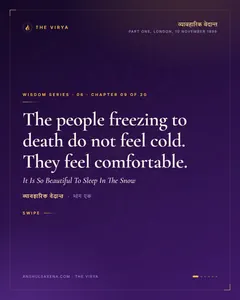
It Is So Beautiful To Sleep In The Snow

The people freezing to death do not feel cold. They feel comfortable

It Is So Beautiful To Sleep In The Snow, card 1 of 6
It Is So Beautiful To Sleep In The Snow, card 2 of 6
It Is So Beautiful To Sleep In The Snow, card 3 of 6
It Is So Beautiful To Sleep In The Snow, card 4 of 6
It Is So Beautiful To Sleep In The Snow, card 5 of 6
It Is So Beautiful To Sleep In The Snow, card 6 of 6
Read as text

व्यावहारिक वेदान्त · भाग एक, "It Is So Beautiful To Sleep In The Snow"

I think of mankind just as I read of persons who become frozen in snow; all such, they say, want to go to sleep, and if you try to drag them up, they say, "Let me sleep; it is so beautiful to sleep in the snow", and they die there in that sleep.

The final stage of decline presents itself as comfort and resists rescue.

The image identifies a state in which your own comfort is the least reliable available signal, and the person trying to help you will be experienced as the problem.

How the text gets there:
1. Freezing produces a sensation of warmth and a desire to sleep.
2. The person closest to death therefore feels best.
3. Rescue is experienced as an intrusion and actively resisted.
4. So comfort is the symptom rather than evidence about the situation, and self-report cannot detect it.

Today: Applies to any slow decline that feels fine from inside: the role you have outgrown, the routine that stopped producing anything. The signal to watch is not discomfort. It is the strength of your objection when someone suggests moving.

What are you defending most strongly against being disturbed? Tell me below.

Practical Vedanta

The Amoeba And I

Climb high enough and the grass and the great tree look the same height

The Amoeba And I, card 1 of 6
The Amoeba And I, card 2 of 6
The Amoeba And I, card 3 of 6
The Amoeba And I, card 4 of 6
The Amoeba And I, card 5 of 6
The Amoeba And I, card 6 of 6
Read as text

व्यावहारिक वेदान्त · भाग एक, "The Amoeba And I"

The amoeba and I are the same, the difference is only in degree; and from the standpoint of the highest life, all these differences vanish. A man may see a great deal of difference between grass and a little tree, but if you mount very high, the grass and the biggest tree will appear much the same.

Distinctions between forms of life are differences of degree along one continuum, not differences of kind.

The image lets both readings be true at once. The distinction is real at the scale you live at and vanishes at another, which is a different claim from saying it was never there.

How the text gets there:
1. Two things are compared that differ obviously at close range.
2. From sufficient altitude the same difference becomes imperceptible.
3. Neither vantage point is declared mistaken.
4. So the difference is one of degree along a continuum, which is what allows it to disappear with scale.

Today: The same structure governs most tribal distinctions people fight over: real at the scale they are experienced, negligible one level up. Noticing which scale you are arguing at settles more disagreements than winning them does.

Which distinction are you defending that disappears from higher up? Tell me below.

Practical Vedanta

The Damaging Truth

A boy admits he does not know who his father was. He is admitted at once

The Damaging Truth, card 1 of 6
The Damaging Truth, card 2 of 6
The Damaging Truth, card 3 of 6
The Damaging Truth, card 4 of 6
The Damaging Truth, card 5 of 6
The Damaging Truth, card 6 of 6
Read as text

व्यावहारिक वेदान्त · भाग दो, "The Damaging Truth"

The sage at once said, "None but a Brahmin could speak such a damaging truth about himself. You are a Brahmin and I will teach you. You have not swerved from truth."

Qualification is established by willingness to state a fact against one's own interest, rather than by lineage.

The test is not the content of the statement but its direction. A fact stated against your own interest carries information that a favorable one cannot.

How the text gets there:
1. The boy seeks a credential he must state in order to be admitted.
2. The honest answer is precisely the one that disqualifies him.
3. He gives it without alteration.
4. The sage treats the willingness to give it as stronger evidence of quality than the credential would have been.

Today: The most informative thing in any interview or reference is the answer that costs the speaker something. Everything favorable is compatible with both honesty and performance. Only the damaging admission separates them.

What true thing about yourself do you leave out because it does not help? Tell me below.

Practical Vedanta

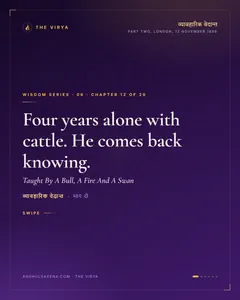
Taught By A Bull, A Fire And A Swan

Four years alone with cattle. He comes back knowing

Taught By A Bull, A Fire And A Swan, card 1 of 6
Taught By A Bull, A Fire And A Swan, card 2 of 6
Taught By A Bull, A Fire And A Swan, card 3 of 6
Taught By A Bull, A Fire And A Swan, card 4 of 6
Taught By A Bull, A Fire And A Swan, card 5 of 6
Taught By A Bull, A Fire And A Swan, card 6 of 6
Read as text

व्यावहारिक वेदान्त · भाग दो, "Taught By A Bull, A Fire And A Swan"

"Satyakama, thy face shines like that of a knower of Brahman! Who then has taught thee?" "Beings other than men," replied Satyakama. "But I wish that you should teach me, sir."

Knowledge arrived through solitary attention, and the student still asked for the teacher's transmission.

The story credits both routes without ranking them out of politeness. What he found alone was real and visible on his face. He still wanted the transmission, and the teacher gave it, leaving nothing out.

How the text gets there:
1. The teacher assigns a task requiring years of solitary attention rather than instruction.
2. Knowledge arrives from the surroundings, in portions, over that period.
3. The teacher recognizes the result before being told anything.
4. The student nonetheless requests formal transmission, and receives the same knowledge in full.

Today: The years of unsupervised work and the good teacher are not substitutes. People who have only the first often cannot place what they know; people who have only the second often have not tested it. The story declines to choose.

What have you learned alone that you have never had checked? Tell me below.

Practical Vedanta

The Honey Does Not Remember The Flowers

Once it is honey, nothing in it knows which tree it came from

The Honey Does Not Remember The Flowers, card 1 of 6
The Honey Does Not Remember The Flowers, card 2 of 6
The Honey Does Not Remember The Flowers, card 3 of 6
The Honey Does Not Remember The Flowers, card 4 of 6
The Honey Does Not Remember The Flowers, card 5 of 6
The Honey Does Not Remember The Flowers, card 6 of 6
Read as text

व्यावहारिक वेदान्त · भाग तीन, "The Honey Does Not Remember The Flowers"

"As a bee, O Shvetaketu, gathers honey from different flowers, and as the different honeys do not know that they are from various trees, and from various flowers, so all of us, having come to that Existence, know not that we have done so."

Distinct origins merge into something in which the distinctions are no longer recoverable, and the merged state does not remember them.

The forgetting is presented as intrinsic rather than as a failure. Complete merging means the parts cannot be identified from inside, which is why the fact has to be told to you.

How the text gets there:
1. Nectar from many distinct sources becomes one substance.
2. The resulting honey retains no record of which flower supplied which portion.
3. The companion image reverses direction with the rivers and the ocean.
4. In both directions the identifying information is lost, which explains why the identity must be taught rather than remembered.

Today: The same holds for anything genuinely synthesised. A view you have properly absorbed no longer carries labels for where each part came from, which is why real understanding is so hard to cite and so easy to mistake for your own invention.

Which of your convictions can you no longer trace to a source? Tell me below.

Practical Vedanta

Why One Apple Is Not Enough

One apple falling is unsatisfying. All apples falling is a law

Why One Apple Is Not Enough, card 1 of 6
Why One Apple Is Not Enough, card 2 of 6
Why One Apple Is Not Enough, card 3 of 6
Why One Apple Is Not Enough, card 4 of 6
Why One Apple Is Not Enough, card 5 of 6
Why One Apple Is Not Enough, card 6 of 6
Read as text

व्यावहारिक वेदान्त · भाग तीन, "Why One Apple Is Not Enough"

When we find that one apple falls, we are dissatisfied; but when we find that all apples fall, we call it the law of gravitation and are satisfied. The fact is that from the particular we deduce the general.

Knowledge proceeds by referring the particular to the general and the general to the universal, and the sense of understanding arrives with the generalisation.

The feeling of having understood tracks generalisation rather than truth. A single accurate observation is unsatisfying and a broad rule feels like knowledge, which is a reliable process and an exploitable one.

How the text gets there:
1. Knowledge is described as classification proceeding from particular to general.
2. A single instance produces dissatisfaction even when it is fully accurate.
3. The same fact stated generally produces the sense of understanding.
4. So satisfaction tracks the level of generality rather than the strength of the evidence.

Today: This is why a confident generalisation outperforms an accurate specific in almost every meeting. The audience is not being careless; they are running the process described here. Knowing that is useful both for explaining things and for noticing when you have been persuaded by scope rather than by evidence.

What have you accepted because it was stated broadly enough to feel true? Tell me below.

Practical Vedanta

Higher Than Ether

The ladder goes up past earth, past light, past space. Then one step more

Higher Than Ether, card 1 of 6
Higher Than Ether, card 2 of 6
Higher Than Ether, card 3 of 6
Higher Than Ether, card 4 of 6
Higher Than Ether, card 5 of 6
Higher Than Ether, card 6 of 6
Read as text

व्यावहारिक वेदान्त · भाग तीन, "Higher Than Ether"

Ether is higher than light, because in the ether are the sun and the moon, lightning and the stars; in ether we live, and in ether we die. Then the question arises, if there is anything higher than that, and Sanatkumara tells him of Prana. ... Prana is in the mother, in the father, in the sister, in the teacher, Prana is the knower.

The ascending series of higher realities does not stop at space but passes to prana, the principle of life and of knowing.

The interesting move is asking the question one time past the point where the answer seemed complete. Ether contains everything, which is exactly why it looked like the end of the series.

How the text gets there:
1. The teaching proceeds by a series in which each level is surpassed by the next.
2. Ether is reached, which contains all observable things.
3. Containing everything makes it appear to be the final term.
4. The question is nonetheless asked again, and the answer shifts from what contains to what animates.

Today: The habit is transferable. When an explanation feels complete because it accounts for everything you can see, that is the point at which the next question is most likely to be productive and least likely to be asked.

Which of your explanations feels complete because it covers everything you looked at? Tell me below.

Practical Vedanta

Would This Whole Earth Make Me Immortal?

He offers her everything he owns. She asks one question about it

Would This Whole Earth Make Me Immortal?, card 1 of 6
Would This Whole Earth Make Me Immortal?, card 2 of 6
Would This Whole Earth Make Me Immortal?, card 3 of 6
Would This Whole Earth Make Me Immortal?, card 4 of 6
Would This Whole Earth Make Me Immortal?, card 5 of 6
Would This Whole Earth Make Me Immortal?, card 6 of 6
Read as text

व्यावहारिक वेदान्त · याज्ञवल्क्य और मैत्रेयी, "Would This Whole Earth Make Me Immortal?"

"Sir, if I had this whole earth full of wealth, would that give me immortality?" Yajnavalkya said, "No, it will not. You will be rich, and that will be all, but wealth cannot give us immortality."

Maximum wealth is tested against the thing actually wanted and found to be a different category of good.

By testing the maximum she settles the whole class in one question. If the entire earth's wealth does not produce it, no amount does, and the matter is closed rather than deferred.

How the text gets there:
1. An offer of wealth is made and neither accepted nor refused.
2. The question raises the offer to its theoretical maximum before evaluating it.
3. That removes insufficiency as an explanation for any shortfall.
4. The answer is negative at the maximum, which settles every lower quantity at the same time.

Today: Run the ceiling test on whatever you are currently accumulating. Not the next increment but all of it: if you had the whole earth's worth, would the thing you actually want be produced. It is a fast question and it does not need to be asked twice.

If you had all of it, would you have what you want? Tell me below.

Practical Vedanta

Why You Love Anything At All

Not for the wife's sake. Not for the children's sake. Not for the wealth

Why You Love Anything At All, card 1 of 6
Why You Love Anything At All, card 2 of 6
Why You Love Anything At All, card 3 of 6
Why You Love Anything At All, card 4 of 6
Why You Love Anything At All, card 5 of 6
Why You Love Anything At All, card 6 of 6
Read as text

व्यावहारिक वेदान्त · याज्ञवल्क्य और मैत्रेयी, "Why You Love Anything At All"

"It is not for the sake of the husband that the wife loves the husband, but for the sake of the Atman that she loves the husband, because she loves the Self. None loves the children for the children; but because one loves the Self, therefore one loves the children."

Every particular love is traced to one underlying love of the Self, which is what is actually being reached for in each case.

The claim reads as deflating and is not, because the Self being loved is not the private ego. Every particular affection is a real contact with the one thing, which makes the loves genuine rather than illusory.

How the text gets there:
1. A single explanatory clause is applied to one relationship.
2. It is then repeated across every category of attachment without exception.
3. Universality rules out the possibility that it is a claim about one relationship type.
4. What follows is a practical instruction, since the thing actually being sought can be approached directly.

Today: The usable version does not require the metaphysics. What you love in the people closest to you is not fully explained by their properties, which is why the affection survives their properties changing. Whatever it is contacting, it is not the résumé.

If they changed completely, would you still love them, and what would you be loving? Tell me below.

Practical Vedanta

Anger Is Not Output

The man who becomes angry never does a great amount of work

Anger Is Not Output, card 1 of 6
Anger Is Not Output, card 2 of 6
Anger Is Not Output, card 3 of 6
Anger Is Not Output, card 4 of 6
Anger Is Not Output, card 5 of 6
Anger Is Not Output, card 6 of 6
Read as text

व्यावहारिक वेदान्त · भाग एक, "Anger Is Not Output"

That is why the man who becomes angry never does a great amount of work, and the man whom nothing can make angry accomplishes so much. ... he only breaks himself to pieces, and does nothing practical.

Anger is presented as an alternative use of energy rather than as a driver of action, so it correlates with reduced output.

Anger presents itself as urgency and is spending the same budget that urgency would need. That is why the angriest person in a project is so rarely the one carrying it.

How the text gets there:
1. Anger is placed in the same energy budget as work.
2. Energy discharged as anger is therefore unavailable for output.
3. The predicted profile of the high producer is calm rather than intense.
4. The claim is offered as an observable regularity, so it can be checked against actual work.

Today: Check it against your own record. The projects that moved were probably not the ones you felt most strongly about, and the meetings where you were most forceful probably changed the least. The correlation is uncomfortable and it is easy to verify.

What did your last burst of anger produce? Tell me below.

Practical Vedanta

Do Not Listen To The One Who Lowers It

Beware of anyone who arrives to explain why your conduct is fine

Do Not Listen To The One Who Lowers It, card 1 of 6
Do Not Listen To The One Who Lowers It, card 2 of 6
Do Not Listen To The One Who Lowers It, card 3 of 6
Do Not Listen To The One Who Lowers It, card 4 of 6
Do Not Listen To The One Who Lowers It, card 5 of 6
Do Not Listen To The One Who Lowers It, card 6 of 6
Read as text

व्यावहारिक वेदान्त · भाग एक, "Do Not Listen To The One Who Lowers It"

Therefore you must struggle towards the ideal, and if a man comes who wants to bring that ideal down to your level, and teach a religion that does not carry that highest ideal, do not listen to him. ... Beware when anyone is trying to apologize for sense vanities and sense weaknesses.

A teaching that accommodates your existing conduct should be treated with suspicion precisely because it is comfortable.

The signal proposed is your own agreement. A teaching that requires nothing of you will feel more reasonable than one that does, and that feeling is what is being flagged rather than trusted.

How the text gets there:
1. Many competing teachings are observed over time.
2. Those that accommodate existing conduct are found to decay.
3. Those that refuse the reconciliation are found to make progress.
4. Since the accommodating version is always the more attractive, agreeableness becomes a warning sign rather than evidence.

Today: Applies well beyond religion. The framework that arrives explaining why what you already do is correct is the one to examine hardest, and it will be the one you are least inclined to examine at all.

Which idea did you adopt because it required nothing of you? Tell me below.

Practical Vedanta

Realized Already

Not something to reach. Something to stop denying

Realized Already, card 1 of 6
Realized Already, card 2 of 6
Realized Already, card 3 of 6
Realized Already, card 4 of 6
Realized Already, card 5 of 6
Realized Already, card 6 of 6
Read as text

व्यावहारिक वेदान्त · भाग एक, "Realized Already"

The Vedanta insists that it can be realized by every one. There is neither man nor woman or child, nor difference of race or sex, nor anything that stands as a bar to the realization of the ideal, because Vedanta shows that it is realized already, it is already there.

The goal is not attained but recognized, which is why no personal characteriztic can disqualify anyone from it.

The equality here is a consequence rather than a principle. It follows from the goal being recognition rather than achievement, since achievement admits of degrees and recognition of a present fact does not.

How the text gets there:
1. The ideal is described as already realized rather than as pending.
2. An already existing state cannot be competed for or approached at different rates.
3. Differences in capacity therefore have nothing to attach to.
4. The stated universality follows from the structure of the claim rather than being added to it.

Today: Changes what a bad day means. If you were accumulating something, a lapse is a loss and the account goes down. If the thing was never being built, the lapse is a period of not noticing, and nothing was destroyed while you were not looking.

Are you building something, or failing to notice something? Tell me below.