
10 posts · 60 cards

Bhavishya Purana भविष्य पुराण

Ten stories from the Purana named for the future.

Bhavishya Purana

A Purana Named for the Future

Named for the future. Obsessed with conduct

A Purana Named for the Future, card 1 of 6
A Purana Named for the Future, card 2 of 6
A Purana Named for the Future, card 3 of 6
A Purana Named for the Future, card 4 of 6
A Purana Named for the Future, card 5 of 6
A Purana Named for the Future, card 6 of 6
Read as text

भविष्य पुराण · ब्राह्मपर्व, अध्याय 1, "A Purana Named for the Future"

इदं स्वस्त्ययनं श्रेष्ठमिदं बुद्धिविवर्धनम्।
इदं यशस्यं सततमिदं निःश्रेयसं परम्॥
idaṃ svastyayanaṃ śreṣṭham idaṃ buddhivivardhanam | idaṃ yaśasyaṃ satatam idaṃ niḥśreyasaṃ param ||

The book's own gloss: this Purana is supremely auspicious and brings welfare, it enlarges good understanding, it steadily confers fame and reputation, and it leads to the highest state, liberation.

A tradition that calls itself a book of the future spends its opening breath on conduct, not prediction. Knowing what is coming is worthless in a person who has not learned how to behave. The text is blunt: without achara, even the Veda yields nothing. Character is not the reward of learning; it is the vessel learning is poured into.

How the text gets there:
1. A king who has heard every great book still asks for one more
2. Sumantu answers by naming the Purana's size, its five parvas, its double lineage
3. Then he stops and says the first dharma is conduct, not knowledge
4. Because an unfit vessel spoils whatever is poured in, even the Veda

Today: Before you chase the next framework, course or forecast, ask what your behavior is actually able to hold. Information poured into an unreliable character leaks. The Purana's test is simple and unflattering: has anything you learned this year changed how you treat people who cannot help you?

What have you learned that has not changed your conduct?, tell me below.

Read the whole series, six Puranas, sixty chapters.

Bhavishya Purana

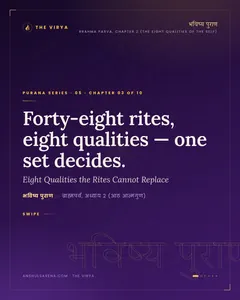
Eight Qualities the Rites Cannot Replace

Forty-eight rites, eight qualities, one set decides

Eight Qualities the Rites Cannot Replace, card 1 of 6
Eight Qualities the Rites Cannot Replace, card 2 of 6
Eight Qualities the Rites Cannot Replace, card 3 of 6
Eight Qualities the Rites Cannot Replace, card 4 of 6
Eight Qualities the Rites Cannot Replace, card 5 of 6
Eight Qualities the Rites Cannot Replace, card 6 of 6
Read as text

भविष्य पुराण · ब्राह्मपर्व, अध्याय 2 (आठ आत्मगुण), "Eight Qualities the Rites Cannot Replace"

अनसूया दया क्षान्तिरनायासश्च मङ्गलम्।
अकार्पण्यं तथा शौचमस्पृहा च कुरूद्वह॥
anasūyā dayā kṣāntir anāyāsaś ca maṅgalam | akārpaṇyaṃ tathā śaucam aspṛhā ca kurūdvaha ||

The book glosses these as the eight qualities of the self: not looking for faults in another's virtues; compassion; forbearance; not staking everything on some trivial matter; holding to auspicious things; not making oneself pitiable in speech; purity outer and inner; and freedom from craving.

The chapter does not attack ritual; it lists ritual exhaustively first. Then it says the machinery is inert without eight interior dispositions, most of them stated negatively, not envying, not dramatising, not begging, not craving. Formation is as much what you have stopped doing as what you have learned to perform.

How the text gets there:
1. The king asks for a shortcut and receives a full inventory of rites
2. Sumantu names forty-eight samskaras from conception to the great soma sacrifices
3. Then he adds eight qualities and glosses each in plain, ordinary terms
4. The eight are conditions, not extras: without them the rites yield nothing

Today: Audit your practice the way this chapter does. First list what you actually perform, routines, streaks, credentials. Then test the eight: did you hunt for someone's flaw today, dramatise a small setback, or make yourself sound pitiable so you would be excused something?

Which of the eight did you fail at before lunch?, tell me below.

Read the whole series, six Puranas, sixty chapters.

Bhavishya Purana

Five Grounds of Respect, Ranked

Wealth, kin, age, deeds, knowledge, in that order

Five Grounds of Respect, Ranked, card 1 of 6
Five Grounds of Respect, Ranked, card 2 of 6
Five Grounds of Respect, Ranked, card 3 of 6
Five Grounds of Respect, Ranked, card 4 of 6
Five Grounds of Respect, Ranked, card 5 of 6
Five Grounds of Respect, Ranked, card 6 of 6
Read as text

भविष्य पुराण · ब्राह्मपर्व, अध्याय 4, "Five Grounds of Respect, Ranked"

वित्तं बन्धुर्वयः कर्म विद्या भवति पञ्चमी।
एतानि मान्यस्थानानि गरीयो यद्यदुत्तरम्॥
vittaṃ bandhur vayaḥ karma vidyā bhavati pañcamī | etāni mānyasthānāni garīyo yad yad uttaram ||

The commentary on the page: wealth, kinship, age, deeds and learning are the five grounds on which a person is honored, and each later one weighs more than the one before it, so learning stands highest of all.

Respect here is not a mood but a structure with an order inside it. Money buys the least of it; learning the most. And the chapter refuses passive presence at contempt, if a room is dismantling someone who taught you, either close your ears or walk out. Staying quietly is counted as taking part.

How the text gets there:
1. Begin with the Veda: sound, breath and Gayatri, all learned only from a person
2. If knowledge arrives through people, then how you treat people becomes technical
3. So rank the grounds of honor, placing learning above money, kin and age
4. Then forbid the cheapest betrayal: standing silent where a teacher is slandered

Today: Notice who actually gets deference in your rooms. Usually it is wealth, which this chapter ranks last of five. Then notice what you do when a former mentor is being taken apart in a group chat. The instruction is not to defend loudly, it is to leave.

Whose slander did you stay silent through this week?, tell me below.

Read the whole series, six Puranas, sixty chapters.

Bhavishya Purana

Water in Cupped Hands at Sunrise

If you have nothing to offer, offer a bow

Water in Cupped Hands at Sunrise, card 1 of 6
Water in Cupped Hands at Sunrise, card 2 of 6
Water in Cupped Hands at Sunrise, card 3 of 6
Water in Cupped Hands at Sunrise, card 4 of 6
Water in Cupped Hands at Sunrise, card 5 of 6
Water in Cupped Hands at Sunrise, card 6 of 6
Read as text

भविष्य पुराण · ब्राह्मपर्व, अध्याय 143, "Water in Cupped Hands at Sunrise"

एहि सूर्य सहस्रांशो तेजोराशे जगत्पते।
अनुकम्प्य हि मे कृत्वा गृहाणार्घ्यं दिवाकर॥
ehi sūrya sahasrāṃśo tejorāśe jagatpate | anukampya hi me kṛtvā gṛhāṇārghyaṃ divākara ||

The invocation printed for the offering of arghya: Come, Sun of a thousand rays, mass of light, lord of the world; show compassion to me and accept this water, O maker of the day. (The page prints this mantra without a Hindi gloss of its own.)

An elaborate ritual page ends by dismantling its own requirements. Every material turns out to be optional; the attention is not. What the chapter is protecting is continuity, the person with nothing must still be able to do the thing this morning, rather than postponing until they can afford to do it properly.

How the text gets there:
1. First specify the full rite precisely, so nothing is left to guesswork
2. Then admit that most people, on most mornings, will lack the materials
3. So define substitutes in descending order: leaves, incense, plain water, a bow
4. End at mental worship, which no poverty or circumstance can take away

Today: This is the anti-perfectionist rule for any daily practice. Define the full version, then the one-minute version, then the version you can do lying down at midnight. The tradition would rather you keep the smallest form daily than perform the complete form occasionally.

What is the smallest honest version of your daily practice?, tell me below.

Read the whole series, six Puranas, sixty chapters.

Bhavishya Purana

When You Break a Vow You Made

The text plans for the day you fail

When You Break a Vow You Made, card 1 of 6
When You Break a Vow You Made, card 2 of 6
When You Break a Vow You Made, card 3 of 6
When You Break a Vow You Made, card 4 of 6
When You Break a Vow You Made, card 5 of 6
When You Break a Vow You Made, card 6 of 6
Read as text

भविष्य पुराण · उत्तरपर्व, अध्याय 110, "When You Break a Vow You Made"

उपसन्नस्य दीनस्य प्रायश्चित्तकृतापदः।
शरणं च प्रपन्नस्य कुरुष्वात्र दयां प्रभो॥
upasannasya dīnasya prāyaścittakṛtāpadaḥ | śaraṇaṃ ca prapannasya kuruṣvātra dayāṃ prabho ||

The book's own paraphrase: Lord, I have come near you, humbled, undertaking expiation for my lapse, and I have taken refuge, show mercy here. Whatever fault or offense has entered the vows and austerities I performed, let it be removed by your grace, and let my vow be made whole.

A tradition built entirely on vows takes it for granted that vows break. It answers not with shame but with procedure: name the lapse, perform a defined act, ask for the gap to be closed, continue. The vow is not destroyed by failing it. It is destroyed by abandoning it after you fail.

How the text gets there:
1. Yudhishthira asks about failure, not success, the question manuals usually avoid
2. Krishna lists the ordinary causes: illness, intoxication, delusion, or simple carelessness
3. He prescribes an act rather than a feeling: image, bath, worship, arghya, prayer
4. The prayer asks that the hole in the vow be filled, not that it be forgotten

Today: Every streak breaks. The useful question is what happens on day two of the break. This chapter builds a re-entry ritual, small, definite, ending in a sentence you say out loud, so the lapse gets closed the same week instead of quietly ending the practice.

What did you quit because breaking it once felt final?, tell me below.

Read the whole series, six Puranas, sixty chapters.

Bhavishya Purana

Pippalada, Saturn, and the Abandoned Child's Rage

Abandoned as a child. He came back for Saturn

Pippalada, Saturn, and the Abandoned Child's Rage, card 1 of 6
Pippalada, Saturn, and the Abandoned Child's Rage, card 2 of 6
Pippalada, Saturn, and the Abandoned Child's Rage, card 3 of 6
Pippalada, Saturn, and the Abandoned Child's Rage, card 4 of 6
Pippalada, Saturn, and the Abandoned Child's Rage, card 5 of 6
Pippalada, Saturn, and the Abandoned Child's Rage, card 6 of 6
Read as text

भविष्य पुराण · उत्तरपर्व, अध्याय 114, "Pippalada, Saturn, and the Abandoned Child's Rage"

क्रोडं नीलाञ्जनप्रख्यं नीलवर्णसमप्रभम्।
छायामार्तण्डसम्भूतं नमस्यामि शनैश्चरम्॥
kroḍaṃ nīlāñjanaprakhyaṃ nīlavarṇasamaprabham | chāyāmārtaṇḍasambhūtaṃ namasyāmi śanaiścaram ||

From the stuti the chapter prescribes: dark as black collyrium, shining with a blue-black lustre, born of Chhaya and the Sun, I bow to Shanaishchara. (The page prints the stuti without a line-by-line Hindi gloss.)

The chapter validates the boy's rage completely, it even lets him win, and then refuses to leave him there. Brahma's argument is not that the injury was imaginary, but that the agent was not malicious. Naming the cause of your suffering is justice. Destroying it is not. The reward for stopping is a name of his own.

How the text gets there:
1. A child is abandoned, and the text does not soften or excuse the parents
2. He is given a mantra, and austerity turns his helplessness into real power
3. He learns what caused his suffering and immediately turns that power on it
4. Brahma concedes the harm, denies the malice, and asks him to relent

Today: When you finally become strong enough to confront whatever hurt you, you get roughly one clean shot. This chapter says spend it naming the thing, not breaking it. The difference between those two is whether, ten years on, you have an identity or only a grievance.

Are you seeking an explanation, or a target?, tell me below.

Read the whole series, six Puranas, sixty chapters.

Bhavishya Purana

The Merchant Who Forgot What He Promised

He got everything he asked for. Then forgot

The Merchant Who Forgot What He Promised, card 1 of 6
The Merchant Who Forgot What He Promised, card 2 of 6
The Merchant Who Forgot What He Promised, card 3 of 6
The Merchant Who Forgot What He Promised, card 4 of 6
The Merchant Who Forgot What He Promised, card 5 of 6
The Merchant Who Forgot What He Promised, card 6 of 6
Read as text

भविष्य पुराण · प्रतिसर्गपर्व, द्वितीय खण्ड, अध्याय 28-29, "The Merchant Who Forgot What He Promised"

सत्यरूपं सत्यसंधं सत्यनारायणं हरिम्।
यत्सत्यत्वेन जगतस्ते सत्यं त्वां नमाम्यहम्॥
satyarūpaṃ satyasandhaṃ satyanārāyaṇaṃ harim | yat satyatvena jagataste satyaṃ tvāṃ namāmy aham ||

The book's gloss: salutation to Hari, Satyanarayana, whose very form is truth and whose word is true; by whose truth the world stands established, to you, truth itself, I bow again and again.

The engine of this story is not disbelief but deferral. The merchant never denies his vow; he simply always has a better time in mind for it. What ruins him is the habit of treating his own word as provisional, which then shows up as a casual lie about cargo, and costs him the cargo.

How the text gets there:
1. A vow is made under pressure, while the outcome is still not secured
2. The outcome arrives, and the reason to keep the promise quietly evaporates
3. The text sends no immediate disaster; it lets the habit set in first
4. Then the same looseness with words reappears as a lie, and takes everything

Today: Track what you promised while you were desperate, to yourself, a partner, a team, and what you actually did once the pressure lifted. Deferral is not neutral; it trains you. The lie that eventually costs you something will sound exactly like the promise you kept postponing.

What did you promise while afraid, then quietly postpone?, tell me below.

Read the whole series, six Puranas, sixty chapters.

Bhavishya Purana

Where Sorrow Hides in Every Stage of Life

Youth, wealth, kingship, pain hides in each

Where Sorrow Hides in Every Stage of Life, card 1 of 6
Where Sorrow Hides in Every Stage of Life, card 2 of 6
Where Sorrow Hides in Every Stage of Life, card 3 of 6
Where Sorrow Hides in Every Stage of Life, card 4 of 6
Where Sorrow Hides in Every Stage of Life, card 5 of 6
Where Sorrow Hides in Every Stage of Life, card 6 of 6
Read as text

भविष्य पुराण · उत्तरपर्व, अध्याय 4, "Where Sorrow Hides in Every Stage of Life"

आये दुःखं व्यये दुःखं धिगर्थं कष्टसंश्रयम्॥
āye duḥkhaṃ vyaye duḥkhaṃ dhig arthaṃ kaṣṭasaṃśrayam ||

The commentary on the page: there is pain in earning wealth, pain in guarding what has been earned, pain when it comes in and pain when it goes out, a curse on wealth, which is a shelter built out of trouble.

This is not pessimism for its own sake. The chapter itemises suffering so precisely, the foetus's forgotten resolve, the child who cannot name its want, the old man's contemptuous relatives, that no stage is left standing as the one where life finally becomes safe. Once that fantasy is gone, practice can start.

How the text gets there:
1. Ask why beings suffer unequally, and the answer must survey every stage
2. So walk the whole life in order: womb, childhood, youth, old age, death
3. Show that each stage's promised relief is exactly where the next pain lives
4. Remove every waiting-room, then name what actually steadies a person

Today: Most plans are secretly a waiting room: after the raise, after the move, after the kids are older. This chapter shuts each door deliberately, not to depress you, but to move your effort from arranging conditions to building the self-control that holds under any of them.

Which future condition are you waiting to be happy after?, tell me below.

Read the whole series, six Puranas, sixty chapters.

Bhavishya Purana

The Snake, the Merchant, and Real Goodness

Kind to those who help you? That is not goodness

The Snake, the Merchant, and Real Goodness, card 1 of 6
The Snake, the Merchant, and Real Goodness, card 2 of 6
The Snake, the Merchant, and Real Goodness, card 3 of 6
The Snake, the Merchant, and Real Goodness, card 4 of 6
The Snake, the Merchant, and Real Goodness, card 5 of 6
The Snake, the Merchant, and Real Goodness, card 6 of 6
Read as text

भविष्य पुराण · उत्तरपर्व, अध्याय 169, "The Snake, the Merchant, and Real Goodness"

उपकारिषु यः साधुः साधुत्वे तस्य को गुणः।
अपकारिषु यः साधुः स साधुः सद्भिरुच्यते॥
upakāriṣu yaḥ sādhuḥ sādhutve tasya ko guṇaḥ | apakāriṣu yaḥ sādhuḥ sa sādhuḥ sadbhir ucyate ||

The gloss on the page: goodness shown to those who do you good carries no special merit and is not worth praising; it is goodness shown towards those who have harmed you that the wise actually call goodness.

The merchant's second feast is the whole teaching. He was not obliged to give it, the snake had just tried to kill his son, and the outcome of the moment was entirely in his favor. He counts his own share in the harm as real and spends everything to reverse a result that suited him. That is what the text calls goodness.

How the text gets there:
1. Kindness is easy while the snake is guarding your house and your wealth
2. The test arrives when the thing you raised turns and threatens your child
3. You win, the blessing kills it, and the account is entirely settled in your favor
4. Then you ask whether it died through your fault, and pay to undo it

Today: You will be right in a conflict at some point, and the other person will lose badly. That is the exact hour this chapter is written for. Being decent to allies proves nothing. What you do for someone after you have already beaten them is the only honest evidence.

Who have you defeated, and what did you do next?, tell me below.

Read the whole series, six Puranas, sixty chapters.

More from Puranas

All 40 collections of भारतीय