10 posts · 60 cards

Vamana Purana वामन पुराण

Ten stories, from the god who was not invited to the ten limbs of dharma.

Vamana Purana

Daksha's Sacrifice and the Uninvited God

The greatest god was left off the guest list

Daksha's Sacrifice and the Uninvited God, card 1 of 6
Daksha's Sacrifice and the Uninvited God, card 2 of 6
Daksha's Sacrifice and the Uninvited God, card 3 of 6
Daksha's Sacrifice and the Uninvited God, card 4 of 6
Daksha's Sacrifice and the Uninvited God, card 5 of 6
Daksha's Sacrifice and the Uninvited God, card 6 of 6
Read as text

वामन पुराण · अध्याय 2, "Daksha's Sacrifice and the Uninvited God"

ज्येष्ठ: श्रेष्ठो वरिष्ठोऽपि आद्योऽपि भगवाञ्छिव:।
कपालीति विदित्वेशो दक्षेण न निमन्त्रित:॥
jyeṣṭhaḥ śreṣṭho variṣṭho'pi ādyo'pi bhagavāñchivaḥ / kapālīti viditveśo dakṣeṇa na nimantritaḥ

Though Shiva is the eldest, the best, the highest and the first of all, Daksha did not invite him to the sacrifice, because he knew him as Kapali, the skull-bearer.

Reverence tracks appearance, not reality. Daksha could recite Shiva's titles, eldest, best, highest, first, and still leave him out, because the skull in his hand offended the ceremony. The warning is precise: a sacrifice that excludes what it finds unpresentable is already broken, and the wound it opens will not stay outside the ritual ground.

How the text gets there:
1. Daksha lists every luminary for his sacrifice, then deliberately omits the greatest one.
2. The stated reason is not unworthiness but a title: Kapali, the skull-bearer.
3. That skull came from Shiva's own past act, still carried, still visible to all.
4. So exclusion rests on a visible mark, and the sacrifice is spoiled at its root.

Today: Every group has a guest list. Watch what actually decides it, competence, or presentability. The person carrying visible damage is the one quietly left off invitations, threads and decisions. Daksha's ritual collapsed not because Shiva attacked it, but because it was built on that omission.

Who do you keep off the list because of how they look?, tell me below.

Read the whole series, six Puranas, sixty chapters.

Vamana Purana

The Ten Limbs of Dharma

Dharma has ten limbs. Anyone may use them

The Ten Limbs of Dharma, card 1 of 6
The Ten Limbs of Dharma, card 2 of 6
The Ten Limbs of Dharma, card 3 of 6
The Ten Limbs of Dharma, card 4 of 6
The Ten Limbs of Dharma, card 5 of 6
The Ten Limbs of Dharma, card 6 of 6
Read as text

वामन पुराण · अध्याय 14, "The Ten Limbs of Dharma"

अहिंसा सत्यमस्तेयं दानं क्षान्तिर्दम: शम:।
अकार्पण्यं च शौचं च तपश्च रजनीचर॥
ahiṃsā satyam asteyaṃ dānaṃ kṣāntir damaḥ śamaḥ / akārpaṇyaṃ ca śaucaṃ ca tapaśca rajanīcara

Non-violence, truth, not stealing, giving, forbearance, restraint of the senses, calm of mind, freedom from meanness, purity and austerity, the commentary states that these ten limbs of dharma are taught for people of every varna alike.

Dharma is defined here before any ritual and before any question of birth: ten portable capacities a person carries in their own body. The text is emphatic that the list is for everyone. What follows, the ashramas, the elaborate daily code, is scaffolding built on those ten, never a substitute for them.

How the text gets there:
1. A rakshasa king asks the sages plainly: tell me what dharma actually is.
2. They answer with ten qualities, not with rites, birth, or authority.
3. They add that these ten hold for every varna alike, without exception.
4. Only afterwards do ashrama rules and daily conduct get built on that base.

Today: Before asking whether your work is ethical, run the ten: are you harming, lying, taking, withholding, retaliating, indulging, agitated, mean, careless, soft? Most of the list is things to stop doing. That is the point, most of dharma here is subtraction, and it needs no institution's permission.

Which of the ten do you fail most reliably?, tell me below.

Read the whole series, six Puranas, sixty chapters.

Vamana Purana

The Hells and the One Unpardonable Sin

Some sins can be washed off. One cannot

The Hells and the One Unpardonable Sin, card 1 of 6
The Hells and the One Unpardonable Sin, card 2 of 6
The Hells and the One Unpardonable Sin, card 3 of 6
The Hells and the One Unpardonable Sin, card 4 of 6
The Hells and the One Unpardonable Sin, card 5 of 6
The Hells and the One Unpardonable Sin, card 6 of 6
Read as text

वामन पुराण · अध्याय 12, "The Hells and the One Unpardonable Sin"

पापीयसां तद्वदिह कृतघ्न: सर्वेषु पापेषु निशाचरेन्द्र।
pāpīyasāṃ tadvad iha kṛtaghnaḥ sarveṣu pāpeṣu niśācarendra

Just so, O lord of the night-wanderers, among all sinners the ungrateful man is the foremost sinner of all. The commentary adds that brahmahatya and cow-killing do have expiation, but the ingrate who destroys what a friend has done finds no release even in crores of years.

The Purana grades sin by repairability. Killing, theft, even brahmahatya have prescribed expiations, the system keeps a door open. Ingratitude has none, because it destroys the very thing that makes repair possible: the fact that someone once chose to act for you. Betray that, and there is nothing left to appeal to.

How the text gets there:
1. The chapter cataloges hells by deed, matching each punishment to a specific act.
2. Most listed sins have named expiations; wrongdoing is assumed to be repairable.
3. The closing verse ranks the ingrate above all of these, alongside the worst hell.
4. The reason given: what a friend did for you can be neither undone nor repaid.

Today: Think of the manager who covered for you, the friend who lent money in a bad year, the colleague whose work carried your promotion. Ingratitude is not rudeness; it is erasing the record of someone's help. This text rates it above violence, because violence at least admits that something happened.

Whose help have you quietly written out of your story?, tell me below.

Read the whole series, six Puranas, sixty chapters.

Vamana Purana

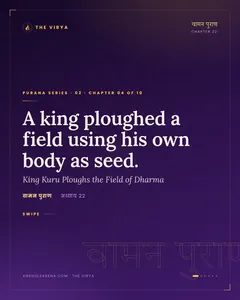
King Kuru Plows the Field of Dharma

A king plowed a field using his own body as seed

King Kuru Plows the Field of Dharma, card 1 of 6
King Kuru Plows the Field of Dharma, card 2 of 6
King Kuru Plows the Field of Dharma, card 3 of 6
King Kuru Plows the Field of Dharma, card 4 of 6
King Kuru Plows the Field of Dharma, card 5 of 6
King Kuru Plows the Field of Dharma, card 6 of 6
Read as text

वामन पुराण · अध्याय 22, "King Kuru Plows the Field of Dharma"

राजाब्रवीत् सुरवर तप: सत्यं क्षमां दयाम्।
कृषामि शौचं दानं च योगं च ब्रह्मचारिताम्॥
rājābravīt suravara tapaḥ satyaṃ kṣamāṃ dayām / kṛṣāmi śaucaṃ dānaṃ ca yogaṃ ca brahmacāritām

The king said: best of the gods, what I am plowing here is austerity, truth, forbearance, compassion, purity, giving, yoga and celibacy, these eight.

Virtue is not a state you hold; it is a crop, and crops need a field, a season, and something buried. The chapter is blunt about what the seed is. Kuru does not fund the field or bless it, he is dismembered into it. Ground consecrated by anything less would not be ground.

How the text gets there:
1. Kuru wants a lasting name, so he looks for a deed that outlasts a reign.
2. He frames virtue as agriculture: eight qualities are what he is sowing here.
3. Indra presses the obvious question, sowing requires seed, so where is it?
4. Kuru gives his own limbs, making the field itself out of his body.

Today: Anyone can name the values. The question Indra asks is the only real one: what is the seed, what of yours goes into the ground and does not come back? Culture, in a team or a family, is made of what someone paid for it, not what someone announced.

What have you actually buried in the field you claim?, tell me below.

Read the whole series, six Puranas, sixty chapters.

Vamana Purana

Remembering the Field Is Enough

Pure or impure, in any state, just remember it

Remembering the Field Is Enough, card 1 of 6
Remembering the Field Is Enough, card 2 of 6
Remembering the Field Is Enough, card 3 of 6
Remembering the Field Is Enough, card 4 of 6
Remembering the Field Is Enough, card 5 of 6
Remembering the Field Is Enough, card 6 of 6
Read as text

वामन पुराण · अध्याय 33, "Remembering the Field Is Enough"

अपवित्र: पवित्रो वा सर्वावस्थां गतोऽपि वा।
य: स्मरेत् कुरुक्षेत्रं स बाह्याभ्यन्तर: शुचि:॥
apavitraḥ pavitro vā sarvāvasthāṃ gato'pi vā / yaḥ smaret kurukṣetraṃ sa bāhyābhyantaraḥ śuciḥ

Whether a person is impure or pure, or has fallen into any condition whatsoever, if he remembers Kurukshetra he becomes clean outside and inside alike.

The severest condition the text can imagine, impure, fallen into any state at all, is not a disqualification. Access is granted by turning toward the place, not by arriving clean. It is a deliberate reversal: purity is what remembrance produces, not what remembrance requires.

How the text gets there:
1. The chapter first ranks tirtha acts: remembering, seeing, bathing, each with its fruit.
2. Then it drops the requirement of presence, remembrance works from any distance.
3. Then it drops the requirement of purity, any condition whatsoever still qualifies.
4. What remains is direction of attention, which cleans both outside and inside.

Today: You do not have to be in good standing to begin again. Most people postpone returning to a practice, a person or a discipline until they feel clean enough to deserve it. This verse removes the waiting room: the turning toward is itself the first act of cleaning.

What are you postponing until you feel worthy of it?, tell me below.

Read the whole series, six Puranas, sixty chapters.

Vamana Purana

Katyayani, Made of Every God's Light

Every god gave up light. One body took it

Katyayani, Made of Every God's Light, card 1 of 6
Katyayani, Made of Every God's Light, card 2 of 6
Katyayani, Made of Every God's Light, card 3 of 6
Katyayani, Made of Every God's Light, card 4 of 6
Katyayani, Made of Every God's Light, card 5 of 6
Katyayani, Made of Every God's Light, card 6 of 6
Read as text

वामन पुराण · अध्याय 18, "Katyayani, Made of Every God's Light"

महेश्वराद् वक्त्रमथो बभूव नेत्रत्रयं पावकतेजसा च।
याम्येन केशा हरितेजसा च भुजास्तथाष्टादश संप्रजज्ञिरे॥
maheśvarād vaktram atho babhūva netratrayaṃ pāvakatejasā ca / yāmyena keśā haritejasā ca bhujās tathāṣṭādaśa saṃprajajñire

From Maheshvara's energy her face came into being, and her three eyes from the energy of fire; from Yama's energy came her hair, and from Hari's energy her eighteen arms.

The gods do not defeat Mahisha by coalition, strategy or numbers, they have already tried that and lost. What works is subtraction: each surrenders a piece of his own power into a single form he no longer controls. Concentrated power belongs to whoever it is concentrated into, not to its donors.

How the text gets there:
1. The gods lose individually, each stripped of his own office by one asura.
2. Anger at the report produces light, but scattered light had changed nothing before.
3. The light is gathered at one ashram and increased there into a single body.
4. Each donor then arms her, transferring authority rather than retaining a share.

Today: When everyone holds a fragment of the mandate, nothing moves. The fix here is uncomfortable and specific: each party gives up its own strength into one place, then equips it. Distributed authority is not the same as pooled authority, and only the second one wins.

What would you have to give up for something to actually work?, tell me below.

Read the whole series, six Puranas, sixty chapters.

Vamana Purana

Prahlada Learns What War Cannot Win

A thousand divine years of war. No result

Prahlada Learns What War Cannot Win, card 1 of 6
Prahlada Learns What War Cannot Win, card 2 of 6
Prahlada Learns What War Cannot Win, card 3 of 6
Prahlada Learns What War Cannot Win, card 4 of 6
Prahlada Learns What War Cannot Win, card 5 of 6
Prahlada Learns What War Cannot Win, card 6 of 6
Read as text

वामन पुराण · अध्याय 8, "Prahlada Learns What War Cannot Win"

भक्त्या यदि हृषीकेश तोषमेषि जगद्गुरो।
नान्यथा त्वं प्रशक्योऽसि जेतुं सर्वगताव्यय॥
bhaktyā yadi hṛṣīkeśa toṣam eṣi jagadguro / nānyathā tvaṃ praśakyo'si jetuṃ sarvagatāvyaya

O Hrishikesha, teacher of the world, you can be satisfied by devotion alone; O all-pervading and imperishable one, there is no other way at all by which you can be conquered.

Force can measure itself against anything except what it depends on. Prahlada spends a thousand years proving that the strongest possible attack still lands on nothing. What ends the war is not surrender but a change of instrument, the one approach that was never a contest to begin with.

How the text gets there:
1. Prahlada accuses two ascetics of hypocrisy and converts the charge into war.
2. A thousand divine years of maximum force produce no decision whatsoever.
3. Vishnu himself names the reason: he yields to devotion and to nothing else.
4. Prahlada praises instead of fighting, and is answered at once with boons.

Today: Some things do not respond to effort, however sincere: a relationship you are trying to argue into place, a reputation you are trying to force, a peace you are trying to win. The text's advice is not to try harder but to change the register entirely.

Where are you attacking something that only opens to trust?, tell me below.

Read the whole series, six Puranas, sixty chapters.

Vamana Purana

Vamana's Three Steps and Bali's Word

His guru said refuse. He had never said no

Vamana's Three Steps and Bali's Word, card 1 of 6
Vamana's Three Steps and Bali's Word, card 2 of 6
Vamana's Three Steps and Bali's Word, card 3 of 6
Vamana's Three Steps and Bali's Word, card 4 of 6
Vamana's Three Steps and Bali's Word, card 5 of 6
Vamana's Three Steps and Bali's Word, card 6 of 6
Read as text

वामन पुराण · अध्याय 31, "Vamana's Three Steps and Bali's Word"

ब्रह्मन् कथमहं ब्रूयामेनेनापि हि याचित:।
नास्तीति किमु देवस्य संसारस्याघहारिण:॥
brahman katham ahaṃ brūyām enenāpi hi yācitaḥ / nāstīti kimu devasya saṃsārasyāghahāriṇaḥ

Brahman, how can I say 'there is none' when I have been asked by this very one, by the god who carries away the sins of the world?

The center of this chapter is not the cosmic stride but the sentence before it. Bali is told exactly what will happen and gives anyway, because a word kept only when it is cheap was never a word. He loses three worlds and keeps the one thing that was actually his.

How the text gets there:
1. Shukra correctly identifies the dwarf and correctly predicts the total loss.
2. Bali does not dispute the prediction; he disputes that it changes anything.
3. His reason is consistency, having never refused a petitioner, he cannot start now.
4. He even urges a larger gift, then loses everything exactly as warned.

Today: Integrity is only tested when the cost is known in advance and the exit is available and reasonable. Everyone keeps the promises that turn out convenient. The question Bali answers is what you do when a trusted advisor gives you sound reasons to break one.

Would your word survive knowing exactly what it will cost?, tell me below.

Read the whole series, six Puranas, sixty chapters.

Vamana Purana

Mankanaka's Dance and Shiva's Thumb

Sap ran from his wound, so he danced

Mankanaka's Dance and Shiva's Thumb, card 1 of 6
Mankanaka's Dance and Shiva's Thumb, card 2 of 6
Mankanaka's Dance and Shiva's Thumb, card 3 of 6
Mankanaka's Dance and Shiva's Thumb, card 4 of 6
Mankanaka's Dance and Shiva's Thumb, card 5 of 6
Mankanaka's Dance and Shiva's Thumb, card 6 of 6
Read as text

वामन पुराण · अध्याय 38, "Mankanaka's Dance and Shiva's Thumb"

ततो भस्म क्षतात् तस्मान्निर्गतं हिमसन्निभम्।
तद् दृष्ट्वा व्रीडितो विप्र: पादयो: पतितोऽब्रवीत्॥
tato bhasma kṣatāt tasmān nirgataṃ himasannibham / tad dṛṣṭvā vrīḍito vipraḥ pādayoḥ patito'bravīt

Then from that cut there came out ash, white as snow; seeing it, the brahmana was ashamed, fell at his feet and spoke.

Attainment becomes dangerous at the moment it is displayed. The sage's sap was real and his austerity was real; what was false was the assumption that having it made him singular. Shiva does not refute him, he simply produces something greater, without comment, and the dance ends by itself.

How the text gets there:
1. A wound reveals sap, real evidence that austerity has altered his body.
2. He converts private evidence into public display, and the world is dragged along.
3. Shiva neither argues nor forbids; he shows a greater sign without comment.
4. Shame arrives from comparison, not correction, and the dance stops instantly.

Today: The most disruptive person in a room is often genuinely good at something, which is exactly what makes the display hard to challenge. Note how Shiva handles it: no lecture, no ranking, one quiet demonstration. Then note the sage's response, which is the real lesson: he stopped.

What real achievement are you still performing for an audience?, tell me below.

Read the whole series, six Puranas, sixty chapters.

Vamana Purana

The Self Is a River You Can Bathe In

Water washes the body. It cannot reach the rest

The Self Is a River You Can Bathe In, card 1 of 6
The Self Is a River You Can Bathe In, card 2 of 6
The Self Is a River You Can Bathe In, card 3 of 6
The Self Is a River You Can Bathe In, card 4 of 6
The Self Is a River You Can Bathe In, card 5 of 6
The Self Is a River You Can Bathe In, card 6 of 6
Read as text

वामन पुराण · अध्याय 43, "The Self Is a River You Can Bathe In"

आत्मा नदी संयमपुण्यतीर्था सत्योदका शीलसमाधियुक्ता।
तस्यां स्नात: पुण्यकर्मा पुनाति न वारिणा शुद्ध्यति चान्तरात्मा॥
ātmā nadī saṃyamapuṇyatīrthā satyodakā śīlasamādhiyuktā / tasyāṃ snātaḥ puṇyakarmā punāti na vāriṇā śuddhyati cāntarātmā

The self is a river whose holy ford is restraint, whose water is truth, and which is joined with good character and meditative absorption. One of pure deeds who bathes in it becomes pure; the inner self is not made clean by water.

The longest tirtha-list in this Purana ends by relocating the tirtha. Every external ford turns out to be a picture of an internal one: restraint where you enter, truth as the medium, character holding the banks. Water reaches only skin. And the same chapter warns that anger drains the whole river.

How the text gets there:
1. Many chapters have cataloged fords, rivers and their specific fruits in detail.
2. Sanatkumara asks what use any of them are to a self-settled mind.
3. He then rebuilds the tirtha internally: restraint, truth, character, absorption.
4. And warns that anger voids every rite, gift and austerity a person performs.

Today: Retreats, rituals and clean routines are the outer ford; they change how you feel, not what you are. The chapter's test is unsentimental, if you come back angry, the practice produced nothing. Restraint, honesty and steady character are where the actual bathing happens.

Does your practice survive contact with someone who angers you?, tell me below.

Read the whole series, six Puranas, sixty chapters.

More from Puranas

All 40 collections of भारतीय