60 posts · 360 cards

Ganesha Purana गणेश पुराण

The remover of obstacles: forty painted lessons and twenty verses.

Ganesha Purana

Begin by listening

Painting for Begin by listening
Begin by listening. A good question opens the way to understanding.
Shaunaka asks for a meaningful story. The sage Shaunaka asks the storyteller Suta to share stories that deepen knowledge, devotion and wise judgment. Suta welcomes the question and invites the gathering to listen with attention. Learning begins with both curiosity and a willingness to hear.
Give the question your attention. Ask with a purpose. Shaunaka wants the stories to deepen understanding. Make room to listen. Suta asks for an attentive mind. Let the answer work on you. A worthwhile story can change the way you see.
Ivory Virya card, a reflection for today. Before you begin learning… Name one thing you want to understand. Set aside an avoidable distraction. Afterward, put the main idea into your own words.
Indigo Virya closing card. A thoughtful question deserves real attention. Reflection question: What would you like to understand more deeply?
Read as text

The sage Shaunaka asks the storyteller Suta to share stories that deepen knowledge, devotion and wise judgment. Suta welcomes the question and invites the gathering to listen with attention.

A reflection for today: Learning begins with both curiosity and a willingness to hear.

What would you like to understand more deeply?

Ganesha Purana

Give the beginning your attention

Painting for Give the beginning your attention
Give the beginning your attention. The first moment can hold the purpose of the whole task.
Ganesha is honored first. Suta explains that Ganesha receives the first worship before other deities are worshiped. The beginning is marked by remembrance of the divine and respect for the work ahead. A reflection for today: begin with attention to what matters and why.
Make the opening meaningful. Recognize the beginning. The first act is given a place of honor. Remember the purpose. Devotion directs attention before activity begins. Enter with care. An intentional opening can shape the way you proceed.
Ivory Virya card, a reflection for today. Before an important task… Pause for a prayer or a quiet moment. Name the purpose of the work. Choose the first action that serves that purpose.
Indigo Virya closing card. Begin with care. Carry it into the work. Reflection question: What would help you begin this task thoughtfully?
Read as text

Suta explains that Ganesha receives the first worship before other deities are worshiped. The beginning is marked by remembrance of the divine and respect for the work ahead.

A reflection for today: begin with attention to what matters and why.

What would help you begin this task thoughtfully?

Ganesha Purana

Wisdom can find another way

Painting for Wisdom can find another way
Wisdom can find another way. Speed is only one way to approach a challenge.
Ganesha rethinks the journey. Asked to circle the world, the gods set off on their vehicles. Ganesha circles Shiva instead, explaining that the world is contained in him, and wins through understanding. The story values seeing the meaning of a task before rushing to complete it.
Look at the question again. Notice the assumption. The challenge seems to demand the fastest journey. Look for deeper meaning. Ganesha considers what the world rests in. Choose a fitting approach. A different insight can reveal a different path.
Ivory Virya card, a reflection for today. When the obvious approach feels impossible… Restate what the task is meant to achieve. Separate the goal from your first method. Look for another honest way to meet the goal.
Indigo Virya closing card. Understand the task before racing ahead. Reflection question: Which assumption could you reconsider before working harder?
Read as text

Asked to circle the world, the gods set off on their vehicles. Ganesha circles Shiva instead, explaining that the world is contained in him, and wins through understanding.

A reflection for today: The story values seeing the meaning of a task before rushing to complete it.

Which assumption could you reconsider before working harder?

Ganesha Purana

Many names. A deeper connection

Painting for Many names. A deeper connection
Many names. A deeper connection. A familiar form need not exhaust the sacred.
The teaching connects divine forms. Ganesha speaks of seeing Shiva, Vishnu, Shakti, Surya and himself without dividing their deepest reality. The passage understands these divine forms as expressions of the same sacred source. Devotion can deepen while respect for other forms of worship grows.
Let reverence make room. Know your own devotion. A chosen form can remain meaningful to you. Notice the connection. The passage sees unity beneath named differences. Listen respectfully. Understanding another practice need not weaken your own.
Ivory Virya card, a reflection for today. When you meet a different practice… Ask what the practice means to the person following it. Listen without ridiculing unfamiliar language. Explain your own devotion with the same respect.
Indigo Virya closing card. Let devotion keep an open heart. Reflection question: Can you honor a difference while looking for understanding?
Read as text

Ganesha speaks of seeing Shiva, Vishnu, Shakti, Surya and himself without dividing their deepest reality. The passage understands these divine forms as expressions of the same sacred source.

A reflection for today: Devotion can deepen while respect for other forms of worship grows.

Can you honor a difference while looking for understanding?

Ganesha Purana

Let responsibility mean care

Painting for Let responsibility mean care
Let responsibility mean care. Leadership is measured by the lives it affects.
Somakanta prepares his successor. When King Somakanta leaves the kingdom to his son Hemakanta, he asks him to govern well and care for the people. He also asks the ministers and citizens to keep offering sound advice. Good leadership combines responsibility for others with a willingness to hear counsel.
Keep people in view. Remember whom you serve. The king places the people’s welfare before his son. Welcome guidance. He asks the community to continue advising the new ruler. Prepare the handover. A change of leader should not mean a loss of care.
Ivory Virya card, a reflection for today. When you take responsibility… Learn who depends on the work. Ask experienced people what needs attention. Make it clear how others can raise a concern.
Indigo Virya closing card. Lead with care. Keep listening. Reflection question: Who is affected by a responsibility you hold?
Read as text

When King Somakanta leaves the kingdom to his son Hemakanta, he asks him to govern well and care for the people. He also asks the ministers and citizens to keep offering sound advice.

A reflection for today: Good leadership combines responsibility for others with a willingness to hear counsel.

Who is affected by a responsibility you hold?

Ganesha Purana

Make help easier to reach

Painting for Make help easier to reach
Make help easier to reach. A considerate response can open the next door.
Chyavana listens to the king. The young sage Chyavana listens as Somakanta explains his distress and asks for help. He speaks with his father Bhrigu, returns with an invitation and brings the visitors to the hermitage. You can help someone reach support even when you do not have the answer yourself.
Be useful at the next step. Hear the need. Chyavana gives the visitor room to explain. Know your role. He takes the request to someone better placed to respond. Help the connection happen. He returns and guides the visitors onward.
Ivory Virya card, a reflection for today. When someone asks for help… Listen before deciding what they need. Be honest about what you can offer. Help them reach appropriate support if the need exceeds your role.
Indigo Virya closing card. You can help by opening a door. Reflection question: Who could you help connect with the right support?
Read as text

The young sage Chyavana listens as Somakanta explains his distress and asks for help. He speaks with his father Bhrigu, returns with an invitation and brings the visitors to the hermitage.

A reflection for today: You can help someone reach support even when you do not have the answer yourself.

Who could you help connect with the right support?

Ganesha Purana

Let achievement leave room to learn

Painting for Let achievement leave room to learn
Let achievement leave room to learn. Knowing much does not mean knowing everything.
Vyasa asks for guidance. After arranging the Vedas, the sage Vyasa becomes proud and struggles when he begins composing the Puranas. Brahma points out his neglected remembrance of Ganesha, and Vyasa responds by asking to learn. An accomplished person can still begin again with a sincere question.
Keep knowledge open. Notice the pride. Success has changed Vyasa’s attitude. Accept the correction. He hears that something important has been overlooked. Ask what you need to learn. His next step is inquiry, not another claim of expertise.
Ivory Virya card, a reflection for today. When your knowledge reaches a limit… State what you do not yet understand. Ask someone with relevant experience. Use the answer to improve the work.
Indigo Virya closing card. Achievement need not end your curiosity. Reflection question: What could you learn by admitting that you do not know?
Read as text

After arranging the Vedas, the sage Vyasa becomes proud and struggles when he begins composing the Puranas. Brahma points out his neglected remembrance of Ganesha, and Vyasa responds by asking to learn.

A reflection for today: An accomplished person can still begin again with a sincere question.

What could you learn by admitting that you do not know?

Ganesha Purana

Different roles. A shared purpose

Painting for Different roles. A shared purpose
Different roles. A shared purpose. A great task can need more than one kind of work.
Each deity receives a role. Ganesha assigns creation to Brahma, preservation to Vishnu and dissolution to Shiva. Each receives a distinct responsibility within the sacred account of the universe. As a daily-life reflection, shared work benefits when responsibilities are understood.
Make the roles clear. See the whole task. The account includes beginning, sustaining and ending. Recognize different work. The roles contribute in different ways. Coordinate the contribution. Clarity helps people understand what they are responsible for.
Ivory Virya card, a reflection for today. Before starting work together… Agree on the purpose. Name who will handle each essential part. Check where one person’s work depends on another’s.
Indigo Virya closing card. Shared work needs clear responsibility. Reflection question: Which responsibility needs to be made clearer in your group?
Read as text

Ganesha assigns creation to Brahma, preservation to Vishnu and dissolution to Shiva. Each receives a distinct responsibility within the sacred account of the universe.

A reflection for today: As a daily-life reflection, shared work benefits when responsibilities are understood.

Which responsibility needs to be made clearer in your group?

Ganesha Purana

Ask before you begin

Painting for Ask before you begin
Ask before you begin. A clear question can be the first responsible action.
Brahma names what he does not know. Given the work of creation, Brahma tells Ganesha that he does not yet understand what he is to create. Ganesha grants him a vision of the worlds within his own form. The episode gives an honest question a place before an immense task.
Understand what is being asked. Recognize the gap. Brahma does not pretend to have the understanding he needs. Ask directly. He explains what makes the task unclear. Learn before acting. The vision provides a context for the work ahead.
Ivory Virya card, a reflection for today. When a task is unclear… Describe what you understand so far. Ask about the part that is missing. Confirm the intended result before committing to a method.
Indigo Virya closing card. A good beginning can be a question. Reflection question: What needs to be clearer before you proceed?
Read as text

Given the work of creation, Brahma tells Ganesha that he does not yet understand what he is to create. Ganesha grants him a vision of the worlds within his own form.

A reflection for today: The episode gives an honest question a place before an immense task.

What needs to be clearer before you proceed?

Ganesha Purana

Wish for clearer understanding

Painting for Wish for clearer understanding
Wish for clearer understanding. What guides your ability matters as much as the ability itself.
Brahma asks for knowledge. When Ganesha offers Brahma a blessing, Brahma asks for obstacles to be removed and for pure knowledge. His request connects the work before him with the understanding needed to carry it out. A worthwhile wish can include the wisdom to use what you receive.
Look beneath the desired result. Name the work. Brahma has a responsibility before him. Value understanding. He asks for more than the disappearance of difficulty. Consider the use. What you gain matters through what it helps you do.
Ivory Virya card, a reflection for today. Before seeking a new opportunity… Name what you hope it will make possible. Ask what understanding you need to use it well. Take one step toward that learning now.
Indigo Virya closing card. Seek the understanding that makes ability useful. Reflection question: What would help you use an opportunity wisely?
Read as text

When Ganesha offers Brahma a blessing, Brahma asks for obstacles to be removed and for pure knowledge. His request connects the work before him with the understanding needed to carry it out.

A reflection for today: A worthwhile wish can include the wisdom to use what you receive.

What would help you use an opportunity wisely?

Ganesha Purana

A simple beginning can hold devotion

Painting for A simple beginning can hold devotion
A simple beginning can hold devotion. Meaning does not have to wait for something elaborate.
Children make a place for worship. Young Ballala and his friends find a stone bearing a figure and begin worshiping it as Ganesha. They build a small shelter and plan a celebration together. The opening of the story gives sincere devotion a modest beginning.
Let meaning come before display. Begin with what is present. The children start with a stone they discover. Give it attention. They make a place for their worship. Share the practice. Their devotion becomes something they do together.
Ivory Virya card, a reflection for today. Begin a meaningful practice simply. Choose a small act that expresses your devotion. Give it a regular place that fits your responsibilities. Let sincerity matter more than an impressive arrangement.
Indigo Virya closing card. A modest beginning can be deeply meaningful. Reflection question: What meaningful practice could you begin with what you have?
Read as text

Young Ballala and his friends find a stone bearing a figure and begin worshiping it as Ganesha. They build a small shelter and plan a celebration together.

A reflection for today: The opening of the story gives sincere devotion a modest beginning.

What meaningful practice could you begin with what you have?

Ganesha Purana

Keep laughter free from contempt

Painting for Keep laughter free from contempt
Keep laughter free from contempt. A joke can leave a real hurt behind.
Chandra laughs at the wrong moment. Chandra, the moon deity, laughs when Ganesha’s fierce appearance frightens Brahma. Ganesha curses him, and Chandra regrets the disrespect he has shown. A reflection for today: notice when amusement turns another person into a target.
Care about the effect of the joke. Notice the situation. The laughter happens while someone else is afraid. Consider the target. What feels funny to one person can humiliate another. Choose kinder humor. Shared laughter need not depend on contempt.
Ivory Virya card, a reflection for today. Before sharing a joke… Ask who is being made uncomfortable. Notice whether the person can freely object. Choose humor that people can enjoy together.
Indigo Virya closing card. Let the laughter leave dignity intact. Reflection question: Is everyone included in the laughter, or is someone its target?
Read as text

Chandra, the moon deity, laughs when Ganesha’s fierce appearance frightens Brahma. Ganesha curses him, and Chandra regrets the disrespect he has shown.

A reflection for today: notice when amusement turns another person into a target.

Is everyone included in the laughter, or is someone its target?

Ganesha Purana

Let an apology change what comes next

Painting for Let an apology change what comes next
Let an apology change what comes next. Regret becomes useful when it changes a pattern.
Chandra asks for more than relief. Chandra, the moon deity, seeks Ganesha’s forgiveness and asks to remain devoted without repeating his foolish behavior. The story moves from the wish to escape a consequence toward the wish to change. A sincere apology looks beyond feeling better in the moment.
Give regret a direction. Acknowledge the act. Chandra recognizes his conduct as a mistake. Ask for a better pattern. He wants to avoid doing it again. Continue the commitment. The story describes his continuing devotional practice.
Ivory Virya card, a reflection for today. When you apologize… Name what you did without hiding behind an excuse. Say what you intend to change. Follow through even after the difficult conversation is over.
Indigo Virya closing card. Let your next action give the apology weight. Reflection question: What change would make your apology believable?
Read as text

Chandra, the moon deity, seeks Ganesha’s forgiveness and asks to remain devoted without repeating his foolish behavior. The story moves from the wish to escape a consequence toward the wish to change.

A reflection for today: A sincere apology looks beyond feeling better in the moment.

What change would make your apology believable?

Ganesha Purana

A request for privacy deserves respect

Painting for A request for privacy deserves respect
A request for privacy deserves respect. Familiarity does not erase the need to ask.
Parvati gives a clear instruction. Wanting privacy, Parvati creates her son Ganesha and asks him to guard her doorway. She tells him that no one should enter her private space without her permission. A reflection for today: take another person’s stated boundary seriously.
Let the request be heard. Understand the need. Parvati wants control over entry to her private space. Make the instruction clear. Her guardian is told to seek her permission. Respect the boundary. Closeness is not a reason to ignore a clear request.
Ivory Virya card, a reflection for today. Before entering someone’s space… Knock or ask first. Wait for an answer. Accept a request for privacy without treating it as an insult.
Indigo Virya closing card. Respect begins with taking the request seriously. Reflection question: What boundary could you respect more thoughtfully?
Read as text

Wanting privacy, Parvati creates her son Ganesha and asks him to guard her doorway. She tells him that no one should enter her private space without her permission.

A reflection for today: take another person’s stated boundary seriously.

What boundary could you respect more thoughtfully?

Ganesha Purana

Repair must answer the hurt

Painting for Repair must answer the hurt
Repair must answer the hurt. Peace needs more than a request to move on.
Parvati asks for her son’s return. After Ganesha is killed in a conflict, his mother Parvati insists that he be restored to life and honored. The gods bring him back with an elephant’s head, and she embraces him with joy. The story makes the injured person’s loss central to the return of peace.
Listen to what needs repair. Recognize the loss. Parvati’s grief cannot be resolved by praise alone. Hear the request. She names what must change. Make the response concrete. The narrative moves toward restoration and recognition.
Ivory Virya card, a reflection for today. After a serious disagreement… Listen to the hurt before asking for closure. Ask what repair is possible and useful. Follow through without demanding immediate reconciliation.
Indigo Virya closing card. Let the repair respond to the hurt. Reflection question: Have you understood what the other person needs repaired?
Read as text

After Ganesha is killed in a conflict, his mother Parvati insists that he be restored to life and honored. The gods bring him back with an elephant’s head, and she embraces him with joy.

A reflection for today: The story makes the injured person’s loss central to the return of peace.

Have you understood what the other person needs repaired?

Ganesha Purana

Let your hopes include others

Painting for Let your hopes include others
Let your hopes include others. A personal wish can carry care for a wider world.
Aditi asks for a protective presence. Aditi asks Ganesha to appear as her son and protect people suffering under oppressive rulers. Her desire for closeness to the divine is joined with concern for those in danger. The prayer gives personal longing and shared well-being a place together.
Let care widen the wish. Name what you long for. Aditi wants the divine present in her life. Notice the wider need. She also asks for protection from oppression. Connect hope with care. A wish can become a reason to help.
Ivory Virya card, a reflection for today. Consider a hope you hold strongly. Name the value beneath it. Ask who else could benefit if it were fulfilled. Express some of that care through an action now.
Indigo Virya closing card. Let your hopes make room for others. Reflection question: Who else could be included in what you hope for?
Read as text

Aditi asks Ganesha to appear as her son and protect people suffering under oppressive rulers. Her desire for closeness to the divine is joined with concern for those in danger.

A reflection for today: The prayer gives personal longing and shared well-being a place together.

Who else could be included in what you hope for?

Ganesha Purana

Respect need not wait for a title

Painting for Respect need not wait for a title
Respect need not wait for a title. Age and rank do not reveal everything a person can offer.
Indra underestimates the child. Indra refuses to bow to Mahotkata, the child form of Ganesha, because he considers his own position superior. A vision of the child’s cosmic form reveals how limited that judgment was. The story challenges the habit of measuring worth through rank alone.
Leave room to be surprised. Notice the assumption. Indra treats a child as beneath his attention. Look beyond rank. What is important may not arrive with familiar signs of status. Offer basic respect. You can listen before you know someone’s full ability.
Ivory Virya card, a reflection for today. When someone seems inexperienced… Listen to what they are actually saying. Assess the idea rather than the title behind it. Offer the courtesy you would want in their place.
Indigo Virya closing card. Let respect come before the status test. Reflection question: Whose contribution might you be overlooking because of their role?
Read as text

Indra refuses to bow to Mahotkata, the child form of Ganesha, because he considers his own position superior. A vision of the child’s cosmic form reveals how limited that judgment was.

A reflection for today: The story challenges the habit of measuring worth through rank alone.

Whose contribution might you be overlooking because of their role?

Ganesha Purana

Keep making room for learning

Painting for Keep making room for learning
Keep making room for learning. Ability and a student’s attitude can belong together.
Mahotkata takes part in study. Mahotkata, a child form of Ganesha, takes up education even though he is described as the source of knowledge. The account names subjects including sacred texts, grammar, mathematics and the use of weapons. The episode gives learning a place even in a story of extraordinary ability.
Stay willing to study. Respect the process. The divine child still participates in education. Welcome different subjects. His learning reaches across several fields. Remain a learner. Being capable need not close the door to instruction.
Ivory Virya card, a reflection for today. Choose something you want to learn. Find a clear starting point. Give the basics patient attention. Ask for feedback instead of assuming talent is enough.
Indigo Virya closing card. Ability grows better with a learner’s attention. Reflection question: Where would returning to the basics help you?
Read as text

Mahotkata, a child form of Ganesha, takes up education even though he is described as the source of knowledge. The account names subjects including sacred texts, grammar, mathematics and the use of weapons.

A reflection for today: The episode gives learning a place even in a story of extraordinary ability.

Where would returning to the basics help you?

Ganesha Purana

Let learning become useful

Painting for Let learning become useful
Let learning become useful. What you know can make someone else’s day easier.
Mahotkata helps the community. After his studies, Mahotkata, a child form of Ganesha, assists his father and protects the hermitage. The narrative connects his learning and strength with the well-being of those around him. Knowledge gains a generous purpose when it becomes a useful contribution.
Look for a place to help. Move beyond possession. Knowing something is only part of its value. Notice a real need. The account turns toward work and protection. Use the ability with care. A contribution should fit the situation and the people involved.
Ivory Virya card, a reflection for today. Use something you have learned. Find one task your knowledge could make easier. Ask whether your help would be welcome. Share the skill in a way the other person can use.
Indigo Virya closing card. Let what you learn become a contribution. Reflection question: Who could benefit from a skill you already have?
Read as text

After his studies, Mahotkata, a child form of Ganesha, assists his father and protects the hermitage. The narrative connects his learning and strength with the well-being of those around him.

A reflection for today: Knowledge gains a generous purpose when it becomes a useful contribution.

Who could benefit from a skill you already have?

Ganesha Purana

Leave room for wonder

Painting for Leave room for wonder
Leave room for wonder. The familiar may hold more than your first impression.
A child reveals a vast vision. When Mahotkata, a child form of Ganesha, opens his mouth, his parents and their visitors see the sacred universe within him. An ordinary family moment becomes a revelation of his divine nature. The story invites wonder at a reality larger than the first appearance.
Let attention deepen the familiar. Notice the surprise. The scene moves from an ordinary encounter to a cosmic vision. Allow the view to widen. The observers recognize more than they expected. Return with fresh attention. Wonder can change how we regard what is near us.
Ivory Virya card, a reflection for today. Look again at something familiar. Pause with something you usually pass by. Notice a detail you have never attended to. Let curiosity replace the assumption that you already know it fully.
Indigo Virya closing card. What is familiar can still invite wonder. Reflection question: What nearby part of life deserves a closer look?
Read as text

When Mahotkata, a child form of Ganesha, opens his mouth, his parents and their visitors see the sacred universe within him. An ordinary family moment becomes a revelation of his divine nature.

A reflection for today: The story invites wonder at a reality larger than the first appearance.

What nearby part of life deserves a closer look?

Ganesha Purana

Different gifts. Shared joy

Painting for Different gifts. Shared joy
Different gifts. Shared joy. A gathering grows richer through different contributions.
The guests bring their own gifts. At the initiation of Mahotkata, a child form of Ganesha, the visiting deities bring gifts reflecting their own powers and roles. The celebration brings many distinct contributions around one honored child. A reflection for today: contribute what you can offer with care.
Make room for different gifts. Notice the variety. The guests do not all bring the same thing. Value the contribution. Different abilities can support a shared occasion. Offer with attention. A useful gift responds to the moment and the people in it.
Ivory Virya card, a reflection for today. When people come together… Ask what the occasion needs. Offer a skill, resource or hour of help. Appreciate contributions that look different from your own.
Indigo Virya closing card. Bring what you can. Value what others bring. Reflection question: What could you contribute to the next shared occasion?
Read as text

At the initiation of Mahotkata, a child form of Ganesha, the visiting deities bring gifts reflecting their own powers and roles. The celebration brings many distinct contributions around one honored child.

A reflection for today: contribute what you can offer with care.

What could you contribute to the next shared occasion?

Ganesha Purana

Let care become action

Painting for Let care become action
Let care become action. Concern matters most when it reaches someone in need.
Parashara brings the child to safety. Finding the abandoned child Ganesha in the forest, the sage Parashara drives away threatening animals and brings him home. Vatsala receives the child with affection, and together they care for him as their son. The welcome turns compassion into protection and belonging.
Give care a practical form. Notice vulnerability. The child needs safety and attention. Respond to the need. Parashara does more than feel concern. Continue the care. Vatsala’s welcome makes room for an ongoing relationship.
Ivory Virya card, a reflection for today. When you see someone needing support… Find out what help is needed. Offer a safe and practical next step. Keep any promise you make about continuing support.
Indigo Virya closing card. Let compassion reach beyond a feeling. Reflection question: What small act would make your concern useful today?
Read as text

Finding the abandoned child Ganesha in the forest, the sage Parashara drives away threatening animals and brings him home. Vatsala receives the child with affection, and together they care for him as their son.

A reflection for today: The welcome turns compassion into protection and belonging.

What small act would make your concern useful today?

Ganesha Purana

Give your strength a better purpose

Painting for Give your strength a better purpose
Give your strength a better purpose. Energy becomes useful when its direction changes.
A destructive mouse becomes a helper. A huge mouse damages the hermitage, ruining its possessions and disturbing its residents. Ganesha stops the destruction and makes the mouse his vehicle, giving its strength a different role. The story turns uncontrolled force toward service.
Change the use of the strength. Recognize the damage. The hermitage cannot thrive while the destruction continues. Stop the harmful pattern. A new role begins after the damage is restrained. Find a useful direction. The same energy can serve a different purpose.
Ivory Virya card, a reflection for today. Think of a habit that disrupts your day. Name the harm without excusing it. Put a practical limit around the behavior. Give the energy a useful task you can repeat.
Indigo Virya closing card. Let your energy serve what you value. Reflection question: Where could a strong impulse become a useful commitment?
Read as text

A huge mouse damages the hermitage, ruining its possessions and disturbing its residents. Ganesha stops the destruction and makes the mouse his vehicle, giving its strength a different role.

A reflection for today: The story turns uncontrolled force toward service.

Where could a strong impulse become a useful commitment?

Ganesha Purana

A useful role needs a workable load

Painting for A useful role needs a workable load
A useful role needs a workable load. Asking for an adjustment can help you keep contributing.
The mouse asks for a lighter burden. When Ganesha mounts the mouse, the mouse finds his weight impossible to carry and asks him to become lighter. Ganesha agrees, allowing the mouse to fulfill its new role. A reflection for today: responsibility works better when limits can be discussed.
Make the task possible. Notice the limit. The mouse cannot carry the weight as it is. Ask clearly. It names the adjustment it needs. Support the contribution. Ganesha changes the burden so the role can continue.
Ivory Virya card, a reflection for today. When a responsibility feels unmanageable… Identify the part that exceeds your capacity. Ask for a specific adjustment or support. Agree on a version of the task you can sustain.
Indigo Virya closing card. Name the limit. Find a workable way. Reflection question: What adjustment would help you do this well?
Read as text

When Ganesha mounts the mouse, the mouse finds his weight impossible to carry and asks him to become lighter. Ganesha agrees, allowing the mouse to fulfill its new role.

A reflection for today: responsibility works better when limits can be discussed.

What adjustment would help you do this well?

Ganesha Purana

Be willing to say: I judged too soon

Painting for Be willing to say: I judged too soon
Be willing to say: I judged too soon. A changed understanding calls for an honest response.
Varenya returns with regret. After recognizing Ganesha’s divinity, King Varenya regrets having abandoned the child and asks forgiveness. Ganesha receives him with affection, and Varenya asks to be taught. A reflection for today: admit when your judgment has failed and become willing to learn.
Let recognition change your response. Name the mistake. Varenya returns to the choice he now regrets. Drop the excuse. His approach is one of humility. Become a learner. He asks for understanding rather than defending his old view.
Ivory Virya card, a reflection for today. When you realize you misjudged someone… Acknowledge the judgment plainly. Listen to what you missed. Change how you treat the person going forward.
Indigo Virya closing card. Let a changed mind change your conduct. Reflection question: Which judgment deserves a more careful second look?
Read as text

After recognizing Ganesha’s divinity, King Varenya regrets having abandoned the child and asks forgiveness. Ganesha receives him with affection, and Varenya asks to be taught.

A reflection for today: admit when your judgment has failed and become willing to learn.

Which judgment deserves a more careful second look?

Ganesha Purana

Ambition needs a sense of enough

Painting for Ambition needs a sense of enough
Ambition needs a sense of enough. Success cannot justify taking away everyone else’s place.
Vakratunda sets conditions for peace. When the ruler Matsara submits, Vakratunda, a form of Ganesha, tells him to return the kingdoms he seized and stop oppressing others. Mercy comes with clear limits on how he may use his power. The story makes peace depend on ending domination.
Let ambition leave room for others. Recognize the overreach. Matsara’s expansion has taken away others’ freedom. Return what was taken. Restoration is part of the settlement. Set a lasting limit. His followers must also stop causing harm.
Ivory Virya card, a reflection for today. As you pursue an important goal… Ask whose needs your plan affects. Check that your gain does not depend on unfair control. Define a point at which you can say: this is enough.
Indigo Virya closing card. Grow without pushing others out. Reflection question: Where does your ambition need a fair boundary?
Read as text

When the ruler Matsara submits, Vakratunda, a form of Ganesha, tells him to return the kingdoms he seized and stop oppressing others. Mercy comes with clear limits on how he may use his power.

A reflection for today: The story makes peace depend on ending domination.

Where does your ambition need a fair boundary?

Ganesha Purana

Strength can make room for humility

Painting for Strength can make room for humility
Strength can make room for humility. Power does not place anyone beyond the need to learn.
Mada gives up his claim to control. After his power fails against Ekadanta, a form of Ganesha, the ruler Mada recognizes the divine presence and asks for devotion. He gives up his domination of the worlds and accepts a different way of living. The turning point is a change in how power is understood and used.
Let strength remain teachable. Notice the limit of force. Mada cannot solve the encounter through greater aggression. Acknowledge what you missed. He moves from self-importance toward recognition. Change the behavior. He relinquishes control rather than only speaking respectfully.
Ivory Virya card, a reflection for today. When your position gives you power… Invite an honest view from someone affected by your choices. Admit what your status does not help you understand. Change a decision when the reasons call for it.
Indigo Virya closing card. Let strength listen and learn. Reflection question: Can you accept correction without feeling that your worth is lost?
Read as text

After his power fails against Ekadanta, a form of Ganesha, the ruler Mada recognizes the divine presence and asks for devotion. He gives up his domination of the worlds and accepts a different way of living.

A reflection for today: The turning point is a change in how power is understood and used.

Can you accept correction without feeling that your worth is lost?

Ganesha Purana

Good advice can change the course

Painting for Good advice can change the course
Good advice can change the course. A conflict can turn when someone becomes willing to listen.
Moha accepts the path to peace. Warned by Narada and advised by his teacher, the ruler Moha considers the terms brought by Vishnu. He accepts them and welcomes Mahodara, a form of Ganesha, ending his oppression without a battle between them. Listening becomes valuable when it changes the choice that follows.
Let useful counsel affect the decision. Hear more than reassurance. Moha receives advice that challenges his conduct. Consider the terms. Peace requires him to stop causing harm. Act on what you hear. He accepts the change instead of continuing the confrontation.
Ivory Virya card, a reflection for today. Before a disagreement hardens… Ask a thoughtful person to challenge your view. Look for a fair proposal you can accept. Take the step that makes the agreement real.
Indigo Virya closing card. Give good advice a chance to change you. Reflection question: What useful advice have you heard but not acted on?
Read as text

Warned by Narada and advised by his teacher, the ruler Moha considers the terms brought by Vishnu. He accepts them and welcomes Mahodara, a form of Ganesha, ending his oppression without a battle between them.

A reflection for today: Listening becomes valuable when it changes the choice that follows.

What useful advice have you heard but not acted on?

Ganesha Purana

Let reverence widen your attention

Painting for Let reverence widen your attention
Let reverence widen your attention. The sacred is not confined to the place where you expect it.
Subodha describes a divine presence everywhere. Subodha tells his father that the divine is present in both of them and throughout the world, including trees and water. His teaching extends reverence beyond a single visible location. A reflection for today: let devotion deepen the care you bring to ordinary life.
Notice what your attention leaves out. Look beyond the familiar. Subodha names more than a temple or image. Include living surroundings. Trees and water belong within his account of sacred presence. Let reverence affect conduct. What you honor should influence how you act.
Ivory Virya card, a reflection for today. Carry one moment of reverence into the day. Notice a person or place you usually overlook. Give it your attention without rushing past. Choose one concrete act of care.
Indigo Virya closing card. Let what you honor shape how you live. Reflection question: What would you treat more carefully if you approached it with reverence?
Read as text

Subodha tells his father that the divine is present in both of them and throughout the world, including trees and water. His teaching extends reverence beyond a single visible location.

A reflection for today: let devotion deepen the care you bring to ordinary life.

What would you treat more carefully if you approached it with reverence?

Ganesha Purana

More is not always a better goal

Painting for More is not always a better goal
More is not always a better goal. Desire for possession can keep expanding after real needs are met.
Lobha learns to stop taking. Lobha conquers the worlds and suppresses others, but eventually accepts the counsel offered to him. He seeks mercy from Gajanana, a form of Ganesha, and gives up his claim to rule over everyone. The story connects peace with an end to endless taking.
Ask what enough could mean. Notice the expanding demand. Lobha’s victories never settle his hunger for more. See who bears the cost. Other people lose freedom under his rule. Choose a different measure. Peace requires him to release his claim to everything.
Ivory Virya card, a reflection for today. When you feel the pull to acquire more… Ask what need you are trying to meet. Notice whether comparison is enlarging the desire. Choose a limit that leaves room for contentment.
Indigo Virya closing card. Let enough be something you can recognize. Reflection question: What do you already have enough of?
Read as text

Lobha conquers the worlds and suppresses others, but eventually accepts the counsel offered to him. He seeks mercy from Gajanana, a form of Ganesha, and gives up his claim to rule over everyone.

A reflection for today: The story connects peace with an end to endless taking.

What do you already have enough of?

Ganesha Purana

Anger need not choose your next act

Painting for Anger need not choose your next act
Anger need not choose your next act. A strong feeling can be heard without being put in charge.
Krodha gives up his destructive course. After confronting Lambodara, a form of Ganesha, the ruler Krodha asks for mercy and agrees to abandon his anger and domination. He returns the kingdoms he seized and learns to live contentedly within his own place. The change becomes visible in what Krodha stops doing to others.
Let the next act interrupt the harm. Recognize the consequence. Krodha’s anger has become oppression. Change the action. He must give up the conduct that causes harm. Restore what you can. Returning the kingdoms makes the change concrete.
Ivory Virya card, a reflection for today. When anger rises during a disagreement… Pause before sending the message or making the accusation. Name the concern in plain words. Choose a response that addresses it without adding harm.
Indigo Virya closing card. Feel the anger. Choose the response. Reflection question: What response would serve your concern without hurting someone?
Read as text

After confronting Lambodara, a form of Ganesha, the ruler Krodha asks for mercy and agrees to abandon his anger and domination. He returns the kingdoms he seized and learns to live contentedly within his own place.

A reflection for today: The change becomes visible in what Krodha stops doing to others.

What response would serve your concern without hurting someone?

Ganesha Purana

A strong desire still needs a boundary

Painting for A strong desire still needs a boundary
A strong desire still needs a boundary. Wanting something does not give us the right to control others.
Kama changes course before Vikata. Kama’s drive to dominate brings him into conflict with Vikata, Ganesha’s peacock-riding form. When force fails, he remembers his teacher’s advice, seeks mercy and accepts a devotional path. The story turns unchecked desire toward a more restrained direction.
Let desire answer to your values. Name what you want. Desire becomes harder to examine when it stays unnamed. Notice the cost. Kama’s ambition has become a threat to others. Accept a limit. He changes direction instead of demanding total control.
Ivory Virya card, a reflection for today. When you want something intensely… State the desire without making it a demand. Ask whether the way you pursue it respects others. Choose a limit you will keep even if the desire remains.
Indigo Virya closing card. Let your values guide what you pursue. Reflection question: What boundary would help you pursue this desire with care?
Read as text

Kama’s drive to dominate brings him into conflict with Vikata, Ganesha’s peacock-riding form. When force fails, he remembers his teacher’s advice, seeks mercy and accepts a devotional path.

A reflection for today: The story turns unchecked desire toward a more restrained direction.

What boundary would help you pursue this desire with care?

Ganesha Purana

Care can leave room for freedom

Painting for Care can leave room for freedom
Care can leave room for freedom. Closeness becomes healthier when it does not demand ownership.
Vighnaraja limits Mamata’s control. The ruler Mamata has seized power and restricted the gods’ worship and duties. After he submits, Vighnaraja, a form of Ganesha, requires him to end the oppression and let others resume their own lives and practices. A reflection for today: caring deeply does not require controlling another person.
Leave room for another person’s choices. Notice the claim of ownership. Mamata’s power crowds out everyone else’s choices. Restore room to act. The settlement allows others to worship and work again. Respect a separate life. Care can support someone without directing every decision.
Ivory Virya card, a reflection for today. When you worry about someone you love… Ask what support they would welcome. Offer your view without making it a command. Respect decisions that are theirs to make.
Indigo Virya closing card. Offer care. Leave room for choice. Reflection question: Where could you replace control with a clearer offer of support?
Read as text

The ruler Mamata has seized power and restricted the gods’ worship and duties. After he submits, Vighnaraja, a form of Ganesha, requires him to end the oppression and let others resume their own lives and practices.

A reflection for today: caring deeply does not require controlling another person.

Where could you replace control with a clearer offer of support?

Ganesha Purana

Choose advice that can challenge you

Painting for Choose advice that can challenge you
Choose advice that can challenge you. Reassurance is not always the same as good guidance.
Mamata listens to flattering voices. Although he has received warnings, the ruler Mamata’s flattering counselors assure him that his power is enough to win. Their praise encourages him to continue a confrontation that ends in defeat. Advice is useful when it helps you see the situation more clearly.
Look beyond what feels good to hear. Notice the appeal. Flattery protects Mamata’s image of his own power. Ask for reasons. Confidence alone does not make advice sound. Welcome an honest challenge. A useful adviser can name what you may be missing.
Ivory Virya card, a reflection for today. Before acting on strong reassurance… Ask what facts support the advice. Invite one serious objection to your plan. Listen without punishing the person who raises it.
Indigo Virya closing card. Make room for the honest voice. Reflection question: Who can disagree with you without losing your trust?
Read as text

Although he has received warnings, the ruler Mamata’s flattering counselors assure him that his power is enough to win. Their praise encourages him to continue a confrontation that ends in defeat.

A reflection for today: Advice is useful when it helps you see the situation more clearly.

Who can disagree with you without losing your trust?

Ganesha Purana

The world is larger than your own image

Painting for The world is larger than your own image
The world is larger than your own image. Self-respect does not require everyone’s attention.
Ahanta makes himself the center. As his power grows, the ruler Ahanta orders divine images replaced with his own and demands that people honor him. His pride turns leadership into a demand for constant recognition. The story shows how self-importance can crowd out the purpose of a role.
Keep the purpose larger than the praise. Notice the demand. Ahanta wants every place of reverence to point back to him. Separate service from display. A role is more than an opportunity to be admired. Share the recognition. Other people’s contributions deserve room to be seen.
Ivory Virya card, a reflection for today. When you want credit for a shared result… Name what others contributed. Ask whether recognition has become more important than the work. Thank someone whose effort has been easy to overlook.
Indigo Virya closing card. Let the work be bigger than your image. Reflection question: What would you do well even if no one applauded?
Read as text

As his power grows, the ruler Ahanta orders divine images replaced with his own and demands that people honor him. His pride turns leadership into a demand for constant recognition.

A reflection for today: The story shows how self-importance can crowd out the purpose of a role.

What would you do well even if no one applauded?

Ganesha Purana

Let change show in your actions

Painting for Let change show in your actions
Let change show in your actions. A new promise gains meaning through a different pattern of conduct.
Dhumravarna gives Ahanta a new responsibility. After his defeat, the ruler Ahanta seeks protection from Dhumravarna, a form of Ganesha, and receives forgiveness. He is then instructed to protect the gods, sages and devotees whose lives his rule had disrupted. The new responsibility reverses the direction of the old harm.
Give the promise a practical form. Recognize the old pattern. Ahanta used power to dominate. Accept a different responsibility. He is now asked to protect others. Make the change observable. Conduct must give the promise substance.
Ivory Virya card, a reflection for today. If you have promised to change… Name the behavior that needs to stop. Choose a repeated action that supports those affected. Let consistency speak without demanding immediate trust.
Indigo Virya closing card. Let repeated care give the promise weight. Reflection question: What action would show the change you want to make?
Read as text

After his defeat, the ruler Ahanta seeks protection from Dhumravarna, a form of Ganesha, and receives forgiveness. He is then instructed to protect the gods, sages and devotees whose lives his rule had disrupted.

A reflection for today: The new responsibility reverses the direction of the old harm.

What action would show the change you want to make?

Ganesha Purana

Ask what the practice means

Painting for Ask what the practice means
Ask what the practice means. A thoughtful question can deepen a familiar act of devotion.
Narada asks for an explanation. Narada asks why Ganesha’s parents are worshiped with him and how the observances are understood. Sanandana answers by explaining the relationships and meaning behind the practice. The dialogue gives curiosity a place within devotion.
Let understanding accompany practice. Notice the question. Narada wants to understand why the practice is done. Seek the meaning. The answer connects the act with a larger devotional view. Keep learning. Familiarity need not bring inquiry to an end.
Ivory Virya card, a reflection for today. Choose a practice you know well. Ask what its words or actions mean. Read or listen to a careful explanation. Let what you learn make your participation more attentive.
Indigo Virya closing card. Let a good question deepen the practice. Reflection question: What familiar practice would you like to understand better?
Read as text

Narada asks why Ganesha’s parents are worshiped with him and how the observances are understood. Sanandana answers by explaining the relationships and meaning behind the practice.

A reflection for today: The dialogue gives curiosity a place within devotion.

What familiar practice would you like to understand better?

Ganesha Purana

Notice the life that surrounds you

Painting for Notice the life that surrounds you
Notice the life that surrounds you. Gratitude can begin with what makes an ordinary day possible.
The hymn gathers the world into praise. The hymn praises Ganesha as the source of the elements, the sun and moon, and the many forms of life. Its vision includes water, trees, animals and creatures that are easy to overlook. A reflection for today: let gratitude widen your attention and your care.
Notice what sustains the day. Look beyond convenience. Water and living surroundings are more than background. Recognize the variety. The hymn names a world filled with different forms of life. Let gratitude become care. Appreciation can influence what you waste or protect.
Ivory Virya card, a reflection for today. Take a moment outdoors or near a window. Notice one living thing without rushing to name its use. Reflect on water, air or light that supports your day. Choose one small act that reduces waste or damage.
Indigo Virya closing card. Let gratitude become attentive care. Reflection question: What part of the living world deserves more of your attention?
Read as text

The hymn praises Ganesha as the source of the elements, the sun and moon, and the many forms of life. Its vision includes water, trees, animals and creatures that are easy to overlook.

A reflection for today: let gratitude widen your attention and your care.

What part of the living world deserves more of your attention?

Ganesha Purana

Leave room for what you do not know

Painting for Leave room for what you do not know
Leave room for what you do not know. Understanding can deepen without becoming complete.
The hymn acknowledges the limits of words. The hymn describes a divine reality that words and the mind cannot fully contain. It praises Ganesha as boundless consciousness and bliss, beyond any complete verbal description. A reflection for today: hold your understanding sincerely, while remaining open to its limits.
Let certainty leave room for learning. Recognize the limit. A description does not necessarily contain all that it describes. Remain curious. What you cannot yet explain can invite further inquiry. Speak with care. Honesty includes saying when your understanding is incomplete.
Ivory Virya card, a reflection for today. When a question reaches beyond what you know… Separate what you know from what you assume. Say clearly where your understanding ends. Stay willing to learn from another careful perspective.
Indigo Virya closing card. Be sincere without claiming to know it all. Reflection question: Where could a little humility improve the way you speak?
Read as text

The hymn describes a divine reality that words and the mind cannot fully contain. It praises Ganesha as boundless consciousness and bliss, beyond any complete verbal description.

A reflection for today: hold your understanding sincerely, while remaining open to its limits.

Where could a little humility improve the way you speak?

Ganesha Purana

Carry devotion into the day

Painting for Carry devotion into the day
Carry devotion into the day. What you honor can shape your words, choices and actions.
The prayer offers the whole of life. A closing prayer offers to Ganesha the actions of body, speech and mind across waking, dreaming and deep sleep. Devotion is expressed as an offering that includes the whole of life. A reflection for today: let reverence influence the ordinary actions you can choose.
Bring care into the next act. Include your actions. The offering names what the body does. Include your words. Speech belongs within the same devotional intention. Attend to your intention. The prayer also names the life of the mind.
Ivory Virya card, a reflection for today. Choose one ordinary act today. Do it with care rather than rushing through it. Let your words reflect the values you honor. Return to that intention when your attention wanders.
Indigo Virya closing card. Let devotion reach the next ordinary act. Reflection question: What small action could express your deepest values today?
Read as text

A closing prayer offers to Ganesha the actions of body, speech and mind across waking, dreaming and deep sleep. Devotion is expressed as an offering that includes the whole of life.

A reflection for today: let reverence influence the ordinary actions you can choose.

What small action could express your deepest values today?

Ganesha Purana

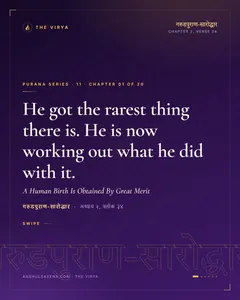
Worship First. Then Go And Fight

Vishnu cannot defeat two demons. He is told what he skipped

Worship First. Then Go And Fight., card 1 of 6
Worship First. Then Go And Fight., card 2 of 6
Worship First. Then Go And Fight., card 3 of 6
Worship First. Then Go And Fight., card 4 of 6
Worship First. Then Go And Fight., card 5 of 6
Worship First. Then Go And Fight., card 6 of 6
Read as text

श्रीगणेश-पुराण · मधु-कैटभ वध, "Worship First. Then Go And Fight."

"गणेशं पूजयित्वैव व्रज युद्धाय केशव।
स च तौ मायया मोहात् जयतां शतां प्राप्यिष्यति॥"
gaṇeśaṁ pūjayitvaiva vraja yuddhāya keśava,
sa ca tau māyayā mohāt jayatāṁ śatāṁ prāpyiṣyati.

Keshava, worship Ganesha and only then go to battle. He can bewilder those two by his maya and bring you victory.

The failure is not of strength and not of will. The most powerful being available lost because he attempted the thing in the wrong order.

How the text gets there:
1. Vishnu is unable to defeat the asuras by direct force.
2. The remedy given is not more power but a prior act of worship.
3. Ganesha notes that the defeat would already have happened had the order been right.
4. So the obstacle was sequence rather than capability.

Today: There is a whole class of failure that looks like insufficient effort and is actually wrong order. The preparation that seems like a delay is often the step that would have made the rest unnecessary.

What are you struggling with that you started in the wrong order? Tell me below.

Ganesha Purana

Tell Me The Method

Vishnu does not just start worshiping. He asks how

Tell Me The Method, card 1 of 6
Tell Me The Method, card 2 of 6
Tell Me The Method, card 3 of 6
Tell Me The Method, card 4 of 6
Tell Me The Method, card 5 of 6
Tell Me The Method, card 6 of 6
Read as text

श्रीगणेश-पुराण · पूजन-विधि, "Tell Me The Method"

'उन्हें प्रसन्न करने की विधि बताइए पार्वतीनाथ! बिना विधि के पूजा सफल नहीं हो पाती।'
unheṁ prasann karne kī vidhi batāiye pārvatīnāth! binā vidhi ke pūjā saphal nahīṁ ho pātī.

Lord of Parvati, tell me the method by which he is pleased. Without the method, worship does not succeed.

The one asking for the method is the god of the situation, not a novice. The admission that sincerity without procedure does not work comes from the most powerful person in the room.

How the text gets there:
1. Vishnu is told to worship but does not proceed on intention alone.
2. He asks for the specific method and states why it matters.
3. The sixteen-part procedure is taught to him.
4. A hundred divine years of practice follow before any result, so both method and duration are required.

Today: The two-part requirement is worth holding on to. Method without persistence produces nothing, and persistence without method produces less than people expect. Most failed practices are missing one, and their owners usually think they are missing motivation.

Are you missing the method or the years? Tell me below.

Ganesha Purana

The Arrow Fell At His Feet

Before it left the bow, it went the wrong way

The Arrow Fell At His Feet, card 1 of 6
The Arrow Fell At His Feet, card 2 of 6
The Arrow Fell At His Feet, card 3 of 6
The Arrow Fell At His Feet, card 4 of 6
The Arrow Fell At His Feet, card 5 of 6
The Arrow Fell At His Feet, card 6 of 6
Read as text

श्रीगणेश-पुराण · मदासुर का गर्व-भंजन, "The Arrow Fell At His Feet"

'यह क्या? वह बाण छूटने से पूर्व ही एकदन्त की ओर खिंचा चला गया और उनके चरणों में जा पड़ा।'
yah kyā? vah bāṇ chūṭne se pūrv hī ekadant kī or khiṁcā calā gayā aur unke caraṇoṁ meṁ jā paṛā.

What was this? Before it was even released, the arrow was drawn toward Ekadanta and fell at his feet.

The demonstration is not that his weapons fail. It is that they change allegiance while he is holding them, which is a different and more disorienting thing.

How the text gets there:
1. The asura declares his intention with confidence in his own capability.
2. His arrow moves toward the target before being released and falls at the feet.
3. His own axe wounds him and then transfers to the opponent's hand.
4. The pattern is not failure of weapons but their reassignment while in his possession.

Today: The image is precise about a particular kind of defeat. Not being outmatched but discovering that the things you were counting on were never actually working for you, and finding it out in the middle of using them.

What are you relying on that may not be working for you? Tell me below.

Ganesha Purana

He Worked It Out Himself

Nobody tells him. He reasons his way to it, wounded on the ground

He Worked It Out Himself, card 1 of 6
He Worked It Out Himself, card 2 of 6
He Worked It Out Himself, card 3 of 6
He Worked It Out Himself, card 4 of 6
He Worked It Out Himself, card 5 of 6
He Worked It Out Himself, card 6 of 6
Read as text

श्रीगणेश-पुराण · मदासुर का गर्व-भंजन, "He Worked It Out Himself"

'क्या यह एकदन्त ही सर्वेश्वर सर्वात्मा एवं सर्व समर्थ परात्पर ब्रह्म हैं? वस्तुतः यही सम्भव है। निश्चय ही यह जगत् के परम कारण परमात्मा ही हैं।'
kyā yah ekadant hī sarveśvar sarvātmā evaṁ sarva samarth parātpar brahma haiṁ? vastutaḥ yahī sambhav hai. niścaya hī yah jagat ke param kāraṇ paramātmā hī haiṁ.

Is this Ekadanta himself the lord of all, the self of all, the all-capable supreme Brahman? Indeed this alone is possible. Certainly he is the supreme cause of the world.

The conversion is by inference rather than by revelation or defeat. He is presented with anomalous evidence, reasons about it, and reaches the conclusion himself.

How the text gets there:
1. The asura observes events his own account cannot explain.
2. He asks what would explain them rather than dismissing them.
3. He identifies the single hypothesis consistent with the evidence.
4. Recognition is immediately followed by action, and praise only after that.

Today: Notice the order: he acts on the conclusion before he articulates it. Most people reverse this, producing the statement first and never getting to the part where anything changes.

What have you concluded and not yet acted on? Tell me below.

Ganesha Purana

Go Home. Go Home

The sage does not curse him. He tells him to go and look at his children

Go Home. Go Home., card 1 of 6
Go Home. Go Home., card 2 of 6
Go Home. Go Home., card 3 of 6
Go Home. Go Home., card 4 of 6
Go Home. Go Home., card 5 of 6
Go Home. Go Home., card 6 of 6
Read as text

श्रीगणेश-पुराण · कपिला गाय प्रसंग, "Go Home. Go Home."

"गृहं गच्छ गृहं गच्छ मत्कोपं नैव वर्द्धय।
पुत्रदारादिकं पश्य देवबाधितपामर॥"
gṛhaṁ gaccha gṛhaṁ gaccha matkopaṁ naiva varddhaya,
putradārādikaṁ paśya devabādhitapāmara.

Go home, go home, do not increase my anger. Look at your sons and wife, you wretch afflicted by the gods.

The most severe thing said is an instruction to go and look at his own family. The threat is left entirely implicit, and the restraint is stated as deliberate.

How the text gets there:
1. The king threatens the sage with death over a cow.
2. The sage becomes angry, which the text records rather than conceals.
3. He deliberately withholds the curse to prevent something unpleasant occurring.
4. What he issues is a dismissal that points the king at what he already has.

Today: The most effective response to an unreasonable demand is often to redirect the person to what they already possess, and to make the restraint visible. Both halves matter, and the second is what makes it land.

What are you demanding while not looking at what you have? Tell me below.

Ganesha Purana

How The Mouse Got Its Job

A gandharva in a hurry brushes a sage with his foot

How The Mouse Got Its Job, card 1 of 6
How The Mouse Got Its Job, card 2 of 6
How The Mouse Got Its Job, card 3 of 6
How The Mouse Got Its Job, card 4 of 6
How The Mouse Got Its Job, card 5 of 6
How The Mouse Got Its Job, card 6 of 6
Read as text

श्रीगणेश-पुराण · मूषक-उत्पत्ति, "How The Mouse Got Its Job"

'तू मूषक तो अवश्य होगा, किन्तु देवाधिदेव गजानन का वाहन होने के कारण अत्यन्त सुखी होगा। उनकी कृपा से तेरा सब दुःख दूर हो जायेगा।'
tū mūṣak to avaśya hogā, kintu devādhidev gajānan kā vāhan hone ke kāraṇ atyant sukhī hogā. unkī kṛpā se terā sab duḥkh dūr ho jāyegā.

You will certainly become a mouse, but because you will be the vehicle of Gajanana, lord of gods, you will be exceedingly happy. By his grace all your sorrow will be removed.

The curse is not lifted and the outcome is still good. What changes is not the shape but what the shape is for, which is a different kind of mercy from reversal.

How the text gets there:
1. A trivial carelessness produces a disproportionate curse.
2. The gandharva pleads and the sage feels compassion.
3. The curse is nonetheless confirmed rather than withdrawn.
4. A function is attached to the cursed form, which makes the same condition a source of happiness.

Today: The structure is worth keeping. Some conditions are not going to be reversed, and the available move is to find what they are for. That is not consolation; it is a different operation from repair and it produces a different result.

What of yours will not be reversed, and what could it be for? Tell me below.

Ganesha Purana

He Waited At The Door

Shani will not go in. He stands outside and asks for permission

He Waited At The Door, card 1 of 6
He Waited At The Door, card 2 of 6
He Waited At The Door, card 3 of 6
He Waited At The Door, card 4 of 6
He Waited At The Door, card 5 of 6
He Waited At The Door, card 6 of 6
Read as text

श्रीगणेश-पुराण · शनि का अन्तःपुर में प्रवेश, "He Waited At The Door"

'निश्चिन्त रहें प्रभो! मैं यहीं खड़ा हुआ आपकी प्रतीक्षा करूँगा। भला आप जैसे उपकारी देव की आज्ञा का उल्लंघन कोई कर सकता है?'
niścint raheṁ prabho! maiṁ yahīṁ khaṛā huā āpkī pratīkṣā karūṁgā. bhalā āp jaise upkārī dev kī ājñā kā ullaṅghan koī kar saktā hai?

Be at ease, lord. I shall stand right here and wait for you. Who could transgress the command of so benevolent a god as you?

Every precaution was observed. He waited, he was announced, permission was granted, and the harm followed from what he is rather than from anything he did wrong.

How the text gets there:
1. Shani is asked to wait outside and complies without argument.
2. He is described by Parvati as one who always keeps to instruction.
3. Permission is properly sought and properly given.
4. The harm nonetheless follows, arising from his nature rather than from any breach of procedure.

Today: Some consequences are not produced by anyone behaving badly. The procedures were followed, everyone was courteous, and the outcome came from what was in the room. Looking for the person who erred, in those cases, wastes the analysis.

Where are you looking for a culprit when nobody erred? Tell me below.

Ganesha Purana

Water, Charged By Mantras

The gods do not perform a miracle. They charge water with verses

Water, Charged By Mantras, card 1 of 6
Water, Charged By Mantras, card 2 of 6
Water, Charged By Mantras, card 3 of 6
Water, Charged By Mantras, card 4 of 6
Water, Charged By Mantras, card 5 of 6
Water, Charged By Mantras, card 6 of 6
Read as text

श्रीगणेश-पुराण · गजानन का अभिषेक, "Water, Charged By Mantras"

'समस्त देवताओं ने वेद मन्त्रों के द्वारा जल को अभिमन्त्रित कर उससे बालक को अभिषिञ्चित किया। उस जल का स्पर्श पाते ही बालक में चेतना लौटने लगी।'
samast devatāoṁ ne ved mantroṁ ke dvārā jal ko abhimantrit kar usse bālak ko abhiṣiñcit kiyā. us jal kā sparś pāte hī bālak meṁ cetanā lauṭne lagī.

All the gods, having charged water with Vedic mantras, sprinkled the boy with it. At the touch of that water consciousness began to return to the boy.

The account is procedural rather than miraculous. There is a medium, a charging, an application and a graded return, and the simile chosen for the result is waking up.

How the text gets there:
1. A specific request is made for a particular energy to enter the child.
2. Mantras are used to charge water, which acts as the medium.
3. The water is applied and consciousness returns gradually rather than instantly.
4. The comparison drawn is to ordinary waking, which normalises rather than heightens the event.

Today: Notice the choice to describe the extraordinary in ordinary terms. The most striking event in the book is narrated with a medium, a method and a comparison to getting out of bed, and it is more convincing for it.

Do you describe your best results as miracles or as methods? Tell me below.

Ganesha Purana

How Many Beggars Have You Made Kings

Two demons praise Shiva by pointing at his track record

How Many Beggars Have You Made Kings, card 1 of 6
How Many Beggars Have You Made Kings, card 2 of 6
How Many Beggars Have You Made Kings, card 3 of 6
How Many Beggars Have You Made Kings, card 4 of 6
How Many Beggars Have You Made Kings, card 5 of 6
How Many Beggars Have You Made Kings, card 6 of 6
Read as text

श्रीगणेश-पुराण · देवान्तक-नरान्तक तप, "How Many Beggars Have You Made Kings"

'न जाने कितने रंकों को आपने राजा बना दिया है! हे भक्तवत्सल! आपके लिए कहीं, कुछ भी तो असम्भव नहीं है।'
na jāne kitne raṅkoṁ ko āpne rājā banā diyā hai! he bhaktavatsal! āpke liye kahīṁ, kuch bhī to asambhav nahīṁ hai.

Who knows how many paupers you have made into kings! O you who are fond of your devotees, for you nothing anywhere is impossible.

The praise is an argument. They cite the record of what he has granted others in order to establish what he can be asked for, and the request follows directly from the evidence they have just assembled.

How the text gets there:
1. The asuras open by conceding their own inadequacy to praise properly.
2. They then cite a pattern of previous transformations he has granted.
3. The pattern establishes his capability and his disposition to use it.
4. The request follows immediately, framed by the precedent they have set up.

Today: The rhetorical structure is one anyone asking for something would recognize. Establish the record, establish the disposition, then make the ask. It works, and in this story it works entirely too well.

What are you about to be granted that you should not ask for? Tell me below.

Ganesha Purana

Ask For These Two. Nothing Else

The teacher is precise about what to request, and what to leave out

Ask For These Two. Nothing Else., card 1 of 6
Ask For These Two. Nothing Else., card 2 of 6
Ask For These Two. Nothing Else., card 3 of 6
Ask For These Two. Nothing Else., card 4 of 6
Ask For These Two. Nothing Else., card 5 of 6
Ask For These Two. Nothing Else., card 6 of 6
Read as text

श्रीगणेश-पुराण · शम्बरासुर का उपदेश, "Ask For These Two. Nothing Else."

'जब वे संतुष्ट होकर वर माँगने को कहें, तब तुम केवल समस्त ब्रह्माण्ड का राज्य और अमरत्व ही माँगना, और कुछ भी न माँगना।'
jab ve saṁtuṣṭ hokar var māṁgne ko kaheṁ, tab tum keval samast brahmāṇḍ kā rājya aur amaratva hī māṁgnā, aur kuch bhī na māṁgnā.

When he is pleased and tells you to ask for a boon, ask only for the kingdom of the whole universe and for immortality, and ask for nothing else.

The coaching is technically excellent and aimed at exactly the wrong things. He has been taught what to want by someone who wanted it and did not get it.

How the text gets there:
1. The pupil is first equipped with every relevant capability.
2. He is then directed toward a source of boons.
3. The request is specified precisely and narrowed to two items.
4. Both items are of the kind this literature consistently shows being granted and then destroying the recipient.

Today: Advice about what to ask for is more consequential than advice about how to get it, and much less examined. Whoever taught you what counts as a good outcome shaped more of your life than whoever taught you to pursue it.

Who taught you what to want, and how did it work out for them? Tell me below.

Ganesha Purana

Why Not Come Rest In My Mouth?

The demon is out of arrows and alone. Then he hears a voice

Why Not Come Rest In My Mouth?, card 1 of 6
Why Not Come Rest In My Mouth?, card 2 of 6
Why Not Come Rest In My Mouth?, card 3 of 6
Why Not Come Rest In My Mouth?, card 4 of 6
Why Not Come Rest In My Mouth?, card 5 of 6
Why Not Come Rest In My Mouth?, card 6 of 6
Read as text

श्रीगणेश-पुराण · देवान्तक का पलायन, "Why Not Come Rest In My Mouth?"

'अब तू अकेला ही क्या करेगा? मेरे मुख में आकर विश्राम क्यों नहीं करता?'
ab tū akelā hī kyā karegā? mere mukh meṁ ākar viśrām kyoṁ nahīṁ kartā?

What will you do now, all alone? Why not come and rest in my mouth?

What breaks him is not a blow but an offer of rest, made at the moment he had nothing left to do. The invitation is the attack.

How the text gets there:
1. The asura's weapons are exhausted and he is undecided.
2. The taunt is framed as an invitation to rest rather than a threat.
3. It restores his awareness of the situation rather than frightening him.
4. He surveys the field, finds himself alone, and chooses flight over death.

Today: The most disarming thing said to someone who is out of resources is often an offer, not a threat. It removes the fight they were holding themselves together with, and what follows is clarity rather than collapse.

What offer of rest would be the hardest thing to hear right now? Tell me below.

Ganesha Purana

The Boy Is The Root Of All This

The asura works out the strategy correctly and it does not help

The Boy Is The Root Of All This, card 1 of 6
The Boy Is The Root Of All This, card 2 of 6
The Boy Is The Root Of All This, card 3 of 6
The Boy Is The Root Of All This, card 4 of 6
The Boy Is The Root Of All This, card 5 of 6
The Boy Is The Root Of All This, card 6 of 6
Read as text

श्रीगणेश-पुराण · उग्रक्षण-युद्ध, "The Boy Is The Root Of All This"

'समस्त विग्रह की जड़ यही बालक है। इसका वध होते ही शिवगणादि पराजित हो जायेंगे। फिर कोई भी युद्ध करने का साहस न करेगा।'
samast vigrah kī jaṛ yahī bālak hai. iskā vadh hote hī śivagaṇādi parājit ho jāyeṁge. phir koī bhī yuddh karne kā sāhas na karegā.

This boy is the root of the entire conflict. The moment he is killed the ganas of Shiva and the rest will be defeated. Then nobody will have the courage to fight.

The reasoning is sound and the identification of the center is right. What defeats him is not a strategic error but the size of the thing he correctly identified.

How the text gets there:
1. The asura has already broken every other significant opponent.
2. He identifies the remaining figure as the actual center of the conflict.
3. His inference that removing him would end resistance is correct.
4. He acts on accurate reasoning and is defeated by the magnitude of what he identified.

Today: Correctly identifying the crux does not mean you can take it. A good deal of confident action follows from analysis that was right about where the leverage is and wrong about whether it was available.

Have you correctly identified something you cannot actually move? Tell me below.

Ganesha Purana

A Hundred And Eight Made By Hand

Not one image. A hundred and eight, made of clay, by her

A Hundred And Eight Made By Hand, card 1 of 6
A Hundred And Eight Made By Hand, card 2 of 6
A Hundred And Eight Made By Hand, card 3 of 6
A Hundred And Eight Made By Hand, card 4 of 6
A Hundred And Eight Made By Hand, card 5 of 6
A Hundred And Eight Made By Hand, card 6 of 6
Read as text

श्रीगणेश-पुराण · उपासना-वर्णन, "A Hundred And Eight Made By Hand"

'श्रीगणेश जी की १०८ मृत्तिका प्रतिमाएँ बनाईं और उन्हें सुन्दर सुखद आसनों पर प्रतिष्ठित कर संकल्पपूर्वक षोडशोपचार से पूजन किया।'
śrīgaṇeś jī kī 108 mṛttikā pratimāeṁ banāīṁ aur unheṁ sundar sukhad āsanoṁ par pratiṣṭhit kar saṅkalpapūrvak ṣoḍaśopacār se pūjan kiyā.

She made a hundred and eight clay images of Ganesha and, installing them on beautiful comfortable seats, worshiped them with the sixteen services, having first made the resolve.

The meditation comes last, after a month of physical work, feeding people and giving things away. It is the final item on a long list rather than the practice itself.

How the text gets there:
1. The practice begins with making the images by hand rather than acquiring them.
2. A full sequence of stages follows, each named and ordered.
3. Feeding and giving are included as parts of the practice, not as additions to it.
4. Meditation appears last, after everything else has been done.

Today: The ordering is instructive for anyone whose practice consists entirely of the sitting. Here the sitting is one stage of a much longer procedure, most of which involves hands, other people and giving things up.

Is your practice only the part you do sitting down? Tell me below.

Ganesha Purana

A Name For Every Part

Right hand, left hand, lip, chin, nose, eye, ear, navel, heart, forehead

A Name For Every Part, card 1 of 6
A Name For Every Part, card 2 of 6
A Name For Every Part, card 3 of 6
A Name For Every Part, card 4 of 6
A Name For Every Part, card 5 of 6
A Name For Every Part, card 6 of 6
Read as text

श्रीगणेश-पुराण · गणेशन्यासः, "A Name For Every Part"

दक्षिणहस्ते वक्रतुण्डाय नमः। वामहस्ते शूर्पकर्णाय नमः।
ओष्ठे विघ्नेशाय नमः। अधरोष्ठे चिन्तामणये नमः।
हृदये धूम्रकेतवे नमः। ललाटे मयूरेशाय नमः॥
dakṣiṇahaste vakratuṇḍāya namaḥ, vāmahaste śūrpakarṇāya namaḥ,
oṣṭhe vighneśāya namaḥ, adharoṣṭhe cintāmaṇaye namaḥ,
hṛdaye dhūmraketave namaḥ, lalāṭe mayūreśāya namaḥ.

On the right hand, salutation to Vakratunda; on the left hand, to Shurpakarna; on the lip, to Vighnesha; on the lower lip, to Chintamani; on the heart, to Dhumraketu; on the forehead, to Mayuresha.

The practice makes the body the text. Nothing is recited in the abstract; each name is said at a place, which means the whole thing has to be performed rather than read.

How the text gets there:
1. Each divine name is paired with a specific bodily location.
2. The practitioner touches the location while pronouncing the name.
3. The sequence covers the body systematically from hands to head.
4. So the recitation cannot be performed mentally or in the abstract.

Today: Attaching each item of a sequence to a physical location is an old and effective memory technique, and it also makes inattention obvious. You cannot drift through something that requires your hand to be in the right place.

What do you recite without your body being involved at all? Tell me below.

Ganesha Purana

Gam Gam Gam

Each verse begins by repeating one syllable three times

Gam Gam Gam, card 1 of 6
Gam Gam Gam, card 2 of 6
Gam Gam Gam, card 3 of 6
Gam Gam Gam, card 4 of 6
Gam Gam Gam, card 5 of 6
Gam Gam Gam, card 6 of 6
Read as text

श्रीगणेश-पुराण · सङ्कष्टहरणं गणेशाष्टकम्, "Gam Gam Gam"

गं गं गं गं गणेशं गजमुखमभितो व्यापकं चिन्तयन्ति॥ १ ॥
वं वं वं विघ्नराजं भजति निजभुजे दक्षिणे न्यस्तशुण्डं
क्रं क्रं क्रं क्रोधमुद्रा-दलित-रिपुबलं कल्पवृक्षस्य मूले।
gaṁ gaṁ gaṁ gaṁ gaṇeśaṁ gajamukham abhito vyāpakaṁ cintayanti.
vaṁ vaṁ vaṁ vighnarājaṁ bhajati nijabhuje dakṣiṇe nyastaśuṇḍaṁ
kraṁ kraṁ kraṁ krodhamudrā-dalita-ripubalaṁ kalpavṛkṣasya mūle.

Gam gam gam, they contemplate Ganesha, elephant-faced and all-pervading. Vam vam vam, one worships the king of obstacles, his trunk laid on his own right arm; kram kram kram, whose angry gesture crushes the strength of enemies, at the root of the wish-granting tree.

The seed syllable and the meaning are locked together by sound, so the mnemonic and the content are the same thing. You cannot recall one half without the other.

How the text gets there:
1. Each verse opens with a bija syllable repeated three or four times.
2. The syllable then alliterates into the description that follows.
3. Sound and sense are therefore bound together at every verse.
4. The structure makes the hymn simultaneously a mantra and a description.

Today: Binding the memory aid to the content rather than adding it on top is why these texts survived oral transmission intact. Anything that separates the two loses the aid the first time someone forgets why it was there.

What do you remember by a device that has nothing to do with the content? Tell me below.

Ganesha Purana

Where This Is Recited

The claim is about the place, not the person

Where This Is Recited, card 1 of 6
Where This Is Recited, card 2 of 6
Where This Is Recited, card 3 of 6
Where This Is Recited, card 4 of 6
Where This Is Recited, card 5 of 6
Where This Is Recited, card 6 of 6
Read as text

श्रीगणेश-पुराण · गणेशसहस्रनामस्तोत्रम्, "Where This Is Recited"

देशे तत्र न दुर्भिक्षमीतयो दुरितानि च।
न तद्गृहं जहाति श्रीर्यत्रायं पठ्यते स्तवः॥ १३ ॥
deśe tatra na durbhikṣam ītayo duritāni ca,
na tadgṛhaṁ jahāti śrīr yatrāyaṁ paṭhyate stavaḥ.

In that region there is no famine, no calamity and no misfortune; prosperity does not leave that house where this hymn is recited.

The unit of benefit expands as the hymn proceeds, from the body to the house to the country. Whatever else it is doing, it is not framed as a private transaction.

How the text gets there:
1. The stated effects begin with individual physical conditions.
2. They are enumerated specifically rather than generally.
3. The scope then widens to the household and its prosperity.
4. It widens again to the region, so the benefit is described as collective.

Today: Notice which unit a promise is made about. A great deal of contemporary practice is framed entirely around the individual, and older formulations routinely place the household and the locality inside the scope by default.

Do your practices benefit anyone besides you? Tell me below.

Ganesha Purana

Accomplished By One Recitation

And the list of who may do it is the interesting part

Accomplished By One Recitation, card 1 of 6
Accomplished By One Recitation, card 2 of 6
Accomplished By One Recitation, card 3 of 6
Accomplished By One Recitation, card 4 of 6
Accomplished By One Recitation, card 5 of 6
Accomplished By One Recitation, card 6 of 6
Read as text

श्रीगणेश-पुराण · गणेशसहस्रनामस्तोत्रम्, "Accomplished By One Recitation"

सकृत्पाठेन संसिद्धः स्त्री-शूद्र-पतितैरपि।
सहस्रनाममन्त्रोऽयं जपितव्यः शुभाप्तये॥ १८ ॥
sakṛtpāṭhena saṁsiddhaḥ strī-śūdra-patitair api,
sahasranāmamantro 'yaṁ japitavyaḥ śubhāptaye.

Accomplished by a single recitation, this thousand-name mantra is to be recited even by women, shudras and the fallen, for the obtaining of good.

The inclusion is stated as an exception rather than assumed, which is honest about the surrounding norm. The text is arguing against its own context rather than pretending the context was not there.

How the text gets there:
1. The requirement is set at a single recitation rather than a repeated count.
2. Three categories customarily excluded from Vedic recitation are named.
3. They are explicitly included, with the particle even marking this as an exception.
4. So the text records both the prevailing restriction and its own departure from it.

Today: Where a text has to say even, it is telling you what the norm was and that someone pushed against it. Those clauses are usually the most historically informative sentences in a document.

In your field, what still needs the word even in front of it? Tell me below.

Ganesha Purana

There Will Be No Doubt

Gajanana answers the sages by telling them what their hymn will do

There Will Be No Doubt, card 1 of 6
There Will Be No Doubt, card 2 of 6
There Will Be No Doubt, card 3 of 6
There Will Be No Doubt, card 4 of 6
There Will Be No Doubt, card 5 of 6
There Will Be No Doubt, card 6 of 6
Read as text

श्रीगणेश-पुराण · देवर्षिकृत गजाननस्तोत्रम्, "There Will Be No Doubt"

यद्यच्च प्रार्थितं देवा मुनयः सर्वमञ्जसा।
भविष्यति न सन्देहो मृत्युकाले सर्वदा हि वः॥ ३१ ॥
भवत्कृतं मदीयं वै स्तोत्रं सर्वत्र सिद्धिदम्।
भविष्यति विशेषेण मम भक्ति-प्रदायकम्॥ ३२ ॥
yadyac ca prārthitaṁ devā munayaḥ sarvam añjasā,
bhaviṣyati na sandeho mṛtyukāle sarvadā hi vaḥ.
bhavatkṛtaṁ madīyaṁ vai stotraṁ sarvatra siddhidam,
bhaviṣyati viśeṣeṇa mama bhakti-pradāyakam.

Gods and sages, whatever has been prayed for shall all come about readily; there is no doubt, and always at the time of death for you. This hymn to me, made by you, shall grant accomplishment everywhere, and especially shall it give devotion to me.

The petitioners asked for outcomes and are told they will get them, and then told what the practice will actually do to them, which is a different thing and is placed higher.

How the text gets there:
1. The sages have composed a hymn and made requests.
2. The requests are granted without qualification.
3. A second effect is then named and marked as the special one.
4. That effect is devotion itself, which was not among the things requested.

Today: The pattern is familiar to anyone who has kept up a practice for years. You get some of what you were after, and the thing that actually changed you was not on the list when you started.

What has your practice given you that you never asked for? Tell me below.

Ganesha Purana

A King Sees Something Fall

He is on his throne. Something crashes in the distance

A King Sees Something Fall, card 1 of 6
A King Sees Something Fall, card 2 of 6
A King Sees Something Fall, card 3 of 6
A King Sees Something Fall, card 4 of 6
A King Sees Something Fall, card 5 of 6
A King Sees Something Fall, card 6 of 6
Read as text

श्रीगणेश-पुराण · इन्द्र के विमान का पतन, "A King Sees Something Fall"

'एक दिन राजा अपनी राज-सभा में श्रेष्ठ सिंहासन पर विराजमान था, तभी उसने कुछ दूर पर एक विमान गिरता देखा। राजा ने अपने दूतों को उसका पता लगाने का आदेश दिया।'
ek din rājā apnī rāj-sabhā meṁ śreṣṭh siṁhāsan par virājmān thā, tabhī usne kuch dūr par ek vimān girtā dekhā. rājā ne apne dūtoṁ ko uskā patā lagāne kā ādeś diyā.

One day the king was seated on his fine throne in his court when he saw a vimana falling at some distance. He ordered his messengers to find out about it.

The king's first response to an inexplicable event is to send people to find out. The story is preserved because he asked rather than because he understood.

How the text gets there:
1. An unexplained event is witnessed from a position of authority.
2. The king's first action is to dispatch messengers to establish the facts.
3. Only once the facts are established does he approach the person involved.
4. The explanation is then obtained from the one to whom it happened rather than inferred.

Today: Two moves in sequence, and most people skip the first. Establish what actually happened, then ask the person it happened to. Interpretation offered before either step is where most confident wrong accounts come from.

What did you interpret before you found out? Tell me below.

Ganesha Purana

They Could Not Kill It Either

It destroys everything. And killing it is not available

They Could Not Kill It Either, card 1 of 6
They Could Not Kill It Either, card 2 of 6
They Could Not Kill It Either, card 3 of 6
They Could Not Kill It Either, card 4 of 6
They Could Not Kill It Either, card 5 of 6
They Could Not Kill It Either, card 6 of 6
Read as text

श्रीगणेश-पुराण · मूषक-उपद्रव, "They Could Not Kill It Either"

'इसे मारना भी सम्भव नहीं है और फिर मारने से जीव-हत्या का पाप भी...'
ise mārnā bhī sambhav nahīṁ hai aur phir mārne se jīv-hatyā kā pāp bhī...

It is not even possible to kill it, and then killing would also incur the sin of taking life.

The problem is defined by two constraints at once, one practical and one moral, and neither would be sufficient alone. Removing either would have made the situation ordinary.

How the text gets there:
1. The creature causes escalating and comprehensive damage.
2. The sages consider removing it and find it cannot be killed.
3. They separately note that killing would incur the sin of taking life.
4. The impasse arises from the two constraints together, so no direct solution exists.

Today: The genuinely hard problems have this shape: the direct solution is both unavailable and impermissible. Recognizing that you are in one saves the time usually spent looking for a version of the direct solution that works.

Which of your problems is both impossible and impermissible to solve directly? Tell me below.

More from Puranas

All 40 collections of भारतीय