20 posts · 120 cards

Garuda Purana गरुड पुराण

Twenty passages on merit, conduct, and what follows a life.

Garuda Purana

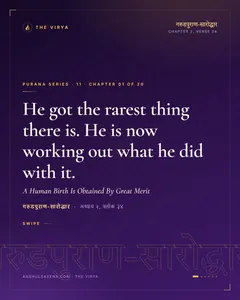
A Human Birth Is Obtained By Great Merit

He got the rarest thing there is. He is now working out what he did with it

A Human Birth Is Obtained By Great Merit, card 1 of 6
A Human Birth Is Obtained By Great Merit, card 2 of 6
A Human Birth Is Obtained By Great Merit, card 3 of 6
A Human Birth Is Obtained By Great Merit, card 4 of 6
A Human Birth Is Obtained By Great Merit, card 5 of 6
A Human Birth Is Obtained By Great Merit, card 6 of 6
Read as text

गरुडपुराण-सारोद्धार · अध्याय २, श्लोक ३४, "A Human Birth Is Obtained By Great Merit"

महता पुण्ययोगेन मानुषं जन्म लभ्यते।
तथाप्यपि न कृतो धर्मः कीदृशं हि मया कृतम्॥ ३४ ॥
mahatā puṇyayogena mānuṣaṁ janma labhyate,
tathāpy api na kṛto dharmaḥ kīdṛśaṁ hi mayā kṛtam.

By a great conjunction of merit a human birth is obtained. Even having obtained it, I did not practice dharma. What indeed have I done?

The regret is not about wrongdoing. It is about a scarce resource that was received and not spent, which is a different kind of failure and has no incident attached to it.

How the text gets there:
1. A human birth is stated to require a great accumulation of merit.
2. The speaker acknowledges having received it.
3. He notes that dharma was nonetheless not practiced.
4. The remorse is therefore about unused opportunity rather than about any specific act.

Today: This form of regret arrives with nothing to point at. There was no disaster and no crime, just a period in which something rare was available and was not used, and it is the harder kind to notice while it is still running.

What are you currently in possession of and not using? Tell me below.

Garuda Purana

Five Things Not Done

No gift, no fire offering, no austerity, no worship, no pilgrimage

Five Things Not Done, card 1 of 6
Five Things Not Done, card 2 of 6
Five Things Not Done, card 3 of 6
Five Things Not Done, card 4 of 6
Five Things Not Done, card 5 of 6
Five Things Not Done, card 6 of 6
Read as text

गरुडपुराण-सारोद्धार · अध्याय २, श्लोक ३५, "Five Things Not Done"

मया न दत्तं न हुतं हुताशने तपो न तप्तं त्रिदशा न पूजिताः।
न तीर्थसेवा विहिता विधानतो देहिन् क्वचिन्निस्तर यत् त्वया कृतम्॥ ३५ ॥
mayā na dattaṁ na hutaṁ hutāśane tapo na taptaṁ tridaśā na pūjitāḥ,
na tīrthasevā vihitā vidhānato dehin kvacin nistara yat tvayā kṛtam.

I gave nothing, offered nothing in fire, performed no austerity, worshiped no gods, made no pilgrimage according to rule. Embodied one, cross over somewhere the result of what you have done.

The refrain does not distinguish between things done and things left undone. Both are covered by what you have done, and the fruit is described as something to be crossed rather than paid.

How the text gets there:
1. Five prescribed acts are listed as not performed.
2. None of them is a prohibition, so nothing was violated.
3. The closing refrain nonetheless assigns a fruit to be borne.
4. Omission is therefore treated as a form of action with its own consequence.

Today: Most self-assessment is a search for things done wrong, and comes back clean. Running the same audit over what was never started produces a much longer list and is the one this verse is conducting.

What is on your list of things never begun? Tell me below.

Garuda Purana

Never Once Did Another A Good Turn

The list ends on the one item that needed no temple

Never Once Did Another A Good Turn, card 1 of 6
Never Once Did Another A Good Turn, card 2 of 6
Never Once Did Another A Good Turn, card 3 of 6
Never Once Did Another A Good Turn, card 4 of 6
Never Once Did Another A Good Turn, card 5 of 6
Never Once Did Another A Good Turn, card 6 of 6
Read as text

गरुडपुराण-सारोद्धार · अध्याय २, श्लोक ३६, "Never Once Did Another A Good Turn"

न पूजिता विप्रगणाः सुरापगा न चाश्रिता सत्पुरुषा न सेविताः।
परोपकारो न कृतः कदाचन देहिन् क्वचिन्निस्तर यत् त्वया कृतम्॥ ३६ ॥
na pūjitā vipragaṇāḥ surāpagā na cāśritā satpuruṣā na sevitāḥ,
aropakāro na kṛtaḥ kadācana dehin kvacin nistara yat tvayā kṛtam.

I did not honor the learned, did not resort to the celestial river, did not serve the good; I never once did a kindness to another. Embodied one, cross over somewhere the result of what you have done.

The one item with no barrier to entry is the one that carries the emphatic negative. The others could plausibly have been unavailable. This one could not.

How the text gets there:
1. Four omissions are listed, three of which depend on access to something external.
2. The fourth, benefiting another, requires no such access.
3. The intensifier never once is attached to that one alone.
4. So the item with no excuse available receives the strongest form of the negation.

Today: Every list of things you did not do has a mix of the genuinely unavailable and the merely unchosen. Separating the two is the only useful part of the exercise, and the second group is always larger than expected.

Which of your omissions had no obstacle in front of it? Tell me below.

Garuda Purana

Not One Tank In A Dry Place

The example given is public infrastructure

Not One Tank In A Dry Place, card 1 of 6
Not One Tank In A Dry Place, card 2 of 6
Not One Tank In A Dry Place, card 3 of 6
Not One Tank In A Dry Place, card 4 of 6
Not One Tank In A Dry Place, card 5 of 6
Not One Tank In A Dry Place, card 6 of 6
Read as text

गरुडपुराण-सारोद्धार · अध्याय २, श्लोक ३७, "Not One Tank In A Dry Place"

जलाशयो नैव कृतो हि निर्जले मनुष्यहेतोः पशुपक्षिहेतवे।
गोविप्रवृत्त्यर्थमकारि नाण्वपि देहिन् क्वचिन्निस्तर यत् त्वया कृतम्॥ ३७ ॥
jalāśayo naiva kṛto hi nirjale manuṣyahetoḥ paśupakṣihetave,
govipravṛttyartham akāri nāṇv api dehin kvacin nistara yat tvayā kṛtam.

I never made a water tank in a dry place for people, or for animals and birds; I did not do even an atom's worth for the sustenance of cattle and the learned. Embodied one, cross over somewhere the result of what you have done.

The one wholly practical item on the list of omissions is a piece of infrastructure that serves animals and birds as well as people. It sits alongside the ritual failures rather than in a separate category.

How the text gets there:
1. The omissions listed so far have been ritual and devotional.
2. This one is a physical public work in a place that lacks water.
3. Its beneficiaries include animals and birds alongside humans.
4. The quantity is measured in atoms, so the failure is total rather than partial.

Today: Worth noticing that the accounting includes what you built for people you will never meet, and that it does not distinguish this from the devotional items. Both are on the same list and neither substitutes for the other.

What have you built that will outlast your involvement with it? Tell me below.

Garuda Purana

Six Things At The End

A vow, a book, river water, a leaf, foot-water, and the names

Six Things At The End, card 1 of 6
Six Things At The End, card 2 of 6
Six Things At The End, card 3 of 6
Six Things At The End, card 4 of 6
Six Things At The End, card 5 of 6
Six Things At The End, card 6 of 6
Read as text

गरुडपुराण-सारोद्धार · अध्याय ८, श्लोक २६, "Six Things At The End"

एकादशीव्रतं गीता गङ्गाम्बु तुलसीदलम्।
विष्णोः पादाम्बुनामानि मरणे मुक्तिदानि च॥ २६ ॥
ekādaśīvrataṁ gītā gaṅgāmbu tulasīdalam,
viṣṇoḥ pādāmbunāmāni maraṇe muktidāni ca.

The Ekadashi vow, the Gita, Ganges water, a tulsi leaf, the water of Vishnu's feet, and his names: these six give liberation at the time of death.

The items are chosen for availability rather than for power. Everything on this list can be present in an ordinary house at short notice, which is the situation the chapter is describing.

How the text gets there:
1. Six items are named as giving liberation at the moment of death.
2. Five are common physical objects requiring no wealth or access.
3. The sixth is the utterance of a name, requiring nothing at all.
4. The list is therefore constructed for availability under the specific circumstances it addresses.

Today: The design principle is worth noting. Whatever matters most has to be available at the worst possible moment, unplanned, in an ordinary room. Anything requiring preparation is not available then, which is a real constraint on what can count.

What that matters to you would be available at the worst moment? Tell me below.

Garuda Purana

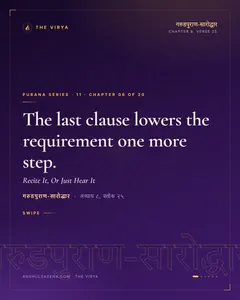
Recite It, Or Just Hear It

The last clause lowers the requirement one more step

Recite It, Or Just Hear It, card 1 of 6
Recite It, Or Just Hear It, card 2 of 6
Recite It, Or Just Hear It, card 3 of 6
Recite It, Or Just Hear It, card 4 of 6
Recite It, Or Just Hear It, card 5 of 6
Recite It, Or Just Hear It, card 6 of 6
Read as text

गरुडपुराण-सारोद्धार · अध्याय ८, श्लोक २५, "Recite It, Or Just Hear It"

अतः स्मरेन्महाविष्णोर्नाम पापौघनाशनम्।
गीतासहस्रनामानि पठेद्वा शृणुयादपि॥ २५ ॥
ataḥ smaren mahāviṣṇor nāma pāpaughanāśanam,
gītāsahasranāmāni paṭhed vā śṛṇuyād api.

Therefore one should remember the name of Mahavishnu, which destroys the flood of sins; and one should recite the Gita and the thousand names, or even merely hear them.

The falling requirement is not generosity. It is a specification written for someone whose capabilities are declining in a known order, and it keeps lowering the bar until it reaches something they will still have.

How the text gets there:
1. Three modes of engagement are named in the verse.
2. They descend from remembering to reciting to merely hearing.
3. The context is a person at the point of death.
4. The sequence matches the order in which such a person loses capacities, so a usable option remains at each stage.

Today: This is why the text is read aloud in the room rather than handed to anyone. The final specification requires only that someone else is present and speaking, which is a design decision about who does the work.

What of value could still reach you if you could only hear? Tell me below.

Garuda Purana

Small Or Large, It Becomes Imperishable

The condition is not the amount. It is that the son agrees

Small Or Large, It Becomes Imperishable, card 1 of 6
Small Or Large, It Becomes Imperishable, card 2 of 6
Small Or Large, It Becomes Imperishable, card 3 of 6
Small Or Large, It Becomes Imperishable, card 4 of 6
Small Or Large, It Becomes Imperishable, card 5 of 6
Small Or Large, It Becomes Imperishable, card 6 of 6
Read as text

गरुडपुराण-सारोद्धार · अध्याय ८, श्लोक २८, "Small Or Large, It Becomes Imperishable"

अन्ते जनो यद्ददाति स्वल्पं वा यदि वा बहु।
तदक्षयं भवेत् तार्क्ष्य यत्पुत्रश्चानुमोदते॥ २८ ॥
ante jano yad dadāti svalpaṁ vā yadi vā bahu,
tad akṣayaṁ bhavet tārkṣya yat putraś cānumodate.

Whatever a person gives at the end, whether little or much, becomes imperishable, Tarkshya, when the son also approves of it.

A person's final gift is made durable by another person's consent to it, which puts the outcome partly outside the giver's control and inside a relationship.

How the text gets there:
1. The amount given is explicitly declared irrelevant.
2. The gift's permanence depends on a separate condition.
3. That condition is the glad approval of the son.
4. So the result rests on the state of a relationship rather than on the resources involved.

Today: Applies directly to estates and to anything given away late. Whether the gift stands depends less on the instrument than on whether the people affected concur with it, and that is settled long before the document is drawn up.

Would the people affected by your last wishes concur with them? Tell me below.

Garuda Purana

He Does Not Fall Into That River

Vaitarani is described as made of flesh, bone and blood

He Does Not Fall Into That River, card 1 of 6
He Does Not Fall Into That River, card 2 of 6
He Does Not Fall Into That River, card 3 of 6
He Does Not Fall Into That River, card 4 of 6
He Does Not Fall Into That River, card 5 of 6
He Does Not Fall Into That River, card 6 of 6
Read as text

गरुडपुराण-सारोद्धार · अध्याय ८, श्लोक २४, "He Does Not Fall Into That River"

मांसास्थिरक्तवत्काये वैतरण्यां पतेन सः।
योऽन्ते दद्याद् द्विजेभ्यश्च नन्दनन्दनगामिति॥ २४ ॥
māṁsāsthiraktavatkāye vaitaraṇyāṁ paten saḥ,
yo 'nte dadyād dvijebhyaś ca nandanandanagāmiti.

He does not fall into the Vaitarani, full of flesh, bone and blood, who at the end makes a gift and utters the name of the son of Nanda.

The river is made of exactly what a body is made of. Falling into it is a description of embodiment, so escaping it is not a rescue but a non-return.

How the text gets there:
1. The Vaitarani is described as composed of flesh, bone and blood.
2. These are the constituents of a physical body.
3. The Hindi gloss states that not falling in means not taking a body again.
4. So crossing the river is another way of describing release from rebirth.

Today: Reading the geography of the afterlife as a description of embodiment rather than as a place changes what the text is doing. It is not mapping a territory; it is describing a condition in the vocabulary of one.

Which of your fears are conditions you have imagined as places? Tell me below.

Garuda Purana

Useful Only Until

Austerity, vows, pilgrimage, japa, fire, worship. All of it has an expiry

Useful Only Until, card 1 of 6
Useful Only Until, card 2 of 6
Useful Only Until, card 3 of 6
Useful Only Until, card 4 of 6
Useful Only Until, card 5 of 6
Useful Only Until, card 6 of 6
Read as text

गरुडपुराण-सारोद्धार · अध्याय १६, श्लोक ९८, "Useful Only Until"

तावत् तपो व्रतं तीर्थं जपहोमार्चनादिकम्।
वेदशास्त्रागमकथा यावत्तत्त्वं न विन्दति॥ ९८ ॥
tāvat tapo vrataṁ tīrthaṁ japahomārcanādikam,
vedaśāstrāgamakathā yāvat tattvaṁ na vindati.

Austerity, vows, pilgrimage, japa, fire offering, worship and the rest, and the discourse of Veda, shastra and agama, are useful only so long as one does not find the truth.

The text spends its length prescribing practices and then states their expiry condition. Nothing is dismissed, and nothing is left permanent either.

How the text gets there:
1. A comprehensive list of religious practices is given.
2. The book itself has prescribed these in detail throughout.
3. Their usefulness is bounded by a stated condition rather than denied.
4. That condition is the attainment of knowledge of the truth, after which they are no longer the point.

Today: The structure is honest in a way most systems are not. A practice with a stated endpoint is making a claim it can be held to, and the absence of such a clause usually means the practice has become the goal.

Does your practice have a stated endpoint, or has it become the point? Tell me below.

Garuda Purana

In All Conditions, At All Times

Three words that leave no gap: every effort, every state, always

In All Conditions, At All Times, card 1 of 6
In All Conditions, At All Times, card 2 of 6
In All Conditions, At All Times, card 3 of 6
In All Conditions, At All Times, card 4 of 6
In All Conditions, At All Times, card 5 of 6
In All Conditions, At All Times, card 6 of 6
Read as text

गरुडपुराण-सारोद्धार · अध्याय १६, श्लोक ९९, "In All Conditions, At All Times"

तस्मात् सर्वप्रयत्नेन सर्वावस्थासु सर्वदा।
तत्त्वनिष्ठो भवेत् तार्क्ष्य यदीच्छेन्मोक्षमात्मनः॥ ९९ ॥
tasmāt sarvaprayatnena sarvāvasthāsu sarvadā,
tattvaniṣṭho bhavet tārkṣya yadīcchen mokṣam ātmanaḥ.

Therefore with every effort, in all conditions, at all times, one should be established in the truth, Tarkshya, if one desires liberation for oneself.

The demand is total and the condition is voluntary. Nothing is required of anyone who does not want the result, which is what makes the totality of the demand tolerable.

How the text gets there:
1. Three universals are stacked: all effort, all conditions, all times.
2. Together they exclude any exempt situation.
3. The entire requirement is then made conditional on desiring liberation.
4. So the demand is absolute for those who want the end and absent for those who do not.

Today: The pairing of a total demand with a voluntary condition is a good structure for anything difficult. It stops being an imposition and becomes a specification: this is what it costs, and you decide whether you are buying.

What do you want that you have not accepted the full price of? Tell me below.

Garuda Purana

Sit In The Shade Of That Tree

Its flowers are dharma and knowledge. Its fruits are heaven and liberation

Sit In The Shade Of That Tree, card 1 of 6
Sit In The Shade Of That Tree, card 2 of 6
Sit In The Shade Of That Tree, card 3 of 6
Sit In The Shade Of That Tree, card 4 of 6
Sit In The Shade Of That Tree, card 5 of 6
Sit In The Shade Of That Tree, card 6 of 6
Read as text

गरुडपुराण-सारोद्धार · अध्याय १६, श्लोक १००, "Sit In The Shade Of That Tree"

धर्मज्ञानप्रसूनस्य स्वर्गमोक्षफलस्य च।
तापत्रयादिसंतप्तश्छायां मोक्षतरोः श्रयेत्॥ १०० ॥
dharmajñānaprasūnasya svargamokṣaphalasya ca,
tāpatrayādisaṁtaptaś chāyāṁ mokṣataroḥ śrayet.

One scorched by the three kinds of affliction should take refuge in the shade of the tree of liberation, whose flowers are dharma and knowledge and whose fruits are heaven and liberation.

The shade is available before anything ripens. You get relief from proximity to the thing long before you get anything the thing produces.

How the text gets there:
1. A tree is described with flowers and fruits assigned to specific goods.
2. The flowers precede the fruits, so dharma and knowledge come before the results.
3. The person addressed is currently burning from the three afflictions.
4. What is offered to him immediately is the shade, which requires no ripening.

Today: Anyone who has taken up something serious knows this. The benefits it advertises are years away and the relief of being near it starts almost immediately, and the second is what actually keeps people there.

What are you close to that gives you shade before it gives you fruit? Tell me below.

Garuda Purana

Easily Released

The bondage is called terrible. The release is called easy

Easily Released, card 1 of 6
Easily Released, card 2 of 6
Easily Released, card 3 of 6
Easily Released, card 4 of 6
Easily Released, card 5 of 6
Easily Released, card 6 of 6
Read as text

गरुडपुराण-सारोद्धार · अध्याय १६, श्लोक १०१, "Easily Released"

तस्माज्ज्ञानेनात्मतत्त्वं विज्ञेयं श्रीगुरोर्मुखात्।
सुखेन मुच्यते जन्तुर्घोरसंसारबन्धनात्॥ १०१ ॥
tasmāj jñānenātmatattvaṁ vijñeyaṁ śrīgurormukhāt,
sukhena mucyate jantur ghorasaṁsārabandhanāt.

Therefore the truth of the self should be known through knowledge from the mouth of the teacher; the creature is then released easily from the terrible bondage of samsara.

The severity of a bond and the difficulty of releasing it are different quantities. This one is described as terrible to be in and easy to leave, once you know how it is fastened.

How the text gets there:
1. The bondage of samsara is described as terrible.
2. The release from it is described as easy.
3. The difference is located in whether the truth of the self is known.
4. The knowledge is specified as coming from the teacher, so the hard part is obtaining it rather than acting on it.

Today: Anyone who has watched someone struggle with something they could solve in a minute if they knew one fact recognizes this shape. The effort was never going to work; the missing item was information, and it usually comes from a person.

What are you struggling with that is a missing fact rather than a missing effort? Tell me below.

Garuda Purana

Seven Things That Are Not True Of Anything Else

The answer to what exists begins with a list of denials

Seven Things That Are Not True Of Anything Else, card 1 of 6
Seven Things That Are Not True Of Anything Else, card 2 of 6
Seven Things That Are Not True Of Anything Else, card 3 of 6
Seven Things That Are Not True Of Anything Else, card 4 of 6
Seven Things That Are Not True Of Anything Else, card 5 of 6
Seven Things That Are Not True Of Anything Else, card 6 of 6
Read as text

गरुडपुराण-सारोद्धार · अध्याय १६, श्लोक ६, "Seven Things That Are Not True Of Anything Else"

अस्ति देवः परब्रह्मस्वरूपी निष्कलः शिवः।
सर्वज्ञः सर्वकर्ता च सर्वेशो निर्मलोऽद्वयः॥ ६ ॥
asti devaḥ parabrahmasvarūpī niṣkalaḥ śivaḥ,
sarvajñaḥ sarvakartā ca sarveśo nirmalo 'dvayaḥ.

There is a God, of the nature of the supreme Brahman, partless, auspicious, all-knowing, all-doing, lord of all, stainless, without a second.

Partless is not a claim about simplicity. It means the components no longer have separate existence, in the way rivers in the sea have not been destroyed but can no longer be named apart.

How the text gets there:
1. The supreme is described as nishkala, without parts.
2. The Upanishadic image given is rivers entering the sea.
3. Their names and forms end without the water being destroyed.
4. So partlessness describes the loss of separate identity among constituents rather than an absence of constituents.

Today: The river-and-sea image is a precise account of what happens to components in a genuine synthesis. Nothing is lost, and nothing can be pointed to separately afterwards, which is why real integration is so hard to document.

What in your thinking has merged past the point of separate naming? Tell me below.

Garuda Purana

And The Jiva Is A Portion Of That

Six attributes, then one word that changes who the verse is about

And The Jiva Is A Portion Of That, card 1 of 6
And The Jiva Is A Portion Of That, card 2 of 6
And The Jiva Is A Portion Of That, card 3 of 6
And The Jiva Is A Portion Of That, card 4 of 6
And The Jiva Is A Portion Of That, card 5 of 6
And The Jiva Is A Portion Of That, card 6 of 6
Read as text

गरुडपुराण-सारोद्धार · अध्याय १६, श्लोक ७, "And The Jiva Is A Portion Of That"

स्वयंज्योतिरनाद्यन्तो निर्विकारः परात्परः।
निर्गुणः सच्चिदानन्दस्तदंशाज्जीवसंज्ञकः॥ ७ ॥
svayaṁjyotir anādyanto nirvikāraḥ parātparaḥ,
nirguṇaḥ saccidānandas tadaṁśāj jīvasaṁjñakaḥ.

Self-luminous, without beginning or end, changeless, higher than the highest, without attributes, being-consciousness-bliss; and from a portion of that comes what is called the jiva.

The connection is made in one word at the end of a long description, and everything the book says afterwards about liberation depends on it. Remove tad-amshat and the description is about something with no relation to the reader.

How the text gets there:
1. Six attributes are given describing the supreme reality.
2. None of them applies to an individual as ordinarily understood.
3. A single compound then derives the jiva from a portion of that.
4. That one connective is what makes the preceding description relevant to the person hearing it.

Today: The load a single connecting claim carries is worth noticing in any argument. Long stretches of unobjectionable description often rest on one small joint, and that joint is where the disagreement actually is.

In the arguments you accept, where is the single joint holding it together? Tell me below.

Garuda Purana

By Hearing It Alone

Vishnu introduces the answer by stating what the answer does

By Hearing It Alone, card 1 of 6
By Hearing It Alone, card 2 of 6
By Hearing It Alone, card 3 of 6
By Hearing It Alone, card 4 of 6
By Hearing It Alone, card 5 of 6
By Hearing It Alone, card 6 of 6
Read as text

गरुडपुराण-सारोद्धार · अध्याय १६, श्लोक ५, "By Hearing It Alone"

शृणु तार्क्ष्य प्रवक्ष्यामि यन्मां त्वं परिपृच्छसि।
यस्य श्रवणमात्रेण संसारान्मुच्यते नरः॥ ५ ॥
śṛṇu tārkṣya pravakṣyāmi yan māṁ tvaṁ paripṛcchasi,
yasya śravaṇamātreṇa saṁsārān mucyate naraḥ.

Listen, Tarkshya, I shall declare what you ask of me; by the mere hearing of which a man is released from samsara.

The chapter with the lowest entry requirement in the book is the one that carries its actual argument. Everything with detailed prerequisites came first and was declared provisional at verse 98.

How the text gets there:
1. Fifteen chapters have prescribed rites with detailed requirements.
2. The final chapter is introduced as requiring only hearing.
3. That chapter contains the philosophical content of the book.
4. The earlier material is later declared useful only until this content is grasped.

Today: Where a long body of procedure is capped by a short section requiring nothing, the short section is usually the point and the procedure was scaffolding. Reading the last chapter first is often the correct move.

In what you are studying, which part requires nothing and carries everything? Tell me below.

Garuda Purana

Each Act, Its Own Result

Not a general punishment. A specific outcome for each specific thing

Each Act, Its Own Result, card 1 of 6
Each Act, Its Own Result, card 2 of 6
Each Act, Its Own Result, card 3 of 6
Each Act, Its Own Result, card 4 of 6
Each Act, Its Own Result, card 5 of 6
Each Act, Its Own Result, card 6 of 6
Read as text

गरुडपुराण-सारोद्धार · अध्याय ५, श्लोक १०-११, "Each Act, Its Own Result"

गदः स्यात्स्नडोन्मत्तः खल्वाटोऽनिनप्रायकः।
दुर्गन्धः पलविक्रेता रोगान् परमांसभुक्॥ १० ॥
हीनजाती प्रजायेत रत्नानामपहारकः।
कुनखी खर्वपदती स्याद्धातुमात्रहारोऽधनः॥ ११ ॥
gadaḥ syāt snaḍonmattaḥ khalvāṭo 'ninaprāyakaḥ,
durgandhaḥ palavikretā rogān paramāṁsabhuk.
hīnajātī prajāyeta ratnānām apahārakaḥ,
kunakhī kharvapadatī syād dhātumātrahāro 'dhanaḥ.

The seller of flesh becomes foul-smelling; the eater of another's flesh gets diseases; the stealer of gems is born in a low condition; the stealer of metals becomes deformed in nails and feet, and poor.

The scheme maps consequences onto the faculty that committed the act. It is not a scale of severity but a record of which instrument was used.

How the text gets there:
1. Each listed act is paired with a distinct and specific outcome.
2. The outcomes are not graded by severity of the offense.
3. In many cases the affected faculty is the one that performed the act.
4. So the scheme records the instrument used rather than assigning proportionate punishment.

Today: Whatever you make of the mechanism, the underlying observation is sound: sustained use of a faculty for a particular purpose changes that faculty. The person who lies for years has a different relationship to speech than they started with.

Which of your faculties has been shaped by what you use it for? Tell me below.

Garuda Purana

Clay, Stone And Gold Are The Same To Him

The qualification is not learning. It is what he can no longer tell apart

Clay, Stone And Gold Are The Same To Him, card 1 of 6
Clay, Stone And Gold Are The Same To Him, card 2 of 6
Clay, Stone And Gold Are The Same To Him, card 3 of 6
Clay, Stone And Gold Are The Same To Him, card 4 of 6
Clay, Stone And Gold Are The Same To Him, card 5 of 6
Clay, Stone And Gold Are The Same To Him, card 6 of 6
Read as text

गरुडपुराण-सारोद्धार · अध्याय १४, श्लोक ६९, "Clay, Stone And Gold Are The Same To Him"

ब्रह्मचर्यव्रतधरा वानप्रस्थास्तपस्विनः।
श्रीपात्रसंन्यासपराः समलोष्टाश्मकाञ्चनाः॥ ६९ ॥
brahmacaryavratadharā vānaprasthās tapasvinaḥ,
śrīpātrasaṁnyāsaparāḥ samaloṣṭāśmakāñcanāḥ.

Those who hold the vow of continence, forest-dwellers, ascetics, those devoted to renunciation, to whom a clod of earth, a stone and gold are the same.

Every other qualification on the list is a role or a practice that can be taken up. The final one is a condition that either obtains or does not, and it cannot be performed for an occasion.

How the text gets there:
1. The list begins with adoptable statuses and practices.
2. It closes with a description of an internal condition.
3. That condition is indifference between worthless and valuable objects.
4. Unlike the preceding items, it cannot be assumed for the purpose of qualifying.

Today: Any list of qualifications that ends in something unfakeable is worth attention. The earlier items filter for effort and the last one filters for whether the effort did anything, and only the last one predicts behavior.

Which of your qualifications could you have faked? Tell me below.

Garuda Purana

Grain With Ghee, And Gold

The instruction at the deathbed is a shopping list

Grain With Ghee, And Gold, card 1 of 6
Grain With Ghee, And Gold, card 2 of 6
Grain With Ghee, And Gold, card 3 of 6
Grain With Ghee, And Gold, card 4 of 6
Grain With Ghee, And Gold, card 5 of 6
Grain With Ghee, And Gold, card 6 of 6
Read as text

गरुडपुराण-सारोद्धार · अध्याय ८, श्लोक २७, "Grain With Ghee, And Gold"

ततः संकल्पयेदन्नं सघृतं च सकाञ्चनम्।
सवत्सा धेनवो देयाः श्रोत्रियाय द्विजातये॥ २७ ॥
tataḥ saṁkalpayed annaṁ saghṛtaṁ ca sakāñcanam,
savatsā dhenavo deyāḥ śrotriyāya dvijātaye.

Then one should formally resolve the gift of food, with ghee and with gold; and cows with their calves should be given to a learned brahmin.

The sankalpa is required even at the deathbed. The gift does not count as a mere transfer of goods; it has to be formed as an intention first, and the text will not let the moment substitute for that.

How the text gets there:
1. The instruction uses the technical term for formal resolve.
2. This is the declaration that precedes a ritual act.
3. It is required even in the circumstances of imminent death.
4. So the giving must be constituted as a deliberate intention rather than occurring as a transfer.

Today: The distinction between a transfer and a resolved intention shows up in ordinary life more than people notice. The same money moved with and without a formed intention behind it does different things to the person moving it.

What have you given without ever forming the intention to give it? Tell me below.

Garuda Purana

Calling For His Son, His Grandson

On the road of Yama, the names he calls are the family's

Calling For His Son, His Grandson, card 1 of 6
Calling For His Son, His Grandson, card 2 of 6
Calling For His Son, His Grandson, card 3 of 6
Calling For His Son, His Grandson, card 4 of 6
Calling For His Son, His Grandson, card 5 of 6
Calling For His Son, His Grandson, card 6 of 6
Read as text

गरुडपुराण-सारोद्धार · अध्याय २, श्लोक ३३, "Calling For His Son, His Grandson"

हा पुत्र! हा पौत्र! इस प्रकार पुत्र और पौत्रोंको पुकारते हुए, हाय-हाय इस प्रकार विलाप करते हुए पश्चात्तापकी ज्वालासे जलता रहता है॥ ३३ ॥
hā putra! hā pautra! is prakār putra aur pautroṁ ko pukārte hue, hāy-hāy is prakār vilāp karte hue paścāttāp kī jvālā se jaltā rahtā hai.

Alas my son, alas my grandson! Calling out in this way to his sons and grandsons, lamenting, he keeps burning in the flame of remorse.

The sequence is attachment first, reflection second. The lament for the family is not treated as the error; it is what he arrives at the reckoning through.

How the text gets there:
1. The first thing the departing person calls out for is his descendants.
2. The lament is described as burning, using the image of a flame.
3. The text then moves him from lamenting to considering.
4. The self-accounting arises out of the attachment rather than in place of it.

Today: What you reach for first under pressure is information, and the text neither praises nor condemns it. It records it, and then records what came next, which is the part that mattered.

What did you call out for the last time something went badly wrong? Tell me below.

Garuda Purana

The Last Act Of One Who Knows

The book that began with funeral rites ends by describing a different one

The Last Act Of One Who Knows, card 1 of 6
The Last Act Of One Who Knows, card 2 of 6
The Last Act Of One Who Knows, card 3 of 6
The Last Act Of One Who Knows, card 4 of 6
The Last Act Of One Who Knows, card 5 of 6
The Last Act Of One Who Knows, card 6 of 6
Read as text

गरुडपुराण-सारोद्धार · अध्याय १६, श्लोक १०२, "The Last Act Of One Who Knows"

तत्त्वज्ञस्यान्तिमं कृत्यं शृणु वक्ष्यामि तेऽधुना।
येन मोक्षमवाप्नोति ब्रह्मनिर्वाणसंज्ञकम्॥ १०२ ॥
tattvajñasyāntimaṁ kṛtyaṁ śṛṇu vakṣyāmi te 'dhunā,
yena mokṣam avāpnoti brahmanirvāṇasaṁjñakam.

Listen, I shall now tell you the final act of one who knows the truth, by which he obtains liberation called brahmanirvana.

The same phrase covers both, and the difference is who is acting. In the opening chapters the last rites are done to the dead; here the last act is done by the one who knows.

How the text gets there:
1. The book's early chapters prescribe rites performed for the deceased by others.
2. The closing section uses the same phrase, final act, for a different subject.
3. In this case the actor is the person who possesses knowledge of the truth.
4. So the term shifts from something received to something performed.

Today: The whole structure of the book turns on this shift. Everything up to chapter sixteen concerns what others will do for you. The last section concerns what only you can do, and it is placed last because most people never get there.

How much of your plan depends on what others will do for you? Tell me below.

More from Puranas

All 40 collections of भारतीय