

10 posts · 60 cards

Matsya Purana मत्स्य पुराण

Ten stories on fate, giving, and what follows you.

Matsya Purana

Which Is Greater, Fate Or Effort

Fate is just your own old karma

Which Is Greater, Fate Or Effort, card 1 of 6
Which Is Greater, Fate Or Effort, card 2 of 6
Which Is Greater, Fate Or Effort, card 3 of 6
Which Is Greater, Fate Or Effort, card 4 of 6
Which Is Greater, Fate Or Effort, card 5 of 6
Which Is Greater, Fate Or Effort, card 6 of 6
Read as text

मत्स्य पुराण · अध्याय 99, "Which Is Greater, Fate Or Effort"

स्वमेव कर्म दैवाख्यं विद्धि देहान्तरार्जितम् ।
तस्मात्पौरुषमेवेह श्रेष्ठमाहुर्मनीषिण: ॥२॥
svam eva karma daivākhyaṁ viddhi dehāntarārjitam |
tasmāt pauruṣam eveha śreṣṭham āhur manīṣiṇaḥ ||2||

Know that what is called fate is your own action, earned through an earlier body. That is why the thoughtful call human effort the highest thing in this world.

Fate is not a foreign power ruling you; it is your own earlier action arriving late. That reframing collapses the excuse. Since the past was effort and the present is effort, effort is the only real currency you have ever held. Results still wait on their season, but nothing ripens that was never planted.

How the text gets there:
1. Manu poses fate and effort as rivals and asks which one truly governs a life.
2. The text redefines fate as karma performed in a previous body, not an external force.
3. If fate is only past effort, then present effort and fate are the same substance.
4. Therefore the lazy who trust fate alone are simply refusing to make their own future.

Today: Stop treating luck, market, timing or background as separate from your own action. Audit where you say 'it wasn't in my hands' and ask what earlier choice built that hand. Then act, and let the season decide when the crop shows.

What are you calling fate that was actually a choice?, tell me below.

Read the whole series, six Puranas, sixty chapters.

Matsya Purana

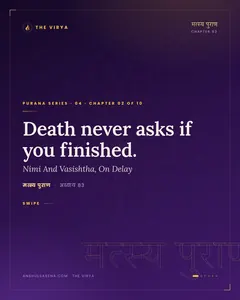
Nimi And Vasishtha, On Delay

Death never asks if you finished

Nimi And Vasishtha, On Delay, card 1 of 6
Nimi And Vasishtha, On Delay, card 2 of 6
Nimi And Vasishtha, On Delay, card 3 of 6
Nimi And Vasishtha, On Delay, card 4 of 6
Nimi And Vasishtha, On Delay, card 5 of 6
Nimi And Vasishtha, On Delay, card 6 of 6
Read as text

मत्स्य पुराण · अध्याय 83, "Nimi And Vasishtha, On Delay"

न हि प्रतीक्षते मृत्यु: कृतञ्चास्य न वा कृतम् ।
क्षेत्रापणगृहासक्तमन्यत्र गतमानसम् ॥८॥
na hi pratīkṣate mṛtyuḥ kṛtaṁ cāsya na vā kṛtam |
kṣetrāpaṇagṛhāsaktam anyatra gatamānasam ||8||

Death does not wait to see whether a man's work is done or not done. It comes quietly and carries off the one absorbed in field, shop and house, whose mind is elsewhere.

Postponement assumes a future you were never promised. Death makes no distinction between the finished and the unfinished, and it does not announce itself; it simply arrives while your attention is on the shop, the field, the house. The only honest response to an unstable life is to move the important work forward, not sideways.

How the text gets there:
1. Nimi wants a sacred act performed now; his priest asks for a reasonable delay.
2. Nimi argues that no one can bargain with Yama for extra waiting time.
3. Since life is unstable, speed in dharma is not impatience but accuracy.
4. Death takes the absorbed and distracted alike, so today is the only reliable slot.

Today: Take the one thing you keep sliding to next quarter, the apology, the check-up, the call to a parent, and put it in today. Not because urgency is a virtue, but because 'later' is an assumption you cannot verify.

What would you do today if tomorrow were not guaranteed?, tell me below.

Read the whole series, six Puranas, sixty chapters.

Matsya Purana

Savitri Argues With The Lord Of Death

Only one thing follows you out

Savitri Argues With The Lord Of Death, card 1 of 6
Savitri Argues With The Lord Of Death, card 2 of 6
Savitri Argues With The Lord Of Death, card 3 of 6
Savitri Argues With The Lord Of Death, card 4 of 6
Savitri Argues With The Lord Of Death, card 5 of 6
Savitri Argues With The Lord Of Death, card 6 of 6
Read as text

मत्स्य पुराण · अध्याय 90, "Savitri Argues With The Lord Of Death"

धर्मादर्थस्तथा कामो धर्माल्लोकद्वयं तथा ।
धर्म एकोऽनुयात्येनं यत्र क्वचन गामिनम् ॥४॥
dharmād arthas tathā kāmo dharmāl lokadvayaṁ tathā |
dharma eko 'nuyāty enaṁ yatra kvacana gāminam ||4||

From dharma come wealth and desire; from dharma come both worlds. Wherever a man goes, dharma alone follows behind him.

Wealth and pleasure are not rivals of ethics; they are its downstream products, and they end where the body ends. What is called dharma here is simply the part of a life that survives the person, the only asset that is not left behind at the door. You arrive alone and you leave alone, accompanied by conduct.

How the text gets there:
1. Savitri accepts Yama's authority but reframes the encounter as a debate about dharma.
2. She separates the threefold aim of life into what produces and what is produced.
3. Wealth and desire are shown to be sterile when detached from the dharma that generates them.
4. Since the body's companions all stop at the body, only conduct crosses over with you.

Today: Run the ledger test on a decision that pays well: which part of it would still stand if the money, the title and the body were subtracted? Build the parts that pass. Treat the rest as perishable inventory, useful, but not yours to keep.

What in your life would survive being separated from your body?, tell me below.

Read the whole series, six Puranas, sixty chapters.

Matsya Purana

Dana, The Supreme Instrument Of Power

Of all the ways to win, giving wins

Dana, The Supreme Instrument Of Power, card 1 of 6
Dana, The Supreme Instrument Of Power, card 2 of 6
Dana, The Supreme Instrument Of Power, card 3 of 6
Dana, The Supreme Instrument Of Power, card 4 of 6
Dana, The Supreme Instrument Of Power, card 5 of 6
Dana, The Supreme Instrument Of Power, card 6 of 6
Read as text

मत्स्य पुराण · अध्याय 102, "Dana, The Supreme Instrument Of Power"

सर्वेषामप्युपायानां दानं श्रेष्ठतमं मतम् ।
सुदत्तेनेह भवति दानेनोभयलोकजित् ॥१॥
sarveṣām apy upāyānāṁ dānaṁ śreṣṭhatamaṁ matam |
sudatteneha bhavati dānenobhayalokajit ||1||

Of all the means, giving is held to be the very best. By a gift well given in this world, a man becomes conqueror of both worlds.

The text places giving inside the toolkit of power, not outside it, and then ranks it above persuasion and division. A gift creates an obligation no argument can create and no split can survive. This is not sentimentality about generosity; it is a claim that open-handedness is the most durable form of influence available.

How the text gets there:
1. The chapter lists seven instruments a ruler can use to bring others into alignment.
2. It ranks giving above talk and above dividing an opponent's camp.
3. The reason offered is reach: no one, not even the gods, stays unmoved by a gift.
4. Even those who accept nothing still become partial to the one who gave.

Today: When you want something from a person or a team, stop opening with the ask or the leverage. Open by giving something real and unbilled, time, credit, an introduction, information. The account you build that way outlasts any negotiation you could have won.

When did you last give without expecting the ledger to balance?, tell me below.

Read the whole series, six Puranas, sixty chapters.

Matsya Purana

The Anointed King Chooses His People

Even a small task defeats one man

The Anointed King Chooses His People, card 1 of 6
The Anointed King Chooses His People, card 2 of 6
The Anointed King Chooses His People, card 3 of 6
The Anointed King Chooses His People, card 4 of 6
The Anointed King Chooses His People, card 5 of 6
The Anointed King Chooses His People, card 6 of 6
Read as text

मत्स्य पुराण · अध्याय 93, "The Anointed King Chooses His People"

यदप्यल्पतरं कर्म तदप्येकेन दुश्चरम् ।
पुरुषेणासहायेन किमु राज्यं महोदयम् ॥३॥
yad apy alpataraṁ karma tad apy ekena duścaram |
puruṣeṇāsahāyena kim u rājyaṁ mahodayam ||3||

Even a very small task is hard to complete by one person acting alone, by a man who has no helper. What then of ruling a kingdom, which is a vast undertaking?

Authority is not capacity. The moment you are given a role, the real work is assembling and placing the people who will actually do it, and placing them by fit rather than by favor. A leader who cannot delegate has not been promoted, only isolated. Nobody is discarded; everybody is sized correctly.

How the text gets there:
1. Manu notes that being crowned changes a title but does not change anyone's capability.
2. The text answers that a ruler's first act is selecting helpers, not issuing orders.
3. It gives a concrete character list, weighting temperament and loyalty beside skill.
4. Then it insists each person be assigned work matched to what they can actually do.

Today: New role, new authority, same trap: doing the work yourself to prove you deserve it. Spend the first month choosing and placing people instead. Rank candidates on forbearance and honest counsel, not just output, and give the weaker ones a right-sized slice rather than none.

Which task are you guarding that someone else should own?, tell me below.

Read the whole series, six Puranas, sixty chapters.

Matsya Purana

Bheda, And The Anger Within

The fire inside burns the house down

Bheda, And The Anger Within, card 1 of 6
Bheda, And The Anger Within, card 2 of 6
Bheda, And The Anger Within, card 3 of 6
Bheda, And The Anger Within, card 4 of 6
Bheda, And The Anger Within, card 5 of 6
Bheda, And The Anger Within, card 6 of 6
Read as text

मत्स्य पुराण · अध्याय 101, "Bheda, And The Anger Within"

अन्त:कोपो बहि:कोपो यत्र स्यातां महीक्षिताम् ।
अन्त:कोपो महांस्तत्र नाशक: पृथिवीक्षिताम् ॥७॥
antaḥkopo bahiḥkopo yatra syātāṁ mahīkṣitām |
antaḥkopo mahāṁs tatra nāśakaḥ pṛthivīkṣitām ||7||

Where rulers face both inner anger and outer anger, the inner anger is the greater of the two, and it is what destroys them.

Every system that can be attacked from outside can be dissolved from inside, and the inside is where the real danger lives. Discord among the people closest to power is not a morale problem; it is the failure mode. External pressure is survivable in almost exact proportion to how sound the core is.

How the text gets there:
1. The chapter first teaches how to split a rival group by exploiting its resentments.
2. It then applies the same logic reflexively: your own camp has the same seams.
3. It maps the seams precisely to the people nearest the throne, not the periphery.
4. Conclusion: guard the inner circle first, because outer attacks fail against a clean core.

Today: Before you spend another week on the competitor, the critic or the market, audit the six people closest to your work. Unspoken resentment among them will end the project long before any external threat does. Fix the room you are already in.

Whose quiet resentment inside your circle are you ignoring?, tell me below.

Read the whole series, six Puranas, sixty chapters.

Matsya Purana

The Greatness Of The Narmada

Purity is what you stop doing to others

The Greatness Of The Narmada, card 1 of 6
The Greatness Of The Narmada, card 2 of 6
The Greatness Of The Narmada, card 3 of 6
The Greatness Of The Narmada, card 4 of 6
The Greatness Of The Narmada, card 5 of 6
The Greatness Of The Narmada, card 6 of 6
Read as text

मत्स्य पुराण · अध्याय 75, "The Greatness Of The Narmada"

ब्रह्मचारी शुचिर्भूत्वा जितक्रोधो जितेन्द्रिय: ।
सर्वहिंसानिवृत्तस्तु सर्वभूतहिते रत: ॥
brahmacārī śucirbhūtvā jitakrodho jitendriyaḥ |
sarvahiṁsānivṛttastu sarvabhūtahite rataḥ ||

One who lives in continence and becomes pure, who has conquered anger and mastered the senses, who has withdrawn from every kind of violence and delights in the welfare of all beings.

The chapter praises a place and then quietly relocates the power. What makes the pilgrimage work is not the coordinates but the conduct carried to them, and the conduct is defined mostly by subtraction: anger conquered, senses mastered, violence withdrawn from. Purity, in this account, is less a thing you acquire than a set of harms you stop committing.

How the text gets there:
1. The sages ask why one river is called great when many rivers are sacred.
2. Markandeya ranks it by reach: pure everywhere, and purifying by sight alone.
3. But when naming who actually benefits, he shifts from geography to character.
4. The listed qualities are almost all restraints, so purity turns out to be subtraction.

Today: Before booking the retreat, the reset or the new city, name the three harms you would still be carrying: the sharpness with a colleague, the contempt in an argument, the habit you excuse. Places do not launder conduct. Removing one harm changes more than any arrival.

Which harm would you have to leave behind to arrive clean?, tell me below.

Read the whole series, six Puranas, sixty chapters.

Matsya Purana

Churning The Ocean, And The Halahala

Someone has to drink the poison

Churning The Ocean, And The Halahala, card 1 of 6
Churning The Ocean, And The Halahala, card 2 of 6
Churning The Ocean, And The Halahala, card 3 of 6
Churning The Ocean, And The Halahala, card 4 of 6
Churning The Ocean, And The Halahala, card 5 of 6
Churning The Ocean, And The Halahala, card 6 of 6
Read as text

मत्स्य पुराण · अध्याय 113, "Churning The Ocean, And The Halahala"

तच्छ्रुत्वा भगवानाह भगनेत्रान्तकृद्भव: ।
भक्षयिष्याम्यहं घोरं कालकूटं महाविषम् ॥५१॥
tac chrutvā bhagavān āha bhaganetrāntakṛd bhavaḥ |
bhakṣayiṣyāmy ahaṁ ghoraṁ kālakūṭaṁ mahāviṣam ||51||

Hearing this, Lord Bhava, who ended the eyes of Bhaga, said: I will consume this terrible kalakuta, the great poison.

Any process worth running produces its toxin before it produces its reward, and the toxin arrives first. What restarts the work is not a clever plan for disposing of it but one party willing to absorb it personally and then say, calmly, that the rest is also handled. Leadership here is metabolic, not managerial.

How the text gets there:
1. Gods and asuras cooperate for nectar, but the ocean yields lethal poison first.
2. The poison itself announces that it can destroy everyone within a moment.
3. No technique disperses it; the assembled powers can only go and ask for help.
4. Shiva absorbs it into himself, and only then can the shared work continue.

Today: In any joint effort the ugly part surfaces before the payoff: the blame, the bad quarter, the unpopular call. Someone senior has to take it into themselves rather than distribute it downward, and say plainly that the rest is covered. That absorption is what lets everyone keep pulling.

What are you distributing that you should be absorbing?, tell me below.

Read the whole series, six Puranas, sixty chapters.

Matsya Purana

Varaha Lifts The Sunken Earth

The earth sank. He went down after it

Varaha Lifts The Sunken Earth, card 1 of 6
Varaha Lifts The Sunken Earth, card 2 of 6
Varaha Lifts The Sunken Earth, card 3 of 6
Varaha Lifts The Sunken Earth, card 4 of 6
Varaha Lifts The Sunken Earth, card 5 of 6
Varaha Lifts The Sunken Earth, card 6 of 6
Read as text

मत्स्य पुराण · अध्याय 111, "Varaha Lifts The Sunken Earth"

मत्तेज एषा वसुधा समासाद्य तपस्विनी ।
रसातलं प्रविशति पंके गौरिव दुर्बला ॥११॥
matteja eṣā vasudhā samāsādya tapasvinī |
rasātalaṁ praviśati paṅke gaur iva durbalā ||11||

This suffering earth, having received my energy, is entering the nether world, sinking as a weak cow sinks in mud.

The earth does not fall because she is bad; she sinks because she was given more than she could carry. The response is neither blame nor abandonment but descent: going down to where the weight took her, and lifting from underneath. Rescue in this text is physical, specific and undignified, a tusk in the mud rather than a decree from above.

How the text gets there:
1. Creation loads the earth with mountains until she is uneven and distressed.
2. The cause is named as excess energy received, not fault or failure on her part.
3. The god does not correct her from a distance; he resolves to lift her himself.
4. He goes down into rasatala and raises her from beneath, on a single tusk.

Today: When someone under your care goes under, check the load before the character. People collapse from what was piled on them far more often than from defect. Then help from below, physically and specifically, rather than from above with advice.

Who around you is sinking under weight you helped pile on?, tell me below.

Read the whole series, six Puranas, sixty chapters.

Matsya Purana

The Origin Of Vastu, The Pinned Being

They pinned the monster. Then built on it

The Origin Of Vastu, The Pinned Being, card 1 of 6
The Origin Of Vastu, The Pinned Being, card 2 of 6
The Origin Of Vastu, The Pinned Being, card 3 of 6
The Origin Of Vastu, The Pinned Being, card 4 of 6
The Origin Of Vastu, The Pinned Being, card 5 of 6
The Origin Of Vastu, The Pinned Being, card 6 of 6
Read as text

मत्स्य पुराण · अध्याय 115, "The Origin Of Vastu, The Pinned Being"

येन यत्रैव चाक्रान्तं स तत्रैवावसत्पुन: ।
निवासात्सर्वदेवानां वास्तुरित्यभिधीयते ॥१४॥
yena yatraiva cākrāntaṁ sa tatraivāvasat punaḥ |
nivāsāt sarvadevānāṁ vāstur ity abhidhīyate ||14||

Wherever each one had pressed down upon it, there he continued to dwell. From this dwelling of all the gods upon it, the name Vastu is given.

The ground you build on is not neutral, and it is not empty. It is a hunger that had to be held down, and the holding is permanent: the gods do not leave once the threat is contained. Every stable structure is a devouring force still being restrained by everyone who took a position on it, and the arrangement only holds while they stay.

How the text gets there:
1. The sages ask a technical question about building and receive a myth instead.
2. The site is not inert ground but a being granted power to devour three worlds.
3. No one destroys it; the gods jointly pin it, each occupying the part they hold.
4. They never leave, so the foundation is a threat permanently held by distributed weight.

Today: The thing you built on, a founding compromise, a habit you contained, an old conflict everyone agreed to sit on, was never resolved. It is being held. Before you remove a person, a rule or a ritual that looks redundant, ask which part of the ground they are standing on.

What in your life is stable only because someone is holding it?, tell me below.

Read the whole series, six Puranas, sixty chapters.

More from Puranas

All 40 collections of भारतीय