20 posts · 120 cards

Brahma Purana ब्रह्म पुराण

Twenty passages on who is happy and who is in hell.

Brahma Purana

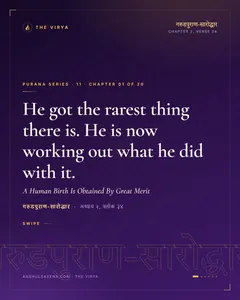
A Boy Visits The House Of Death

He sees people as happy as in heaven, and many suffering. He asks why

A Boy Visits The House Of Death, card 1 of 6
A Boy Visits The House Of Death, card 2 of 6
A Boy Visits The House Of Death, card 3 of 6
A Boy Visits The House Of Death, card 4 of 6
A Boy Visits The House Of Death, card 5 of 6
A Boy Visits The House Of Death, card 6 of 6
Read as text

संक्षिप्त ब्रह्मपुराण · अध्याय १६५, "A Boy Visits The House Of Death"

'तात! ये कौन सुखी हैं और कौन नरकमें कष्ट भोगते हैं?'
tāt! ye kaun sukhī haiṁ aur kaun narak meṁ kaṣṭ bhogte haiṁ?

Father, who are these that are happy, and who are those suffering in hell? Harshana's question to Yama, his maternal uncle, on visiting his house.

The question is asked from inside the place, after seeing both outcomes, by someone with no stake in the answer. That is a better position to ask it from than any theological one.

How the text gets there:
1. A pure-hearted boy arrives at the house of death as a visitor.
2. He observes both the happy and the suffering in the same place.
3. Rather than reacting, he asks for the principle that separates them.
4. The full account of karma is given in response to that question.

Today: The framing is worth borrowing. Faced with obviously unequal outcomes, the useful first move is not judgement in either direction but asking what rule produced the difference, and asking it of someone who actually knows.

When you see unequal outcomes, do you judge them or ask what produced them? Tell me below.

Brahma Purana

Three Ways To Get There

Yama's answer names three habits, and none of them is a crime

Three Ways To Get There, card 1 of 6
Three Ways To Get There, card 2 of 6
Three Ways To Get There, card 3 of 6
Three Ways To Get There, card 4 of 6
Three Ways To Get There, card 5 of 6
Three Ways To Get There, card 6 of 6
Read as text

संक्षिप्त ब्रह्मपुराण · अध्याय १६५, श्लोक ३६, "Three Ways To Get There"

न मानयन्ति ये शास्त्रं नाचारं न बहुश्रुतम्।
विहितातिक्रमं कुर्वन्ति ते नरकगामिनः॥ ३६ ॥
na mānayanti ye śāstraṁ nācāraṁ na bahuśrutam,
vihitātikramaṁ kurvanti te narakagāminaḥ.

Those who do not respect the scriptures, nor right conduct, nor the deeply learned, and who transgress what is prescribed: they are the ones who go to hell.

The three refusals are listed before the transgression, in that order. Disregard for the standard is treated as the cause and the violation as the symptom.

How the text gets there:
1. Those who keep to prescribed duty are said not to see hell.
2. Three failures of respect are then named: for scripture, for conduct, for the learned.
3. Transgression is placed last in the sequence rather than first.
4. So the ordering treats contempt for the standard as producing the violation.

Today: Applies to any institution where things go wrong. The breach is usually preceded by a period in which the rules, the norms and the people who know them stopped commanding respect. Watch the three refusals and you can predict the fourth.

Which standard have you stopped respecting before you stopped following it? Tell me below.

Brahma Purana

The Rest Are Diseases

Yama tells the boy: many are born. Very few are sons

The Rest Are Diseases, card 1 of 6
The Rest Are Diseases, card 2 of 6
The Rest Are Diseases, card 3 of 6
The Rest Are Diseases, card 4 of 6
The Rest Are Diseases, card 5 of 6
The Rest Are Diseases, card 6 of 6
Read as text

संक्षिप्त ब्रह्मपुराण · अध्याय १६५, "The Rest Are Diseases"

'पुत्र तो बहुत-से होते हैं, किंतु वे सभी कुलका विस्तार करनेवाले नहीं होते। एक ही कोई ऐसा पुत्र होता है, जो समूचे कुलको धारण करता है... अन्य जितने हैं, वे रोग हैं।'
putra to bahut-se hote haiṁ, kintu ve sabhī kul kā vistār karnevāle nahīṁ hote. ek hī koī aisā putra hotā hai, jo samūce kul ko dhāraṇ kartā hai... anya jitne haiṁ, ve rog haiṁ.

Sons are many, but not all of them extend the family. There is only one such son who upholds the whole line; he who is its foundation, dear to father and mother, and who raises the ancestors, is truly a son. As many others as there are, they are diseases.

The test is what the person carries rather than what they are owed. By that measure most members of any line are consumers of it, and the language chosen refuses to soften that.

How the text gets there:
1. Many sons are born into a line and the number is not the question.
2. A functional criterion is applied: does the person uphold the whole family.
3. Only one is typically found to meet it.
4. The rest are classed not as neutral but as a drain, using the word for disease.

Today: The harshness is a feature. Every family, team and institution has members who carry it and members it carries, and the second group usually does not know which one it is in. The question is answerable and almost nobody asks it about themselves.

In the groups you belong to, are you carrying or being carried? Tell me below.

Brahma Purana

Six Things You Do Not Choose

A daughter tells her father why arranging a good match will not help

Six Things You Do Not Choose, card 1 of 6
Six Things You Do Not Choose, card 2 of 6
Six Things You Do Not Choose, card 3 of 6
Six Things You Do Not Choose, card 4 of 6
Six Things You Do Not Choose, card 5 of 6
Six Things You Do Not Choose, card 6 of 6
Read as text

संक्षिप्त ब्रह्मपुराण · अध्याय १६५, "Six Things You Do Not Choose"

'पति, पुत्र, धन, सुख, आयु, रूप और परस्पर प्रेम, ये पूर्वजन्ममें किये हुए कर्मोंके अनुसार प्राप्त होते हैं।'
pati, putra, dhan, sukh, āyu, rūp aur paraspar prem, ye pūrvajanma meṁ kiye hue karmoṁ ke anusār prāpt hote haiṁ.

Husband, son, wealth, happiness, lifespan, beauty and mutual love: these are obtained according to the deeds done in a previous birth. Vishti to her father Surya.

She accepts the diagnosis and denies that the remedy works. The father is trying to secure by arrangement things her own list says are not distributed by arrangement.

How the text gets there:
1. The father assesses his daughter by the ordinary marriage criteria and finds her lacking.
2. She does not dispute the assessment.
3. She lists seven outcomes and attributes them to previous deeds rather than to the match.
4. So the father's careful arrangement cannot determine what he is arranging for.

Today: The uncomfortable half of any belief in earned outcomes. If the list is right, a great deal of parental strategy is optimizing a variable that was set elsewhere, and the effort is really about the parent's own obligation rather than the child's result.

What are you arranging that was decided before you started? Tell me below.

Brahma Purana

Two Brothers Fly At The Sun

They were strong, intoxicated with their own power, and always competing

Two Brothers Fly At The Sun, card 1 of 6
Two Brothers Fly At The Sun, card 2 of 6
Two Brothers Fly At The Sun, card 3 of 6
Two Brothers Fly At The Sun, card 4 of 6
Two Brothers Fly At The Sun, card 5 of 6
Two Brothers Fly At The Sun, card 6 of 6
Read as text

संक्षिप्त ब्रह्मपुराण · अध्याय १६५, "Two Brothers Fly At The Sun"

'वे दोनों अपने बलसे उन्मत्त और एक-दूसरेसे लाग-डाँट रखनेवाले थे। एक दिन वे दोनों भगवान् सूर्यको नमस्कार करनेके लिये आकाशमें गये।'
ve donoṁ apne bal se unmatt aur ek-dūsare se lāg-ḍāṁṭ rakhnevāle the. ek din ve donoṁ bhagavān sūrya ko namaskār karne ke liye ākāś meṁ gaye.

The two of them were intoxicated with their own strength and in constant rivalry with each other. One day they both went into the sky to salute the sun.

The two elements of the story are not the flight and the fall but the rivalry and the salute. They went up for a good reason, competitively, and the competitiveness is what took them too close.

How the text gets there:
1. Two brothers of great strength are described as intoxicated by it and in rivalry.
2. Their stated purpose in flying is reverence rather than conquest.
3. The rivalry carries them past the survivable distance and their wings burn.
4. The remedy granted is survival rather than restoration, so the loss is permanent.

Today: The pattern is familiar in any pair of high performers pointed at the same target. The intention can be entirely legitimate and the rivalry still supplies the extra distance that does the damage. Nothing is granted back afterwards.

Where is rivalry adding distance you did not intend to travel? Tell me below.

Brahma Purana

Say It Out Loud

The more clearly he states what he did, the more he is released from it

Say It Out Loud, card 1 of 6
Say It Out Loud, card 2 of 6
Say It Out Loud, card 3 of 6
Say It Out Loud, card 4 of 6
Say It Out Loud, card 5 of 6
Say It Out Loud, card 6 of 6
Read as text

संक्षिप्त ब्रह्मपुराण · अध्याय २१८, श्लोक ४-७, "Say It Out Loud"

मोहाद्धर्मं यः कृत्वा पुनः समनुतप्यते।
मनःसमाधिसंयुक्तो न स सेवेत दुष्कृतम्॥
यथा यथा नरः सम्यगधर्ममनुभाषते।
समाहितेन मनसा विमुच्यते तथा तथा॥
mohād dharmaṁ yaḥ kṛtvā punaḥ samanutapyate,
manaḥsamādhisaṁyukto na sa seveta duṣkṛtam.
yathā yathā naraḥ samyag adharmam anubhāṣate,
samāhitena manasā vimucyate tathā tathā.

He who acts wrongly through delusion and afterwards repents, with mind gathered, does not repeat the misdeed. The more correctly a man speaks out his wrongdoing, with a concentrated mind, so much the more is he freed from it.

The mechanism is articulation, not remorse. What releases is speaking the thing correctly with a gathered mind, which is a much more demanding operation than feeling bad about it.

How the text gets there:
1. Wrongdoing done through delusion is followed by repentance.
2. A gathered mind is specified as a condition, not merely regret.
3. Release is stated as proportional to how correctly the fault is spoken out.
4. There is no threshold, so the process is continuous rather than a single absolution.

Today: The requirement to state it accurately is the useful part. Vague guilt does nothing here; naming precisely what was done, to someone who will not soften it, is the operation being described, and most people substitute the first for the second.

Have you ever said the whole thing out loud, accurately, to anyone? Tell me below.

Brahma Purana

The Best Of All Gifts

Of everything you could give, the text picks food

The Best Of All Gifts, card 1 of 6
The Best Of All Gifts, card 2 of 6
The Best Of All Gifts, card 3 of 6
The Best Of All Gifts, card 4 of 6
The Best Of All Gifts, card 5 of 6
The Best Of All Gifts, card 6 of 6
Read as text

संक्षिप्त ब्रह्मपुराण · अध्याय २१८, श्लोक २६-२७, "The Best Of All Gifts"

अन्नस्य हि प्रदानेन नरो याति परां गतिम्।
सर्वकामसमायुक्तः प्रेत्य चाप्यश्नुते सुखम्॥
annasya hi pradānena naro yāti parāṁ gatim,
sarvakāmasamāyuktaḥ pretya cāpy aśnute sukham.

By the giving of food a man goes to the highest state; endowed with all he desires, he enjoys happiness even after death.

The gift is ranked by what it is the precondition for. Nothing you could give instead operates further upstream than the thing that keeps the recipient alive.

How the text gets there:
1. All gifts are compared and food is declared the best.
2. The reason given is that food is the life of beings and the origin of creatures.
3. The whole world is said to be established in it.
4. So its rank follows from being the precondition of everything else rather than from its value.

Today: The upstream principle transfers. When choosing where to give, the question is not what is most valuable but what the recipient's other options depend on. Almost everything else becomes usable only after that.

What are you giving that is downstream of what is actually needed? Tell me below.

Brahma Purana

A Cataloge Of Small Thefts

Steal curd, become a heron. Steal water, become a crow

A Cataloge Of Small Thefts, card 1 of 6
A Cataloge Of Small Thefts, card 2 of 6
A Cataloge Of Small Thefts, card 3 of 6
A Cataloge Of Small Thefts, card 4 of 6
A Cataloge Of Small Thefts, card 5 of 6
A Cataloge Of Small Thefts, card 6 of 6
Read as text

संक्षिप्त ब्रह्मपुराण · अध्याय २१७, "A Cataloge Of Small Thefts"

'दहीकी चोरी करनेसे मनुष्य बगुला और मेढक होता है। फल, मूल अथवा पुआ चुरानेसे वह चींटी होता है। जलकी चोरी करनेसे कौआ... रेशमका कीड़ा चुरानेसे मनुष्य वानर होता है।'
dahī kī corī karne se manuṣya bagulā aur meḍhak hotā hai. phal, mūl athavā puā curāne se vah cīṁṭī hotā hai. jal kī corī karne se kauā... reśam kā kīṛā curāne se manuṣya vānar hotā hai.

By stealing curd a man becomes a heron and a frog; by stealing fruit, roots or cakes, an ant; by stealing water, a crow; by stealing silk, a monkey.

The point of the cataloge is its granularity. Nothing is too small to be recorded, and the system is not weighing severity, it is tracking each item individually.

How the text gets there:
1. A long list pairs specific small thefts with specific rebirths.
2. None of the items listed is a major crime.
3. Each is assigned its own distinct outcome rather than a proportionate penalty.
4. The list is presented as abbreviated, so the granularity extends further than shown.

Today: The interesting claim is not the zoology but the bookkeeping. Most moral attention goes to a few large questions while the small unrecorded takings accumulate unexamined, and this passage is entirely about the second category.

What small thing do you take regularly without counting it? Tell me below.

Brahma Purana

Like A Snake Leaving Its Skin

Not scrubbing it off. Walking out of it

Like A Snake Leaving Its Skin, card 1 of 6
Like A Snake Leaving Its Skin, card 2 of 6
Like A Snake Leaving Its Skin, card 3 of 6
Like A Snake Leaving Its Skin, card 4 of 6
Like A Snake Leaving Its Skin, card 5 of 6
Like A Snake Leaving Its Skin, card 6 of 6
Read as text

संक्षिप्त ब्रह्मपुराण · अध्याय २१८, "Like A Snake Leaving Its Skin"

'जैसे साँप केंचुल छोड़ता है, उसी प्रकार वह पहलेके अनुभव किये हुए पापोंका त्याग करता है।'
jaise sāṁp keṁcul choṛtā hai, usī prakār vah pahle ke anubhav kiye hue pāpoṁ kā tyāg kartā hai.

As a snake sheds its skin, so does he abandon the sins he had previously experienced.

Shedding requires that something new has already formed underneath. The old skin is not removed by effort directed at it, which is why the process cannot be hurried from the outside.

How the text gets there:
1. The comparison is to shedding rather than to washing or removing.
2. A snake's old skin separates because a new one has formed beneath it.
3. No work is done on the old skin itself.
4. So the release follows from what has grown, which is why the preceding process of articulation matters.

Today: Explains why trying to eliminate an old pattern directly rarely works and why it sometimes falls away unremarked. Something else had to be in place first, and until it is, effort spent on the surface is wasted.

What fell away from you without you fighting it? Tell me below.

Brahma Purana

Counting To A Parardha

One, ten, hundred, thousand. Then fourteen more names

Counting To A Parardha, card 1 of 6
Counting To A Parardha, card 2 of 6
Counting To A Parardha, card 3 of 6
Counting To A Parardha, card 4 of 6
Counting To A Parardha, card 5 of 6
Counting To A Parardha, card 6 of 6
Read as text

संक्षिप्त ब्रह्मपुराण · प्रलय-वर्णन, टीका, "Counting To A Parardha"

स्थानं दशगुणं विद्यादेकं दश शतं ततः।
सहस्रमयुतं तस्मान्नियुतं प्रयुतं ततः॥
अर्बुदं न्यर्बुदं चैव वृन्दं चैव ततः परम्।
खर्वं चैव निखर्वं च शङ्खं पद्मं तथैव च॥
समुद्रो मध्यमन्त्यश्च परार्धं परमेव च।
एवमष्टादशैतानि पदानि गणनाविधौ॥
sthānaṁ daśaguṇaṁ vidyād ekaṁ daśa śataṁ tataḥ,
sahasram ayutaṁ tasmān niyutaṁ prayutaṁ tataḥ.
arbudaṁ nyarbudaṁ caiva vṛndaṁ caiva tataḥ param,
kharvaṁ caiva nikharvaṁ ca śaṅkhaṁ padmaṁ tathaiva ca.
samudro madhyam antyaś ca parārdhaṁ param eva ca,
evam aṣṭādaśaitāni padāni gaṇanāvidhau.

Know each place to be ten times the last: one, ten, hundred, thousand, ayuta, niyuta, prayuta, arbuda, nyarbuda, vrinda, kharva, nikharva, shankha, padma, samudra, madhya, antya, parardha. These are the eighteen places in the method of counting.

Cosmology here is blocked by a notation problem and stops to solve it. The place-value rule is stated explicitly as a general principle before any of the names are given.

How the text gets there:
1. A question is asked about the duration of a cosmic period.
2. Answering it requires numbers larger than ordinary vocabulary supplies.
3. The rule that each place is ten times the previous is stated as a general principle.
4. Eighteen named places are then enumerated, after which the duration can be expressed.

Today: Worth noticing what the passage takes for granted. Positional decimal notation is stated as a rule and then used, inside a religious text, because the theology could not proceed without it. The mathematics is infrastructure here rather than subject.

What are you unable to think about because you lack the notation for it? Tell me below.

Brahma Purana

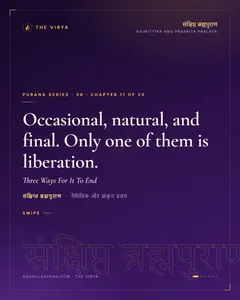
Three Ways For It To End

Occasional, natural, and final. Only one of them is liberation

Three Ways For It To End, card 1 of 6
Three Ways For It To End, card 2 of 6
Three Ways For It To End, card 3 of 6
Three Ways For It To End, card 4 of 6
Three Ways For It To End, card 5 of 6
Three Ways For It To End, card 6 of 6
Read as text

संक्षिप्त ब्रह्मपुराण · नैमित्तिक और प्राकृत प्रलय, "Three Ways For It To End"

'समस्त प्राणियोंका प्रलय नैमित्तिक, प्राकृतिक और आत्यन्तिक भेदसे तीन प्रकारका माना गया है। कल्पके अन्तमें जो ब्राह्म प्रलय होता है, वह नैमित्तिक है। मोक्षको आत्यन्तिक प्रलय कहते हैं।'
samast prāṇiyoṁ kā pralaya naimittika, prākṛtika aur ātyantika bhed se tīn prakār kā mānā gayā hai. kalpa ke ant meṁ jo brāhma pralaya hotā hai, vah naimittika hai. mokṣa ko ātyantika pralaya kahte haiṁ.

The dissolution of all beings is held to be of three kinds: occasional, natural and final. The Brahma dissolution at the end of a kalpa is the occasional one. Liberation is called the final dissolution.

Placing liberation in the same list as cosmic dissolution treats it as the same operation at a different scale. For the one it happens to, the world ends either way.

How the text gets there:
1. Dissolution is divided into three kinds.
2. Two are cosmic, occurring at the end of a kalpa and after two parardhas.
3. The third is liberation, which occurs to an individual.
4. Including it in the same taxonomy treats the individual case as the same kind of event.

Today: The taxonomy makes an unusual point about scale. What ends for you when you stop being the person you were is, by this classification, the same category of event as the universe dissolving. Neither is described as loss.

Which of your worlds has already ended without you calling it that? Tell me below.

Brahma Purana

Like The Back Of A Tortoise

Seven suns appear. The image chosen for the result is domestic

Like The Back Of A Tortoise, card 1 of 6
Like The Back Of A Tortoise, card 2 of 6
Like The Back Of A Tortoise, card 3 of 6
Like The Back Of A Tortoise, card 4 of 6
Like The Back Of A Tortoise, card 5 of 6
Like The Back Of A Tortoise, card 6 of 6
Read as text

संक्षिप्त ब्रह्मपुराण · प्रलय-वर्णन, "Like The Back Of A Tortoise"

'तीनों लोकोंके जल और वृक्ष दग्ध हो जानेके कारण यह पृथिवी कछुएकी पीठकी भाँति दिखायी देती है।'
tīnoṁ lokoṁ ke jal aur vṛkṣ dagdh ho jāne ke kāraṇ yah pṛthivī kachue kī pīṭh kī bhāṁti dikhāyī detī hai.

The waters and the trees of the three worlds being burnt away, this earth appears like the back of a tortoise.

Choosing a small familiar object for the end of the world is a deliberate change of register. The scale collapses to something you could hold, which is more unsettling than magnification.

How the text gets there:
1. The destruction is described in escalating stages over long periods.
2. The result is the removal of all water and vegetation from the earth.
3. The image chosen for that state is a tortoise's back, a small familiar object.
4. The reduction in scale contrasts with the magnitude of the event described.

Today: The rhetorical choice is worth noting. Enormous events are usually communicated by magnification, and this text does the opposite. Something the reader could pick up conveys the totality better than any expansion would.

What large thing would be clearer to you if it were described smaller? Tell me below.

Brahma Purana

The Clouds That Put It Out

After the fire, clouds shaped like great elephants arrive

The Clouds That Put It Out, card 1 of 6
The Clouds That Put It Out, card 2 of 6
The Clouds That Put It Out, card 3 of 6
The Clouds That Put It Out, card 4 of 6
The Clouds That Put It Out, card 5 of 6
The Clouds That Put It Out, card 6 of 6
Read as text

संक्षिप्त ब्रह्मपुराण · प्रलय-वर्णन, "The Clouds That Put It Out"

'उस समय आकाशमें घोर संवर्तक मेघ उमड़ आते हैं, जो बड़े-बड़े गजराजोंके समान प्रतीत होते हैं। वे बिजलीकी गड़गड़ाहटके साथ भयंकर गर्जना करते हैं।'
us samay ākāś meṁ ghor saṁvartak megh umaṛ āte haiṁ, jo baṛe-baṛe gajarājoṁ ke samān pratīt hote haiṁ. ve bijlī kī gaṛgaṛāhaṭ ke sāth bhayaṅkar garjanā karte haiṁ.

Then terrible samvartaka clouds well up in the sky, appearing like great lordly elephants. They roar fearfully with the crash of lightning.

The fire and the flood are consecutive acts of the same agent rather than opposing forces. Nothing arrives to rescue the world from the destroyer; the destroyer exhales the rain.

How the text gets there:
1. The world is burnt by the agency of Rudra.
2. The clouds that extinguish the fire are produced from the same being's breath.
3. They rain for over a century until everything is submerged.
4. So destruction and quenching are stages of one process rather than a conflict between forces.

Today: The structure is worth holding on to. In most accounts of catastrophe there is a destroyer and a rescuer. Here they are one, which reframes the fire as a phase rather than as something that had to be survived.

What ended for you that turned out to be a stage rather than an attack? Tell me below.

Brahma Purana

And Then He Sleeps

The world is one ocean. He drinks the wind and lies down

And Then He Sleeps, card 1 of 6
And Then He Sleeps, card 2 of 6
And Then He Sleeps, card 3 of 6
And Then He Sleeps, card 4 of 6
And Then He Sleeps, card 5 of 6
And Then He Sleeps, card 6 of 6
Read as text

संक्षिप्त ब्रह्मपुराण · प्रलय-वर्णन, "And Then He Sleeps"

'भगवान् विष्णुके निःश्वाससे प्रकट हुई वायु उन मेघोंको छिन्न-भिन्न कर देती है... भूतभावन भगवान् सम्पूर्ण वायुको पीकर एकार्णवके जलमें शेषनागकी शय्यापर आसीन होते हैं।'
bhagavān viṣṇu ke niḥśvās se prakaṭ huī vāyu un meghoṁ ko chinna-bhinna kar detī hai... bhūtabhāvan bhagavān sampūrṇ vāyu ko pīkar ekārṇav ke jal meṁ śeṣanāg kī śayyā par āsīn hote haiṁ.

The wind arisen from Vishnu's breath scatters those clouds; and the Lord, origin of beings, having drunk up all the wind, rests on the couch of Shesha in the water of the single ocean.

The final act is reabsorption rather than destruction. Every element of the process is drawn back into its origin, which is what leaves the state completely still.

How the text gets there:
1. The clouds were produced from the being's own breath.
2. The wind that disperses them arises from the same source.
3. The wind is then drunk back in, completing the cycle of emission and absorption.
4. What remains is undisturbed water, since nothing external was ever introduced.

Today: The image of an ending is not wreckage but stillness, arrived at by taking everything back rather than by breaking it. That is a different picture of how things finish, and a considerably less anxious one.

Are your endings breakages, or reabsorptions? Tell me below.

Brahma Purana

Three Thousand Years Of Standing Still

The moon was produced by a man not moving for three thousand years

Three Thousand Years Of Standing Still, card 1 of 6
Three Thousand Years Of Standing Still, card 2 of 6
Three Thousand Years Of Standing Still, card 3 of 6
Three Thousand Years Of Standing Still, card 4 of 6
Three Thousand Years Of Standing Still, card 5 of 6
Three Thousand Years Of Standing Still, card 6 of 6
Read as text

संक्षिप्त ब्रह्मपुराण · चन्द्रवंश-वर्णन, "Three Thousand Years Of Standing Still"

'जो चन्द्रमाके पिता थे। सुननेमें आया है कि अत्रिने तीन हजार दिव्य वर्षोंतक अनुत्तर नामकी तपस्या की थी, उसमें उनका वीर्य ऊर्ध्वगामी हो गया।'
jo candramā ke pitā the. sunne meṁ āyā hai ki atri ne tīn hazār divya varṣoṁ tak anuttar nām kī tapasyā kī thī, usmeṁ unkā vīrya ūrdhvagāmī ho gayā.

He was the father of the moon. It is heard that Atri performed the austerity called anuttara for three thousand divine years, and in it his energy became upward-moving.

The mechanism given is redirection rather than production. Nothing new is generated by the austerity; something that ordinarily goes one way is turned to go another, and the light is the result of the change in direction.

How the text gets there:
1. A named austerity is performed for a stated duration.
2. Its effect is described as energy becoming upward-moving.
3. The light emerges through the eyes and is dispersed in all directions.
4. So the outcome follows from redirecting an existing force rather than creating a new one.

Today: The model of concentration here is worth separating from the mythology. Nothing is added; a force that normally disperses in one direction is held and turned, and the visible result is a by-product of the holding.

What in you is dispersing that could be turned? Tell me below.

Brahma Purana

One Hundred And Eight Names For One Sun

The sages ask for the names. There turn out to be a hundred and eight

One Hundred And Eight Names For One Sun, card 1 of 6
One Hundred And Eight Names For One Sun, card 2 of 6
One Hundred And Eight Names For One Sun, card 3 of 6
One Hundred And Eight Names For One Sun, card 4 of 6
One Hundred And Eight Names For One Sun, card 5 of 6
One Hundred And Eight Names For One Sun, card 6 of 6
Read as text

संक्षिप्त ब्रह्मपुराण · सूर्यदेवकी स्तुति, "One Hundred And Eight Names For One Sun"

'ब्रह्माजी बोले, ब्राह्मणो! भगवान् भास्करके परम गोपनीय एक सौ आठ नाम, जो स्वर्ग और मोक्ष प्रदान करते हैं, बतलाता हूँ; सुनो।'
brahmājī bole, brāhmaṇo! bhagavān bhāskar ke param gopanīya ek sau āṭh nām, jo svarga aur mokṣa pradān karte haiṁ, batlātā hūṁ; suno.

Brahma said: brahmins, I shall tell you the hundred and eight most secret names of Lord Bhaskara, which grant heaven and liberation; listen.

Naming the sun as Kala and Mrityu, time and death, places what destroys inside the same list as what illuminates. The hundred and eight are not all flattering.

How the text gets there:
1. A hundred and eight names are given for a single deity.
2. They range across natural elements, functions and abstractions.
3. Time and death are included among them.
4. So the naming covers the destructive aspects rather than only the benign ones.

Today: A list of names for one thing is a claim that no single name is adequate. The inclusion of the unwelcome ones is what makes it an account rather than praise, and most descriptions of anything important stop before that point.

How many names would you need for the thing you understand best? Tell me below.

Brahma Purana

The Fee They Chose To Pay

Their education is finished. They ask what the teacher wants

The Fee They Chose To Pay, card 1 of 6
The Fee They Chose To Pay, card 2 of 6
The Fee They Chose To Pay, card 3 of 6
The Fee They Chose To Pay, card 4 of 6
The Fee They Chose To Pay, card 5 of 6
The Fee They Chose To Pay, card 6 of 6
Read as text

संक्षिप्त ब्रह्मपुराण · गुरुपुत्रको यमपुरसे लाना, "The Fee They Chose To Pay"

'भगवान्‌की माता-पितासे भेंट, उग्रसेनका राज्याभिषेक, श्रीकृष्ण-बलरामका विद्याध्ययन, गुरुपुत्रको यमपुरसे लाना'
bhagavān kī mātā-pitā se bheṁṭ, ugrasena kā rājyābhiṣek, śrīkṛṣṇa-balarām kā vidyādhyayan, gurupūtra ko yamapur se lānā

The chapter heading: the Lord meeting his parents, the coronation of Ugrasena, the education of Krishna and Balarama, and the bringing of the guru's son from the city of Yama.

The sequence is the point. Having just acquired absolute power, he returns the kingdom, becomes a student, and then treats the teacher's request as an obligation to be discharged rather than a favor.

How the text gets there:
1. Having removed the tyrant, Krishna is in a position to take the throne.
2. He instead installs the previously deposed king.
3. He then enters a period of study as an ordinary student.
4. The teacher's fee is treated as a debt to be paid in full, whatever is asked.

Today: The order in which he does things is the instruction. Winning does not end with taking; it is followed by returning what was not yours, submitting to teaching, and paying what you owe on the terms the other party sets.

After your last win, what did you take that you could have returned? Tell me below.

Brahma Purana

Give After You Have Paid

The sequence is specified: the tax first, then the gift

Give After You Have Paid, card 1 of 6
Give After You Have Paid, card 2 of 6
Give After You Have Paid, card 3 of 6
Give After You Have Paid, card 4 of 6
Give After You Have Paid, card 5 of 6
Give After You Have Paid, card 6 of 6
Read as text

संक्षिप्त ब्रह्मपुराण · अध्याय २१८, "Give After You Have Paid"

'अपने द्वारा उपार्जित खेतीके अन्नमेंसे छठा भाग राजाको देनेके बाद जो शेष शुद्ध भाग बच जाता है, वह अन्न यदि वैश्य ब्राह्मणको दान करे तो वह सब पापोंसे मुक्त हो जाता है।'
apne dvārā upārjit khetī ke ann meṁ se chaṭhā bhāg rājā ko dene ke bād jo śeṣ śuddh bhāg bac jātā hai, vah ann yadi vaiśya brāhmaṇ ko dān kare to vah sab pāpoṁ se mukt ho jātā hai.

If, after giving the sixth part of the grain he has produced to the king, a vaishya gives the pure remainder in charity, he is freed from all sins.

The gift is qualified by what was settled before it. Generosity from what you owe elsewhere is not generosity, and the text makes the sequence explicit rather than assuming it.

How the text gets there:
1. The obligation to the state is discharged first, at a specified rate.
2. What remains after that is described as the pure portion.
3. Only the pure portion is eligible to be given.
4. So charity is conditional on prior obligations having been met.

Today: The order is the useful part and it is routinely inverted. Visible giving from resources that have unmet obligations attached does not clear the obligations, and this text declines to let the second stand in for the first.

Is what you are giving from actually yours to give? Tell me below.

Brahma Purana

What Do I Do With You?

A father tells his daughter, to her face, that she has no qualities

What Do I Do With You?, card 1 of 6
What Do I Do With You?, card 2 of 6
What Do I Do With You?, card 3 of 6
What Do I Do With You?, card 4 of 6
What Do I Do With You?, card 5 of 6
What Do I Do With You?, card 6 of 6
Read as text

संक्षिप्त ब्रह्मपुराण · अध्याय १६५, "What Do I Do With You?"

'बेटी! मैं क्या करूँ। तुम्हारी आकृति भयंकर है, इसलिये कोई तुम्हें ग्रहण नहीं करता... मेरे यहाँ सब कुछ है, केवल तुममें गुणोंका अभाव है। क्या करूँ, कहाँ तुम्हारा विवाह करूँ?'
beṭī! maiṁ kyā karūṁ. tumhārī ākṛti bhayaṅkar hai, isliye koī tumheṁ grahaṇ nahīṁ kartā... mere yahāṁ sab kuch hai, keval tum meṁ guṇoṁ kā abhāv hai. kyā karūṁ, kahāṁ tumhārā vivāh karūṁ?

Daughter, what am I to do? Your form is fearsome, and so nobody will accept you. I have everything here; only in you is there an absence of qualities. What shall I do, where shall I marry you?

The match that was made out of resignation produced lasting love, for a reason the text states plainly: they were alike. And the child worth remembering came from it.

How the text gets there:
1. A father cannot arrange a marriage on the usual criteria and says so.
2. The daughter accepts the assessment and releases him to do as he can.
3. The match made is with someone of the same fearsome nature.
4. Their likeness is given as the reason love persisted, and their last son is the pure Harshana.

Today: The outcome contradicts the criteria the father was using. Matching on the qualities everyone screens for produced nothing available, and matching on likeness produced a marriage that held. The story does not comment; it just reports the sequence.

Are you screening for qualities or for likeness? Tell me below.

More from Puranas

All 40 collections of भारतीय